Results by title
681 books match the query 'English language' and 63 start with c
Carnal Rhetoric
Milton’s Iconoclasm and the Poetics of DesireLana Cable
Duke University Press, 1995
Cable traces the development of Milton’s iconoclastic poetics from its roots in the antiprelatical tracts, through the divorce tracts and Areopagitica, to its fullest dramatic representation in Eikonoklastes and Samson Agonistes. Arguing that, like every creative act, metaphor is by nature a radical and self-transgressing agent of change, she explores the site where metaphoric language and imaginative desire merge. Examining the demands Milton places on metaphor, particularly his emphasis on language as a vehicle for mortal redemption, Cable demonstrates the ways in which metaphor acts for him as that creative and radical agent of change. In the process, she reveals Milton’s engagement, at the deepest levels of linguistic creativity, with the early modern commitment to an imaginative and historic remaking of the world.
An insightful and synthetic book, Carnal Rhetoric will appeal to scholars of English literature, Milton, and the Renaissance, as well as to those with an interest in the theory of affective stylistics as it pertains to reader-response criticism, semantics, epistemology, and the philosophy and psychology of language.
Case for Critical Literacy
A History of Reading in Writing StudiesAlice S. Horning
Utah State University Press, 2024
This book examines how college-level instruction reached this point and provides pedagogical strategies that writing instructors and teachers can use to address the problem. Alice Horning makes the case for the importance of critical reading in the teaching of writing with intentionality and imagination, while sharing glimpses of her own personal history with reading and writing. Horning provides the context for understanding what college faculty face in their classrooms and offers a history of critical literacy that explains why, to date, it has mostly neglected or ignored the diverse statuses of students’ reading challenges.
The Case for Critical Literacy explores actionable options to better meet students’ literacy needs. College and university faculty, especially writing instructors, will benefit from an understanding of what has happened in the field and what needs to change.
Center Will Hold
edited by Michael A. Pemberton & Joyce Kinkead
Utah State University Press, 2003
In The Center Will Hold, Pemberton and Kinkead have compiled a major volume of essays on the signal issues of scholarship that have established the writing center field and that the field must successfully address in the coming decade. The new century opens with new institutional, demographic, and financial challenges, and writing centers, in order to hold and extend their contribution to research, teaching, and service, must continuously engage those challenges.
Appropriately, the editors offer the work of Muriel Harris as a key pivot point in the emergence of writing centers as sites of pedagogy and research. The volume develops themes that Harris first brought to the field, and contributors here offer explicit recognition of the role that Harris has played in the development of writing center theory and practice. But they also use her work as a springboard from which to provide reflective, descriptive, and predictive looks at the field.
Changing Conceptions, Changing Practices
Innovating Teaching across Disciplinesedited by Angela Glotfelter, Caitlin Martin, Mandy Olejnik, Ann Updike & Elizabeth Wardle
Utah State University Press, 2022
The authors draw on the threshold concepts framework, research in writing studies, and theories of learning, leadership, and change to deftly explore why faculty are often stymied in their efforts to design meaningful curricula for deep learning and how carefully scaffolded professional development for faculty teams can help make such change possible. This book is a powerful demonstration of how faculty members can be empowered when professional development leaders draw on a range of scholarship that is not typically connected.
In today’s climate, courses, programs, and institutions are often assessed by and rewarded for proxy metrics that have little to do with learning, with grave consequences for students. The stakes have never been higher, particularly for public higher education. Faculty members need opportunities to work together using their own expertise and to enact meaningful learning opportunities for students. Professional developers have an important role to play in such change efforts.
WAC scholars and practitioners, leaders of professional development and centers for teaching excellence, program administrators and curriculum committees from all disciplines, and faculty innovators from many fields will find not only hope but also a blueprint for action in Changing Conceptions, Changing Practices.
Contributors: Juan Carlos Albarrán, José Amador, Annie Dell'Aria, Kate de Medeiros, Keith Fennen, Jordan A. Fenton, Carrie E. Hall, Elena Jackson Albarrán, Erik N. Jensen, Vrinda Kalia, Janice Kinghorn, Jennifer Kinney, Sheri Leafgren, Elaine Maimon, Elaine Miller, Gaile Pohlhaus Jr., Jennifer J. Quinn, Barbara J. Rose, Scott Sander, Brian D. Schultz, Ling Shao, L. James Smart, Pepper Stetler
Changing of Knowledge in Composition
Contemporary PerspectivesLance Massey and Richard C Gephardt
Utah State University Press, 2011
Lance Massey and Richard Gebhardt offer in this collection many signs that composition again faces a moment of precariousness, even as it did in the 1980s—the years of the great divorce from literary studies. The contours of writing in the university again are rapidly changing, making the objects of scholarship in composition again unstable. Composition is poised to move not from modern to postmodern but from process to postprocess, from a service-oriented "field" to a research-driven "discipline." Some would say we are already there. Momentum is building to replace "composition" and the pedagogical imperative long implied in that term with a "writing studies" model devoted to the study of composition as a fundamental tool of, and force within, all areas of human activity.
Appropriately, contributors here use Stephen M. North's 1987 book The Making of Knowledge in Composition to frame and background their discussion, as they look at both the present state of the field and its potential futures. As in North's volume, The Changing of Knowledge in Composition describes a body of research and pedagogy brimming with conflicting claims, methodologies, and politics, and with little consensus regarding the proper subjects and modes of inquiry.
The deep ambivalence within the field itself is evident in this collection. Contributors here envision composition both as retaining its commitment to broad-based, generalized writing instruction and as heading toward content-based vertical writing programs in departments and programs of writing studies. They both challenge and affirm composition's pedagogical heritage. And they sound both sanguine and pessimistic notes about composition's future.
Changing the Subject in English Class
Discourse and the Constructions of DesiresMarshall W. Alcorn Jr.
Southern Illinois University Press, 2002
Drawing on the theoretical work of Jacques Lacan, Marshall W. Alcorn Jr. formulates a systematic explanation of the function and value of desire in writing instruction.
Alcorn argues that in changing the subject matter of writing instruction in order to change student opinions, composition instructors have come to adopt an insufficiently complex understanding of subjectivity. This oversimplification hinders attempts to foster cultural change. Alcorn proposes an alternative mode of instruction that makes effective use of students’ knowledge and desire. The resulting freedom in expression—personal as well as political—engenders the recognition, circulation, and elaboration of desire necessary for both human communication and effective politics.
Responding to James Berlin’s reconception of praxis in the classroom, Theresa Ebert’s espousal of disciplined instructions, and Lester Faigley’s introduction of a postmodern theory of subjectivity, Alcorn follows both Lacan and Slavoj Žižek in insisting desire be given free voice and serious recognition. In composition as in politics, desire is the ground of agency. Competing expressions of desire should generate a dialectic in social-epistemic discourse that encourages enlightenment over cynicism and social development over authoritarian demands.
With clarity and personal voice, Alcorn explains how discourse is rooted in primitive psychological functions of desire and responds to complex cultural needs. In its theoretical scope this book describes a new pedagogy that links thought to emotion and the personal to the social.
Changing the Way We Teach
Writing and Resistance in the Training of Teaching AssistantsSally Barr Ebest
Southern Illinois University Press, 2005
Changing the Way We Teach: Writing and Resistance in the Training of Teaching Assistants draws on eighteen case studies to illustrate the critical role writing plays in overcoming graduate student resistance to instruction, facilitating change, and developing professional identity. Sally Barr Ebest argues that teaching assistants in English must be actively engaged in the theory and practice underlying composition pedagogy in order to better understand how to alter the way they teach and why such change is necessary.
In illustrating the potential for change when the paradigm shift in composition is applied to graduate education, Ebest considers recent discussions of composition pedagogy; post-secondary teaching theories; cognitive, social cognitive, and educational psychology; and issues of gender, voice, and writing.
Stemming from research conducted over a five-year period, this volume explores how a cross-section of teaching assistants responded to pedagogy as students and how their acceptance of pedagogy affected their performance as instructors. Investigating reasons behind manifestations of resistance and necessary elements for overcoming it, Ebest finds that engagement in composition strategies—reflective writing, journaling, drafting, and active learning—and restoration of feelings of self-efficacy are the primary factors that facilitate change.
Concerned with gender as it relates to personal construct, Changing the Way We Teach traces the influence of familial expectations and the effects of literacy experiences on students and draws correlations between feminist and composition pedagogy. Ebest asserts that the phenomena contributing to the development of a strong, unified voice in women—self-knowledge, empathy, positive role models, and mentors—should be essential elements of a constructivist graduate curriculum.
To understand composition pedagogy and to convince students of its values, Ebest holds that educators must embrace it themselves and trace the effects through active research. By providing graduate students with pedagogical sites for research and reflection, faculty enable them to express their anger or fear, study its sources, and quite often write their way to a new understanding.
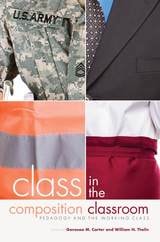
Class in the Composition Classroom
Pedagogy and the Working ClassGenesea M. Carter
Utah State University Press, 2017
Class in the Composition Classroom considers what college writing instructors should know about their working-class students—their backgrounds, experiences, identities, learning styles, and skills—in order to support them in the classroom, across campus, and beyond. In this volume, contributors explore the nuanced and complex meaning of “working class” and the particular values these college writers bring to the classroom.
The real college experiences of veterans, rural Midwesterners, and trade unionists show that what it means to be working class is not obvious or easily definable. Resisting outdated characterizations of these students as underprepared and dispensing with a one-size-fits-all pedagogical approach, contributors address how region and education impact students, explore working-class pedagogy and the ways in which it can reify social class in teaching settings, and give voice to students’ lived experiences.
As community colleges and universities seek more effective ways to serve working-class students, and as educators, parents, and politicians continue to emphasize the value of higher education for students of all financial and social backgrounds, conversations must take place among writing instructors and administrators about how best to serve and support working-class college writers. Class in the Composition Classroom will help writing instructors inside and outside the classroom prepare all their students for personal, academic, and professional communication.
Contributors: Aaron Barlow, Cori Brewster, Patrick Corbett, Harry Denny, Cassandra Dulin, Miriam Eisenstein Ebsworth, Mike Edwards, Rebecca Fraser, Brett Griffiths, Anna Knutson, Liberty Kohn, Nancy Mack, Holly Middleton, Robert Mundy, Missy Nieveen Phegley, Jacqueline Preston, James E. Romesburg, Edie-Marie Roper, Aubrey Schiavone, Christie Toth, Gail G. Verdi
Classical Rhetoric in English Poetry
Brian Vickers
Southern Illinois University Press, 1989
Back in print after 17 years, this is a concise history of rhetoric as it relates to structure, genre, and style, with special reference to English literature and literary criticism from Ancient Greece to the end of the 18th century.
The core of the book is a quite original argument that the figures of rhetoric were not mere mechanical devices, were not, as many believed, a "nuisance, a quite sterile appendage to rhetoric to which (unaccountably) teachers, pupils, and writers all over the world devoted much labor for over 2,000 years." Rather, Vickers demonstrates, rhetoric was a stylized representation of language and human feelings.
Vickers supplements his argument through analyses of the rhetorical and emotional structure of four Renaissance poems. He also defines 16 of the most common figures of rhetoric, citing examples from the classics, the Bible, and major English poets from Chaucer to Pope.
Clear Grammar 2, 2nd Edition
Keys to Grammar for English Language LearnersKeith S. Folse
University of Michigan Press, 2012
Clear Grammaris a four-level grammar series that features a unique combination of useful grammar information written in clear language with activities that promote more accurate and fluent vocabulary usage, writing, speaking, and reading.
Important features of all four new editions of Clear Grammarinclude:
- More user-friendly charts to accompany grammar explanations
- High-frequency, corpus-based vocabulary related to each grammar point
- Grammar discovery tasks using students’ inductive learning skills
- A greater variety and increased number of activities, including more practice online
- Many more activities at the longer discourse level
- The addition of reading practice at the end of the unit, as well a critical-reading task
- More writing practice, including one on editing student writing and another for original student writing
- Two vocabulary practice activities, including a focus on collocations, in each unit, as well as many one-minute mini lessons showing the connection between grammar and vocabulary
- More speaking practice, with activities that require students to speak and listen to each other while using the target grammar
Support for teachers in the form of indicators that reference how to teach the grammar points in the Clear Grammar series from Keys to Teaching Grammar for English Language Learners by Keith S. Folse (978-0-472-03220-4).
Clear Grammar 2offers students and teachers a solid introduction to low-intermediate grammar.
Clear Grammar 2, 2nd Ed., includes
* Articles
* Past tense of irregular verbs
* Present perfect tense
* Adverbs of frequency
* Nouns used as adjectives
* Object pronouns
* Past progressive tense
* One and Other
* Possessives
*Comparatives and superlatives
*Modals
The book's companion website includes the additional grammar/vocabulary activities that are referenced in the textbook.
Clear Grammar 4, 2nd Edition
Keys to Advanced ESL GrammarKeith S. Folse, Deborah Mitchell, Barbara Smith-Palinkas, and Donna Tortorella
University of Michigan Press, 2013
Clear Grammar 4 introduces advanced grammar. Clear Grammar 4, 2nd Ed., includes
- Subject-verb agreement
- Word forms
- Past perfect tense
- Conditionals
- Adverb clauses
- Noun clauses
- Reduction of adjective and adverb clauses (including appositives)
- Past modals
- Review of verb tenses
Clear Grammar 4 concludes with a review of this volume’s contents of advanced grammar points.
Clear Grammar is a four-level grammar series that features a unique combination of useful grammar information written in clear language with activities that promote more accurate and fluent writing, speaking, reading, and vocabulary usage. Important features of the new editions of Clear Grammar include:
- More user-friendly charts to accompany grammar explanations
- High-frequency, corpus-informed vocabulary related to each grammar point
- Grammar discovery tasks using students’ inductive learning skills
- A greater variety and more activities, including practice online (www.press.umich.edu/esl/compsite/cleargrammar/)
- Many more activities at the longer discourse level
- The addition of reading practice at the end, plus a critical-reading task
- More writing practice, including one on editing student writing and another for original student writing
- Two vocabulary practice activities per unit, with one on collocations; plus many one-minute lessons showing the connection between grammar and vocabulary
- More speaking practice, with activities that require students to speak and listen to each other while using the target grammar
- Support for teachers in the form of indicators that reference how to teach the grammar points in the Clear Grammar series from Keys to Teaching Grammar for English Language Learners by Keith S. Folse (978-0-472-03220-4).
Coauthoring with Undergraduates in Writing Studies
Revising Identities and InstitutionsLaurie Grobman
Utah State University Press, 2025
In this book, faculty and undergraduates describe and theorize about their coauthoring experiences within a variety of institutional contexts including land-grant universities, Historically Black Colleges and Universities, Hispanic-Serving Institutions, religiously affiliated research universities, and regional campuses of statewide higher education systems. They explore the relationships between undergraduates and faculty that lead to coauthoring opportunities in a range of courses—first-year writing classes, general educational requirements in various disciplines, and upper-level offerings for English majors—as well as in other institutional spaces such as writing centers, community engagement initiatives, and assessment offices. The collection offers faculty and undergraduates models, ideas, and strategies for how to coauthor together while also preparing them for the challenges—pragmatic, intellectual, and ethical—that they may encounter.
Coauthoring with Undergraduates in Writing Studies showcases why and how coauthorship between faculty and undergraduates is a vital site for scholarly engagement, professional development, and socially just education. It boldly enacts rhetoric and composition’s commitment to collaborative scholarship and is significant for graduate students and faculty in rhetoric and writing studies, especially in community-engaged writing, undergraduate education, collaborative writing, and mentorship, as well as those interested in WAC, WID, and the scholarship of teaching and learning.
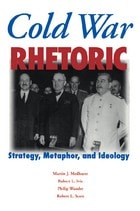
Cold War Rhetoric
Strategy, Metaphor, and IdeologyMartin J. Medhurst
Michigan State University Press, 1997
Cold War Rhetoric is the first book in over twenty years to bring a sustained rhetorical critique to bear on central texts of the Cold War. The rhetorical texts that are the subject of this book include speeches by Presidents Eisenhower and Kennedy, the Murrow- McCarthy confrontation on CBS, the speeches and writings of peace advocates, and the recurring theme of unAmericanism as it has been expressed in various media throughout the Cold War years. Each of the authors brings to his texts a particular approach to rhetorical criticism—strategic, metaphorical, or ideological. Each provides an introductory chapter on methodology that explains the assumptions and strengths of their particular approach.
Cold Warriors
Manliness on Trial in the Rhetoric of the WestSuzanne Clark
Southern Illinois University Press, 2000
Cold Warriors: Manliness on Trial in the Rhetoric of the West returns to familiar cultural forces—the West, anticommunism, and manliness—to show how they combined to suppress dissent and dominate the unruliness of literature in the name of a national identity after World War II. Few realize how much the domination of a “white male” American literary canon was a product not of long history, but of the Cold War. Suzanne Clark describes here how the Cold War excluded women writers on several levels, together with others—African American, Native American, poor, men as well as women—who were ignored in the struggle over white male identity.
Clark first shows how defining national/individual/American identity in the Cold War involved a brand new configuration of cultural history. At the same time, it called upon the nostalgia for the old discourses of the West (the national manliness asserted by Theodore Roosevelt) to claim that there was and always had been only one real American identity.
By subverting the claims of a national identity, Clark finds, many male writers risked falling outside the boundaries not only of public rhetoric but also of the literary world: men as different from one another as the determinedly masculine Ernest Hemingway and the antiheroic storyteller of the everyday, Bernard Malamud. Equally vocal and contentious, Cold War women writers were unwilling to be silenced, as Clark demonstrates in her discussion of the work of Mari Sandoz and Ursula Le Guin.
The book concludes with a discussion of how the silencing of gender, race, and class in Cold War writing maintained its discipline until the eruptions of the sixties. By questioning the identity politics of manliness in the Cold War context of persecution and trial, Clark finds that the involvement of men in identity politics set the stage for our subsequent cultural history.
Collaborations & Innovations
Supporting Multilingual Writers across Campus UnitsNancy DeJoy and Beatrice Quarshie Smith
University of Michigan Press, 2017
The chapters in this volume demonstrate that teaching effective communication skills to all students in ways that recognize the needs of multiple language users requires a shift in perspective that approaches multilingualism as an opportunity that is enhanced by the internationalization of higher education because it makes transparent the problems of current structures and disciplinary approaches in accessing those opportunities. A goal of this collection is to address the economic, structural, disciplinary, and pedagogical challenges of making this type of shift in bold and compassionate ways.
Chapters are organized into these four parts--Program-Level Challenges and Opportunities, Opportunities for Enhancing Teacher Training, Multilingualism and the Revision of First-Year Writing, and Integrating Writing Center Insights—and reflect the perspectives of a variety of university language settings. The contributions feature collaborative models and illustrate the need to rethink structures, pedagogies, assessment/evaluation processes, and teacher training for graduate and undergraduate students who will teach writing and other forms of communication.
College Writing and Beyond
A New Framework for University Writing InstructionAnne Beaufort
Utah State University Press, 2007
Composition research consistently demonstrates that the social context of writing determines the majority of conventions any writer must observe. Still, most universities organize the required first-year composition course as if there were an intuitive set of general writing "skills" usable across academic and work-world settings.
In College Writing and Beyond: A New Framework for University Writing Instruction, Anne Beaufort reports on a longitudinal study comparing one student’s experience in FYC, in history, in engineering, and in his post-college writing. Her data illuminate the struggle of college students to transfer what they learn about "general writing" from one context to another. Her findings suggest ultimately not that we must abolish FYC, but that we must go beyond even genre theory in reconceiving it.
Accordingly, Beaufort would argue that the FYC course should abandon its hope to teach a sort of general academic discourse, and instead should systematically teach strategies of responding to contextual elements that impinge on the writing situation. Her data urge attention to issues of learning transfer, and to developmentally sound linkages in writing instruction within and across disciplines. Beaufort advocates special attention to discourse community theory, for its power to help students perceive and understand the context of writing.
Coming To Terms
A Theory of Writing AssessmentPatricia Lynne
Utah State University Press, 2004
In a provocative book-length essay, Patricia Lynne argues that most programmatic assessment of student writing in U.S. public and higher education is conceived in the terms of mid-20th century positivism. Since composition as a field had found its most compatible home in constructivism, she asks, why do compositionists import a conceptual frame for assessment that is incompatible with composition theory?
By casting this as a clash of paradigms, Lynne is able to highlight the ways in which each theory can and cannot influence the shape of assessment within composition. She laments, as do many in composition, that the objectively oriented paradigm of educational assessment theory subjugates and discounts the very social constructionist principles that empower composition pedagogy. Further, Lynne criticizes recent practice for accommodating the big business of educational testing—especially for capitulating to the discourse of positivism embedded in terms like "validity" and "reliability." These terms and concepts, she argues, have little theoretical significance within composition studies, and their technical and philosophical import are downplayed by composition assessment scholars.
There is a need, Lynne says, for terms of assessment that are native to composition. To open this needed discussion within the field, she analyzes cutting-edge assessment efforts, including the work of Broad and Haswell, and she advances a set of alternate terms for evaluating assessment practices, a set of terms grounded in constructivism and composition.
Coming to Terms is ambitious and principled, and it takes a controversial stand on important issues. This strong new volume in assessment theory will be of serious interest to assessment specialists and their students, to composition theorists, and to those now mounting assessments in their own programs.
Commentary for Academic Writing for Graduate Students, 2d ed.
Essential Tasks and SkillsJohn M. Swales and Christine B. Feak
University of Michigan Press, 2004
Like its predecessor, this edition of Academic Writing for Graduate Students
"explains understanding the intended audience, the purpose of the paper, and academic genres.
"includes the use of task-based methodology, analytic group discussion, and genre consciousness-raising.
"shows how to write summaries and critiques.
"features "language focus" sections that address linguistic elements as they affect the wider rhetorical objectives.
"helps students position themselves as junior scholars in their academic communities.
Commentary for Academic Writing for Graduate Students, 3rd Ed.
Essential Tasks and SkillsJohn M. Swales & Christine B. Feak
University of Michigan Press, 2012
The Commentary for the third edition of this successful guide to writing has been revised and expanded in many ways to provide more support for instructors; this includes additional tasks for Units Two and Four to supplement the main text. However, the collegial tone established in previous Commentaries between Swales & Feak and instructors has been retained.
This volume contains commentaries on each of the eight units plus the two appendixes. The format for each unit includes
- a summary of the main points of the unit along with a list of topics covered.
- a synopsis of activities, divided into Language Focus sections and description of tasks.
- some general notes designed to capture the character of the unit, to indicate alternative activities, or to anticipate problems that may arise.
- detailed commentary and discussion of individual tasks, including model or sample answers where possible.
Community Is the Way
Engaged Writing and Designing for Transformative Changeby Aimée Knight
University Press of Colorado, 2022
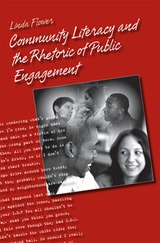
Community Literacy and the Rhetoric of Public Engagement
Linda Flower
Southern Illinois University Press, 2008
Community Literacy and the Rhetoric of Public Engagement explores the critical practice of intercultural inquiry and rhetorical problem-solving that encourages urban writers and college mentors alike to take literate action. Author Linda Flower documents an innovative experiment in community literacy, the Community Literacy Center in Pittsburgh, and posits a powerful and distinctively rhetorical model of community engagement and pedagogy for both marginalized and privileged writers and speakers. In addition, she articulates a theory of local publics and explores the transformative potential of alternative discourses and counter-public performances.
In presenting a comprehensive pedagogy for literate action, the volume offers strategies for talking and collaborating across difference, forconducting an intercultural inquiry that draws out situated knowledge and rival interpretations of shared problems, and for writing and speaking to advocate for personal and public transformation. Flower describes the competing scripts for social engagement, empowerment, public deliberation, and agency that characterize the interdisciplinary debate over models of social engagement.
Extending the Community Literacy Center’s initial vision of community literacy first published a decade ago, Community Literacy and the Rhetoric of Public Engagement makes an important contribution to theoretical conversations about the nature of the public sphere while providing practical instruction in how all people can speak publicly for values and visions of change.
Winner, 2009 Rhetoric Society of America Book Award
Compelled to Write
Alternative Rhetoric in Theory and PracticeDavid L. Wallace
Utah State University Press, 2011
David Wallace argues that any understanding of writing studies must include the conception of discourse as an embodied force with real consequences for real people. Informed in important ways by queer theory, Wallace calls to account users of dominant discourses and at the same time articulates a theory base from which to interpret "alternative rhetoric."
To examine the practice of writing from varied margins of society, Compelled to Write offers careful readings of four exemplar American writers, each of whom felt compelled within their own time and place to write in response to systemic injustices in American society.
Sarah Grimké, a privileged white woman advocating for abolition, is forced to defend her right to speak as a woman; Frederick Douglass begins his public career almost as a curiosity (the articulate ex-slave) and ends it as one of the most important rhetors in American history; Gloria Anzaldúa writes not only in multiple languages and dialects but from marginalized positions related to gender, race, class, sexual identity, and physical abled-ness; David Sedaris uses his privileged position as a middle-class white male humorist to speak unabashedly of his sexuality, his addictions, and obsessive-compulsive personality disorder.
Through these writers, Wallace explores a range of strategies that comprise alternative rhetorical practice, and demonstrates how such practice is inflected by social constraints on rhetorical agency and by how writers employ alternative discourses to resist those constraints. Grounding and personalizing Compelled to Write with rich material from his own teaching and his own experience, Wallace considers a number of implications for teachers of writing.
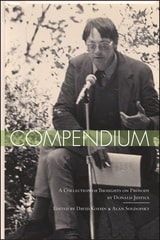
Compendium
A Collection of Thoughts on ProsodyDonald Justice
Omnidawn, 2017
Composing Feminist Interventions
Activism, Engagement, PraxisKristine L. Blair
University Press of Colorado, 2018
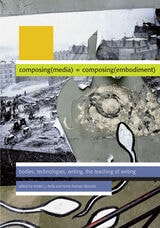
Composing Media Composing Embodiment
Kristin L. Arola and Anne Frances Wysocki
Utah State University Press, 2012
“What any body is—and is able to do—cannot be disentangled from the media we use to consume and produce texts.” ---from the Introduction.
Kristin Arola and Anne Wysocki argue that composing in new media is composing the body—is embodiment. In Composing (Media) = Composing (Embodiment), they havebrought together a powerful set of essays that agree on the need for compositionists—and their students—to engage with a wide range of new media texts. These chapters explore how texts of all varieties mediate and thereby contribute to the human experiences of communication, of self, the body, and composing. Sample assignments and activities exemplify how this exploration might proceed in the writing classroom.
Contributors here articulate ways to understand how writing enables the experience of our bodies as selves, and at the same time to see the work of (our) writing in mediating selves to make them accessible to institutional perceptions and constraints. These writers argue that what a body does, and can do, cannot be disentangled from the media we use, nor from the times and cultures and technologies with which we engage.
To the discipline of composition, this is an important discussion because it clarifies the impact/s of literacy on citizens, freedoms, and societies. To the classroom, it is important because it helps compositionists to support their students as they enact, learn, and reflect upon their own embodied and embodying writing.
Composing Place
Digital Rhetorics for a Mobile WorldJacob Greene
Utah State University Press, 2022
Greene identifies three emerging “modalities” through which mobile technologies are being used by digital writers. First, to counter dominant discourses in contested spaces; second, to historicize entrenched narratives in iconic spaces; and third, to amplify marginalized voices in mundane spaces. Through these modalities, Greene employs Indigenous philosophies and theories that upend the ways that the discipline has centered placed-based rhetorics, offering digital writers better strategies for using mobile media as a platform for civic deliberation, social advocacy, and political action.
Composing Place offers close analyses of mobile media experiences created by various artists and digital media practitioners, as well as detailed overviews of Greene’s own projects (also accessible through the companion website: www.composingplace.com). These projects include a digital “countertour” of SeaWorld that demonstrates the ways in which the attraction is driven by capitalism; an augmented reality tour of Detroit’s Woodward Avenue; and a mobile advocacy project in Jacksonville, Florida, that demonstrates the inequitable effects of car-centric public infrastructure. Ultimately, by engaging with these theoretical frameworks, rhetorical design principles, and pedagogical practices of mobile writing, readers can utilize the unique affordances of mobile media in various teaching and research contexts.
Composing Research
A Contextualist Paradigm for Rhetoric and CompositionCindy Johanek
Utah State University Press, 2000
Cindy Johanek offers a new perspective on the ideological conflict between qualitative and quantitative research approaches, and the theories of knowledge that inform them. With a paradigm that is sensitive to the context of one's research questions, she argues, scholars can develop less dichotomous forms that invoke the strengths of both research traditions. Context-oriented approaches can lift the narrative from beneath the numbers in an experimental study, for example, or bring the useful clarity of numbers to an ethnographic study.
A pragmatic scholar, Johanek moves easily across the boundaries that divide the field, and argues for contextualist theory as a lens through which to view composition research. This approach brings with it a new focus, she writes. "This new focus will call us to attend to the contexts in which rhetorical issues and research issues converge, producing varied forms, many voices, and new knowledge, indeed reconstructing a discipline that will be simultaneously focused on its tasks, its knowledge-makers, and its students."
Composing Research is a work full of personal voice and professional commitment and will be a welcome addition to the research methods classroom and to the composition researcher's own bookshelf.
2000 Outstanding Scholarship Award from the International Writing Centers Association.
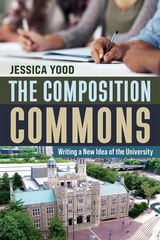
Composition Commons
Writing a New Idea of the UniversityJessica Yood
Utah State University Press, 2024
Jessica Yood traces the century-long origins of a writing-centered idea of the American university and tracks the resurgence of this idea today. Drawing on archival and classroom evidence from public colleges and universities and written in a lively autoethnographic voice, Yood names “genres of the commons”: intimate, informal writing activities that create peer-to-peer knowledge networks. She shows how these unique genres create collectivity—an academic commons—and calls on scholars to invest in composition as a course cultivating reflective, emergent, shared knowledge. Yood departs from movements that divest from the first-year composition classroom and details how an increasingly diverse student population composes complex, evolving cultural literacies that forge social bonds and forward innovation and intellectual and civic engagement.
The Composition Commons reclaims the commons as critical idea and writing classroom activities as essential practices for remaking higher education in the United States.
Composition Studies As A Creative Art
Teaching, Writing, Scholarship, AdministrationLynn Z. Bloom
Utah State University Press, 1998
Composition Studies in the New Millennium
Rereading the Past, Rewriting the FutureEdited by Lynn Z. Bloom, Donald A. Daiker, and Edward M. White
Southern Illinois University Press, 2003
A collection of twenty-four essays assessing and challenging the current state of writing instruction, Composition Studies in the New Millennium: Rereading the Past, Rewriting the Future emerges from presentations given at the national Writing Program Administrators conference held at Miami University in Oxford, Ohio, in 2001. Like its acclaimed and widely-used predecessor, Composition in the Twenty-First Century: Crisis and Change, this timely collection by leading scholars in composition studies responds to concerns about the evolution and future of this field of study.
Charting new directions, the contributors grapple with seven distinct questions: What do we mean by composition studies—past, present, and future? What do and should we teach when we teach composition? Where will composition be taught, and who will teach it? What theories and philosophies will undergird our research paradigms, and what will those paradigms be? How will new technologies change composition studies? What languages will our students write, and what will they write about? What political and social issues have shaped composition studies in the past and will shape this field in the future?
In addressing these queries, the essayists approach composition studies from perspectives ranging from rhetorical to cultural, political to economic, administrative to technological; and they do so with a style and organization appropriate for composition instructors, scholars, and administrators at all levels, from teaching assistants to college presidents. The result is an invaluable vision of the future of composition studies in the new millennium.
Composition and Cornel West
Notes toward a Deep DemocracyKeith Gilyard
Southern Illinois University Press, 2008
Composition and Cornel West: Notes toward a Deep Democracy identifies and explains key aspects of the work of Cornel West—the highly regarded scholar of religion, philosophy, and African American studies—as they relate to composition studies, focusing especially on three rhetorical strategies that West suggests we use in our questioning lives as scholars, teachers, students, and citizens.
In this study, author Keith Gilyard examines the strategies of Socratic Commitment (a relentless examination of received wisdom), Prophetic Witness (an abiding concern with justice and the plight of the oppressed), and Tragicomic Hope (a keep-on-pushing sensibility reflective of the African American freedom struggle). Together, these rhetorical strategies comprise an updated form of cultural criticism that West calls prophetic pragmatism.
This volume, which contains the only interview in which Cornel West directly addresses the field of composition,sketches the development of Cornel West’s theories of philosophy, political science, religion, and cultural studies and restates the link between Deweyan notions of critical intelligence and the notion of critical literacy developed by Ann Berthoff, Ira Shor, and Henry Giroux. Gilyard provides examples from the classroom to illustrate the possibilities of Socratic Commitment as part of composition pedagogy, shows the alignment of Prophetic Witness with traditional aims of critical composition, and in his chapter on Tragicomic Hope, addresses African American expressive culture with an emphasis on music and artists such as Curtis Mayfield, Marvin Gaye, Aretha Franklin, and Kanye West.
The first book to comprehensively connect the ideas of one of America's premier scholars of religion, philosophy and African American studies with composition theory and pedagogy, Composition and Cornel West will be valuable to scholars, teachers, and students interested in race, class, critical literacy, and the teaching of writing.
Composition and Literature
Bridging the GapEdited by Winifred Bryan Horner
University of Chicago Press, 1983
Composition and Rhetoric in Contentious Times
Rachel McCabe
Utah State University Press, 2023
Editors Rachel McCabe and Jennifer Juszkiewicz consider how educators can respond to multiple current crises relating to composition and rhetoric with generosity and cautious optimism; in the process, they address the current concerns about the longevity of the humanities. By engaging with social constructivist, critical race, socioeconomic, and activist pedagogies, each chapter provides an answer to the question, How can our courses help students become stronger writers while contending with current social, environmental, and ethical questions posed by the world around them? The contributors consider this question from numerous perspectives, recognizing the important ways that power and privilege affect our varying means of addressing this question.
Relying on both theory and practice, Composition and Rhetoric in Contentious Times engages the future of composition and rhetoric as a discipline shaped by recent and current global events. This text appeals to early-career writing program administrators, writing center directors, and professional specialists, as well as Advanced Placement high school instructors, graduate students, and faculty teaching graduate-level pedagogy courses.
Composition and the Rhetoric of Science
Engaging the Dominant DiscourseMichael J. Zerbe
Southern Illinois University Press, 2007
Composition in the Age of Austerity
Nancy Welch
Utah State University Press, 2016
In the face of the gradual saturation of US public education by the logics of neoliberalism, educators often find themselves at a loss to respond, let alone resist. Through state defunding and many other “reforms” fueled by austerity politics, a majority of educators are becoming casual labor in US universities while those who hang onto secure employment are pressed to act as self-supporting entrepreneurs or do more with less. Focusing on the discipline of writing studies, this collection addresses the sense of crisis that many educators experience in this age of austerity.
The chapters in this book chronicle how neoliberal political economy shapes writing assessments, curricula, teacher agency, program administration, and funding distribution. Contributors also focus on how neoliberal political economy dictates the direction of scholarship, because the economic and political agenda shaping the terms of work, the methods of delivery, and the ways of valuing and assessing writing also shape the primary concerns and directions of scholarship.
Composition in the Age of Austerity offers critical accounts of how the restructuring of higher education is shaping the daily realities of composition programs. The book documents the effects and implications of the current restructuring, examines how cherished rhetorical ideals actually leave the field unprepared to respond effectively to defunding and corporatizing trends, and establishes points of departure for collective response.
Composition in the Twenty-First Century
Crisis and ChangeEdited by Lynn Z. Bloom, Donald A. Daiker, and Edward M. White
Southern Illinois University Press, 1997
Despite its pervasiveness and its significance, composition has an unstable status within the curriculum. Writing programs and writing faculty are besieged by academic, political, and financial concerns that have not been well understood or addressed.
At many institutions, composition functions paradoxically as both the gateway to academic success and as the gatekeeper, reducing access to academic work and opportunity for those with limited facility in English. Although writing programs are expected to provide services that range from instruction in correct grammar to assisting—or resisting—political correctness, expanding programs and shrinking faculty get caught in the crossfire. The bottom line becomes the firing line as forces outside the classroom determine funding and seek to define what composition should do.
In search of that definition, the contributors ask and answer a series of specific and salient questions: What implications—intellectual, political, and institutional—will forces outside the classroom have on the quality and delivery of composition in the twenty-first century? How will faculty and administrators identify and address these issues? What policies and practices ought we propose for the century to come?
This book features sixteen position papers by distinguished scholars and researchers in composition and rhetoric; most of the papers are followed by invited responses by other notable compositionists. In all, twenty-five contributors approach composition from a wide variety of contemporary perspectives: rhetorical, historical, social, cultural, political, intellectual, economic, structural, administrative, and developmental. They propose solutions applicable to pedagogy, research, graduate training of composition teachers, academic administration, and public and social policy. In a very real sense, then, this is the only book to offer a map to the future of composition.
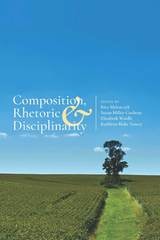
Composition, Rhetoric, and Disciplinarity
Rita Malenczyk
Utah State University Press, 2018
Edited by four nationally recognized leaders of composition scholarship, Composition, Rhetoric, and Disciplinarity asks a fundamental question: can Composition and Rhetoric, as a discipline, continue its historical commitment to pedagogy without sacrificing equal attention to other areas, such as research and theory? In response, contributors to the volume address disagreements about what it means to be called a discipline rather than a profession or a field; elucidate tensions over the defined breadth of Composition and Rhetoric; and consider the roles of research and responsibility as Composition and Rhetoric shifts from field to discipline.
Outlining a field with a complex and unusual formation story, Composition, Rhetoric, and Disciplinarity employs several lenses for understanding disciplinarity—theory, history, labor, and pedagogy—and for teasing out the implications of disciplinarity for students, faculty, institutions, and Composition and Rhetoric itself. Collectively, the chapters speak to the intellectual and embodied history leading to this point; to questions about how disciplinarity is, and might be, understood, especially with regard to Composition and Rhetoric; to the curricular, conceptual, labor, and other sites of tension inherent in thinking about Composition and Rhetoric as a discipline; and to the implications of Composition and Rhetoric’s disciplinarity for the future.
Contributors: Linda Adler-Kassner, Elizabeth H. Boquet, Christiane Donahue, Whitney Douglas, Doug Downs, Heidi Estrem, Kristine Hansen, Doug Hesse, Sandra Jamieson, Neal Lerner, Jennifer Helene Maher, Barry Maid, Jaime Armin Mejía, Carolyn R. Miller, Kelly Myers, Gwendolynne Reid, Liane Robertson, Rochelle Rodrigo, Dawn Shepherd, Kara Taczak
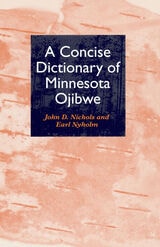
Concise Dictionary of Minnesota Ojibwe
John Nichols
University of Minnesota Press, 1994
The most up-to-date resource for those interested in the linguistic and cultural heritage of the Anishinaabe, A Concise Dictionary of Minnesota Ojibwe contains more than 7,000 of the most frequently used Ojibwe words. Presented in Ojibwe-English and English-Ojibwe sections, this dictionary spells words to reflect their actual pronunciation with a direct match between the letters used and the speech sounds of Ojibwe. It contains many ancient words and meanings as well as language added in the twentieth century.
Most entries give several sample inflected forms such as the plural, diminutive, and locative forms of nouns and first person and participle forms of verbs. The basic patterns of Ojibwe word structure and the organization of the dictionary entries are clearly explained in the introduction. The most widely used modern standard writing system for Ojibwe is used throughout, and some of the key objects of Ojibwe life are authentically illustrated by coauthor and artist Earl Nyholm.Acknowledged as one of the three largest Native American languages, Ojibwe is spoken in many local varieties in the Upper Midwest and across Central and Eastern Canada. Minnesota Ojibwe is spoken in Central and Northern Minnesota, and is very similar to the Ojibwe spoken in the Ontario-Minnesota border region, Wisconsin, and Michigan's Upper Peninsula. A Concise Dictionary of Minnesota Ojibwe is an essential reference for all students of Ojibwe culture, history, language, and literature.
Considering Students, Teachers, and Writing Assessment, Vol 2
Emerging Theoretical and Pedagogical PracticeDiane Kelly-Riley
University Press of Colorado, 2024
Considering Students, Teachers, and Writing Assessment, Vol. 1
Technical and Political ContextsDiane Kelly-Riley
University Press of Colorado, 2024
Constructing Rhetorical Education
Edited by Marie Secor and Davida Charney
Southern Illinois University Press, 1992
In nineteen essays illustrating its many aspects, this book offers an argument for what it takes to construct a complete rhetorical education.
The editors take an approach that is pragmatic and pluralistic, based as it is on the assumptions that a rhetorical education is not limited to teaching freshman composition (or any specific writing course) and that the contexts in which such an education occurs are not limited to classrooms. This thought-provoking volume stresses that while a rhetorical education results in the growth of writing skills, its larger goal is to foster critical thinking.
Contingency, Exploitation, and Solidarity
Labor and Action in English CompositionSeth Kahn
University Press of Colorado, 2017
Composition has been a microcosm of the corporatization of higher education for thirty years, with adjuncts often handling the hard work of writing instruction. We've learned enough to know that change is needed. Influenced by the efforts of organizations such as New Faculty Majority, Faculty Forward, PrecariCorps, and national faculty unions, this collection highlights action, describing efforts that have improved adjunct working conditions in English departments. The editors categorize these efforts into five threads: strategies for self-advocacy; organizing within and across ranks; professionalizing in complex contexts; working for local changes to workload, pay, and material conditions; and protecting gains.
Contributors to this collection include contingent and tenure-line faculty from private, public, and community colleges, as well as writing program administrators and writing center faculty. Their voices address contingency, exploitation, and solidarity in activist terms deriving from institutional realities and cases. Collectively, they offer creative and constructive responses that can enact labor justice and champion the disciplinary energies of all members of our collegial community.
Contributors: Janelle Adsit, Jacob Babb, Chris Blankenship, Rebekah Shultz Colby, Richard Colby, Anicca Cox, Sue Doe, Tracy Donhardt, Dawn Fels, Barbara Heifferon, Desirée M. Holter, Justin Jory, Jeffrey Klausman, Michelle LaFrance, Sarah Layden, Carol Lind, Maria Maisto, Amanda Martin, Mark McBeth, Tim McCormack, Joan Mullin, Dani Nier-Weber, Glenn Moomau, Michael Murphy, Anna K. Nardo, Rolf Norgaard, Courtney Adams Wooten, Lacey Wootton, Allison Laubach Wright
Continuing Cooperative Development
A Discourse Framework for Individuals as ColleaguesJulian Edge
University of Michigan Press, 2002
Controversies in Second Language Writing, Second Edition
Dilemmas and Decisions in Research and InstructionChristine Pearson Casanave
University of Michigan Press, 2017
The second edition is a thorough revision with all chapters updated to refer to works written since the first edition was published. A few chapters have been added: one devoted to writing in a digital era (Chapter 3); one devoted to the debates about English as a lingua franca, "translingual literacy practices," and other hybrid uses of English that have been ongoing in the last ten years (Chapter 4); and one giving special attention to issues related to writing from sources and plagiarism (Chapter 6).
As with the first edition, the second edition of Controversies is not a book that will teach readers how to do things. Rather, it is a book designed to help readers think and to wrestle with issues in L2 writing that are not easily resolved by how-to prescriptions.
Controversies in Second Language Writing
Dilemmas and Decisions in Research and InstructionChristine Pearson Casanave
University of Michigan Press, 2003
To counteract some of the debates, Casanave explores the different sides of the arguments and provides examples of how other teachers have dealt with these issues. The book presents novice and seasoned teachers with thought-provoking issues and questions to consider when determining and reflecting on their own teaching strategies and criteria.
Topics discussed include:
contrastive rhetoric
product vs. process
fluency and accuracy
assessment of student work
audience
plagiarism
politics and ideology.
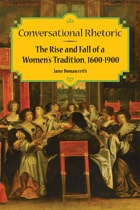
Conversational Rhetoric
The Rise and Fall of a Women's Tradition, 1600-1900Jane Donawerth
Southern Illinois University Press, 2011
Donawerth traces the development of women’s rhetorical theory through the voices of English and American women (and one much-translated French woman) over three centuries. She demonstrates how they cultivated theories of rhetoric centered on conversation that faded once women began writing composition textbooks for mixed-gender audiences in the latter part of the nineteenth century. She recovers and elucidates the importance of the theories in dialogues and defenses of women’s education by Bathsua Makin, Mary Astell, and Madeleine de Scudéry; in conduct books by Hannah More, Lydia Sigourney, and Eliza Farrar; in defenses of women’s preaching by Ellen Stewart, Lucretia Mott, Catherine Booth, and Frances Willard; and in elocution handbooks by Anna Morgan, Hallie Quinn Brown, Genevieve Stebbins, and Emily Bishop. In each genre, Donawerth explores facets of women’s rhetorical theory, such as the recognition of the gendered nature of communication in conduct books, the incorporation of the language of women’s rights in the defenses of women’s preaching, and the adaptation of sentimental culture to the cultivation of women’s bodies as tools of communication in elocution books.
Rather than a linear history, Conversational Rhetoric follows the starts, stops, and starting over in women’s rhetorical theory. It covers a broad range of women’s rhetorical theory in the Anglo-American world and places them in their social, rhetorical, and gendered historical contexts. This study adds women’s rhetorical theory to the rhetorical tradition, advances our understanding of women’s theories and their use of rhetoric, and offers a paradigm for analyzing the differences between men’s and women’s rhetoric from 1600 to 1900.
Cookies, Coleslaw, and Stoops
The Influence of Dutch on the North American LanguagesNicoline van der Sijs
Amsterdam University Press, 2010
From Santa Claus (after the Dutch folklore saint Sinterklaas) and his sleigh (the pronunciation of the Dutch slee is almost identical) to a dumbhead talking poppycock, the contributions of the Dutch language to American English are indelibly embedded to some of our most vernacular terms and expressions. The menu in most of our restaurants sports some originally Dutch names, and even our dollar is named after a Dutch coin (daalder). In this captivating volume, the renowned linguist Nicoline van der Sijs glosses over 300 Dutch loan words like these that travelled to the New World on board the Dutch ship the Halve Maan, captained by Henry Hudson, which dropped anchor in Manhattan more than 400 years ago. Surprisingly, the Dutch also gave several Native American languages words for everyday things like “pants”, “cat” and “turkey”. Lively and accessible, the information presented in this volume charts the journey of these words into the American territory and languages, from more obscure uses which maybe have survived in only regional dialects to such ubiquitous contributions to our language like Yankee, cookie, and dope. Each entry marks the original arrival of its term into American English and adds up-to-date information on its evolving meaning, etymology, and regional spread. Not to be missed by anyone with a passion for the history behind our everyday expressions, Cookies, Coleslaw and Stoops is the perfect gift for the linguistic adventurer in us all.
Cosmopolitan English and Transliteracy
Xiaoye You
Southern Illinois University Press, 2016
Despite the vast number of multilingual speakers in the United States and the pervasive influence of globalization, writing studies in this country is still inextricably linked to a nationalistic, monolingual English ideology. In Cosmopolitan English and Transliteracy, Xiaoye You addresses this issue by proposing that writing studies programs adopt a cosmopolitan perspective. Emphasizing local and global forms of citizenship and identification, You merges a humanistic vision with the rigor of social science, arguing that linguistic and cultural differences can be explored to recover human connections normally severed by geographical and semiotic borders.
You examines several areas of writing affected by globalization. He then turns to the composition classroom, highlighting the challenges and possibilities of crossing cultural boundaries in academic discourse before introducing a pedagogy aimed at fostering American students’ translingual and transcultural sensibilities. Included is a model for training writing teachers in the context of globalization, which aims to help instructors gain practical knowledge about the needs and resources of multilingual writers through communication technologies and cross-cultural partnerships.
By introducing cosmopolitan perspectives into the composition classroom, You challenges traditional assumptions about language, identity, and literacy as they relate to writing studies. Innovative and provocative, Cosmopolitan English and Transliteracy charts a new way forward for writing programs, with a call to focus on global rather than national identity.
CounterStories from the Writing Center
Frankie Condon
Utah State University Press, 2021
Practicing what Derrick Bell has termed “creative truth telling,” these writers are not concerned with individual white women in writing centres but with the social, political, and cultural capital that is the historical birthright of white, straight, cis-gendered women, particularly in writing centre studies. The essays collected in this volume test, defy, and overflow the bounds of traditional academic discourse in the service of powerful testimony, witness, and counterstory.
CounterStories from the Writing Center is a must-read for writing centre directors, scholars, and tutors who are committed to antiracist pedagogy and offers a robust intersectional analysis to those who seek to understand the relationship between the work of writing centres and the problem of racism. Accessible and usable for both graduate and undergraduate students of writing centre theory and practice, this work troubles the field’s commonplaces and offers a rich envisioning of what writing centres materially committed to inclusion and equity might be and do.
Contributors: Dianna Baldwin, Nicole Caswell, Mitzi Ceballos, Romeo Garcia, Neisha-Anne Green, Doug Kern, T. Haltiwanger Morrison, Bernice Olivas, Moira Ozias, Trixie Smith, Willow Trevino
Counting-Out Rhymes
A DictionaryEdited by Roger D. Abrahams and Lois Rankin
University of Texas Press, 1980
Eeny, meeny, figgledy, fig.
Delia, dolia, dominig,
Ozy, pozy doma-nozy,
Tee, tau, tut,
Uggeldy, buggedy, boo!
Out goes you. (no. 129)
You can stand,
And you can sit,
But, if you play,
You must be it. (no. 577)
Counting-out rhymes are used by children between the ages of six and eleven as a special way of choosing it and beginning play. They may be short and simple ("O-U-T spells out/And out goes you") or relatively long and complicated; they may be composed of ordinary words, arrant nonsense, or a mixture of the two.
Roger D. Abrahams and Lois Rankin have gathered together a definitive compendium of counting-out rhymes in English reported to 1980. These they discovered in over two hundred sources from the nineteenth and twentieth centuries, including rhymes from England, Scotland, Ireland, Australia, New Zealand, and the United States. Representative texts are given for 582 separate rhymes, with a comprehensive listing of sources and variants for each one, as well as information on each rhyme's provenience, date, and use. Cross-references are provided for variants whose first lines differ from those of the representative texts. Abrahams's introduction discusses the significance of counting-out rhymes in children's play.
Children's folklore and speech play have attracted increasing attention in recent years. Counting-Out Rhymes will be a valuable resource for researchers in this field.