78 books match the query 'Fascism & Totalitarianism' and 5 start with c

cover of Cinema is the Strongest Weapon: Race-Making and Resistance in Fascist Italy

Cinema is the Strongest Weapon

Race-Making and Resistance in Fascist Italy

Lorenzo Fabbri

University of Minnesota Press, 2023

A deep dive into Italian cinema under Mussolini’s regime and the filmmakers who used it as a means of antifascist resistance
 

Looking at Italy’s national film industry under the rule of Benito Mussolini and in the era that followed, Cinema Is the Strongest Weapon examines how cinema was harnessed as a political tool by both the reigning fascist regime and those who sought to resist it. Covering a range of canonical works alongside many of their neglected contemporaries, this book explores film’s mutable relationship to the apparatuses of state power and racial capitalism. 


Exploiting realism’s aesthetic, experiential, and affective affordances, Mussolini’s biopolitical project employed cinema to advance an idealized vision of life under fascism and cultivate the basis for a homogenous racial identity. In this book, Lorenzo Fabbri crucially underscores realism’s susceptibility to manipulation from diametrically opposed political perspectives, highlighting the queer, Communist, Jewish, and feminist filmmakers who subverted Mussolini’s notion that “cinema is the regime’s strongest weapon” by developing film narratives and film forms that challenged the prevailing ethno-nationalist ideology. 


Focusing on an understudied era of film history and Italian cultural production, Fabbri issues an important recontextualization of Italy’s celebrated neorealist movement and the structural ties it shares with its predecessor. Drawing incisive parallels to contemporary debates around race, whiteness, authoritarianism, and politics, he presents an urgent examination into the broader impact of visual media on culture and society.


Retail e-book files for this title are screen-reader friendly with images accompanied by short alt text and/or extended descriptions.
[more]
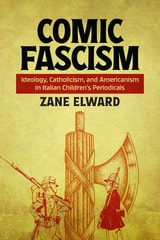
cover of Comic Fascism: Ideology, Catholicism, and Americanism in Italian Children’s Periodicals

Comic Fascism

Ideology, Catholicism, and Americanism in Italian Children’s Periodicals

Zane Elward

The Ohio State University Press, 2025

Comics in Italy—produced by Fascists, conservatives, Catholics, and, after World War II, youth groups on the political left—promoted competing yet sometimes convergent visions for Italian society to children in the first half of the twentieth century. In Comic Fascism, Zane Elward dives deep into the archives to reveal how Italian comics reflected transformations within Italian society during Fascist rule (1922–45) and how conservative and Catholic circles were entangled with Mussolini’s agenda, normalizing and promoting it through their own periodicals. At the same time, he offers new interpretations of American comics, demonstrating that despite Italian suspicion of US culture, these comics often aligned with Fascism and were co-opted by its proponents. Elward also identifies the persistence of Fascist political ideas after the fall of the Fascist state and highlights growing tensions between the right and the left in the lead-up to the Cold War. Ultimately, Elward broadens previous temporal and cultural frames to offer fresh insights into the origins and long tail of Fascist indoctrination and how it remained at the heart of the ongoing quest to redefine Italian society.
[more]
cover of Conspiracies in Broad Daylight?: Conspiracism, Fascism, and the Radical Right

Conspiracies in Broad Daylight?

Conspiracism, Fascism, and the Radical Right

Marco Bresciani

Central European University Press, 2027
This edited volume examines the myths of conspiracy within radical-right and fascist cultures and practices from the late nineteenth century onward. While its scope is broad, most contributions focus on the first half of the twentieth century in both European and global contexts, spanning events from the Great War and the Russian Revolutions to the Spanish Civil War and the Second World War. Bringing together scholars from a range of disciplines and geographical areas, the volume explores the cultural roots, forms, political strategies, and effects of conspiracy imagery within counter-revolutionary, reactionary, fascist, and neo-fascist currents. Particular attention is paid to antisemitism and anti-Bolshevism as strategies for legitimizing radical-right and fascist movements and governments, as well as to their role in mobilizing and polarizing politics and society, especially in wartime contexts.
[more]
cover of Conspiracies in Broad Daylight?: Conspiracism, Fascism, and the Radical Right

Conspiracies in Broad Daylight?

Conspiracism, Fascism, and the Radical Right

Marco Bresciani

Central European University Press, 2027

This edited volume examines the myths of conspiracy within radical-right and fascist cultures and practices from the late nineteenth century onward. While its scope is broad, most contributions focus on the first half of the twentieth century in both European and global contexts, spanning events from the Great War and the Russian Revolutions to the Spanish Civil War and the Second World War. Bringing together scholars from a range of disciplines and geographical areas, the volume explores the cultural roots, forms, political strategies, and effects of conspiracy imagery within counter-revolutionary, reactionary, fascist, and neo-fascist currents. Particular attention is paid to antisemitism and anti-Bolshevism as strategies for legitimizing radical-right and fascist movements and governments, as well as to their role in mobilizing and polarizing politics and society, especially in wartime contexts.
[more]
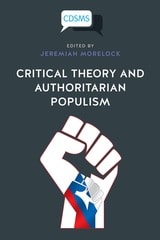
cover of Critical Theory and Authoritarian Populism

Critical Theory and Authoritarian Populism

Jeremiah Morelock

University of Westminster Press, 2018

After President Trump’s election, BREXIT and the widespread rise of far-Right political parties, much public discussion has intensely focused on populism and authoritarianism. In the middle of the twentieth century, members of the early Frankfurt School prolifically studied and theorized fascism and anti-Semitism in Germany and the United States. In this volume, leading European and American scholars apply insights from the early Frankfurt School to present-day authoritarian populism, including the Trump phenomenon and related developments across the globe. Chapters are arranged into three sections exploring different aspects of the topic: theories, historical foundations, and manifestations via social media. Contributions examine the vital political, psychological and anthropological theories of early Frankfurt School thinkers, and how their insights could be applied now amidst the insecurities and confusions of twenty-first century life. The many theorists considered include Adorno, Fromm, Löwenthal and Marcuse, alongside analysis of Austrian Facebook pages and Trump’s tweets and operatic media drama. This book is a major contribution towards deeper understanding of populism’s resurgence in the age of digital capitalism.
[more]