Results by title
52 books match the query 'Foreign speakers' and 7 start with c
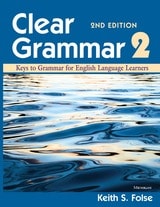
Clear Grammar 2, 2nd Edition
Keys to Grammar for English Language LearnersKeith S. Folse
University of Michigan Press, 2012
Clear Grammaris a four-level grammar series that features a unique combination of useful grammar information written in clear language with activities that promote more accurate and fluent vocabulary usage, writing, speaking, and reading.
Important features of all four new editions of Clear Grammarinclude:
- More user-friendly charts to accompany grammar explanations
- High-frequency, corpus-based vocabulary related to each grammar point
- Grammar discovery tasks using students’ inductive learning skills
- A greater variety and increased number of activities, including more practice online
- Many more activities at the longer discourse level
- The addition of reading practice at the end of the unit, as well a critical-reading task
- More writing practice, including one on editing student writing and another for original student writing
- Two vocabulary practice activities, including a focus on collocations, in each unit, as well as many one-minute mini lessons showing the connection between grammar and vocabulary
- More speaking practice, with activities that require students to speak and listen to each other while using the target grammar
Support for teachers in the form of indicators that reference how to teach the grammar points in the Clear Grammar series from Keys to Teaching Grammar for English Language Learners by Keith S. Folse (978-0-472-03220-4).
Clear Grammar 2offers students and teachers a solid introduction to low-intermediate grammar.
Clear Grammar 2, 2nd Ed., includes
* Articles
* Past tense of irregular verbs
* Present perfect tense
* Adverbs of frequency
* Nouns used as adjectives
* Object pronouns
* Past progressive tense
* One and Other
* Possessives
*Comparatives and superlatives
*Modals
The book's companion website includes the additional grammar/vocabulary activities that are referenced in the textbook.
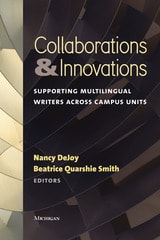
Collaborations & Innovations
Supporting Multilingual Writers across Campus UnitsNancy DeJoy and Beatrice Quarshie Smith
University of Michigan Press, 2017
The chapters in this volume demonstrate that teaching effective communication skills to all students in ways that recognize the needs of multiple language users requires a shift in perspective that approaches multilingualism as an opportunity that is enhanced by the internationalization of higher education because it makes transparent the problems of current structures and disciplinary approaches in accessing those opportunities. A goal of this collection is to address the economic, structural, disciplinary, and pedagogical challenges of making this type of shift in bold and compassionate ways.
Chapters are organized into these four parts--Program-Level Challenges and Opportunities, Opportunities for Enhancing Teacher Training, Multilingualism and the Revision of First-Year Writing, and Integrating Writing Center Insights—and reflect the perspectives of a variety of university language settings. The contributions feature collaborative models and illustrate the need to rethink structures, pedagogies, assessment/evaluation processes, and teacher training for graduate and undergraduate students who will teach writing and other forms of communication.
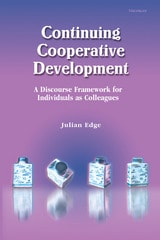
Continuing Cooperative Development
A Discourse Framework for Individuals as ColleaguesJulian Edge
University of Michigan Press, 2002
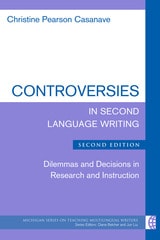
Controversies in Second Language Writing, Second Edition
Dilemmas and Decisions in Research and InstructionChristine Pearson Casanave
University of Michigan Press, 2017
The second edition is a thorough revision with all chapters updated to refer to works written since the first edition was published. A few chapters have been added: one devoted to writing in a digital era (Chapter 3); one devoted to the debates about English as a lingua franca, "translingual literacy practices," and other hybrid uses of English that have been ongoing in the last ten years (Chapter 4); and one giving special attention to issues related to writing from sources and plagiarism (Chapter 6).
As with the first edition, the second edition of Controversies is not a book that will teach readers how to do things. Rather, it is a book designed to help readers think and to wrestle with issues in L2 writing that are not easily resolved by how-to prescriptions.
Controversies in Second Language Writing
Dilemmas and Decisions in Research and InstructionChristine Pearson Casanave
University of Michigan Press, 2003
To counteract some of the debates, Casanave explores the different sides of the arguments and provides examples of how other teachers have dealt with these issues. The book presents novice and seasoned teachers with thought-provoking issues and questions to consider when determining and reflecting on their own teaching strategies and criteria.
Topics discussed include:
contrastive rhetoric
product vs. process
fluency and accuracy
assessment of student work
audience
plagiarism
politics and ideology.
Cosmopolitan English and Transliteracy
Xiaoye You
Southern Illinois University Press, 2016
Despite the vast number of multilingual speakers in the United States and the pervasive influence of globalization, writing studies in this country is still inextricably linked to a nationalistic, monolingual English ideology. In Cosmopolitan English and Transliteracy, Xiaoye You addresses this issue by proposing that writing studies programs adopt a cosmopolitan perspective. Emphasizing local and global forms of citizenship and identification, You merges a humanistic vision with the rigor of social science, arguing that linguistic and cultural differences can be explored to recover human connections normally severed by geographical and semiotic borders.
You examines several areas of writing affected by globalization. He then turns to the composition classroom, highlighting the challenges and possibilities of crossing cultural boundaries in academic discourse before introducing a pedagogy aimed at fostering American students’ translingual and transcultural sensibilities. Included is a model for training writing teachers in the context of globalization, which aims to help instructors gain practical knowledge about the needs and resources of multilingual writers through communication technologies and cross-cultural partnerships.
By introducing cosmopolitan perspectives into the composition classroom, You challenges traditional assumptions about language, identity, and literacy as they relate to writing studies. Innovative and provocative, Cosmopolitan English and Transliteracy charts a new way forward for writing programs, with a call to focus on global rather than national identity.
Critical Academic Writing and Multilingual Students
A. Suresh Canagarajah
University of Michigan Press, 2002
This volume facilitates teacher self-reflection and enables readers to better understand the motivations and pedagogical implications--especially for L2 writing--of a more openly pedagogical approach.
Critical Academic Writing and Multilingual Students explains what it means to commit to an academic pedagogy, in terms of form, self, content, and community--and what it can accomplish in the L2 writing classroom. It's a guide for writing teachers who wish to embark on a journey toward increased critical awareness of the role they play, or potentially could play, in the lives of their students.