Results by title
93 books match the query 'Historians' and 9 start with c
C. L. R. James's Caribbean
Paget Henry and Paul Buhle, eds.
Duke University Press, 1992
Drawing upon James's observations of his own life as revealed to interviewers and close friends, this volume provides an examination of James's childhood and early years as colonial literatteur and his massive contribution to West Indian political-cultural understanding. Moving beyond previous biographical interpretations, the contributors here take up the problem of reading James's texts in light of poststructuralist criticism, the implications of his texts for Marxist discourse, and for problems of Caribbean development.
Capitalism and the Historians
Edited by F. A. Hayek
University of Chicago Press, 1963
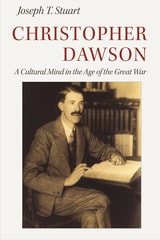
Christopher Dawson
A Cultural Mind in the Age of the Great WarJoseph T. Stuart
Catholic University of America Press, 2022
Clio's Favorites
Leading Historians of the United States, 1945-2000Robert Allen Rutland
University of Missouri Press, 2000
Although historians talk about each other's work routinely, they have been reluctant to record their thoughts about the leading practitioners of U.S. history. Robert Allen Rutland attempts to remedy this state of things with this collection named for Clio, the Greek muse vested with the inspirations of history. The volume offers a glimpse of the lives and work of historians who must be considered among the most remarkable from the last half of the twentieth century.
The roll call of excellence for Clio's Favorites was established after Rutland informally polled some twenty-five historians, asking them to name the outstanding workers in the field of U.S. history since the end of World War II. Among the criteria for selection were: quality (not volume) of the historian's work; influence in the field of study; importance of his or her graduate and undergraduate teaching; and the figure's public persona as reflected by awards, honors, and involvement in public service. The historians profiled in Clio's Favorites, most of whom broke new ground, met and surpassed these standards. The list could have gone on, but Rutland believes these twelve represent the cream of the crop. They are: Bernard Bailyn, Merle Curti, David Herbert Donald, John Hope Franklin, Richard Hofstadter, Howard Roberts Lamar, Gerda Lerner, Arthur S. Link, Edmund S. Morgan, David M. Potter, Arthur M. Schlesinger, Jr., and C. Vann Woodward.
Just as the subject of each essay in Clio's Favorites is a remarkably distinguished historian, the authors of these twelve essays are accomplished historians themselves. Good historical writing is never outdated, Rutland argues. The extensive work of the scholars profiled here has endured and will continue to endure. Likewise, the writing in Clio's Favorites, by twelve expert historians, will survive. This book will be a lasting record of the contributions made by the best U.S. historians practicing their craft over the last fifty years.
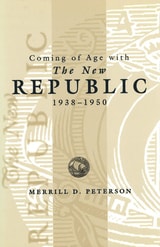
Coming of Age with the New Republic, 1938-1950
Merrill D. Peterson
University of Missouri Press, 1999
In this absorbing memoir, Merrill D. Peterson traces his progress from a young Kansas Republican to a "Left Liberal," Democrat by reconstructing how the New Republic singularly influenced his intellectual development and academic career during some of the most turbulent years in American history—the final years of the Great Depression through World War II and the beginnings of the Cold War. Peterson recalls how, as a young man, he was guided to intellectual maturity by such extraordinary individuals as Max Lerner, Archibald MacLeish, Vincent Sheean, Alfred Kazin, Lewis Mumford, and Malcolm Cowley—all contributors to this important magazine. We look back, with Peterson, and see how their views are inextricably reflected in his own developing worldview.
Peterson was introduced to this liberal weekly by one of his teachers during his senior year of high school (1938-1939). For the next ten years, the magazine served as his principal guide to the politics and culture of the times. Now, at seventy-eight years of age, Peterson revisits the magazine that he read so eagerly during those early, impressionable years. With considerable skill and charm, Peterson weaves together the fresh reading, the history of the country during the 1940s, and his own personal history to give us the heart of the book. In addition, he includes brief essays on Vernon L. Parrington, Lewis Mumford, and Max Lerner, the three American writers and intellectuals he believes had the most influence on him.
Peterson discusses several turning points in his young life, but he focuses primarily on his education and the role the magazine played in it. The book concludes when Peterson, with a Ph.D. in the history of American civilization, accepts his first academic appointment, at Brandeis University, and approaches the publication of his first book. Thus, a critical chapter in his life comes to a close.
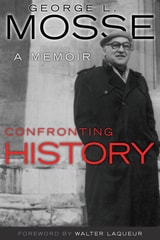
Confronting History
A MemoirGeorge L. Mosse; Foreword by Walter Laqueur
University of Wisconsin Press, 2000
Confronting History describes Mosse's opulent childhood in Weimar Berlin; his exile in Paris and England, including boarding school and study at Cambridge University; his second exile in the U.S. at Haverford, Harvard, Iowa, and Wisconsin; and his extended stays in London and Jerusalem. Mosse discusses being a Jew and his attachment to Israel and Zionism, and he addresses his gayness, his coming out, and his growing scholarly interest in issues of sexuality. This touching memoir—told with the clarity, passion, and verve that entranced thousands of Mosse's students—is guided in part by his belief that "what man is, only history tells" and, most of all, by the importance of finding one's self through the pursuit of truth and through an honest and unflinching analysis of one's place in the context of the times.
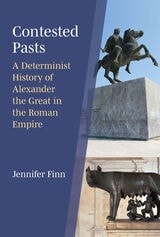
Contested Pasts
A Determinist History of Alexander the Great in the Roman EmpireJennifer Finn
University of Michigan Press, 2022
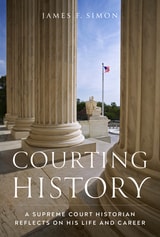
Courting History
A Supreme Court Historian Reflects on His Life and CareerJames F. Simon
University of Texas Press, 2025
A Supreme Court historian’s memoir places court events in the larger context of American history.
Legal scholar James F. Simon has written many acclaimed books on the history of the US Supreme Court, but in this memoir, he turns his attention to a more personal subject: himself. Simon, a native of Fort Worth, details what it was like growing up in segregated Texas. He left home for college and law school at Yale, interspersed with travels abroad to build a schoolhouse in Ghana, work at an Israeli kibbutz, and spend a year on a fellowship in India.
Simon worked as a legal journalist for Time magazine before embarking on a career as a Supreme Court historian. He later was appointed professor of constitutional law and served as dean of New York Law School. Meanwhile, he continued his work on what became his specialty, well-researched books on the history of the Supreme Court that place events at the court in the larger context of American history. Much of this research is included in his papers, which are now housed at the Briscoe Center for American History.
In this engaging memoir, Simon describes the challenges of interviewing Supreme Court justices and researching constitutional history for his books and juggling his law school and family responsibilities, all the while reflecting on changing American perspectives on civil rights and liberties.
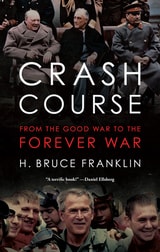
Crash Course
From the Good War to the Forever WarFranklin, H. Bruce
Rutgers University Press, 2024
Now, after fifty years as a renowned cultural historian, Franklin offers a set of hard-learned lessons about modern American history. Crash Course is essential reading for anyone who wonders how America ended up where it is today: with a deeply divided and disillusioned populace, led by a dysfunctional government, and mired in unwinnable wars. It also finds startling parallels between America’s foreign military exploits and the equally brutal tactics used on the home front to crush organized labor, antiwar, and civil rights movements.
More than just a memoir or a history book, Crash Course gives readers a unique firsthand look at the building of the American empire and the damage it has wrought. Shocking and gripping as any thriller, it exposes the endless deception of the American public, and reveals from inside how and why many millions of Americans have been struggling for decades against our own government in a fight for peace and justice.