Results by title
200 books match the query 'Indians of Mexico' and 10 start with c
Caciques and Their People
A Volume in Honor of Ronald SporesEdited by Joyce Marcus and Judith Francis Zeitlin
University of Michigan Press, 1994
Canal Irrigation in Prehistoric Mexico
The Sequence of Technological ChangeBy William E. Doolittle
University of Texas Press, 1990
Prehistoric farmers in Mexico invented irrigation, developed it into a science, and used it widely. Indeed, many of the canal systems still in use in Mexico today were originally begun well before the discovery of the New World. In this comprehensive study, William E. Doolittle synthesizes and extensively analyzes all that is currently known about the development and use of irrigation technology in prehistoric Mexico from about 1200 B.C. until the Spanish conquest in the sixteenth century A.D.
Unlike authors of previous studies who have focused on the political, economic, and social implications of irrigation, Doolittle considers it in a developmental context. He examines virtually all the known systems, from small canals that diverted runoff from ephemeral mountain streams to elaborate networks that involved numerous large canals to irrigate broad valley floors with water from perennial rivers. Throughout the discussion, he gives special emphasis to the technological elaborations that distinguish each system from its predecessors. He also traces the spread of canal technology into and through different ecological settings.
This research substantially clarifies the relationship between irrigation technology in Mexico and the American Southwest and argues persuasively that much of the technology that has been attributed to the Spaniards was actually developed in Mexico by indigenous people. These findings will be important not only for archaeologists working in this area but also for geographers, historians, and engineers interested in agriculture, technology, and arid lands.
Casas Grandes and Its Hinterlands
Prehistoric Regional Organization in Northwest MexicoMichael E. Whalen and Paul E. Minnis
University of Arizona Press, 2001
Cenote of Sacrifice
Maya Treasures from the Sacred Well at Chichen ItzaClemency Chase Coggins
University of Texas Press, 1984
Chichén Itzá ("mouth of the well of the Itza") was one of the great centers of civilization in prehistoric America, serving between the eighth and twelfth centuries A.D. as a religious, economic, social, and political capital on the Yucatán Peninsula. Within the ancient city there were many natural wells or cenotes. One, within the ceremonial heart of the city, is an impressive natural feature with vertical limestone walls enclosing a deep pool of jade green water some eighty feet below ground level. This cenote, which gave the city its name, became a sacred shrine of Maya pilgrimage, described by one post-Conquest observer as similar to Jerusalem and Rome. Here, during the city's ascendancy and for centuries after its decline, the peoples of Yucatán consulted their gods and made ritual offerings of precious objects and living victims who were thought to receive prophecies.
Although the well was described by Bishop Diego de Landa in the late sixteenth century, its contents were not known until the early 1900s when revealed by the work of Edward H. Thompson. Conducting excavations for the Peabody Museum of Harvard University, Thompson recovered almost thirty thousand artifacts, most ceremonially broken and many beautifully preserved by burial in the deep silt at the bottom of the well. The materials were sent to the Peabody Museum, where they remained, unexhibited, for over seventy years.
In 1984, for the first time, nearly three hundred objects of gold, jade, copper, pottery, wood, copal, textile, and other materials from the collection were gathered into a traveling interpretive exhibition. No other archaeological exhibition had previously given this glimpse into Maya ritual life because no other collection had objects such as those found in the Sacred Cenote. Moreover, the objects from the Cenote come from throughout Mesoamerica and lower Central America, representing many artistic traditions. The exhibit and this, its accompanying catalog, marked the first time all of the different kinds of offerings have ever been displayed together, and the first time many have been published.
Essays by Gordon R. Willey and Linnea H. Wren place the Cenote of Sacrifice and the great Maya city of Chichén Itzá within the larger context of Maya archaeology and history. The catalog entries, written by Clemency Chase Coggins, describe the objects displayed in the traveling exhibition. Some entries are brief descriptive statements; others develop short scholarly themes bearing on the function and interpretation of specific objects. Coggins' introductory essay describes how the objects were collected by Thompson and how the exhibition collection has been studied to reveal the periods of Cenote ritual and the changing practices of offering to the Sacred Cenote.
Ceramic Sequence in Colima
Capacha, an Early PhaseIsabel Kelly
University of Arizona Press, 1980
Chipped Stone Tools in Formative Oaxaca, Mexico
Their Procurement, Production and UseWilliam J. Parry
University of Michigan Press, 1987
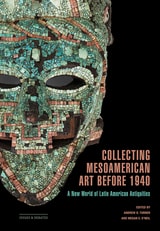
Collecting Mesoamerican Art before 1940
A New World of Latin American AntiquitiesAndrew D. Turner
J. Paul Getty Trust, The, 2024
This book traces the fascinating history of how and why ancient Mesoamerican objects have been collected. It begins with the pre-Hispanic antiquities that first entered European collections in the sixteenth century as gifts or seizures, continues through the rise of systematic collecting in Europe and the Americas during the nineteenth and twentieth centuries, and ends in 1940—the start of Europe’s art market collapse at the outbreak of World War II and the coinciding genesis of the large-scale art market for pre-Hispanic antiquities in the United States.
Drawing upon archival resources and international museum collections, the contributors analyze the ways shifting patterns of collecting and taste—including how pre-Hispanic objects changed from being viewed as anthropological and scientific curiosities to collectible artworks—have shaped modern academic disciplines as well as public, private, institutional, and nationalistic attitudes toward Mesoamerican art. As many nations across the world demand the return of their cultural patrimony and ancestral heritage, it is essential to examine the historical processes, events, and actors that initially removed so many objects from their countries of origin.
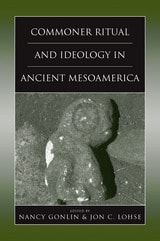
Commoner Ritual and Ideology in Ancient Mesoamerica
Nancy Gonlin
University Press of Colorado, 2016
This volume explores the ritual life of Mesoamerica's common citizens, inside and outside of the domestic sphere, from Formative through Postclassic periods. Building from the premise that ritual and ideological expression inhered at all levels of society in Mesoamerica, the contributors demonstrate that ideology did not emanate solely from exalted individuals and that commoner ritual expression was not limited to household contexts. Taking an empirical approach to this under-studied and under-theorized area, contributors use material evidence to discover how commoner status conditioned the expression of ideas and values.
Revealing complex social hierarchies that varied across time and region, this volume offers theoretical approaches to commoner ideology, religious practice, and sociopolitical organization and builds a framework for future study of the correlation of ritual and ideological expression with social position for Mesoamericanists and archaeologists worldwide.
Cueva Blanca
Social Change in the Archaic of the Valley of OaxacaKent V. Flannery and Frank Hole
University of Michigan Press, 2019
Culture Change and Shifting Populations in Central Northern Mexico
William B. Griffen
University of Arizona Press, 1969