Results by title
63 books match the query 'Indigenous Languages in the Americas' and 7 start with c
Caddoan Texts
Douglas R. Parks
University of Chicago Press Journals, 1977
Comanche Vocabulary
Trilingual EditionCompiled by Manuel García Rejón
University of Texas Press, 1995
The Comanche Vocabulary collected in Mexico during the years 1861-1864 by Manuel García Rejón is by far the most extensive Comanche word list compiled before the establishment of the Kiowa-Comanche-Apache Reservation in 1867. It preserves words and concepts that have since changed or even disappeared from the language, thus offering a unique historical window on earlier Comanche culture.
This translation adds the English equivalents to the original Spanish-Comanche list of 857 words, as well as a Comanche-English vocabulary and comparisons with later Comanche word lists. Daniel J. Gelo's introduction discusses the circumstances in which García Rejón gathered his material and annotates significant aspects of the vocabulary in light of current knowledge of Comanche language and culture. The book also includes information on pictography, preserving a rare sample of Comanche scapula drawing.
This information will help scholars understand the processes of language evolution and cultural change that occurred among all Native American peoples following European contact. The Comanche Vocabulary will also hold great interest for the large public fascinated by this once-dominant tribe.
Concise Dictionary of Minnesota Ojibwe
John Nichols
University of Minnesota Press, 1994
The most up-to-date resource for those interested in the linguistic and cultural heritage of the Anishinaabe, A Concise Dictionary of Minnesota Ojibwe contains more than 7,000 of the most frequently used Ojibwe words. Presented in Ojibwe-English and English-Ojibwe sections, this dictionary spells words to reflect their actual pronunciation with a direct match between the letters used and the speech sounds of Ojibwe. It contains many ancient words and meanings as well as language added in the twentieth century.
Most entries give several sample inflected forms such as the plural, diminutive, and locative forms of nouns and first person and participle forms of verbs. The basic patterns of Ojibwe word structure and the organization of the dictionary entries are clearly explained in the introduction. The most widely used modern standard writing system for Ojibwe is used throughout, and some of the key objects of Ojibwe life are authentically illustrated by coauthor and artist Earl Nyholm.Acknowledged as one of the three largest Native American languages, Ojibwe is spoken in many local varieties in the Upper Midwest and across Central and Eastern Canada. Minnesota Ojibwe is spoken in Central and Northern Minnesota, and is very similar to the Ojibwe spoken in the Ontario-Minnesota border region, Wisconsin, and Michigan's Upper Peninsula. A Concise Dictionary of Minnesota Ojibwe is an essential reference for all students of Ojibwe culture, history, language, and literature.
Coyote Stories
Edited by William Bright
University of Chicago Press Journals, 1978
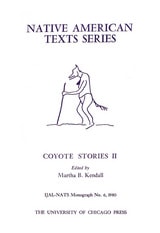
Coyote Stories II
Edited by Martha B. Kendall
University of Chicago Press Journals, 1980
Cree Legends and Narratives from the West Coast of James Bay
Simeon Scott
University of Manitoba Press, 1995
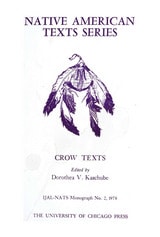
Crow Texts
Dorothea Kaschube
University of Chicago Press Journals, 1978