Results by title
124 books match the query 'Information technology' and 10 start with c

Chasing Literacy
Reading and Writing in an Age of AccelerationDaniel Keller
Utah State University Press, 2013
Employing case-study research of student reading practices, Keller explores reading-writing connections in new media contexts. He identifies a culture of acceleration—a gathering of social, educational, economic, and technological forces that reinforce the values of speed, efficiency, and change—and challenges educators to balance new “faster” literacies with traditional “slower” literacies. In addition, Keller details four significant features of contemporary literacy that emerged from his research: accumulation and curricular choices; literacy perceptions; speeds of rhetoric; and speeds of reading.
Chasing Literacy outlines a new reading pedagogy that will help students gain versatile, dexterous approaches to both reading and writing and makes a significant contribution to this emerging area of interest in composition theory and practice.
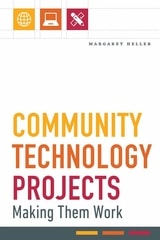
Community Technology Projects
Making Them WorkMargaret Heller
American Library Association, 2019

Computers, Surveillance, and Privacy
David Lyon and Elia Zureik, Editors
University of Minnesota Press, 1996
Computers, Surveillance, and Privacy was first published in 1996. Minnesota Archive Editions uses digital technology to make long-unavailable books once again accessible, and are published unaltered from the original University of Minnesota Press editions.
From computer networks to grocery store checkout scanners, it is easier and easier for governments, employers, advertisers, and individuals to gather detailed and sophisticated information about each of us. In this important new collection, the authors question the impact of these new technologies of surveillance on our privacy and our culture.
Although surveillance-literally some people "watching over" others-is as old as social relationships themselves, with the advent of the computer age this phenomenon has acquired new and distinctive meanings. Technological advances have made it possible for surveillance to become increasingly global and integrated-both commercial and government-related personal data flows more frequently across national boundaries, and the flow between private and public sectors has increased as well.
Addressing issues of the global integration of surveillance, social control, new information technologies, privacy violation and protection, and workplace surveillance, the contributors to Computers, Surveillance, and Privacy grapple with the ramifications of these concerns for society today. Timely and provocative, this collection will be of vital interest to anyone concerned with resistance to social control and incursions into privacy.
Contributors: Jonathan P. Allen, Colin J. Bennett, Simon G. Davies, Oscar H. Gandy Jr., Calvin C. Gotlieb, Rob Kling, Gary T. Marx, Abbe Mowshowitz, Judith A. Perrolle, Mark Poster, Priscilla M. Regan, James B. Rule.
David Lyon is professor of sociology at Queen's University, Canada. His previous books include The Electronic Eye: The Rise of Surveillance Society (Minnesota, 1994). Elia Zureik is also professor of sociology at Queen's University, Canada, and coedited (with Dianne Hartling) The Social Context of the New Information and Communication Technologies (1987).
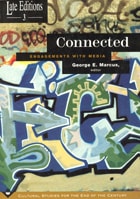
Connected
Engagements with MediaEdited by George E. Marcus
University of Chicago Press, 1996
Connected, the third volume in the groundbreaking and highly acclaimed Late Editions series, confronts these provocative questions through unique experiments with the interview format. It explores both the new pathways being forged through media and the predicaments of those struggling to find their way in the twilight of the twentieth century.

Core Tech Competencies for Librarians and Library Staff
American Library Association, 2009

Crip Screens
Countering Psychiatric Media TechnologiesOlivia Banner
Duke University Press, 2025

Cyber-Marx
Cycles and Circuits of Struggle in High Technology CapitalismNick Dyer-Witheford
University of Illinois Press, 1999
Dyer-Witheford maps the dynamics of modern capitalism, showing how capital depends for its operations not just on exploitation in the immediate workplace, but on the continuous integration of a whole series of social sites and activities, from public health and maternity to natural resource allocation and the geographical reorganization of labor power. He also shows how these sites and activities may become focal points of subversion and insurgency, as new means of communication vital for the smooth flow of capital also permit otherwise isolated and dispersed points of resistance to connect and combine with one another.
Cutting through the smokescreen of high-tech propaganda, Dyer-Witheford predicts the advent of a reinvented, "autonomist" Marxism that will rediscover the possibility of a collective, communist transformation of society. Refuting the utopian promises of the information revolution, he discloses the real potentialities for a new social order in the form of a twenty-first-century communism based on the common sharing of wealth.

Cyber-Proletariat
Global Labour in the Digital VortexNick Dyer-Witheford
Pluto Press, 2015
Cyber-Proletariat brings Marxist analysis to bear on a range of modern informational technologies. The result is a book indispensable to social theorists and hacktivists alike and essential reading for anyone who wants to understand how Silicon Valley shapes the way we live today.
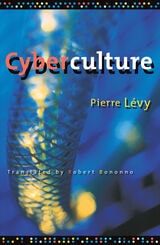
Cyberculture
Pierre Levy
University of Minnesota Press, 2001
A clear explanation and provocative look at the impact of new technologies on world society.
Needing guidance and seeking insight, the Council of Europe approached Pierre Lévy, one of the world’s most important and well-respected theorists of digital culture, for a report on the state (and, frankly, the nature) of cyberspace. The result is this extraordinary document, a perfectly lucid and accessible description of cyberspace—from infrastructure to practical applications-along with an inspired, far-reaching exploration of its ramifications. A window on the digital world for the technologically timid, the book also offers a brilliant vision of the philosophical and social realities and possibilities of cyberspace for the adept and novice alike.
In an overview, Lévy discusses the distinguishing features of cyberspace and cyberculture from anthropological, philosophical, cultural, and sociological points of view. An optimist about the future potential of cyberspace, he eloquently argues that technology—and specifically the infrastructure of cyberspace, the Internet—can have a transformative effect on global society. Some of the issues he takes up are new art forms; changes in relationships to knowledge, education, and training; the preservation of linguistic and cultural differences; the emergence and implications of collective intelligence; the problems of social exclusion; and the impact of new technology on the city and democracy in general. In considerable detail, Lévy describes the ways in which cyberspace will help promote the growth of democracy, primarily through the participation of individuals or groups. His analysis is enlivened by his own personal impressions of cyberculture—garnered from bulletin boards, mailing lists, virtual reality demonstrations, and simulations. Immediate in its details, visionary in its scope, deeply informed yet free of unnecessary technical language, Cyberculture is the book we require in our digital age.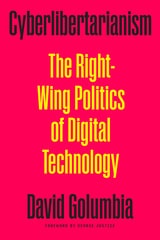
Cyberlibertarianism
The Right-Wing Politics of Digital TechnologyDavid Golumbia
University of Minnesota Press, 2024
An urgent reckoning with digital technology’s fundamentally right-wing legal and economic underpinnings
In a timely challenge to the potent political role of digital technology, Cyberlibertarianism argues that right-wing ideology was built into both the technical and social construction of the digital world from the start. Leveraging more than a decade of research, David Golumbia traces how digital evangelism has driven the worldwide shift toward the political right, concealing inequality, xenophobia, dishonesty, and massive corporate concentrations of wealth and power beneath the utopian presumption of digital technology as an inherent social good.
Providing an incisive critique of the push for open access and open-source software and the legal battles over online censorship and net neutrality, Cyberlibertarianism details how the purportedly democratic internet has been employed as an organizing tool for terror and hate groups and political disinformation campaigns. As he unpacks our naively utopian conception of the digital world, Golumbia highlights technology’s role in the advancement of hyperindividualist and antigovernment agendas, demonstrating how Silicon Valley corporations and right-wing economists; antiestablishment figures such as Julian Assange, Elon Musk, Peter Thiel, Edward Snowden, and Mark Zuckerberg; and seemingly positive voices such as John Perry Barlow, Cory Doctorow, the Electronic Freedom Foundation, and Wikipedia all have worked to hamper regulation and weaken legal safeguards against exploitation.
Drawing from a wide range of thought in digital theory, economics, law, and political philosophy as well as detailed research and Golumbia’s own experience as a software developer, Cyberlibertarianism serves as a clarion call to reevaluate the fraught politics of the internet. In the hope of providing a way of working toward a more genuinely democratic and egalitarian future for digital technology, this magisterial work insists that we must first understand the veiled dogmas from which it has been constructed.
Retail e-book files for this title are screen-reader friendly.