Results by title
593 books match the query 'Jews' and 31 start with c
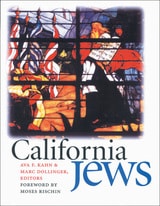
California Jews
Edited by Ava F. Kahn and Marc Dollinger
Brandeis University Press, 2011
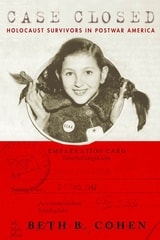
Case Closed
Holocaust Survivors in Postwar AmericaCohen, Beth B
Rutgers University Press, 2006
Case Closed challenges the prevailing optimistic perception of the lives of Holocaust survivors in postwar America by scrutinizing their first years through the eyes of those who lived it. The facts brought forth in this book are supported by case files recorded by Jewish social service workers, letters and minutes from agency meetings, oral testimonies, and much more.
Cohen explores how the Truman Directive allowed the American Jewish community to handle the financial and legal responsibility for survivors, and shows what assistance the community offered the refugees and what help was not available. She investigates the particularly difficult issues that orphan children and Orthodox Jews faced, and examines the subtleties of the resettlement process in New York and other locales. Cohen uncovers the truth of survivors' early years in America and reveals the complexity of their lives as "New Americans."
Catholics and Jews in Twentieth-Century America
Egal Feldman
University of Illinois Press, 2006
Focusing primarily on the Catholic doctrinal view of the Jews and its ramifications, Egal Feldman traces the historicalroots of anti-Semitism, examining tenacious Catholic beliefsincluding the idea that the Jews lost their place as the chosen people with the coming of Christianity, deicide, and the conviction that their purported responsibility for the Crucifixion justified subsequent Jewish misery.
A new era of Catholic-Jewish relations opened in 1962 with Vatican II’s Declaration on the Jews, reversing the theology of contempt. Feldman explores the strides made in improving relations, such as the Vatican’s diplomatic recognition of the Jewish state, as well as a number of recent issues.
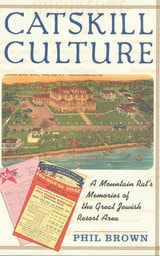
Catskill Culture
A Mountain Rat'S Memories OfPhil Brown
Temple University Press, 2003
Born to a small hotel-owning family who worked for decades in hotels after losing their own, Phil Brown tells a story of the many elements of this magical environment. His own waiter's tales, his mother's culinary exploits as a chef, and his father's jobs as maitre d' and coffee shop operator offer a backdrop to the vital life of Catskills summers. Catskill Culture recounts the life of guests, staff, resort owners,entertainers, and local residents through the author's memories and archival research and the memories of 120 others.
The Catskills resorts shaped American Jewish culture, enabling Jews to become more American while at the same time introducing the American public to immigrant Jewish culture. Catskills entertainment provided the nation with a rich supply of comedians, musicians, and singers. Legions of young men and women used the Catskills as a springboard to successful careers and marriages.
A decline for the resort area beginning in the 1970s has led to many changes. Today most of the hotels and bungalow colonies are gone or in ruins, while other communities, notably those of the Hasidim, have appeared. The author includes an appendix listing over 900 hotels he has been able to document and invites readers to contact him with additional entries.
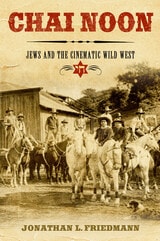
Chai Noon
Jews and the Cinematic Wild WestJonathan L. Friedmann
University of Wisconsin Press, 2025
This volume joins other reconsiderations of outsider and minority representations in Westerns to offer a more nuanced view of the genre. Friedmann engages with larger themes of Jewish identity in popular film, including depictions of race, ethnicity, and foreignness. He also identifies similar concerns within the invention and creation of the imaginary West writ large in American culture. The juxtapositions prove to be both unexpected and intuitively understandable.
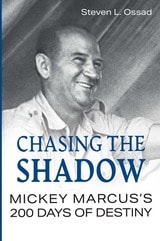
Chasing the Shadow
Mickey Marcus's 200 Days of DestinySteven L. Ossad
University of Missouri Press, 2024
The life of David “Mickey” Marcus has become the stuff of legends and myths (even fantasy), conspiracy, wild exaggeration, and untethered embellishment. The image of Marcus cast by the character portrayed by Kirk Douglas in the film version of his life still dominates most evocations of the man, for good or ill. And these days, reactions to the book or film rest mostly on the current headlines rather than the historical context of the struggle in which Marcus died, or the events that cast him as a real-life player in an event marked by destiny.
Chasing the Shadow: Mickey Marcus’s 200 Days of Destiny is the first comprehensive and balanced biography of David Daniel “Mickey” Marcus, a founder of American Civil Affairs and Military Government doctrine and practice and a seminal figure in early Israeli military history. Far from merely a tribute to Mickey Marcus's legacy, Ossad’s work serves as a critical tool for understanding the realities of mid-20th-century warfare in a Postwar colonial struggle and the dynamics of U.S.-Israeli military and political relations in 1948, the critical year for Israel’s struggle for independence. Indeed, Chasing the Shadow is a valuable read for those interested in Middle East history, Jewish military history, and a fascinating character whose story is told in an engaging, informative, and insightful narrative.
Checkbook Zionism
Philanthropy and Power in the Israel-Diaspora RelationshipEric Fleisch
Rutgers University Press, 2024
By delving into the history of American Jews’ philanthropic giving to Israelis, Fleisch assesses the core nature of power sharing between both sides of the Jewish diaspora to the United States through in-depth contemporary case studies of the relationship between sixteen non-governmental organizations and their American Jewish donors. Field observation, document analysis, and interviews with leaders, activists, and select donors alike serve a critical role here, as Fleisch assesses whether these contemporary philanthropic associations repeat classic dynamics of power-sharing or whether they represent a marked departure from the Checkbook Zionism of old. The result is a new paradigm for evaluating power sharing that can be applied to future considerations of development in the Israel-Diaspora relationship.
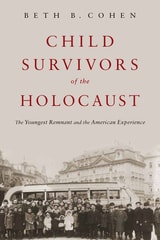
Child Survivors of the Holocaust
The Youngest Remnant and the American ExperienceCohen, Beth B
Rutgers University Press, 2018
The majority of European Jewish children alive in 1939 were murdered during the Holocaust. Of 1.5 million children, only an estimated 150,000 survived. In the aftermath of the Shoah, efforts by American Jews brought several thousand of these child survivors to the United States. In Child Survivors of the Holocaust, historian Beth B. Cohen weaves together survivor testimonies and archival documents to bring their story to light. She reveals that even as child survivors were resettled and “saved,” they struggled to adapt to new lives as members of adoptive families, previously unknown American Jewish kin networks, or their own survivor relatives. Nonetheless, the youngsters moved ahead. As Cohen demonstrates, the experiences both during and after the war shadowed their lives and relationships through adulthood, yet an identity as “survivors” eluded them for decades. Now, as the last living link to the Holocaust, the voices of Child Survivors are finally being heard.

China Dreams
Growing Up Jewish in TientsinIsabelle Maynard
University of Iowa Press, 1996
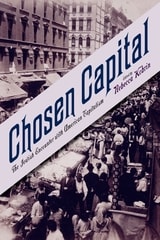
Chosen Capital
The Jewish Encounter with American CapitalismKobrin, Rebecca
Rutgers University Press, 2012
Surveying such diverse topics as Jews’ participation in the real estate industry, the liquor industry, and the scrap metal industry, as well as Jewish political groups and unions bent on reforming American capital, such as the American Labor Party and the International Ladies’ Garment Workers’ Union, contributors to this volume provide a new prism through which to view the Jewish encounter with America. The volume also lays bare how American capitalism reshaped Judaism itself by encouraging the mass manufacturing and distribution of foods like matzah and the transformation of synagogue cantors into recording stars. These essays force us to rethink not only the role Jews played in American economic development but also how capitalism has shaped Jewish life and Judaism over the course of the twentieth century.
Contributors:
Marni Davis, Georgia State University
Phyllis Dillon, independent documentary producer, textile conservator, museum curator
Andrew Dolkart, Columbia University
Andrew Godley, Henley Business School, University of Reading
Jonathan Karp, executive director, American Jewish Historical Society
Daniel Katz, Empire State College, State University of New York
Ira Katznelson, Columbia University
David S. Koffman, New York University
Eli Lederhendler, Hebrew University, Jerusalem
Jonathan Z. S. Pollack, University of Wisconsin—Madison
Jonathan D. Sarma, Brandeis University
Jeffrey Shandler, Rutgers University
Daniel Soyer, Fordham University
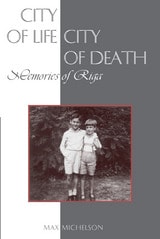
City of Life, City of Death
Memories of RigaMax Michelson
University Press of Colorado, 2001
Michelson had a serene boyhood in an upper middle-class Jewish family in Riga, Latvia--at least until 1940, when the fifteen-year old Michelson witnessed the annexation of Latvia by the Soviet Union. Private properties were nationalized, and Stalin's terror spread to Soviet Latvia. Soon after, Michelson's family was torn apart by the 1941 Nazi invasion of the Soviet Union. He quickly lost his entire family, while witnessing the unspeakable brutalities of war and genocide.
Michelson's memoir is an ode to his lost family; it is the speech of their muted voices and a thank you for their love. Although badly scarred by his experiences, like many other survivors he was able to rebuild his life and gain a new sense of what it means to be alive.
His experiences will be of interest to scholars of both the Holocaust and Eastern European history, as well as the general reader.
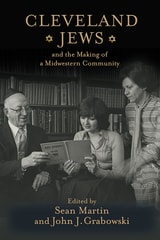
Cleveland Jews and the Making of a Midwestern Community
Sean Martin
Rutgers University Press, 2020
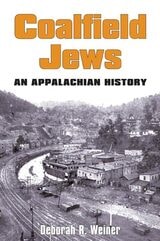
Coalfield Jews
An Appalachian HistoryDeborah R. Weiner
University of Illinois Press, 2006
The stories of vibrant eastern European Jewish communities in the Appalachian coalfields
Coalfield Jews explores the intersection of two simultaneous historic events: central Appalachia’s transformative coal boom (1880s-1920), and the mass migration of eastern European Jews to America. Traveling to southern West Virginia, eastern Kentucky, and southwestern Virginia to investigate the coal boom’s opportunities, some Jewish immigrants found success as retailers and established numerous small but flourishing Jewish communities.
Deborah R. Weiner’s Coalfield Jews provides the first extended study of Jews in Appalachia, exploring where they settled, how they made their place within a surprisingly receptive dominant culture, how they competed with coal company stores, interacted with their non-Jewish neighbors, and maintained a strong Jewish identity deep in the heart of the Appalachian mountains. To tell this story, Weiner draws on a wide range of primary sources in social, cultural, religious, labor, economic, and regional history. She also includes moving personal statements, from oral histories as well as archival sources, to create a holistic portrayal of Jewish life that will challenge commonly held views of Appalachia as well as the American Jewish experience.
Coming of Age in Jewish America
Bar and Bat Mitzvah ReinterpretedPatricia Keer Munro
Rutgers University Press, 2016
Commentary In American Life
edited by Murray Friedman
Temple University Press, 2005

Communal Solidarity
Immigration, Settlement, and Social Welfare in Winnipeg's Jewish Community, 1882–1930Arthur Ross
University of Manitoba Press, 2019
Comparing Jewish Societies
Todd M. Endelman, Editor
University of Michigan Press, 1997
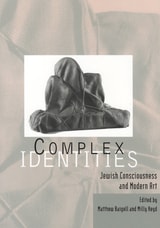
Complex Identities
Jewish Consciousness and Modern ArtBaigell, Matthew
Rutgers University Press, 2001
Complex Identities is a joint effort by American and Israeli scholars who ask challenging questions about art as formed by society and ethnicity. Focusing on nineteenth– and twentieth–century European, American, and Israeli artists, the contributors delve into the many ways in which Jewish artists have responded to their Jewishness and to the societies in which they lived, and how these factors have influenced their art, their choice of subject matter, and presentation of their work.
The contributions reflect a broad range of contemporary art criticism drawn from the history of art, culture, and literature. By analyzing how Jewish experiences have depicted and shaped art, the collection begins to answer how art, in its turn, depicts and shapes Jewish experience. An introduction by the volume editors unifies the essays and gives a historical overview.
Confronting the Nation
Jewish and Western NationalismGeorge L. Mosse
University of Wisconsin Press, 2024
Mosse considers a broad range of topics, from Nazi book burnings to Americans’ search for unifying national symbols during the Great Depression, exploring how the development of particular modes of art, architecture, and mass movements served nationalist agendas by dictating who was included in the image of the nation. These essays retain their significance today in their examination of the cultural and social implications of contemporary nationalism. A new critical introduction by Shulamit Volkov, professor emerita of history at Tel Aviv University, situates Mosse’s analysis within its historiographical context.
Contours of Israeli Politics
Jewish Ethnicity, Religious Nationalism, and DemocracyHannah M. Ridge
Temple University Press, 2025
The timely Contours of Israeli Politics focuses on the socio-political ramifications of this hierarchy within the upper stratum of Israeli society. Using public opinion studies and qualitative data, Hannah Ridge examines the effects of this social hierarchy to address attitudes on Israeli ethnicity and religious majoritarianism, support for Israeli democracy, and preference for an expanded territorial state and peace with its neighbors.
As various Jewish ethnic groups face greater pressure to assert their in-group membership (their Jewishness), they are more likely to protect the status privileges of that group. This can strengthen their ideas about identity, nationalism, democratic values, and conflict attitudes. Ridge’s findings reveal the ways in which Jewish ethnicity continues to influence the politics of Israel, a Jewish ethno-religious state.
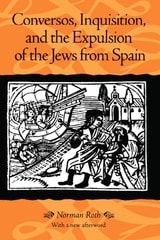
Conversos, Inquisition, and the Expulsion of the Jews from Spain
Norman Roth
University of Wisconsin Press, 2002
The Jewish community of medieval Spain was the largest and most important in the West for more than a thousand years, participating fully in cultural and political affairs with Muslim and Christian neighbors. This stable situation began to change in the 1390s, and through the next century hundreds of thousands of Jews converted to Christianity. Norman Roth argues here with detailed documentation that, contrary to popular myth, the conversos were sincere converts who hated (and were hated by) the remaining Jewish community. Roth examines in depth the reasons for the Inquisition against the conversos, and the eventual expulsion of all Jews from Spain.
“With scrupulous scholarship based on a profound knowledge of the Hebrew, Latin, and Spanish sources, Roth sets out to shatter all existing preconceptions about late medieval society in Spain.”—Henry Kamen, Journal of Ecclesiastical History
“Scholarly, detailed, researched, and innovative. . . . As the result of Roth’s writing, we shall need to rethink our knowledge and understanding of this period.”—Murray Levine, Jewish Spectator
“The fruit of many years of study, investigation, and reflection, guaranteed by the solid intellectual trajectory of its author, an expert in Jewish studies. . . . A contribution that will be particularly valuable for the study of Spanish medievalism.”—Miguel Angel Motis Dolader, Annuario de Estudios Medievales
Cornerstones of Peace
Jewish Identity Politics and Democratic TheoryBrettschneider, Marla
Rutgers University Press, 1996
Throughout the seventies, the idea of being “pro-Israel” was traditionally equated with support for the Israeli government and was central to an understanding of American Jewish identity. It was so central, argues Marla Brettschneider, that even committed activists who took issue with such a monolithic stance were silenced by mainstream Jewish organizations. But during the 1980s, a change took place. An explosion of new Jewish groups intent on challenging the dominant definition of the pro-Israel attitude transformed an increasingly closed Jewish community into one more democratic and inclusive.
In Cornerstones of Peace, Marla Brettschneider skillfully combines a lucid review of contemporary Liberal political theory and its understanding of the role of groups in the political process, a sophisticated analysis of Hobbesian philosophy, and a rich history of “alternative” Jewish activist groups like Breira and Americans for Peace Now (APN) to ask: What can we learn about identity and democratic theory from the changes that have taken place in the Jewish community? Through an insightful exploration of how small, activist groups have reclaimed pro-Israel identity politics as a collective multilayered process, Brettschneider adds her voice to the growing number of political theorists envisioning a pro-diversity alternative to Liberal political thought. She theorizes about a new democratic theory, showing theorists and activists how to envision and enact more vibrant, inclusive democratic politics.
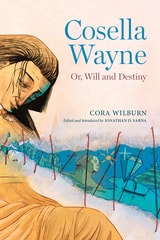
Cosella Wayne
Or, Will and DestinyCora Wilburn, edited and introduced by Jonathan D. Sarna
University of Alabama Press, 2019
Published serially in the spiritualist journal Banner of Light in 1860, Cosella Wayne: Or, Will and Destiny is the first coming-of-age novel, written and published in English by an American Jewish woman, to depict Jews in the United States and transforms what we know about the history of early American Jewish literature. The novel never appeared in book form, went unmentioned in Jewish newspapers of the day, and studies of nineteenth-century American Jewish literature ignore it completely. Yet the novel anticipates many central themes of American Jewish writing: intermarriage, generational tension, family dysfunction, Jewish-Christian relations, immigration, poverty, the place of women in Jewish life, the nature of romantic love, and the tension between destiny and free will.
The narrative recounts a relationship between an abusive Jewish father and the rebellious daughter he molested as well as that daughter’s struggle to find a place in the complex social fabric of nineteenth-century America. It is also unique in portraying such themes as an unmarried Jewish woman’s descent into poverty, her forlorn years as a starving orphaned seamstress, her apostasy and return to Judaism, and her quest to be both Jewish and a spiritualist at one and the same time.
Jonathan Sarna, who introduces the volume, discovered Cosella Wayne while pursuing research at the Israel Institute for Advanced Studies in Jerusalem. This edition is supplemented with selections from Cora Wilburn’s recently rediscovered diary, which are reprinted in the appendix. Together, these materials help to situate Cosella Wayne within the life and times of one of nineteenth-century American Jewry’s least known and yet most prolific female authors.
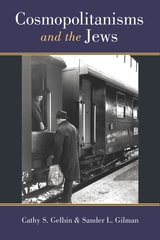
Cosmopolitanisms and the Jews
Cathy S. Gelbin and Sander L. Gilman
University of Michigan Press, 2017

Cosmopolitans and Parochials
Modern Orthodox Jews in AmericaSamuel C. Heilman and Steven M. Cohen
University of Chicago Press, 1989
Heilman and Cohen reveal that American Jewish Orthodoxy is not a monolith by distinguishing its three broad varieties: the "traditionalists," the "centrists," and the "nominally" orthodox. To illuminate this full spectrum of orthodoxy the authors focus on the "centrists," taking us through the dimensions of their ritual observances, religious beliefs, community life, and their social, political, and sexual attitudes. Both parochial and cosmopolitan, orthodox and liberal, these Jews are characterized by their dualism, by their successful involvement in both the modern Western world and in traditional Jewish culture. In painting this provocative and fascinating portrait of what Jewish Orthodoxy has become in America today, Heilman and Cohen's study also sheds light on the larger picture of the persistence of religion in the modern world.
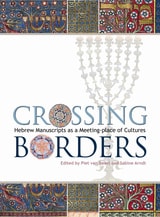
Crossing Borders
Hebrew Manuscripts as a Meeting-place of CulturesEdited by Piet van Boxel and Sabine Arndt
Bodleian Library Publishing, 2010
Crossing Borders tells the intriguing but largely unfamiliar story of the exchange of culture and knowledge between Jews and non-Jews in the Muslim and Christian worlds during the late Middle Ages as part of the preparation of Hebrew manuscripts. The book is composed of ten narratives, each of which brings to light a different aspect of Jewish life in a non-Jewish medieval society—highlighting the practical cooperation, social interaction, and religious toleration that was surprisingly common between the groups involved in the early enterprise of book production.
Alongside the narratives, Crossing Borders is beautifully illustrated with images from the Hebrew holdings at the Bodleian Library—one of the largest and most important collections of Hebrew manuscripts worldwide. The art includes Christian codex fragments from the third century, a copy of Moses Maimonides’ Mishneh Torah signed by Maimonides himself, a thirteenth century German Jewish prayer book, and lavishly illuminated Spanish Bible manuscripts from the fifteenth century. This exquisitely illustrated book takes a fascinating look at the often-ignored role of Jews in the written transmission of culture and science throughout medieval Europe.
Crossing Cultures
Creating Identity in Chinese and Jewish American LiteratureJudith Oster
University of Missouri Press, 2003
Crossing the River
Shalom Eilati
University of Alabama Press, 2009
A child’s journey through war, memory, and survival—told with haunting clarity and poetic grace.
Crossing the River is a personal memoir—and more. Against the backdrop of Lithuania’s occupation—first by the Red Army, next by the Germans, and then again by the Russians—it is a story reflected through the prism of a sharp-eyed young child, Shalom Eilati. His story starts in the occupied Kovno Ghetto and ends with his flight across the Soviet border, through Poland and Germany and finally, his arrival in Palestine.
The adult survivor, while recalling the terrorized child that he was and how he then perceived the adult world, also takes stock of his present life. Throughout the memoir, Eilati attempts to reconcile his present life as a husband, father, scientist, and writer, with the images, feelings, and thoughts from the past that have left an indelible mark on his life and that continue to haunt him.
Cultural Disjunctions
Post-Traditional Jewish IdentitiesPaul Mendes-Flohr
University of Chicago Press, 2021
Cultural Genocide
Davidson, Lawrence
Rutgers University Press, 2012
Most scholars of genocide focus on mass murder. Lawrence Davidson, by contrast, explores the murder of culture. He suggests that when people have limited knowledge of the culture outside of their own group, they are unable to accurately assess the alleged threat of others around them. Throughout history, dominant populations have often dealt with these fears through mass murder. However, the shock of the Holocaust now deters today’s great powers from the practice of physical genocide. Majority populations, cognizant of outside pressure and knowing that they should not resort to mass murder, have turned instead to cultural genocide as a “second best” politically determined substitute for physical genocide.
In Cultural Genocide, this theory is applied to events in four settings, two events that preceded the Holocaust and two events that followed it: the destruction of American Indians by uninformed settlers who viewed these natives as inferior and were more intent on removing them from the frontier than annihilating them; the attack on the culture of Eastern European Jews living within Russian-controlled areas before the Holocaust; the Israeli attack on Palestinian culture; and the absorption of Tibet by the People’s Republic of China.
In conclusion, Davidson examines the mechanisms that may be used to combat today’s cultural genocide as well as the contemporary social and political forces at work that must be overcome in the process.
Cultural Revolution in Berlin
Jews in the Age of EnlightenmentShmuel Feiner and Natalie Naimark-Goldberg
Bodleian Library Publishing, 2011