Results by title
108 books match the query 'Knowledge and learning' and 11 start with c
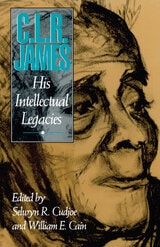
C.L.R. James
His Intellectual LegaciesEdited by Selwyn R. Cudjoe and William E. Cain
University of Massachusetts Press, 1995
C.L.R. James (1901–1989) made important contributions in a host of fields—literature, criticism, cultural studies, political theory, history, and philosophy. One of the most astute minds of this century, he served as mentor for two generations of international intellectuals. He contributed enormously to their understanding of the colonial question, the Negro question, the Russian question, the role of dialectics in proletarian struggle, and the theory and practice of Marxism in the Americas. In addition to The Black Jacobins, his incisive account of the Haitian revolution of the 1790s, and Notes on Dialectics, James published a range of other books, including a classic work on the game of cricket and a study of Herman Melville.
This collection of essays offers a variety of fresh perspectives on James's life and writings. Included are reminiscences of those who knew James well and critical essays by eminent scholars. The book is the first to offer a full treatment of James's many contributions to twentieth-century intellectual life.
Caliban's Curse
George Lamming and the Revisioning of HistorySupriya Nair
University of Michigan Press, 1996
Caliban's Curse draws upon a range of theories--postcolonial, Marxist, and feminist--to contextualize the black diaspora of the modern Caribbean through one of its primary anglophone novelists. Putting George Lamming in conversation with such contemporaries as C.L.R. James, Derek Walcott, and Wilson Harris, Nair argues that Lamming's works expand the protest of Shakespeare's Caliban to articulate a reinvention of Caribbean cultures. Both cursed by and cursing the weight of colonial history, Lamming works against the paralysis induced by such an encounter; his work serves to rewrite canonical icons and to reimagine popular cultures.
"Supriya Nair writes about the problems of history and social revolution with passion and clarity and an amazing range of critical and cultural reference. . . . She brings to existing studies of Lamming a wide and sustained knowledge of the forces that have shaped the West Indian novel, and the wider postcolonial debates in which these novels are read and discussed." --Simon Gikandi, University of Michigan
Supriya Nair is Associate Professor of English, Tulane University.
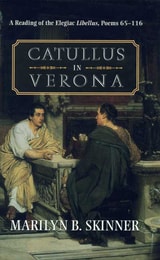
Catullus in Verona
A Reading of the Elegiac Libellus, Poems 65–116Marilyn B. Skinner
The Ohio State University Press, 2003
“Skinner’s Catullus in Verona . . . gives a dazzling demonstration of how even the seemingly over-familiar can yield fresh insights. Subtly interweaving old biographical platitudes and new literary theory, persona and person, she offers us a Catullus (sorry, construct of Catullus) faced with a public and private crisis of late Republican values—political, social, and literary—that forced him to abandon his neoteric models, to rethink all his relationships; plus a Lesbia, the ‘written woman,’ who here generates more semantic flux than heartbreak. Skinner’s readers, too, will end by rethinking a group of poems they thought they knew. This is no small achievement.” —Peter Green, The Times Literary Supplement
“This book is an important contribution to the study of Catullus, and more broadly to the study of Latin poetry. As an example of erudite scholarship and sensitive, supple criticism, I believe it will be of interest as well to a wider audience, including scholars and students working in other disciplines in the humanities.” —David Wray, assistant professor of classics, University of Chicago
Gaius Valerius Catullus is one of Rome’s greatest surviving poets and also one of the most popular Latin authors. Comprehensive treatments of his work have been hindered, however, by the problems posed by the Catullan collection as it has come down to us. Although many scholars now believe that Catullus did publish his verse in one or more small volumes (libelli), the theory that these books were rearranged after his death means that individual pieces continue to be read and analyzed separately, without reference to their placement within the collection. Skinner challenges this theory of posthumous editorship by offering a unified reading of Catullus’ elegiac poetry (poems 65–116 in our collection) and arguing that it constitutes what was once a separately circulated libellus whose authorial arrangement has been preserved intact. Purportedly issued from the poet’s native city, Verona, to his Roman readership, the volume presents itself as a valedictory.
This reading of the elegiac collection represents a major departure in Catullan studies. The methodological contention that Catullus’ elegiac poems are better approached as a single cohesive poetic statement makes this book a valuable new contribution to Catullan scholarship.
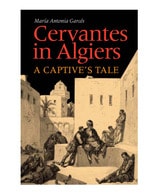
Cervantes in Algiers
A Captive's TaleMaria Antonia Garces
Vanderbilt University Press, 2005
No work has documented in such vivid and illuminating detail the socio-political world of sixteenth-century Algiers, Cervantes's life in the prison-house, his four escape attempts, and the conditions of his final ransom. Garces's portrait of a sophisticated multi-ethnic culture in Algiers, moreover, is likely to open up new discussions about early modern encounters between Christians and Muslims. By bringing together evidence from many different sources, historical and literary, Garces reconstructs the relations between Christians, Muslims, and renegades in a number of Cervantes's writings.
The idea that survivors of captivity need to repeat their story in order to survive (an insight invoked from Coleridge to Primo Levi to Dori Laub) explains not only Cervantes's storytelling but also the book that theorizes it so compellingly. As a former captive herself (a hostage of Colombian guerrillas), the author reads and listens to Cervantes with another ear.
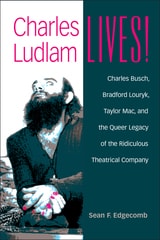
Charles Ludlam Lives!
Charles Busch, Bradford Louryk, Taylor Mac, and the Queer Legacy of the Ridiculous Theatrical CompanySean F. Edgecomb
University of Michigan Press, 2017
Author Sean F. Edgecomb focuses on the neo-Ridiculous artists Charles Busch, Bradford Louryk, and Taylor Mac to trace the connections between Ludlam’s legacy and their performances, using alternative queer models such as kinetic kinship, lateral historiography, and a new approach to camp. Charles Ludlam Lives! demonstrates that the queer legacy of Ludlam is one of distinct transformation—one where artists can reject faithful interpretations in order to move in new interpretive directions.
Chaucer and the Subject of History
Lee Patterson
University of Wisconsin Press, 1991
Renowned scholar of medieval literature, Lee Patterson, presents a compelling vision of the shape and direction of Geoffrey Chaucer’s entire career in Chaucer and the Subject of History.
Chaucer's interest in individuality was strikingly modern. At the same time he was profoundly aware of the pressures on individuality exerted by the past and by society—by history. This tension between the subject and history is Patterson's topic. He begins by showing how Chaucer’s understanding of history as a subject for poetry—a world to be represented and a cultural force affecting human action—began to take shape in his poems on classical themes, especially in Troilus and Criseyde. Patterson's extended analysis of this profound yet deeply conflicted exploration of the relationship between "history" and "the subject" provides the basis for understanding Chaucer's shift to his contemporary world in the Canterbury Tales. There, in the shrewdest and most wide-ranging analysis of late medieval society we possess, Chaucer investigated not just the idea of history but the historical world intimately related to his own political and literary career.
Patterson's chapters on individual tales clarify and confirm his provocative arguments. He shows, for example, how the Knight's Tale represents the contemporary crisis of governance in terms of a crisis in chivalric identity itself; how the Miller’s Tale reflects the social pressures and rhetoric of peasant movements generally and the Rising of 1381 in particular; and how the tales of the Merchant and Shipman register the paradoxical placement of a bourgeois class lacking class identity. And Patterson's brilliant readings of the Wife of Bath’s Tale—"the triumph of the subject"—and the Pardoner’s Tale —"the subject of confession"—reveal how Chaucer reworked traditional materials to accomplish stunning innovations that make visible unmistakably social meanings. Chaucer and the Subject of History is a landmark book, one that will shape the way that Chaucer is read for years to come.
Chaucer's Italian Tradition
Warren Ginsberg
University of Michigan Press, 2002
Because divergent political, municipal, and literary histories would have made the Italian cities--Genoa, Florence, and Milan--unfamiliar to an English poet from medieval London, Ginsberg argues that we must consider what Chaucer overlooked and mistook from his Italian models alongside the material he did appropriate. To make sense of premises in texts like Dante's Comedy that were peculiarly Italian, Chaucer would look to Boccaccio as a gloss; by reading these authors in conjunction with one another, Chaucer generates an "Italian tradition" that translates into the terms of his English experience works already mediated by a prior stage of transposition.
Ginsberg explores Chaucer's relationship to Italian poets not in terms of the interaction of individual talents with accredited authorities (Chaucer and Dante, Boccaccio and Petrarch, etc.). Rather, he focuses on the shifts in tension that occur when the civic engagements and disengagements of Florence's poets are brought into contact with Chaucer's growing metropolitanism and increasing reluctance to make London the locus of his poetic art.
Beyond its appeal to medievalists and those who study the Renaissance, Chaucer's Italian Tradition will be welcomed by readers interested in theoretical questions about translation and the development of tradition, including individuals who study history, literature, and the nature of the humanities.
Warren Ginsberg is Professor of English, University of Oregon.
Chekhov and Russian Religious Culture
Poetics of the Marian ParadigmJulie de Sherbinin
Northwestern University Press, 1997
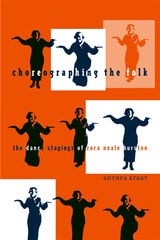
Choreographing the Folk
The Dance Stagings of Zora Neale HurstonAnthea Kraut
University of Minnesota Press, 2008
Recovers an important dimension of the work of the renowned African American artist
While Zora Neale Hurston and her 1937 novel Their Eyes Were Watching God have become widely celebrated, she was also a prolific stage director and choreographer. In the 1930s Hurston produced theatrical concerts that depicted a day in the life of a railroad work camp in Florida and featured a rousing Bahamian Fire Dance as the dramatic finale. In Choreographing the Folk, Anthea Kraut traces the significance and influence of Hurston’s little-known choreographic work.
Hurston’s concerts were concrete illustrations of the “real Negro art theatre” she was eager to establish, and they compellingly demonstrate how she used the arena of performance to advance a nuanced understanding of the black diaspora. Her version of the Fire Dance was staged in a variety of venues during the 1930s. In its multiple representations, Kraut asserts, the dance raised critical issues about ownership, artistry, and authenticity. Choreographing the Folk argues for the significance of Hurston’s choreography, and with perceptiveness, sensitivity, and originality, Kraut illuminates the important and often-contested place of black folk dance in American culture.
Creole Medievalism
Colonial France and Joseph Bédier’s Middle AgesMichelle R. Warren
University of Minnesota Press, 2010
In Creole Medievalism, Michelle Warren demonstrates that Bédier's relationship to this multicultural and economically peripheral colony motivates his nationalism in complex ways. Simultaneously proud of his French heritage and nostalgic for the island, Bédier defends French sovereignty based on an ambivalent resistance to his creole culture. Warren shows that in the early twentieth century, influential intellectuals from Réunion helped define the new genre of the "colonial novel," adopting a pro-colonial spirit that shaped both medieval and Francophone studies. Probing the work of a once famous but little understood cultural figure, Creole Medievalism illustrates how postcolonial France and Réunion continue to grapple with histories too varied to meet expectations of national unity.
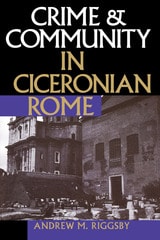
Crime and Community in Ciceronian Rome
By Andrew M. Riggsby
University of Texas Press, 1999
In the late Roman Republic, acts of wrongdoing against individuals were prosecuted in private courts, while the iudicia publica (literally "public courts") tried cases that involved harm to the community as a whole. In this book, Andrew M. Riggsby thoroughly investigates the types of cases heard by the public courts to offer a provocative new understanding of what has been described as "crime" in the Roman Republic and to illuminate the inherently political nature of the Roman public courts.
Through the lens of Cicero's forensic oratory, Riggsby examines the four major public offenses: ambitus (bribery of the electorate), de sicariis et veneficiis (murder), vis (riot), and repetundae (extortion by provincial administrators). He persuasively argues that each of these offenses involves a violation of the proper relations between the state and the people, as interpreted by orators and juries. He concludes that in the late Roman Republic the only crimes were political crimes.