Results by title
4030 books match the query 'Language Arts & Disciplines' and 283 start with c
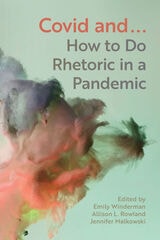
COVID and...
How to Do Rhetoric in a PandemicEmily Winderman
Michigan State University Press, 2023

Caldecott Fun
Poems, Songs, and Games with Caldecott WinnersNancy Polette
American Library Association, 2013

Calling All Cars
Radio Dragnets and the Technology of PolicingKathleen Battles
University of Minnesota Press, 2010
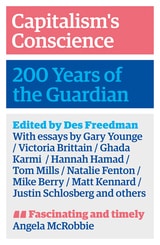
Capitalism's Conscience
200 Years of the GuardianDes Freedman
Pluto Press, 2021
Since its inception in Manchester in 1821 as a response to the 1819 Peterloo Massacre, the Guardian has been a key institution in the definition and development of liberalism. The stereotype of the 'Guardianista', an environmentally-conscious, Labour-voting, progressively-minded public sector worker endures in the popular mythology of British press history.
Yet the title has a complex lineage and occupies an equivocal position between capital and its opponents. It has both fiercely defended the need for fearless, independent journalism and handed over documents to the authorities; it has carved out a niche for itself in the UK media as a progressive voice but has also consistently diminished more radical projects on the left.
Published to coincide with its 200th anniversary, Capitalism's Conscience brings together historians, journalists and activists in an appraisal of the Guardian's contribution to British politics, society and culture - and its distinctive brand of centrism. Contextualising some of the main controversies in which the title has been implicated, the book offers timely insights into the publication's history, loyalties and political values.
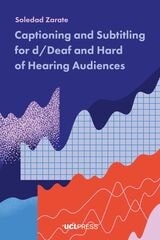
Captioning and Subtitling for d/Deaf and Hard of Hearing Audiences
Soledad Zárate
University College London, 2021
Captioning and Subtitling for d/Deaf and Hard of Hearing Audiences is a comprehensive guide to the theory and practice of captioning and subtitling, with examples and exercises at the end of each chapter. Analyzing the requirements of d/Deaf and hard of hearing audiences in detail, as well as treating the linguistic and technical considerations necessary for effective captioning, this volume will familiarize the reader with the characteristics, needs, and diversity of d/Deaf and hard of hearing audiences. Based on first-hand experience in the field, the book provides a step-by-step guide to making live performances accessible to d/Deaf and hard of hearing audiences. The guide will be valuable reading to students of audiovisual translation, professional subtitlers, and captioners, as well as any organization or venue that engages with d/Deaf and hard of hearing people.
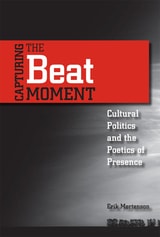
Capturing the Beat Moment
Cultural Politics and the Poetics of PresenceErik Mortenson
Southern Illinois University Press, 2010
CHOICE Outstanding Academic Title
Examining “the moment” as one of the primary motifs of Beat writing, Erik Mortenson offers the first book to investigate immediacy and its presence and importance in Beat writing. Capturing the Beat Moment: Cultural Politics and the Poetics of Presence places an expanded canon of Beat writers in an early postmodern context that highlights their importance in American poetics and provides an account of Beat practices that reveal how gender and race affect Beat politics of the moment.
Mortenson argues that Beat writers focused on action, desire, and spontaneity to establish an authentic connection to the world around them and believed that “living in the moment” was the only way in which they might establish the kind of life that led to good writing. With this in mind, he explores the possibility that, far from being the antithesis of their times, the Beats actually were a product of them. Mortenson outlines the effects of gender and race on Beat writing in the postwar years, as well as the Beats’ attempts to break free of the constrictive notions of time and space prevalent during the 1950s.
Mortenson discusses such topics as the importance of personal visionary experiences; the embodiment of sexuality and the moment of ecstasy in Beat writing; how the Beats used photographs to evoke the past; and the ways that Beat culture was designed to offer alternatives to existing political and social structures. Throughout the volume, Mortenson moves beyond the Kerouac-Ginsberg-Burroughs triumvirate commonly associated with Beat literature, discussing women—such as Diane di Prima, Janine Pommy Vega, and Joyce Johnson—and African American writers, including Bob Kaufman and Amiri Baraka. With the inclusion of these authors comes a richer understanding of the Beat writers’ value and influence in American literary history.
Cart's Top 200 Adult Books for Young Adults
Two Decades in ReviewMichael Cart
American Library Association, 2013
Case Marking and Grammatical Relations in Polynesian
By Sandra Chung
University of Texas Press, 1978
Case Marking and Grammatical Relations in Polynesian makes an outstanding contribution to both Polynesian and historical linguistics. It is at once a reference work describing Polynesian syntax, an investigation of the role of grammatical relations in syntax, and a discussion of ergativity, case marking, and other areas of syntactic diversity in Polynesian. In its treatment of the history of case marking in Polynesian, it attempts to specify what counts as evidence in syntactic reconstruction and how syntactic reanalysis progresses. It therefore represents a first step toward a general theory of syntactic change.
Chung first describes the basic syntax of the Polynesian languages, discussing Maori, Tongan, Samoan, Kapingamarangi, and Pukapukan in depth. She then presents an investigation of the grammatical relations of these languages and their relevance to syntax and shows that the syntax of all these languages—even those with ergative case marking—revolves around the familiar grammatical relations subject and direct object. Finally the book traces the historical development of the different case systems from their origins in Proto-Polynesian.
Case for Critical Literacy
A History of Reading in Writing StudiesAlice S. Horning
Utah State University Press, 2024
This book examines how college-level instruction reached this point and provides pedagogical strategies that writing instructors and teachers can use to address the problem. Alice Horning makes the case for the importance of critical reading in the teaching of writing with intentionality and imagination, while sharing glimpses of her own personal history with reading and writing. Horning provides the context for understanding what college faculty face in their classrooms and offers a history of critical literacy that explains why, to date, it has mostly neglected or ignored the diverse statuses of students’ reading challenges.
The Case for Critical Literacy explores actionable options to better meet students’ literacy needs. College and university faculty, especially writing instructors, will benefit from an understanding of what has happened in the field and what needs to change.
Cataloging Correctly for Kids
Michele Zwierski, Marilyn McCroskey, and Joanna F. Fountain
American Library Association, 2021
Cataloging library materials for children in the internet age has never been as challenging or as important. RDA: Resource Description and Access is now the descriptive standard, there are new ways to find materials using classifications, and subject heading access has been greatly enhanced by the keyword capabilities of today’s online catalogs. It’s the perfect moment to present a completely overhauled edition of this acclaimed bestseller. The new sixth edition guides catalogers, children’s librarians, and LIS students in taking an effective approach towards materials intended for children and young adults. Informed by recent studies of how children search, this handbook’s top-to-bottom revisions address areas such as
- how RDA applies to a variety of children’s materials, with examples provided;
- authority control, bibliographic description, subject access, and linked data;
- electronic resources and other non-book materials; and
- cataloging for non-English-speaking and preliterate children.
Cataloging Correctly for Kids
An Introduction to the ToolsSheila S. Intner
American Library Association, 2011
Cataloging Cultural Objects
A Guide to Describing Cultural Works and Their ImagesMurtha Baca
American Library Association, 2006
Cataloging and Managing Film and Video Collections
Colin Higgins
American Library Association, 2015
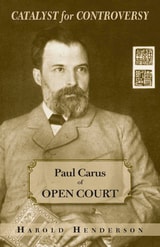
Catalyst for Controversy
Paul Carus of Open CourtHarold Henderson
Southern Illinois University Press, 2009
"I am not a common atheist; I am an atheist who loves God."—Paul Carus, "The God of Science," 1904
In the summer of 1880, while teaching at the military academy of the Royal Corps of Cadets of Saxony in Dresden, Paul Carus published a brief pamphlet denying the literal truth of scripture and describing the Bible as a great literary work comparable to the Odyssey.
This unremarkable document was Carus’s first step in a wide-ranging intellectual voyage in which he traversed philosophy, science, religion, mathematics, history, music, literature, and social and political issues. The Royal Corps, Carus later reported, found his published views "not in harmony with the Christian spirit, in accordance with which the training and education of the Corps of Cadets should be conducted." And so the corps offered the young teacher the choice of asking "most humbly for forgiveness for daring to have an opinion of my own and to express it, perhaps even promise to publish nothing more on religious matters, or to give up my post. I chose the latter. . . . There was thus no other choice for me but to emigrate and, trusting in my own powers, to establish for myself a new home." His resignation was effective on Easter Sunday, 1881.
Carus toured the Rhine, lived briefly in Belgium, and taught in a military college in England to learn English well enough to "thrive in the United States." By late 1884 or early 1885 he was on his way to the New World. Thriving in the United States proved more difficult than it had in England, but before 1885 ended he had published his first philosophical work in English, Monism and Meliorism. The book was not widely read, but it did reach Edward C. Hegeler, a La Salle, Illinois, zinc processor who became his father-in-law as well as his ideological and financial backer.
Established in La Salle, Carus began the work that would place him among the prominent American philosophers of his day and make the Open Court Publishing Company a leading publisher of philosophical, scientific, and religious books. He edited The Open Court and The Monist, offering the finest view of Oriental thought and religion then available in the West, and sought unsuccessfully to bring about a second World Parliament of Religions. He befriended physicist-philosopher Ernst Mach. For eleven years he employed D. T. Suzuki, who later became a great Zen Buddhist teacher. He published more articles by Charles S. Peirce, now viewed as one of the great world philosophers, in The Monist than appeared in any other publication.
Biographer Harold Henderson concludes his study of this remarkable man: "Whenever anyone is so fired with an idea that he or she can’t wait to write it down, there the spirit of Paul Carus remains, as he would have wished, active in the world."
Censorship and Selection
Issues and Answers for SchoolsHenry Reichman
American Library Association, 2001
Center Will Hold
edited by Michael A. Pemberton & Joyce Kinkead
Utah State University Press, 2003
In The Center Will Hold, Pemberton and Kinkead have compiled a major volume of essays on the signal issues of scholarship that have established the writing center field and that the field must successfully address in the coming decade. The new century opens with new institutional, demographic, and financial challenges, and writing centers, in order to hold and extend their contribution to research, teaching, and service, must continuously engage those challenges.
Appropriately, the editors offer the work of Muriel Harris as a key pivot point in the emergence of writing centers as sites of pedagogy and research. The volume develops themes that Harris first brought to the field, and contributors here offer explicit recognition of the role that Harris has played in the development of writing center theory and practice. But they also use her work as a springboard from which to provide reflective, descriptive, and predictive looks at the field.
Centering Student Activism
Feminist Rhetorical Interruptions of Sexual Assault CultureShari J. Stenberg
Utah State University Press, 2026
Centering Student Activism is a deep exploration of institutional responses to sexual assault. It addresses critical issues facing campuses today, examining how students navigate institutional dynamics and utilize the power of new and traditional rhetorical strategies to effect change. In doing so, it provides a profound understanding of the mechanisms by which coalitions can transform educational environments.
Centering Student Activism features a national interview-based study of contemporary student activists who deploy rhetorical strategies and tactics—old and new, embodied and digital—with agility and awareness. They aim their strategies and tactics of “intersectional rhetorical feminism” to interrupt and transform a sedimented culture. The students’ activism highlights not only the harms experienced by survivors in the aftermath of their assaults but also how their efforts to communicate those harms are often stymied or silenced by official responses and practices. These student activists pair interruption with rhetorical transformation as they seek to create a survivor-centric culture. In so doing they spotlight the systemic roots of sexual violence and respond to sexual assault through intersectional, coalition-based work.
Through detailed analysis and compelling narratives, Shari J. Stenberg underscores the importance of community care and mutual support in advocacy efforts. Centering Student Activism is an essential work for navigating institutional dynamics, providing an important resource to students, educators, and administrators who seek to understand how universities silence survivors and how students create ways to speak back and transform institutional culture.

Centers for Learning
Writing Centers and Libraries in CollaborationJames K. Elmborg
Assoc of College & Research Libraries, 2011
Centros y Programas de Escritura en América Latina
Opciones teóricas y pedagógicas para la enseñanza de la escritura disciplinarEstela Inés Moyano
University Press of Colorado, 2023
Chaim Perelman
Alan G. Gross and Ray D. Dearin
Southern Illinois University Press, 2002
Chain of Gold
Greek Rhetoric in the Roman EmpireSusan C. Jarratt
Southern Illinois University Press, 2019
Through allusions to classical Greek literature, sophists such as Dio Chrysostom, Aelius Aristides, and Philostratus slipped oblique challenges to empire into otherwise innocuous works. Such figures protected their creators from the danger of direct confrontation but nonetheless would have been recognized by elite audiences, Roman and Greek alike, by virtue of their common education. Focusing on such moments, Jarratt presents close readings of city encomia, biography, and texts in hybrid genres from key second sophistic figures, setting each in its geographical context. Although all the authors considered are male, the analyses here bring to light reflections on gender, ethnicity, skin color, language differences, and sexuality, revealing an underrecognized diversity in the rhetorical activity of this period.
While US scholars of ancient rhetoric have focused largely on the pedagogical, Jarratt brings a geopolitical lens to her study of the subject. Her inclusion of fourth-century texts—the Greek novel Ethiopian Story, by Heliodorus, and the political orations of Libanius of Antioch—extends the temporal boundary of the period. She concludes with speculations about the pressures brought to bear on sophistic political subjectivity by the rise of Christianity and with ruminations on a third sophistic in ancient and contemporary eras of empire.
Changing Academic Library
Operations, Culture, EnvironmentsJohn Budd
Assoc of College & Research Libraries, 2012
Changing Academic Library
Operations, Culture, EnvironmentsJohn Budd
Assoc of College & Research Libraries, 2012
Changing Conceptions, Changing Practices
Innovating Teaching across Disciplinesedited by Angela Glotfelter, Caitlin Martin, Mandy Olejnik, Ann Updike & Elizabeth Wardle
Utah State University Press, 2022
The authors draw on the threshold concepts framework, research in writing studies, and theories of learning, leadership, and change to deftly explore why faculty are often stymied in their efforts to design meaningful curricula for deep learning and how carefully scaffolded professional development for faculty teams can help make such change possible. This book is a powerful demonstration of how faculty members can be empowered when professional development leaders draw on a range of scholarship that is not typically connected.
In today’s climate, courses, programs, and institutions are often assessed by and rewarded for proxy metrics that have little to do with learning, with grave consequences for students. The stakes have never been higher, particularly for public higher education. Faculty members need opportunities to work together using their own expertise and to enact meaningful learning opportunities for students. Professional developers have an important role to play in such change efforts.
WAC scholars and practitioners, leaders of professional development and centers for teaching excellence, program administrators and curriculum committees from all disciplines, and faculty innovators from many fields will find not only hope but also a blueprint for action in Changing Conceptions, Changing Practices.
Contributors: Juan Carlos Albarrán, José Amador, Annie Dell'Aria, Kate de Medeiros, Keith Fennen, Jordan A. Fenton, Carrie E. Hall, Elena Jackson Albarrán, Erik N. Jensen, Vrinda Kalia, Janice Kinghorn, Jennifer Kinney, Sheri Leafgren, Elaine Maimon, Elaine Miller, Gaile Pohlhaus Jr., Jennifer J. Quinn, Barbara J. Rose, Scott Sander, Brian D. Schultz, Ling Shao, L. James Smart, Pepper Stetler
Changing Minds or Changing Channels?
Partisan News in an Age of ChoiceKevin Arceneaux and Martin Johnson
University of Chicago Press, 2013
Changing Practices for the L2 Writing Classroom
Moving Beyond the Five-Paragraph EssayNigel A. Caplan and Ann M. Johns
University of Michigan Press, 2019
Part 1 discusses what the five-paragraph essay is not: it is not a very old, established form of writing; it is not a genre; and it is not universal.
Part 2 looks at writing practices to show the essay’s ineffectiveness in elementary schools, secondary schools, first-year writing classes, university writing courses, undergraduate discipline courses, and graduate school.
Part 3 looks beyond the classroom at testing. At the end of each chapter, the authors--all well-known in the field of second language writing--suggest changes to teaching practices based on their theoretical approach and classroom experience.
The book closes by reviewing some of the major questions raised in the book, by exploring which questions have been left unanswered, and by offering suggestions for teachers who want to move away from the five-paragraph essay. An assignment sequence for genre-aware writing instruction is included.
Changing Their Minds?
Donald Trump and Presidential LeadershipGeorge C. Edwards III
University of Chicago Press, 2021
Donald Trump has been a distinctive president, and his arrival in the Oval Office brought new questions. Could someone with his decades of experience as a self-promoter connect with the public and win its support? Could a president who is an experienced negotiator obtain the support in Congress needed to pass his legislative programs? Would we need to adjust the theory of presidential leadership to accommodate a president with unique persuasive skills?
Building on decades of research and employing extensive new data, George C. Edwards III addresses these questions. He finds that President Trump has been no different than other presidents in being constrained by his environment. He moved neither the public nor Congress. Even for an experienced salesman and dealmaker, presidential power is still not the power to persuade. Equally important was the fact that, as Edwards shows, Trump was not able to exploit the opportunities he had. In fact, we learn here that the patterns of the president’s rhetoric and communications and his approach to dealing with Congress ultimately lessened his chances of success. President Trump, it turns out, was often his own agenda’s undoing.
Changing of Knowledge in Composition
Contemporary PerspectivesLance Massey and Richard C Gephardt
Utah State University Press, 2011
Lance Massey and Richard Gebhardt offer in this collection many signs that composition again faces a moment of precariousness, even as it did in the 1980s—the years of the great divorce from literary studies. The contours of writing in the university again are rapidly changing, making the objects of scholarship in composition again unstable. Composition is poised to move not from modern to postmodern but from process to postprocess, from a service-oriented "field" to a research-driven "discipline." Some would say we are already there. Momentum is building to replace "composition" and the pedagogical imperative long implied in that term with a "writing studies" model devoted to the study of composition as a fundamental tool of, and force within, all areas of human activity.
Appropriately, contributors here use Stephen M. North's 1987 book The Making of Knowledge in Composition to frame and background their discussion, as they look at both the present state of the field and its potential futures. As in North's volume, The Changing of Knowledge in Composition describes a body of research and pedagogy brimming with conflicting claims, methodologies, and politics, and with little consensus regarding the proper subjects and modes of inquiry.
The deep ambivalence within the field itself is evident in this collection. Contributors here envision composition both as retaining its commitment to broad-based, generalized writing instruction and as heading toward content-based vertical writing programs in departments and programs of writing studies. They both challenge and affirm composition's pedagogical heritage. And they sound both sanguine and pessimistic notes about composition's future.
Changing the Subject in English Class
Discourse and the Constructions of DesiresMarshall W. Alcorn Jr.
Southern Illinois University Press, 2002
Drawing on the theoretical work of Jacques Lacan, Marshall W. Alcorn Jr. formulates a systematic explanation of the function and value of desire in writing instruction.
Alcorn argues that in changing the subject matter of writing instruction in order to change student opinions, composition instructors have come to adopt an insufficiently complex understanding of subjectivity. This oversimplification hinders attempts to foster cultural change. Alcorn proposes an alternative mode of instruction that makes effective use of students’ knowledge and desire. The resulting freedom in expression—personal as well as political—engenders the recognition, circulation, and elaboration of desire necessary for both human communication and effective politics.
Responding to James Berlin’s reconception of praxis in the classroom, Theresa Ebert’s espousal of disciplined instructions, and Lester Faigley’s introduction of a postmodern theory of subjectivity, Alcorn follows both Lacan and Slavoj Žižek in insisting desire be given free voice and serious recognition. In composition as in politics, desire is the ground of agency. Competing expressions of desire should generate a dialectic in social-epistemic discourse that encourages enlightenment over cynicism and social development over authoritarian demands.
With clarity and personal voice, Alcorn explains how discourse is rooted in primitive psychological functions of desire and responds to complex cultural needs. In its theoretical scope this book describes a new pedagogy that links thought to emotion and the personal to the social.
Changing the Subject
A Theory of Rhetorical EmpathyLisa Blankenship
Utah State University Press, 2019
Departing from agonistic win-or-lose rhetoric in the classical Greek tradition that has so strongly influenced Western thinking, Blankenship proposes that we ourselves are changed (“changing the subject” or the self) when we focus on trying to understand rather than simply changing an Other. This work is informed by her experiences growing up in the conservative South and now working as a professor in New York City, as well as the stories and examples of three people working across profound social, political, class, and gender differences: Jane Addams’s activist work on behalf of immigrants and domestic workers in Gilded Age Chicago; the social media advocacy of Brazilian rap star and former maid Joyce Fernandes for domestic worker labor reform; and the online activist work of Justin Lee, a queer Christian who advocates for greater understanding and inclusion of LGBTQ+ people in conservative Christian churches.
A much-needed book in the current political climate, Changing the Subject charts new theoretical ground and proposes ways of integrating principles of rhetorical empathy in our everyday lives to help fight the temptations of despair and disengagement. The book will appeal to students, scholars, and teachers of rhetoric and composition as well as people outside the academy in search of new ways of engaging across differences.
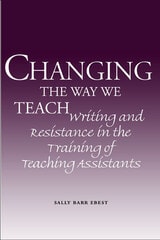
Changing the Way We Teach
Writing and Resistance in the Training of Teaching AssistantsSally Barr Ebest
Southern Illinois University Press, 2005
Changing the Way We Teach: Writing and Resistance in the Training of Teaching Assistants draws on eighteen case studies to illustrate the critical role writing plays in overcoming graduate student resistance to instruction, facilitating change, and developing professional identity. Sally Barr Ebest argues that teaching assistants in English must be actively engaged in the theory and practice underlying composition pedagogy in order to better understand how to alter the way they teach and why such change is necessary.
In illustrating the potential for change when the paradigm shift in composition is applied to graduate education, Ebest considers recent discussions of composition pedagogy; post-secondary teaching theories; cognitive, social cognitive, and educational psychology; and issues of gender, voice, and writing.
Stemming from research conducted over a five-year period, this volume explores how a cross-section of teaching assistants responded to pedagogy as students and how their acceptance of pedagogy affected their performance as instructors. Investigating reasons behind manifestations of resistance and necessary elements for overcoming it, Ebest finds that engagement in composition strategies—reflective writing, journaling, drafting, and active learning—and restoration of feelings of self-efficacy are the primary factors that facilitate change.
Concerned with gender as it relates to personal construct, Changing the Way We Teach traces the influence of familial expectations and the effects of literacy experiences on students and draws correlations between feminist and composition pedagogy. Ebest asserts that the phenomena contributing to the development of a strong, unified voice in women—self-knowledge, empathy, positive role models, and mentors—should be essential elements of a constructivist graduate curriculum.
To understand composition pedagogy and to convince students of its values, Ebest holds that educators must embrace it themselves and trace the effects through active research. By providing graduate students with pedagogical sites for research and reflection, faculty enable them to express their anger or fear, study its sources, and quite often write their way to a new understanding.
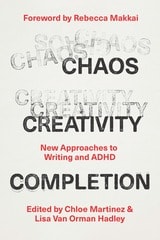
Chaos, Creativity, Completion
New Approaches to Writing and ADHDEdited by Chloe Martinez and Lisa Van Orman Hadley
University of Chicago Press, 2026
A rising number of ADHD diagnoses, particularly among adults, is not only confirmed by medical studies and mainstream reporting but also borne out across social media and elsewhere among people who’d been privately coping with persistent, often inexpressible challenges. Many of the contributors to this collection can attest to how a later-in-life diagnosis radically demystified the patterns, impulses, and impasses that had affected their lives and their writing. The essays in Chaos, Creativity, Completion reflect the ways poets, novelists, memoirists, filmmakers, and others have come to understand and engage the relationship between their ADHD and their creative tool kits.
These essays consider how writers can embrace rather than mask their neurodifference, offering multiple ways of finding writing practices that work for ADHD brains—including techniques that often look quite different from traditional writing instruction. Some essays are analytical, some are reflective, and some are delightfully weird, employing humor, research, personal narrative, deep description, close reading, and experimental approaches to genre and form. Each essay also concludes with a writing prompt, providing readers with opportunities to expand their own creative toolkits. Finally, the book includes an interview with David Kessler, a licensed therapist and nationally recognized ADHD advocate, and an appendix with a glossary of helpful terms and a list of recommended resources, from books and organizations to apps and gadgets.
Just as the experience of ADHD varies from person to person, so, too, do the ways those experiences can be expressed. Chaos, Creativity, Completion is a kaleidoscopic, adventurous series of takes on what writing looks like today.
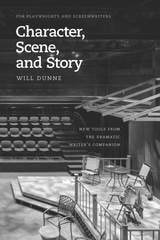
Character, Scene, and Story
New Tools from the Dramatic Writer's CompanionWill Dunne
University of Chicago Press, 2017
Featuring forty-two new workshop-tested exercises, this sequel to The Dramatic Writer’s Companion allows writers to dig deeper into their scripts by fleshing out images, exploring characters from an emotional perspective, tapping the power of color and sense memory to trigger ideas, and trying other visceral techniques. The guide also includes a troubleshooting section to help tackle problem scenes. Writers with scripts already in progress will find they can think deeper about their characters and stories. And those who are just beginning to write will find the guidance they need to discover their best starting point. The guide is filled with hundreds of examples, many of which have been developed as both plays and films.
Character, Scene, and Story is fully aligned with the new edition of The Dramatic Writer’s Companion, with cross-references between related exercises so that writers have the option to explore a given topic in more depth. While both guides can stand alone, together they give writers more than one hundred tools to develop more vivid characters and craft stronger scripts.
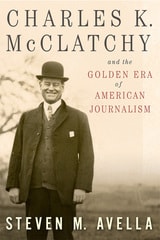
Charles K. McClatchy and the Golden Era of American Journalism
Steven M. Avella
University of Missouri Press, 2016
Charles K. McClatchy was twenty-five when he inherited The Sacramento Bee from his father, and his ensuing career as the paper’s editor extended well beyond the newsroom. Until his death in 1936, McClatchy was a consistent advocate for Progressive politics, a crusader for urban reform, a staunch isolationist, and a voice for Northern California. This biography explores his career as the long-time editor of the Bee in a work that weaves the history of Northern California with that of American newspapers.
Charleston Conference Proceedings 2023
Edited by Beth Bernhardt, Leah Hinds, and Lars Meyer
Against the Grain, LLC, 2024
With strong numbers for 2023, conference attendees continue to remark on the informative and thought‐provoking sessions. The conference provides a casual, collegial atmosphere where librarians, publishers, and vendors talk freely and directly about issues facing their libraries and information providers. All of this interaction occurs in the beautiful city of Charleston, South Carolina. The proceedings continue to be edited by: Beth R. Bernhardt, Consortia Account Manager at Oxford University Press; Leah Hinds, Executive Director of the Charleston Hub; and Lars Meyer, Associate University Librarian for Access and Resource Services, Emory University Libraries. We are pleased to share some of the learning experiences that we and other attendees had at the conference.
Charleston Conference Proceedings 2024
Edited by Beth Bernhardt, Leah Hinds, and Lars Meyer
Against the Grain, LLC, 2025
The Charleston Conference remains a leading international gathering for the exchange of ideas among librarians, publishers, and vendors. Now in its forty-fourth year, the conference continues to thrive as one of the most dynamic and engaging events in the library and information community. Building on the momentum of 2023, when the Charleston Hub joined nonprofit science publisher Annual Reviews, the 2024 conference marked the first full year of this exciting collaboration. The partnership has strengthened Charleston’s mission to foster open dialogue, innovation, and collaboration across all sectors of scholarly communication while preserving the collegial, independent spirit that makes Charleston unique.
The 2024 meeting once again delivered strong participation and rich discussion on emerging issues shaping libraries, publishing, and research. Attendees consistently highlight the Charleston Conference’s relaxed, inclusive atmosphere, where professionals from all corners of the information world come together to share insights and challenge assumptions. Set against the historic and welcoming backdrop of Charleston, South Carolina, the event continues to inspire and connect our global community.
The proceedings are edited by Beth R. Bernhardt, Consortia Account Manager at Oxford University Press; Leah Hinds, Executive Director of the Charleston Hub; and Lars Meyer, Associate University Librarian for Access and Resource Services at Emory University Libraries. We are pleased to share highlights, key themes, and reflections from another memorable year of learning and exchange at the Charleston Conference.
Charleston Conference Proceedings, 2020
Lars Meyer
Against the Grain, LLC, 2020
The Charleston Conference continues to be a major event for information and idea exchange among librarians, vendors, and publishers. 2020 was a year for the history books in every way, with a global pandemic shutting down the world for most of the year. Events pivoted from in-person to virtual in record-breaking times and the Charleston Conference was no exception. The Conference saw a surge in attendance with an almost 150% increase from 2019, and Conference attendees continued to remark on the informative and thought‐ provoking sessions in a virtual environment.
This is the sixteenth year that Beth R. Bernhardt, Consortia Account Manager at Oxford University Press, has put together the proceedings from the Conference. It’s the twelfth year for Leah Hinds, Executive Director, and the fourth year that we are joined by Lars Meyer, Director, Access & Resource Services, Library & Information Technology Services at Emory University. We are pleased to share some of the learning experiences that we, and other attendees, had at the conference.
Charleston Proceedings 2021
Lars Meyer
Against the Grain, LLC, 2022
This is the seventeenth year that Beth R. Bernhardt, Consortia Account Manager at Oxford University Press, has put together the proceedings from the Conference. It’s the thirteenth year for Leah Hinds, Executive Director, and the fifth year that we are joined by Lars Meyer, Associate University Librarian, Access and Resource Services at Emory University. We are pleased to share some of the learning experiences that we, and other attendees, had at the conference.
With contributions from: Brent Appling, Scott D. Bacon, Sarah Rachel Benson, Gaëlle Béquet, Vida Damijonaitis, Denis Galvin, Alicia Wise, Bradley Wade Bishop, David Eby, Claire Jordan, Katerina Ozment, Rebecca Blakiston, Shelby Carroll, Sarah Guy, Angela Carreño, Travis Clamon, Jennifer Young, Ashley Sergiadis, Michelle E. Colquitt, Jennifer A. Mezick, Steve M. Cramer, Summer Krstevska, Corey Seeman, Sara F. Hess, Jill Dawson, Laurel Crawford Claire, Sara Duff, Bob Nardini, Pamela Smith, Emily Tufts, Susan Garrison, Dan Hawkins, Shawn Hendrikx, David McCord, Sara F. Ashley Hosbach, Brittany Kester, Mihoko Hosoi, Sarah Philbrick Hunter, Maridath Wilson, Marc Jaffy, Maureen James, Carol Macheak, Donna Rose, Charlotte M. Johnson, Boaz Nadav Manes, Linda Wobbe, Heather McMullen, Annie Johnson, Jillian Kehoe, Michael Levine-Clark, Tim Lloyd, Tricia Miller, Sara Scheib, Arielle Lomness, Rob Tiessen, Dean Smith, Michael Zeoli, Elizabeth Lorbeer, Karen Gau, Tim Butzen-Cahill, Lindsay Barnett, Daniel C. Mack, Maggie Z. Saponaro, Leigh Ann DePope, Alexis Smith Macklin, Tim Schlak, Jennifer Matthews, Christine Davidian, Antje Mays, Brittany Haynes, Rachelle McLain, Hannah McKelvey, Wendy Michelle Moore, Ida Sofie Reher, James G. Rhoades, Rob Tench, Sion Patrick Romaine, Barbara Albee, Laura A. Sill, George Stachokas, Rebekah Lahue, David Stern Sandy Stift, Roxy M. Garstad, Matthew Torrence, Cory Tucker, Chris Vidas, Bobby Hollandsworth Maureen P. Walsh, Gene R. Springs, Anita K. Foster, Mary Wegmann, Laura Krier, Hilary Smith, George Wrenn, and Angelina Zaytsev.
Charleston Voices
Perspectives from the 2017 ConferenceEdited by Lars Meyer
Against the Grain, LLC, 2018
TESTIMONIALS
“The best library gathering around. I look forward to it.”
“The Charleston Conference is an incredibly stimulating venue. I am tired afterwards, but get so many great ideas, network with my colleagues, and learn what is going on. I recommend it highly.”
“Charleston is the only conference that is worth attending.”
https://www.charlestonlibraryconference.com/about/
Charleston Voices
Perspectives from the 2018 ConferenceEdited by Lars Meyer
Against the Grain, LLC, 2019
TESTIMONIALS
“The best library gathering around. I look forward to it.”
“The Charleston Conference is an incredibly stimulating venue. I am tired afterwards, but get so many great ideas, network with my colleagues, and learn what is going on. I recommend it highly.”
“Charleston is the only conference that is worth attending.”
https://www.charlestonlibraryconference.com/about/
Charleston Voices
Perspectives from the 2019 ConferenceEdited by Lars Meyer
Against the Grain, LLC, 2020
TESTIMONIALS
“The best library gathering around. I look forward to it.”
“The Charleston Conference is an incredibly stimulating venue. I am tired afterwards, but get so many great ideas, network with my colleagues, and learn what is going on. I recommend it highly.”
“Charleston is the only conference that is worth attending.”
https://www.charlestonlibraryconference.com/about/
Chasing Literacy
Reading and Writing in an Age of AccelerationDaniel Keller
Utah State University Press, 2013
Employing case-study research of student reading practices, Keller explores reading-writing connections in new media contexts. He identifies a culture of acceleration—a gathering of social, educational, economic, and technological forces that reinforce the values of speed, efficiency, and change—and challenges educators to balance new “faster” literacies with traditional “slower” literacies. In addition, Keller details four significant features of contemporary literacy that emerged from his research: accumulation and curricular choices; literacy perceptions; speeds of rhetoric; and speeds of reading.
Chasing Literacy outlines a new reading pedagogy that will help students gain versatile, dexterous approaches to both reading and writing and makes a significant contribution to this emerging area of interest in composition theory and practice.
Chasing Newsroom Diversity
From Jim Crow to Affirmative ActionGwyneth Mellinger
University of Illinois Press, 2013
Checklist of Library Building Design Considerations
William W. Sannwald
American Library Association, 2016

Chicago Guide to Preparing Electronic Manuscripts
The University of Chicago Press
University of Chicago Press, 1987
Chicago by the Book
101 Publications That Shaped the City and Its ImageCaxton Club
University of Chicago Press, 2018
Chicago by the Book profiles 101 landmark publications about Chicago from the past 170 years that have helped define the city and its image. Each title—carefully selected by the Caxton Club, a venerable Chicago bibliophilic organization—is the focus of an illustrated essay by a leading scholar, writer, or bibliophile.
Arranged chronologically to show the history of both the city and its books, the essays can be read in order from Mrs. John H. Kinzie’s 1844 Narrative of the Massacre of Chicago to Sara Paretsky’s 2015 crime novel Brush Back. Or one can dip in and out, savoring reflections on the arts, sports, crime, race relations, urban planning, politics, and even Mrs. O’Leary’s legendary cow. The selections do not shy from the underside of the city, recognizing that its grit and graft have as much a place in the written imagination as soaring odes and boosterism. As Neil Harris observes in his introduction, “Even when Chicagoans celebrate their hearth and home, they do so while acknowledging deep-seated flaws.” At the same time, this collection heartily reminds us all of what makes Chicago, as Norman Mailer called it, the “great American city.”
With essays from, among others, Ira Berkow, Thomas Dyja, Ann Durkin Keating, Alex Kotlowitz, Toni Preckwinkle, Frank Rich, Don Share, Carl Smith, Regina Taylor, Garry Wills, and William Julius Wilson; and featuring works by Saul Bellow, Gwendolyn Brooks, Sandra Cisneros, Clarence Darrow, Erik Larson, David Mamet, Studs Terkel, Ida B. Wells-Barnett, Frank Lloyd Wright, and many more.
Childfree and Happy
Transforming the Rhetoric of Women's Reproductive ChoicesCourtney Adams Wooten
Utah State University Press, 2023
Through interviews with thirty-four childfree women and analysis of childfree rhetorics circulating in historical and contemporary texts and events, this book demonstrates how childfree women individually and collectively try to speak back to common beliefs about their reproductive experiences, even as they struggle to make their identities legible in a sociocultural context that centers motherhood. Childfree and Happy theorizes how affect and rhetoric work together to circulate reproductive doxa by using Sara Ahmed’s theories of gendered happiness scripts to analyze what reproductive doxa is embedded in those scripts and how they influence rhetoric by, about, and around childfree women.
Delving into how childfree women position their decision not to have children and the different types of interactions they have with others about this choice, including family members, friends, colleagues, and medical professionals, Childfree and Happy also explores how communities that make space for alternative happiness scripts form between childfree women and those who support them. It will be of interest to scholars in the fields of the rhetoric of motherhood/mothering, as well as feminist rhetorical studies.
Children's Literature Gems
Choosing and Using Them in Your Library CareerElizabeth American Library Association
American Library Association, 2009
Children's Services
Betsy Diamant-Cohen
American Library Association, 2010
Chinese Paintings in Chinese Publications, 1956–1968
An Annotated Bibliography and Index to the PaintingsEllen Johnston Laing
University of Michigan Press, 1969