642 books match the query 'Linguistics' and 26 start with c
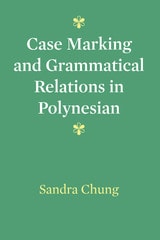
cover of Case Marking and Grammatical Relations in Polynesian

Case Marking and Grammatical Relations in Polynesian

By Sandra Chung

University of Texas Press, 1978

Case Marking and Grammatical Relations in Polynesian makes an outstanding contribution to both Polynesian and historical linguistics. It is at once a reference work describing Polynesian syntax, an investigation of the role of grammatical relations in syntax, and a discussion of ergativity, case marking, and other areas of syntactic diversity in Polynesian. In its treatment of the history of case marking in Polynesian, it attempts to specify what counts as evidence in syntactic reconstruction and how syntactic reanalysis progresses. It therefore represents a first step toward a general theory of syntactic change.

Chung first describes the basic syntax of the Polynesian languages, discussing Maori, Tongan, Samoan, Kapingamarangi, and Pukapukan in depth. She then presents an investigation of the grammatical relations of these languages and their relevance to syntax and shows that the syntax of all these languages—even those with ergative case marking—revolves around the familiar grammatical relations subject and direct object. Finally the book traces the historical development of the different case systems from their origins in Proto-Polynesian.
[more]
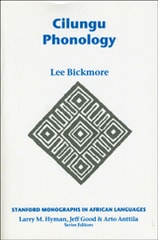
cover of Cilungu Phonology

Cilungu Phonology

Lee Bickmore

CSLI, 2007

Cilungu is an underrepresented language spoken in northern Zambia and Tanzania whose future is far from certain, given ongoing urbanization and the ascendancy of other regional languages. The product of over fifteen years of fieldwork, Cilungu Phonology presents a comprehensive description and analysis of this endangered language.

Featuring a reference grammar and formal analysis of Cilungu, this volume will be a major contribution to our understanding of tonology, since several of the forty-four processes analyzed appear to be unique to the language. It also includes a discussion of morphology, both nominal and verbal.
[more]
cover of Coherence, Reference, and the Theory of Grammar

Coherence, Reference, and the Theory of Grammar

Andrew Kehler

CSLI, 2001

A natural language discourse is more than an arbitrary sequence of utterances; a discourse exhibits coherence. Despite its centrality to discourse interpretation, coherence rarely plays a role in theories of linguistic phenomena that apply across utterances.

In this book, Andrew Kehler provides an analysis of coherence relationships between utterances that is rooted in three types of 'connection among ideas' first articulated by the philosopher David Hume—Resemblance, Cause or Effect, and Contiguity. Kehler then shows how these relationships affect the distribution of a variety of linguistic phenomena, including verb phrase ellipsis, gapping, extraction from coordinate structures, tense, and pronominal reference. In each of these areas, Kehler demonstrates how the constraints imposed by linguistic form interact with those imposed by the process of establishing coherence to explain data that has eluded previous analyses. his book will be of interest to researchers from the broad spectrum of disciplines from which discourse is studied, as well as those working in syntax, semantics, computational linguistics, psycholinguistics, and philosophy of language.
[more]
cover of Collaborative Language Engineering: A Case Study in Efficient Grammar-Based Processing

Collaborative Language Engineering

A Case Study in Efficient Grammar-Based Processing

Edited by Stephan Oepen, Dan Flickinger, Jun-ichi Tsujii, and Hans Uszkoreit

CSLI, 2001

Following high hopes and subsequent disillusionment in the late 1980s, the past decade of work in language engineering has seen a dramatic increase in the power and sophistication of statistical approaches to natural language processing, along with a growing recognition that these methods alone cannot meet the full range of demands for applications of NLP. While statistical methods, often described as 'shallow' processing techniques, can bring real advantages in robustness and efficiency, they do not provide the precise, reliable representations of meaning which more conventional symbolic grammars can supply for natural language. A consistent, fine-grained mapping between form and meaning is of critical importance in some NLP applications, including machine translation, speech prosthesis, and automated email response. Recent advances in grammar development and processing implementations offer hope of meeting these demands for precision.

This volume provides an update on the state of the art in the development and application of broad-coverage declarative grammars built on sound linguistic foundations - the 'deep' processing paradigm - and presents several aspects of an international research effort to produce comprehensive, re-usable grammars and efficient technology for parsing and generating with such grammars.
[more]
cover of Color and Cognition in Mesoamerica: Constructing Categories as Vantages

Color and Cognition in Mesoamerica

Constructing Categories as Vantages

By Robert E. MacLaury

University of Texas Press, 1996

More than 100 indigenous languages are spoken in Mexico and Central America. Each language partitions the color spectrum according to a pattern that is unique in some way. But every local system of color categories also shares characteristics with the systems of other Mesoamerican languages and of languages elsewhere in the world.

This book presents the results of the Mesoamerican Color Survey, which Robert E. MacLaury conducted in 1978-1981. Drawn from interviews with 900 speakers of some 116 Mesoamerican languages, the book provides a sweeping overview of the organization and semantics of color categorization in modern Mesoamerica.

Extensive analysis and MacLaury's use of vantage theory reveal complex and often surprising interrelationships among the ways languages categorize colors. His findings offer valuable cross-cultural data for all students of Mesoamerica. They will also be of interest to all linguists and cognitive scientists working on theories of categorization more generally.
[more]
cover of Complex Predicates

Complex Predicates

Edited by Alex Alsina, Joan Bresnan, and Peter Sells

CSLI, 1996
Complex predicates can be defined as predicates which are composed of more than one grammatical element (either morphemes or words), each of which contributes a non-trivial part of the information of the complex predicate. The papers collected in this volume, which were presented at a workshop at Stanford in 1993, represent a variety of approaches to the question of the range and nature of complex predicates, and draw on data from a wide spectrum of languages. This collection develops a better understanding of the range of phenomena that a general theory of complex predicates would have to account for, and to see what kinds of linguistic ideas and methodologies would be necessary for such a task.
[more]
cover of Complex Predicates and Information Spreading in LFG

Complex Predicates and Information Spreading in LFG

Avery D. Andrews and Christopher D. Manning

CSLI, 1999
This book provides a simple but precise framework for describing complex predicates and related constructions, and applies it principally to the analysis of complex predicates in Romance, and certain serial verb constructions in Tariana and Miskitu. The authors argue for replacing the projection architecture of LFG with a notion of differential information spreading within a unified feature structure. Another important feature is the use of the conception of argument-structure in Chris Manning's Ergativity to facilitate the description of how complex predicates are assembled. In both of these aspects the result is a framework that preserves the descriptive parsimony of LFG while taking on key ideas from HPSG.
[more]
cover of Complex Predicates in Japanese: A Syntactic and Semantic Study of the Notion 'Word'

Complex Predicates in Japanese

A Syntactic and Semantic Study of the Notion 'Word'

Yo Matsumoto

CSLI, 1996

In this thoroughly revised version of 1992 Stanford dissertation, the author presents an extensive discussion of Japanese complex predicates. A broad range of constructions and predicates are discussed, which include predicative complement constructions, light verbs, causative predicates, desiderative predicates, syntactic and lexical compound verbs, and complex motion predicates. A number of new interesting facts are uncovered, and a detailed syntactic and semantic analyses are presented. On the basis of the analyses, the author argues that the notion 'word' must be relativized to at least three different senses: morphological, grammatical (functional), and semantic; and that this observation can be insightfully captured in the theory of Lexical-Functional Grammar. Previous proposals for each type of predicate that involve such mechanisms as argument transfer, incorporation, restructuring, etc. are thoroughly reviewed. Concrete proposals on the constraints on semantic wordhood are also made (an issue rarely discussed in the literature), drawing insights from cognitive linguistics.
[more]
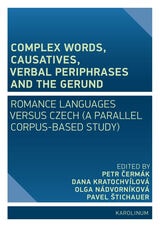
cover of Complex Words, Causatives, Verbal Periphrases and the Gerund: Romance Languages versus Czech (A Parallel Corpus-Based Study)

Complex Words, Causatives, Verbal Periphrases and the Gerund

Romance Languages versus Czech (A Parallel Corpus-Based Study)

Edited by Petr Cermák, Dana Kratochvílová, Olga Nadvornikova, and Pavel Štichauer

Karolinum Press, 2020
This book focuses on the typological differences among the four most widely spoken Romance languages--French, Italian, Portuguese, and Spanish--and Czech. Utilizing findings from the Czech National Corpus’ massive language database, the authors analyze a range of linguistic categories to discover the differences and similarities between Czech and the Romance languages. Due to the massive amount of data mined, as well as the high number of languages examined, this book presents general and individual typological features of the four Romance languages and Czech that often exceed what has previously been accepted in the field of comparative linguistics.
 
[more]
cover of Composing Research: A Contextualist  Paradigm for Rhetoric and Composition

Composing Research

A Contextualist Paradigm for Rhetoric and Composition

Cindy Johanek

Utah State University Press, 2000

Cindy Johanek offers a new perspective on the ideological conflict between qualitative and quantitative research approaches, and the theories of knowledge that inform them. With a paradigm that is sensitive to the context of one's research questions, she argues, scholars can develop less dichotomous forms that invoke the strengths of both research traditions. Context-oriented approaches can lift the narrative from beneath the numbers in an experimental study, for example, or bring the useful clarity of numbers to an ethnographic study.

A pragmatic scholar, Johanek moves easily across the boundaries that divide the field, and argues for contextualist theory as a lens through which to view composition research. This approach brings with it a new focus, she writes. "This new focus will call us to attend to the contexts in which rhetorical issues and research issues converge, producing varied forms, many voices, and new knowledge, indeed reconstructing a discipline that will be simultaneously focused on its tasks, its knowledge-makers, and its students."

Composing Research is a work full of personal voice and professional commitment and will be a welcome addition to the research methods classroom and to the composition researcher's own bookshelf.

2000 Outstanding Scholarship Award from the International Writing Centers Association.
[more]
cover of Conceptual Structure, Discourse and Language

Conceptual Structure, Discourse and Language

Edited by Adele Goldberg

CSLI, 1996
This collection of papers is the outcome of the first Conceptual Structure, Discourse and Language conference (CSDL) held at the University of Califronia, San Diego in October 1995.  CSDL was organized with the intention of bringing together researchers from both "cognitive" and "functional" approaches to linguistics.  The papers in this volume span a variety of topics, but there is a common thread running through them: the claim that semantics and discourse properties are fundamental to our understanding of language.
[more]
cover of Concreteness in Grammar

Concreteness in Grammar

Lise Dobrin

CSLI, 2013

Based on an exhaustive search of published sources and the author’s firsthand fieldwork, Concreteness in Grammar explores the role of phonological form in the noun class systems of the Arapesh languages spoken in Papua New Guinea. Linguists have long known that formal critical play a role alongside semantics in the classification of lexical terms. In Arapesh, virtually every possible final ending of a noun is represented in the paradigm of noun class and agreement markers, reflecting an interpenetraion of sound structure and grammar that many theories would disallow as wildly unconstrained. In this book, Lise Dobrin describes these formal patterns in order to reveal their naturalness and elegance, establishing their place in a typology of noun class systems and drawing out their significance for theories of grammatical architecture.
A rigorous study of an endangered language, Concreteness in Grammar revisits the definition of a morpheme and looks at unusual language patterns to reveal the naturalness of grammar.
[more]
cover of Confessions of St. Augustine in Latin

Confessions of St. Augustine in Latin

Andrew Beer

Catholic University of America Press, 2026
This book will fill a gap in the current resources available to students of the Confessions in Latin. The scope, method, and intended readership will align not only in college Latin classrooms, but also by high school students who have completed their study of elementary Latin grammar; or by any non-specialist who would benefit from generous lexical and grammatical help in a first attempt to read the Confessions in Latin. Greek and Latin philology and classical education have long privileged classical pagan authors to the neglect of early Christian ones. This lack of attention is felt most keenly at the level of aids for intermediate students. While the Classics profession has begun to shift towards greater inclusion of Late Antique and early Christian authors, at least at the level of scholarly activity, the provision of corresponding aids for Classics students lags behind. The current AP Latin syllabus is a case in point: No opportunity is offered for the study of authors whose works comprise an enormous portion of the corpus of Latin literature and were, arguably, no less seminal to medieval and modern culture than the works of Virgil and Caesar. This book will thus serve as a vital educational tool for all persons engaged in studying and teaching the Confessions in Latin.
[more]
cover of Configuring Topic and Focus in Russian

Configuring Topic and Focus in Russian

Tracy Holloway King

CSLI, 1995
This work examines word order. More accurately, it is the ordering of constituents that is discussed since prepositional phrases and most noun phrases form syntactic constituents and the encoding of topic and focus in Russian. As has long been observed, word order in Russian encodes specific discourse information: with neutral intonation, topics precede discourse-neutral constituents which precede foci. King extends this idea to show that word order encodes different types of topic and focus in a principled manner.
[more]
cover of Consciousness and the Acquisition of Language

Consciousness and the Acquisition of Language

Maurice Merleau-Ponty

Northwestern University Press, 1979
The tools, concepts, and vocabulary of phenomenology are used in this book to explore language in a multitude of contexts.
[more]
cover of Constraint-Based Approaches to Germanic Syntax

Constraint-Based Approaches to Germanic Syntax

Edited by W. Detmar Meurers and Tibor Kiss

CSLI, 2001

A wealth of research has been conducted on the various linguistic phenomena found in Germanic languages. But these studies were restricted by their use of only one theoretical perspective to analyze one particular language. Inspired by the need to expand the research base of Germanic languages while broadening the empirical coverage of constraint-based linguistic approaches, a handful of researchers are employing various constraint-based theoretical perspectives to study multiple Germanic languages.

This volume begins with an introduction to the recent research performed on Germanic syntax using constraint-based frameworks. It then goes on to investigate the linguistic phenomena found in the grammar of the German and Danish languages. Using such approaches as Lexical-Functional Grammar and Head-Driven Phrase Structure Grammar, contributors shed a different light on theoretical issues addressed by past studies, including semi-free word order, partial front phenomena, and complex predicate formation. While alternative approaches have assumed that meaning (semantics) is dependent on form (syntax), various analyses presented in this volume explore the idea that both form and meaning are equally constitutive for grammatical descriptions.
[more]
cover of Constraints and Resources in Natural Language Syntax and Semantics

Constraints and Resources in Natural Language Syntax and Semantics

Edited by Gosse Bouma, Erhard Hinrichs, Geert-Jan M. Kruijff, and Richard Oehrle

CSLI, 1999
This collection draws together recent work on constraint-based and resource-sensitive approaches to the grammar of natural languages. Some of the issues addressed are: extraction phenomena in a range of languages, the syntax of nominal phrases, the role of argument structure, defining the interface between syntax and morphology and between semantics and prosody, quantifier scope, remnant movement, construction grammar, and formal and computational aspects of grammar formalisms. This volume brings together the leading linguists, logicians, and computer scientists working on Head-driven Phrase Structure Grammar and Categorial Grammar. Derived from two recent conferences on Formal Grammar and Head-driven Phrase Structure Grammar in Aix (1997) and Saarbrücken (1998), this volume represents the most current work in these frameworks.
[more]
cover of Constructions in Acquisition

Constructions in Acquisition

Edited by Barb Kelly and Eve V. Clark

CSLI, 2006
The Acquisition of Constructions is the culmination of new research into constructions of grammar in languages as diverse as Cantonese, English, French, German, Mandarin, Thai, and Tzeltal. The contributors, all noted scholars in the field of construction grammar, investigate the acquisition of constructions—that is, the consistent patterns for combining words and phrases within a language—in children, from the first and most rudimentary gesture combinations to the production of larger syntactic constructions and complex clauses. Timely and comprehensive, it will be a superb resource for scholars of syntax.
[more]
cover of Constructions: A Construction Grammar Approach to Argument Structure

Constructions

A Construction Grammar Approach to Argument Structure

Adele E. Goldberg

University of Chicago Press, 1995

Drawing on work in linguistics, language acquisition, and computer science, Adele E. Goldberg proposes that grammatical constructions play a central role in the relation between the form and meaning of simple sentences. She demonstrates that the syntactic patterns associated with simple sentences are imbued with meaning—that the constructions themselves carry meaning independently of the words in a sentence.

Goldberg provides a comprehensive account of the relation between verbs and constructions, offering ways to relate verb and constructional meaning, and to capture relations among constructions and generalizations over constructions. Prototypes, frame semantics, and metaphor are shown to play crucial roles. In addition, Goldberg presents specific analyses of several constructions, including the ditransitive and the resultative constructions, revealing systematic semantic generalizations.

Through a comparison with other current approaches to argument structure phenomena, this book narrows the gap between generative and cognitive theories of language.

[more]
cover of Contact, Structure, and Change: A Festschrift in Honor of Sarah G. Thomason

Contact, Structure, and Change

A Festschrift in Honor of Sarah G. Thomason

Edited by Anna M. Babel and Mark A. Sicoli

Michigan Publishing Services, 2021
Contact, Structure, and Change addresses the classic problem of how and why languages change over time through the lens of two uniquely productive and challenging perspectives: the study of language contact and the study of Indigenous American languages. Each chapter in the volume draws from a distinct theoretical positioning, ranging from documentation and description, to theoretical syntax, to creole languages and sociolinguistics. This volume acts as a Festschrift honoring Sarah G. Thomason, a long-time professor at the University of Michigan, whose career spans the disciplines of historical linguistics, contact linguistics, and Native American studies. This conversation among distinguished scholars who have been influenced by Thomason extends and in some cases refracts the questions her work addresses through a collection of studies that speak to the enduring puzzles of language change.
[more]
cover of Content-Based Second Language Instruction: Michigan Classics Edition

Content-Based Second Language Instruction

Michigan Classics Edition

Donna M. Brinton, Marguerite Ann Snow, and Marjorie Wesche

University of Michigan Press, 2003

In the Michigan Classics Edition of Content-Based Second Language Instruction, the authors provide updates on the field of CBI in second language acquisition since 1989.
While the core of the book remains the same, new features discuss important CBI-related research and modifications to the pedagogy in the past many years.
Content-Based Second Language Instruction, Michigan Classics Edition, now includes:
a new preface
a glossary of key terms
an updated bibliography
an epilogue highlighting the major developments in the field since 1989.
[more]
cover of Continuing Cooperative Development: A Discourse Framework for Individuals as Colleagues

Continuing Cooperative Development

A Discourse Framework for Individuals as Colleagues

Julian Edge

University of Michigan Press, 2002

In Continuing Cooperative Development, a series of guided tasks helps the reader acquire specific skills of listening and responding that, in turn, help a speaker to express and articulate thoughts and plans that lie just beyond what they knew that they knew.
By adopting a certain style of speaking and listening to colleagues for agreed periods of time, motivated professionals can take individual control of their own development and increase the feeling of collegiality in their workplace. Continuing Cooperative Development draws on Edge's experience of more than ten years using this framework worldwide and provides authentic examples to guide the reader. This interactive framework is demonstrated in the book as part of a reflective teaching approach in response to everyday classroom problems, and also as part of a more formal, action-research approach to the formulation of local educational theory.
The key theme of this book is the power of non-judgmental discourse to facilitate the development of ideas and action, accessing both cognitive and emotional intelligence. The transcribed and interpreted data of authentic interactions from the Americas, Europe, and Asia serve as evidence for the argument and as guidelines for implementation.
The work is set in the field of TESOL, although its relevance reaches across discipline boundaries. The teachers featured in the book have duties ranging from the instruction of young learners to the supervision of doctoral research. The common denominator is that these people are motivated educators, committed to extending their own understanding and developing their own style of being an aware professional.
[more]
cover of Conversation and Community: Chat in a Virtual World

Conversation and Community

Chat in a Virtual World

Lynn Cherny

CSLI, 1999

Conversation and Community is an examination of the speech community in an Internet 'virtual community'. Based on ethnographic research on a community of users of a MUD, or 'multi-user dimension', the book describes a close-knit community united in features of their language use, shared history, and relationships to other online communities. The author invokes the notion of register, or the variety of speech adapted to the communication situation, in her discussion of how users overcome the limitations of the typed, text medium and exploit its affordances for comfortable communication. Routines, conventional vocabulary and abbreviations, syntactic and semantic phenomena, and special turn-taking and repair strategies distinguish the MUD community's register. Because the MUD is programmable, commands may be added which reflect, alter, or reinforce the linguistic practices and culture of the community; competent speakers must also know the commands that produce the correct linguistic forms.
[more]
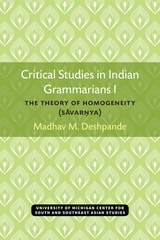
cover of Critical Studies in Indian Grammarians I: The Theory of Homogeneity (Savar?ya)

Critical Studies in Indian Grammarians I

The Theory of Homogeneity (Savar?ya)

Madhav M. Deshpande

University of Michigan Press, 1975
In the historical study of the Indian grammarian tradition, a line of demarcation can often be drawn between the conformity of a system with the well-known grammar of Pāṇini and the explanatory effectiveness of that system. One element of Pāṇini’s grammar that scholars have sometimes struggled to bring across this line of demarcation is the theory of homogeneity, or sāvarṇya, which concerns the final consonants in Pāṇini’s reference catalog, as well as phonetic similarities between sounds. While modern Sanskrit scholars understand how to interpret and apply Pāṇini’s homogeneity, they still find it necessary to unravel the history of varying interpretations of the theory in subsequent grammars.
Madhav Deshpande’s The Theory of Homogeneity provides a thorough account of the historical development of the theory. Proceeding first to study this conception in the Pāṇinian tradition, Deshpande then passes on to other grammatical systems. Deshpande gives attention not only to the definitions of homogeneity in these systems but also the implementation of the theory in those respective systems. Even where definitions are identical, the concept may be applied quite differently, in which cases Deshpande examines by considering the historical relationships among the various systems.
[more]
cover of Cross-Language Relations in Composition

Cross-Language Relations in Composition

Edited by Bruce Horner, Min-Zhan Lu, and Paul Kei Matsuda

Southern Illinois University Press, 2010

Cross-Language Relations in Composition brings together the foremost scholars in the fields of composition, second language writing, education, and literacy studies to address the limitations of the tacit English-only policy prevalent in composition pedagogy and research and to suggest changes for the benefit of writing students and instructors throughout the United States. Recognizing the growing linguistic diversity of students and faculty, the ongoing changes in the English language as a result of globalization, and the increasingly blurred categories of native, foreign, and second language English speakers, editors Bruce Horner, Min-Zhan Lu, and Paul Kei Matsuda have compiled a groundbreaking anthology of essays that contest the dominance of English monolingualism in the study and teaching of composition and encourage the pursuit of approaches that embrace multilingualism and cross-language writing as the norm for teaching and research.

The nine chapters comprising part 1 of the collection focus on the origins of the “English only” bias dominating U.S. composition classes and present alternative methods of teaching and research that challenge this monolingualism. In part 2, nine composition teachers and scholars representing a variety of theoretical, institutional, and professional perspectives propose new, compelling, and concrete ways to understand and teach composition to students of a “global,” plural English, a language evolving in a multilingual world.

Drawing on recent theoretical work on genre, complexity, performance and identity, as well as postcolonialism, Cross-Language Relations in Composition offers a radically new approach to composition teaching and research, one that will prove invaluable to all who teach writing in today’s multilingual college classroom.
[more]
cover of Cultural Semantics: Keywords of Our Time

Cultural Semantics

Keywords of Our Time

Martin Jay

University of Massachusetts Press, 1998

A selection of Martin Jay's recent writings on contemporary thought and culture, this is a book about ideas that matter—and about why ideas matter. Borrowing from Flaubert's notion of a dictionary of “received ideas” and Raymond Williams's explorations of the “keywords” of the modern age, Jay investigates some of the central concepts by which we currently organize our thoughts and lives. His topics range from “theory” and “experience” to the meaning of “multiculturalism” and the dynamics of cultural “subversion.” Among the thinkers he engages are Bataille and Foucault, Adorno and Lacoue-Labarthe, Walter Benjamin, Christa Wolf, and Jean-François Lyotard. 

By looking closely at what “words do and perform,” Jay makes us aware of the extent to which the language we use mediates and shapes our experience. By helping to distance us from much that we now take for granted, he makes it difficult for us to remain comfortably certain about what we think we know. 

Elegantly written and richly insightful, this is a work of cultural criticism and intellectual analysis of the first order.

[more]