Results by title
111 books match the query 'Museum Studies' and 18 start with c
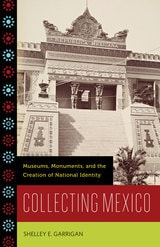
Collecting Mexico
Museums, Monuments, and the Creation of National IdentityShelley E. Garrigan
University of Minnesota Press, 2012
Collecting Mexico centers on the ways in which aesthetics and commercialism intersected in officially sanctioned public collections and displays in late nineteenth-century Mexico. Shelley E. Garrigan approaches questions of origin, citizenry, membership, and difference by reconstructing the lineage of institutionally collected objects around which a modern Mexican identity was negotiated. In doing so, she arrives at a deeper understanding of the ways in which displayed objects become linked with nationalistic meaning and why they exert such persuasive force.
Spanning the Porfiriato period from 1867 to 1910, Collecting Mexico illuminates the creation and institutionalization of a Mexican cultural inheritance. Employing a wide range of examples—including the erection of public monuments, the culture of fine arts, and the representation of Mexico at the Paris World’s Fair of 1889—Garrigan pursues two strands of thought that weave together in surprising ways: national heritage as a transcendental value and patrimony as potential commercial interest.
Collecting Mexico shows that the patterns of institutional collecting reveal how Mexican public collections engendered social meaning. Using extensive archival materials, Garrigan’s close readings of the processes of collection building offer a new vantage point for viewing larger issues of identity, social position, and cultural/capital exchange.
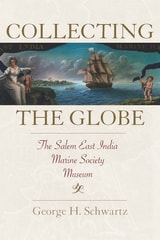
Collecting the Globe
The Salem East India Marine Society MuseumGeorge H. Schwartz
University of Massachusetts Press, 2020
Collecting the Globe presents the first in-depth exploration of the East India Marine Society Museum, the precursor to the internationally acclaimed Peabody Essex Museum. Offering fresh perspectives on museums in the United States before the Civil War and how they helped shape an American identity, George H. Schwartz explores the practices of collecting, exhibiting, and interpreting a diversity of international objects and art in the early United States.
Collections Management as Critical Museum Practice
Edited by Cara Krmpotich and Alice Stevenson
University College London, 2024
Collections Management as Critical Museum Practice redefines collections management as a political, critical, and social project, contradicting its misperception as a set of fixed procedures and universal practices. Highlighting national museums and community-led heritage work worldwide, this book explores the complexities of numbering, digitization, and description alongside the realities of climate change, global pandemics, and natural disasters. The contributors draw on their local experiences to emphasize the varying practices, ethics, and workplace pragmatics defining this work.
Conflict, Heritage and World-Making in the Chaco
War at the End of the Worlds?Esther Breithoff
University College London, 2020
Framing the study as an exploration of modern, industrialized warfare as a sort of “hyper object”, Breithoff shows how the material culture and heritage of modern conflict fuse together objects, people, and landscapes, connecting them physically and conceptually across vast, almost unimaginable distances and time periods. This book makes a major contribution to key debates in anthropology, archaeology, critical heritage, and material culture studies on the significance of conflict in understanding the Anthropocene, and the roles played by its persistent heritages in assembling worlds.
Conservation of Natural and Cultural Heritage in Kenya
Edited by Anne-Marie Deisser and Mugwima Njuguna
University College London, 2016
Conserving Active Matter
Edited by Peter N. Miller and Soon Kai Poh
Bard Graduate Center, 2022
This volume brings together the findings from a five-year research project that seeks to reimagine the relationship between conservation knowledge and the humanistic study of the material world. The project, “Cultures of Conservation,” was supported by the Andrew W. Mellon Foundation and included events, seminars, and an artist-in-residence.
The effort to conserve things amid change is part of the human struggle with the nature of matter. For as long as people have made things and kept things, they have also cared for and repaired them. Today, conservators use a variety of tools and categories developed over the last one hundred and fifty years to do this work, but in the coming decades, new kinds of materials and a new scale of change will pose unprecedented challenges. Looking ahead to this moment from the perspectives of history, philosophy, materials science, and anthropology, this volume explores new possibilities for both conservation and the humanities in the rethinking of active matter.
Conserving Canvas
Cynthia Schwarz
J. Paul Getty Trust, The, 2023
In 2019, Yale University, with the support of the Getty Foundation, held an international conference, where nearly four hundred attendees from more than twenty countries gathered to discuss a vital topic: how best to conserve paintings on canvas. It was the first major symposium on the subject since 1974, when wax-resin and glue-paste lining reigned as the predominant conservation techniques. Over the past fifty years, such methods, which were often destructive to artworks, have become less widely used in favor of more minimalist approaches to intervention. More recent decades have witnessed the reevaluation of traditional practices as well as focused research supporting significant new methodologies, procedures, and synthetic materials for the care and conservation of paintings on fabric supports.
Conserving Canvas compiles the proceedings of the conference, presenting a wide array of papers and posters that provide important global perspectives on the history, current state, and future needs of the field. Featuring an expansive glossary of terms that will be an invaluable resource for conservators, this publication promises to become a standard reference for the international conservation community.
The free online edition of this open-access publication is available at getty.edu/publications/conserving-canvas. Also available are free PDF and EPUB downloads of the book.
Contemporary Art and the Display of Ancient Egypt
Alice Stevenson
University College London, 2025
Contemporary art installations in Egyptian galleries are often framed as dialogues between past and present—but what if they are, instead, shaped by the museum itself? Contemporary Art and the Display of Ancient Egypt argues that both contemporary and ancient works are mediated through the structures and ideologies of the museum space. In this seminal work, Alice Stevenson examines how artists’ work influences museum discourse and public engagement with ancient artifacts.
Drawing on case studies from the British Museum, the Egyptian Museum in Turin, and the State Museum of Egyptian Art in Munich, this book assesses the motivations behind these interventions and their lasting impact. Through an evidence-based approach, Stevenson offers new insights into how curators, scholars, and artists can collaborate to create more meaningful and politically engaged museum experiences. Of particular interest to Egyptologists, museum professionals, and contemporary art scholars, this work redefines the role of artistic intervention in shaping our understanding of ancient cultures.
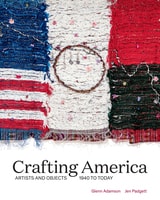
Crafting America
Artists and Objects, 1940 to TodayJen Padgett
University of Arkansas Press, 2020
Craft is a diverse, democratic art form practiced by Americans of every gender, age, ethnicity, and class. Crafting America traces this expansive range of skilled making in a variety of forms, from ceramics and wood to performance costume and community-based practice. In exploring the intertwining of craft and American experience, this volume reveals how artists leverage their craft to realize the values of life, liberty, and the pursuit of happiness.
Accompanying an exhibition of the same title organized by Crystal Bridges Museum of American Art, Crafting America features contributions from scholars that illuminate craft’s relationship to ritual and memory, personal independence, abstraction, and Native American histories. The richly illustrated catalog section—with more than a hundred color images accompanied by lively commentary—presents a vivid picture of American craft over the past eight decades, offering fresh insights on the relationships between objects.
Building upon recent advances in craft scholarship and encouraging more inclusive narratives, Crafting America presents a bold statement on the vital role of craft within the broader context of American art and identity.
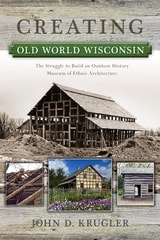
Creating Old World Wisconsin
The Struggle to Build an Outdoor History Museum of Ethnic ArchitectureJohn D. Krugler
University of Wisconsin Press, 2013
Visionaries, researchers, curators, and volunteers launched a massive preservation initiative to salvage fast-disappearing immigrant and migrant architecture. Dozens of historic buildings in the 1970s were transported from locations throughout the state to the Kettle Moraine State Forest. These buildings created a backdrop against which twenty-first-century interpreters demonstrate nineteenth- and early twentieth-century agricultural techniques and artisanal craftsmanship. The site, created and maintained by the Wisconsin Historical Society, offers visitors a unique opportunity to learn about the state’s rich and ethnically diverse past through depictions of the everyday lives of its Norwegian, Danish, Finnish, German, Polish, African American, and Yankee inhabitants.
Creating Old World Wisconsin chronicles the fascinating and complex origins of this outdoor museum, highlighting the struggles that faced its creators as they worked to achieve their vision. Even as Milwaukee architect and preservationist Richard W. E. Perrin, the Society's staff, and enthusiastic volunteers opened the museum in time for the national bicentennial in 1976, the site was plagued by limited funds, bureaucratic tangles, and problems associated with gaining public support. By documenting the engaging story of the challenges, roadblocks, false starts, and achievements of the site's founders, Krugler brings to life the history of the dedicated corps who collected and preserved Wisconsin's diverse social history and heritage.

Critical Heritage Studies and the Futures of Europe
Edited by Rodney Harrison, Nélia Dias, and Kristian Kristiansen
University College London, 2023
Cultural and natural heritage are central to ideas of what Europe and “the European project’” are. Heritage studies were prevalent in the emergence of nation-states in the eighteenth and nineteenth centuries, where they were used to justify differences over which border conflicts were fought. Later, the idea of a “common European heritage” provided a rationale for the development of the European Union. Now, the emergence of “new” populist nationalisms shows how the imagined past continues to play a role in cultural and social governance, while a series of interlinked social and ecological crises are changing the ways that heritage operates, with new discourses and ontologies emerging to reconfigure heritage for the circumstances of the present and the uncertainties of the future.
Critical Heritage and Social Justice
Redistribution, Recognition and Representation in ContextEdited by Veysel Apaydin, Kalliopi Fouseki, David Francis, Jonathan Gardner, and Sara Perry
University College London, 2026
The first edited volume in the field of heritage to conceptualize and contextualize social justice in depth, both theoretically and through practical applications.
In this edited volume, scholars and practitioners working across heritage, museums, galleries, and cultural institutions explore how principles of social justice can be embedded within these spaces. Highlighting intersections between critical heritage studies and urgent global challenges, the book seeks to foster inclusive, community-engaged heritage practices. Applying Nancy Fraser’s theory of three-dimensional justice—redistribution, recognition, and representation—within the context of heritage studies, the authors reflect on global social, cultural, political, and environmental issues through an interdisciplinary heritage-focused approach.
Critical Perspectives on Cultural Memory and Heritage
Construction, Transformation and DestructionEdited by Veysel Apaydin
University College London, 2020
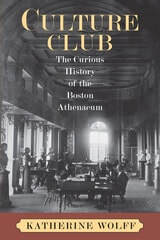
Culture Club
The Curious History of the Boston AthenaeumKatherine Wolff
University of Massachusetts Press, 2009
Yet from the outset, Katherine Wolff shows, the Boston Athenaeum was more than a library; it was also a breeding ground for evolving notions of cultural authority and American identity. Though governed by the Boston elite, who promoted it as a way of strengthening their own clout in the city, the early Athenaeum reflected conflicting and at times contradictory aims and motives on the part of its membership. On the one hand, by drawing on European aesthetic models to reinforce an exalted sense of mission, Athenaeum leaders sought to establish themselves as guardians of a nascent American culture. On the other, they struggled to balance their goals with their concerns about an increasingly democratic urban populace. As the Boston Athenaeum opened its doors to women as well as men outside its inner circle, it eventually began to define itself against a more accessible literary institution, the Boston Public Library.
Told through a series of provocative episodes and generously illustrated, Culture Club offers a more complete picture than previously available of the cultural politics behind the making of a quintessentially American institution.
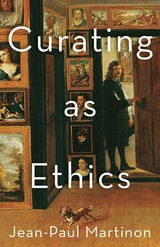
Curating As Ethics
Jean-Paul Martinon
University of Minnesota Press, 2020
A new ethics for the global practice of curating
Today, everyone is a curator. What was once considered a hallowed expertise is now a commonplace and global activity. Can this new worldwide activity be ethical and, if yes, how? This book argues that curating can be more than just selecting, organizing, and presenting information in galleries or online. Curating can also constitute an ethics, one of acquiring, arranging, and distributing an always conjectural knowledge about the world.
Curating as Ethics is primarily philosophical in scope, evading normative approaches to ethics in favor of an intuitive ethics that operates at the threshold of thought and action. It explores the work of authors as diverse as Heidegger, Spinoza, Meillassoux, Mudimbe, Chalier, and Kofman. Jean-Paul Martinon begins with the fabric of these ethics: how it stems from matter, how it addresses death, how it apprehends interhuman relationships. In the second part he establishes the ground on which the ethics is based, the things that make up the curatorial—for example, the textual and visual evidence or the digital medium. The final part focuses on the activity of curating as such—sharing, caring, preparing, dispensing, and so on.
With its invigorating new approach to curatorial studies, Curating as Ethics moves beyond the field of museum and exhibition studies to provide an ethics for anyone engaged in this highly visible activity, including those using social media as a curatorial endeavor, and shows how philosophy and curating can work together to articulate the world today.
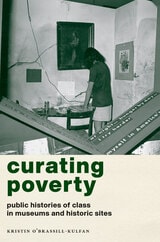
Curating Poverty
Public Histories of Class in Museums and Historic SitesKristin O'Brassill-Kulfan
University of Massachusetts Press, 2027
Asking how Americans’ fraught relationship with class has played out in public history
In 1966, a Smithsonian curator proposed recreating a “slum” dwelling inside the Museum of History and Technology, complete with rats in the walls, synthesized smells, and heat in summer and cold in winter. The public was not pleased. One editorialist called it “preserving a very insignificant aspect of civilization.” A Life magazine reporter worried that schoolchildren on field trips might find the exhibit’s horrors “pretty tame compared to their own homes.” The proposal was shelved. But the debate it ignited over whether poverty could or should be presented in museums cast a long shadow in US public history.
In Curating Poverty, Kristin O’Brassill-Kulfan examines how public historians have curated, preserved, and interpreted the experiences of people living in poverty—and how different publics have responded to these efforts. Poverty and economic inequality have shaped the lives of millions of Americans since the colonial period. For most of the nation’s history, welfare institutions such as almshouses and poor farms could be found in nearly every county in the United States. Yet explicit interpretation of poverty, welfare, and inequality remains an outlier in public history.
Documenting attempts to incorporate histories of poverty and class into exhibitions from the 1930s to the present, O’Brassill-Kulfan interrogates institutions of varying sizes and missions, paying particular attention to museums within the Smithsonian network. She traces how communities and public historians have remembered, neglected, erased, and sometimes reclaimed the surviving landscapes of poverty relief—from preserved almshouses and poor farm cemeteries to tenement museums and public housing sites. By placing poverty at the center of public history, Curating Poverty reveals how Americans have constructed, contested, and obscured histories of class and inequality and what it might look like to finally tell those stories honestly.
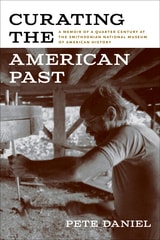
Curating the American Past
A Memoir of a Quarter Century at the Smithsonian National Museum of American HistoryPete Daniel
University of Arkansas Press, 2022
“As is well known, Pete is an outstanding storyteller, and this book is no exception."
—Claire Strom, Journal of Southern History
In addition to chronicling significant exhibit work at the Smithsonian National Museum of American History, Curating the American Past, captures the excitement inherent in researching and writing history and Pete Daniel’s efforts to prevent diluted celebratory stories from replacing the red meat of the American past.
In Curating the American Past, Pete Daniel reveals how curators collect objects, plan exhibits, and bring alive the country’s complex and exciting history. In vivid detail, Daniel recounts the exhilaration of innovative research, the joys of collaboration, and the rewards of mentoring new generations of historians. In a career distinguished by prize-winning publications and pathbreaking exhibitions, Daniel also confronted the challenges of serving as a public historian tasked with protecting a definitive American museum from the erosion of scholarly standards. Curating the American Past offers a wealth of museum wisdom, illuminating the crucial role that dedicated historians and curators serve within our most important repositories of cultural memory.
Curators and Culture
The Museum Movement in America, 1740-1870Joel J. Orosz
University of Alabama Press, 1990
Tracing the birth of American museums and the curators who shaped a nation’s cultural identity.
As they formed their pioneer museums, these men were guided not so much by European examples, but rather by the imperatives of the American democratic culture, including the Enlightenment, the simultaneous decline of the respectability and rise of the middle classes, the Age of Egalitarianism, and the advent of professionalism in the sciences. Thus the pre-1870 American museum was neither the frivolous sideshow some critics have imagined, nor the enclave for elitists that others have charged. Instead, the proprietors displayed serious motives and egalitarian aspirations.
The conflicting demands for popular education on the one hand and professionalism on the other were a continuing source of tension in American museums after about 1835, but by 1870 the two claims had synthesized into a rough parity. This synthesis, the "American Compromise," has remained the basic model of museums in America down to the present. Thus, by 1870, the form of the modern American museum as an institution which simultaneously provides popular education and promotes scholarly research was completely developed.