Results by title
78 books match the query 'National security' and 7 start with c
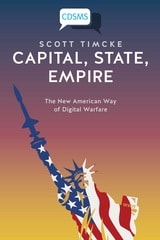
Capital, State, Empire
The New American Way of Digital WarfareScott Timcke
University of Westminster Press, 2017
The United States presents the greatest source of global geo-political violence and instability. Guided by the radical political economy tradition, this book offers an analysis of the USA’s historical impulse to weaponize communication technologies.
Scott Timcke explores the foundations of this impulse and how the militarization of digital society creates structural injustices and social inequalities. He analyses how new digital communication technologies support American paramountcy and conditions for worldwide capital accumulation. Identifying selected features of contemporary American society, Capital, State, Empire undertakes a materialist critique of this digital society and of the New American Way of War. At the same time it demonstrates how the American security state represses activists—such as Black Lives Matter—who resist this emerging security leviathan. The book also critiques the digital positivism behind the algorithmic regulation used to control labour and further diminish prospects for human flourishing for the ‘99%’.
Capital, State, Empire contributes to a broader understanding of the dynamics of global capitalism and political power in the early 21st century.
Carter's Conversion
The Hardening of American Defense PolicyBrian J. Auten
University of Missouri Press, 2008
Challenged Sovereignty
The Impact of Drugs, Crime, Terrorism, and Cyber Threats in the CaribbeanIvelaw Lloyd Griffith
University of Illinois Press, 2024
Informed and up to date, Challenged Sovereignty explains the effects of today’s globalized problems on the contemporary Caribbean.

Citizenship in Cold War America
The National Security State and the Possibilities of DissentAndrea Friedman
University of Massachusetts Press, 2014
The stories told here capture a wide-ranging debate about the workings of the national security state and the meaning of American citizenship. Some of the participants in this debate—women like war bride Ellen Knauff and Pentagon employee Annie Lee Moss—were able to make their own experiences compelling examples of the threats posed by the national security regime. Others, such as Ruth Reynolds and Lolita Lebrón, who advocated an end to American empire in Puerto Rico, or the psychiatrist Fredric Wertham, who sought to change the very definition of national security, were less successful. Together, however, they exposed the gap between democratic ideals and government policies.
Friedman traverses immigration law and loyalty boards, popular culture and theoretical treatises, U.S. court-rooms and Puerto Rican jails, to demonstrate how Cold War repression made visible in new ways the unevenness and limitations of American citizenship. Highlighting the ways that race and gender shaped critiques and defenses of the national security regime, she offers new insight into the contradictions of Cold War political culture.
Compound Dilemmas
Democracy, Collective Action, and Superpower RivalryMichael Dean McGinnis and John T. Williams
University of Michigan Press, 2001
Constructing National Interests
The United States and the Cuban Missile CrisisJutta Weldes
University of Minnesota Press, 1999
Not simply an “event” or merely an “incident,” the 1962 standoff between the U. S. and the Soviet Union over missiles in Cuba was a crisis, which subsequently has achieved almost mythic significance in the annals of United States foreign policy. Jutta Weldes asks why this occurrence in particular should be cast as a crisis, and how this so significantly affected “the national interest.” Here, Weldes analyzes the so-called Cuban missile crisis as a means to rethink the idea of national interest, a notion central to both the study and practice of international relations.
Why did the presence of Soviet missiles in Cuba constitute a crisis for U.S. state officials and thus a dire threat to U.S. national interests? It was, Weldes suggests, more a matter of discursive construction than of objective facts or circumstances. Drawing on social theory and on concepts from cultural studies, she exposes the “realities” of the crisis as social creations in the service of a particular and precarious U.S. state identity defined within the Cold War U.S. “security imaginary.”
Constructing National Interests shows how this process allowed for a redefining of the identities, interests, and likely actions of various states, so that it seemed to logically serve the U.S. national interest in removing the missiles from Cuba.
Crimes of Power & States of Impunity
The U.S. Response to TerrorWelch, Michael
Rutgers University Press, 2009
Welch continues the work he began in Scapegoats of September 11th and argues that current U.S. policies, many enacted after the attacks, undermine basic human rights and violate domestic and international law. He recounts these offenses and analyzes the system that sanctions them, offering fresh insight into the complex relationship between power and state crime. Welch critically examines the unlawful enemy combatant designation, Guantanamo Bay, recent torture cases, and collateral damage relating to the war in Iraq. This book transcends important legal arguments as Welch strives for a broader sociological interpretation of what transpired early this century, analyzing the abuses of power that jeopardize our safety and security.