Results by title
344 books match the query 'Nationalism' and 28 start with c
Campaigning in Europe for a Free Indonesia
Indonesian Nationalists and the Worldwide Anticolonial Movement, 1917–1932Klaas Stutje
National University of Singapore Press, 2019
Celebrating the Fourth
Independence Day and the Rites of Nationalism in the Early RepublicLen Travers
University of Massachusetts Press, 1997
A CHOICE Outstanding Academic Book
Public rituals have always held a vital place in American culture. By far the noisiest and most popular of these to emerge in the nation's early years was Independence Day. After a decade of fitful starts, the Fourth of July eclipsed local and regional patriotic observances to become the premier “American Jubilee.” Celebrating the Fourth provides a history of this holiday and explores its role in shaping a national identity and consciousness in three cities—Boston, Charleston, and Philadelphia—during the first fifty years of the American republic. Independence Day celebrations justified, validated, and helped maintain nationalism among people unused to offering political allegiance beyond their own state borders. As the observances became increasingly popular and symbolically important, political partisans competed hotly for the right to control the meaning of the festivals.
Changing Places
Society, Culture, and Territory in the Saxon-Bohemian Borderlands, 1870-1946Caitlin E. Murdock
University of Michigan Press, 2010
"Changing Places is an interesting meditation on the varying identities and rights claimed by residents of borderlands, the limits placed on the capacities of nation-states to police their borders and enforce national identities, and the persistence of such contact zones in the past and present. It is an extremely well-written and engaging study, and an absolute pleasure to read."
---Dennis Sweeney, University of Alberta
"Changing Places offers a brilliantly transnational approach to its subject, the kind that historians perennially demand of themselves but almost never accomplish in practice."
---Pieter M. Judson, Swarthmore College
Changing Places is a transnational history of the birth, life, and death of a modern borderland and of frontier peoples' changing relationships to nations, states, and territorial belonging. The cross-border region between Germany and Habsburg Austria---and after 1918 between Germany and Czechoslovakia---became an international showcase for modern state building, nationalist agitation, and local pragmatism after World War I, in the 1930s, and again after 1945.
Caitlin Murdock uses wide-ranging archival and published sources from Germany and the Czech Republic to tell a truly transnational story of how state, regional, and local historical actors created, and eventually destroyed, a cross-border region. Changing Places demonstrates the persistence of national fluidity, ambiguity, and ambivalence in Germany long after unification and even under fascism. It shows how the 1938 Nazi annexation of the Czechoslovak "Sudetenland" became imaginable to local actors and political leaders alike. At the same time, it illustrates that the Czech-German nationalist conflict and Hitler's Anschluss are only a small part of the larger, more complex borderland story that continues to shape local identities and international politics today.
Caitlin E. Murdock is Associate Professor of History at California State University, Long Beach.
Jacket Credit: Cover art courtesy of the author
China Inside Out
Contemporary Chinese Nationalism and TransnationalismJoana Breidenbach
Central European University Press, 2005
The authors of this text believe that “areas” as assemblages of social processes requiring distinct, culture-bound explanations cannot be replaced with global theories, but that the meaning of “the area” can be different depending on the question one studies. The study of China and Chinese, in particular, is a good arena to challenge the disciplinary and geographic boundaries of conventional area studies for several reasons. First, because of the wealth of simultaneous processes of rapid political, social, and discursive change in contemporary Chinese society; second, because of the problematic relationship between state, territory, nation, and ethnicity in China; third, because China studies, perhaps more than any other area studies at the moment, is a highly competitive political and academic industry whose internal working must be critically examined. In addition, the subject of China has become one of the primary loci of contesting the meanings of globalization and the universality versus relativity of “values” and modernity.
City of Broken Dreams
Myth-Making, Nationalism and the University in an African Motor CityLeslie J. Bank
Michigan State University Press, 2019
Civic and Uncivic Values
Serbia in the Post-Miloševic EraOla Listhaug
Central European University Press, 2011
Colonial Fantasies
Conquest, Family, and Nation in Precolonial Germany, 1770-1870Susanne Zantop
Duke University Press, 1997
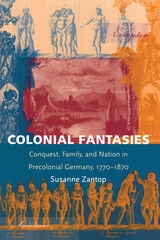
From as early as the sixteenth century, Germans preoccupied themselves with an imaginary drive for colonial conquest and possession that eventually grew into a collective obsession. Zantop illustrates the gendered character of Germany’s colonial imagination through critical readings of popular novels, plays, and travel literature that imagine sexual conquest and surrender in colonial territory—or love and blissful domestic relations between colonizer and colonized. She looks at scientific articles, philosophical essays, and political pamphlets that helped create a racist colonial discourse and demonstrates that from its earliest manifestations, the German colonial imagination contained ideas about a specifically German national identity, different from, if not superior to, most others.
Colonial Reckoning
Race and Revolution in Nineteenth-Century CubaLouis A. Pérez Jr.
Duke University Press, 2023

Colonizing Trick
National Culture And Imperial Citizenship In Early AmericaDavid Kazanjian
University of Minnesota Press, 2003
An illuminating look at the concepts of race, nation, and equality in eighteenth- and nineteenth-century America
The idea that “all men are created equal” is as close to a universal tenet as exists in American history. In this hard-hitting book, David Kazanjian interrogates this tenet, exploring transformative flash points in early America when the belief in equality came into contact with seemingly contrary ideas about race and nation. The Colonizing Trick depicts early America as a white settler colony in the process of becoming an empire-—one deeply integrated with Euro-American political economy, imperial ventures in North America and Africa, and pan-American racial formations.
Kazanjian traces tensions between universal equality and racial or national particularity through theoretically informed critical readings of a wide range of texts: the political writings of David Walker and Maria Stewart, the narratives of black mariners, economic treatises, the personal letters of Thomas Jefferson and Phillis Wheatley, Charles Brockden Brown’s fiction, congressional tariff debates, international treaties, and popular novelettes about the U.S.–Mexico War and the Yucatán’s Caste War. Kazanjian shows how emergent racial and national formations do not contradict universalist egalitarianism; rather, they rearticulate it, making equality at once restricted, formal, abstract, and materially embodied.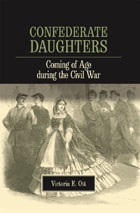
Confederate Daughters
Coming of Age during the Civil WarVictoria E. Ott
Southern Illinois University Press, 2008
Confederate Daughters: Coming of Age during the Civil War explores gender, age, and Confederate identity by examining the lives of teenage daughters of Southern slaveholding, secessionist families. These young women clung tenaciously to the gender ideals that upheld marriage and motherhood as the fulfillment of female duty and to the racial order of the slaveholding South, an institution that defined their status and afforded them material privileges. Author Victoria E. Ott discusses how the loyalty of young Southern women to the fledgling nation, born out of a conservative movement to preserve the status quo, brought them into new areas of work, new types of civic activism, and new rituals of courtship during the Civil War.
Social norms for daughters of the elite, their preparation for their roles as Southern women, and their material and emotional connections to the slaveholding class changed drastically during the Civil War. When differences between the North and South proved irreconcilable, Southern daughters demonstrated extraordinary agency in seeking to protect their futures as wives, mothers, and slaveholders.
From a position of young womanhood and privilege, they threw their support behind the movement to create a Confederate identity, which was in turn shaped by their participation in the secession movement and the war effort. Their political engagement is evident from their knowledge of military battles, and was expressed through their clothing, social activities, relationships with peers, and interactions with Union soldiers.
Confederate Daughters also reveals how these young women, in an effort to sustain their families throughout the war, adjusted to new domestic duties, confronting the loss of slaves and other financial hardships by seeking paid work outside their homes.
Drawing on their personal and published recollections of the war, slavery, and the Old South, Ott argues that young women created a unique female identity different from that of older Southern women, the Confederate bellehood. This transformative female identity was an important aspect of the Lost Cause mythology—the version of the conflict that focused on Southern nationalism—and bridged the cultural gap between the antebellum and postbellum periods.
Augmented by twelve illustrations, this book offers a generational understanding of the transitional nature of wartime and its effects on women’s self-perceptions. Confederate Daughters identifies the experiences of these teenage daughters as making a significant contribution to the new woman in the New South.
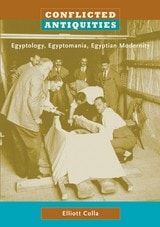
Conflicted Antiquities
Egyptology, Egyptomania, Egyptian ModernityElliott Colla
Duke University Press, 2007
Colla draws on medieval and modern Arabic poetry, novels, and travel accounts; British and French travel writing; the history of archaeology; and the history of European and Egyptian museums and exhibits. The struggle over the ownership of Pharaonic Egypt did not simply pit Egyptian nationalists against European colonial administrators. Egyptian elites found arguments about the appreciation and preservation of ancient objects useful for exerting new forms of control over rural populations and for mobilizing new political parties. Finally, just as the political and expressive culture of Pharaonism proved critical to the formation of new concepts of nationalist identity, it also fueled Islamist opposition to the Egyptian state.
Confronting the Nation
Jewish and Western NationalismGeorge L. Mosse
University of Wisconsin Press, 2024
Mosse considers a broad range of topics, from Nazi book burnings to Americans’ search for unifying national symbols during the Great Depression, exploring how the development of particular modes of art, architecture, and mass movements served nationalist agendas by dictating who was included in the image of the nation. These essays retain their significance today in their examination of the cultural and social implications of contemporary nationalism. A new critical introduction by Shulamit Volkov, professor emerita of history at Tel Aviv University, situates Mosse’s analysis within its historiographical context.
Conservative Ideology in the Making
Ivan Zoltan Denes
Central European University Press, 2009
Constructing Citizenship
Transnational Workers and Revolution on the Mexico-Guatemala Border, 1880--1950Catherine A. Nolan-Ferrell
University of Arizona Press, 2012
Constructing Nationhood in Modern East Asia
Kai-wing Chow, Kevin M. Doak, and Poshek Fu, Editors
University of Michigan Press, 2001
This is an interdisciplinary study of the cultural politics of nationalism and national identities in modern East Asia. Combining theoretical insights with empirical research, it explores the cultural dimensions of nationhood and identity-making in China, Japan, Korea, Hong Kong, and Taiwan. The essays address issues ranging from the complex relations between popular culture and national consciousness to the representation of ethnic/racial identity and gendered discourse on nationalism. The cutting-edge research on the diverse forms of cultural preacceptance and the various ways in which this participates in the construction and projection of national and ethnic identities in East Asia illuminates several understudied issues in Asian studies, including the ambiguity of Hong Kong identity during World War II and the intricate politics of the post-war Taiwanese trial of collaboration.
Addressing a wide range of theoretical and historical issues regarding cultural dimensions of nationalism and national identities all over East Asia, these essays draw insights from such recent theories as cultural studies, postcolonial theories, and archival-researched cultural anthropology. The book will be important reading for students of Asian studies as well as for serious readers interested in issues of nationalism and culture.
Kai-wing Chow is Associate Professor of East Asian Languages and Cultures. Kevin Doak is Associate Professor of History. Poshek Fu is Associate Professor of History and Cinema Studies. All three teach at University of Illinois, Urbana-Champaign.
Constructions of Race, Place, and Nation
Peter Jackson
University of Minnesota Press, 1993
Consumers And Citizens
Globalization and Multicultural ConflictsNestor Garcia Canclini
University of Minnesota Press, 2001
An essential analysis of the ways consumerism and globalization intersect with political power.
In Consumers and Citizens, Néstor García Canclini, the best-known and most innovative cultural studies scholar in Latin America, maps the critical effects of urban sprawl and global media and commodity markets on citizens-and shows at the same time that the complex results mean not only a shrinkage of certain traditional rights (particularly those of the welfare or client state) but also new openings for expanding citizenship.
García Canclini focuses on the diverse ways in which democratic societies recognize markets of citizen opinions, however heterogeneous and dissonant, as in the fashion and entertainment industries. He shows how identity issues, brought to the fore by the aligning of citizenship and consumption, can no longer be understood strictly within the purview of territory or nation. Rather, the postmodern citizen-consumer inhabits a transterritorial and multilingual space, structured more along the lines of markets than states. Defining this space, García Canclini seeks to formulate a participatory and critical approach to consumption in which national culture, far from being extinguished, is reconstituted in transnational, cultural interactions.
Contagions
Nationalism, Populism, and the Pandemic at Europe’s EdgeJosip Glaurdic
Central European University Press, 2026
Contested Histories in Public Space
Memory, Race, and NationDaniel J. Walkowitz and Lisa Maya Knauer, eds.
Duke University Press, 2009
Several contributors examine how the experiences of indigenous groups and the imperial past are incorporated into public histories in British Commonwealth nations: in Te Papa, New Zealand’s national museum; in the First Peoples’ Hall at the Canadian Museum of Civilization; and, more broadly, in late-twentieth-century Australian culture. Still others focus on the role of governments in mediating contested racialized histories: for example, the post-apartheid history of South Africa’s Voortrekker Monument, originally designed as a tribute to the Voortrekkers who colonized the country’s interior. Among several essays describing how national narratives have been challenged are pieces on a dispute over how to represent Nepali history and identity, on representations of Afrocuban religions in contemporary Cuba, and on the installation in the French Pantheon in Paris of a plaque honoring Louis Delgrès, a leader of Guadeloupean resistance to French colonialism.
Contributors. Paul Amar, Paul Ashton, O. Hugo Benavides, Laurent Dubois, Richard Flores, Durba Ghosh, Albert Grundlingh, Paula Hamilton, Lisa Maya Knauer, Charlotte Macdonald, Mark Salber Phillips, Ruth B. Phillips, Deborah Poole, Anne M. Rademacher, Daniel J. Walkowitz
Contesting Sacrifice
Religion, Nationalism, and Social Thought in FranceIvan Strenski
University of Chicago Press, 2002
Strenski suggests that the annihilating spirituality rooted in the Catholic model of Eucharistic sacrifice persuaded the judges in the Dreyfus Case to overlook or play down his possible innocence because a scapegoat was needed to expiate the sins of France and save its army from disgrace. Strenski also suggests that the French army's strategy in World War I, French fascism, and debates over public education and civic morals during the Third Republic all owe much to Catholic theology of sacrifice and Protestant reinterpretations of it. Pointing out that every major theorist of sacrifice is French, including Bataille, Durkheim, Girard, Hubert, and Mauss, Strenski argues that we cannot fully understand their work without first taking into account the deep roots of sacrificial thought in French history.

Continental Drift
From National Characters to Virtual SubjectsEmily Apter
University of Chicago Press, 1999
Among the many topics Apter explores are the fate of national literatures in an increasingly transnational literary climate; the volatile stakes of Albert Camus's life and reputation against the backdrop of Algerian civil strife; the use of literary and theatrical productions to "script" national character for the colonies; belly-dancing and aesthetic theory; and the impact of new media on colonial and postcolonial representation, from tourist photography to the videos of Digital Diaspora.
Continental Drift advances debates not just in postcolonial studies, but also in gender, identity, and cultural studies; ethnography; psychoanalysis; and performance studies.
Controlling the Past, Owning the Future
The Political Uses of Archaeology in the Middle EastEdited by Ran Boytner, Lynn Swartz Dodd, and Bradley J. Parker
University of Arizona Press, 2010
The diverse contributions to this volume share a common framework in which the political use of the past is viewed as a process of social discourse. According to this model, political appropriations are seen as acts of social communication designed to accrue benefits to particular groups. Thus the contributors pay special attention to competing social visions and the filters these impose on archaeological data. But they are also attentive to the potential consequences of their own work. Indeed, as the editors remind us, “people’s lives may be affected, sometimes dramatically, because of the material remains that surround them.”
Rounding out this important volume are critiques by two top scholars who summarize and synthesize the preceding chapters.
Crafting Mexico
Intellectuals, Artisans, and the State after the RevolutionRick A. López
Duke University Press, 2010
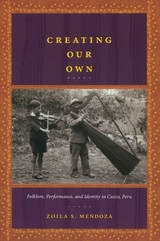
Creating Our Own
Folklore, Performance, and Identity in Cuzco, PeruZoila S. Mendoza
Duke University Press, 2007
Mendoza draws on early-twentieth-century newspapers and other archival documents as well as interviews with key artistic and intellectual figures and their descendants. She offers vivid descriptions of the Peruvian Mission of Incaic Art, a tour undertaken by a group of artists from Cuzco, at their own expense, to represent Peru to Bolivia, Argentina, and Uruguay in 1923–24, as well as of the origins in the 1920s of the Qosqo Center of Native Art, the first cultural institution dedicated to regional and national folkloric art. She highlights other landmarks, including both The Charango Hour, a radio show that contributed to the broad acceptance of rural Andean music from its debut in 1937, and the rise in that same year of another major cultural institution, the American Art Institute of Cuzco. Throughout, she emphasizes the intricate local, regional, national, and international pressures that combined to produce folkloric art, especially the growing importance of national and international tourism in Cuzco.
Please visit the Web site http://nas.ucdavis.edu/creatingbook for samples of the images and music discussed in this book.
Creating Spaniards
Culture and National Identity in Republican SpainSandie Holguin
University of Wisconsin Press, 2002
Creating Spaniards is a cultural and intellectual history that explains the intersection of politics and culture, and the formation of a national identity, during Spain’s Second Republic and Civil War. It counters recent scholarship claiming that leaders of the Second Republic had no programs for "inventing traditions" to encourage a Spanish national identity.
Focusing on the Second Republic, 1931–1936, Sandie Holguín illustrates how various intellectuals and politicians of the Republican–Socialist coalition used theater, literature, and film to aid the construction of a unified Spanish culture and history. She uses memoirs, journals, newspapers, parliamentary debates, and archival sources in her examination of the impact that cultural reforms had on the transformation of one of Europe’s oldest states.
Creole Indigeneity
Between Myth and Nation in the CaribbeanShona N. Jackson
University of Minnesota Press, 2012
During the colonial period in Guyana, the country’s coastal lands were worked by enslaved Africans and indentured Indians. In Creole Indigeneity, Shona N. Jackson investigates how their descendants, collectively called Creoles, have remade themselves as Guyana’s new natives, displacing indigenous peoples in the Caribbean through an extension of colonial attitudes and policies.
Looking particularly at the nation’s politically fraught decades from the 1950s to the present, Jackson explores aboriginal and Creole identities in Guyanese society. Through government documents, interviews, and political speeches, she reveals how Creoles, though unable to usurp the place of aboriginals as First Peoples in the New World, nonetheless managed to introduce a new, more socially viable definition of belonging, through labor. The very reason for bringing enslaved and indentured workers into Caribbean labor became the organizing principle for Creoles’ new identities.
Creoles linked true belonging, and so political and material right, to having performed modern labor on the land; labor thus became the basis for their subaltern, settler modes of indigeneity—a contradiction for belonging under postcoloniality that Jackson terms “Creole indigeneity.” In doing so, her work establishes a new and productive way of understanding the relationship between national power and identity in colonial, postcolonial, and anticolonial contexts.
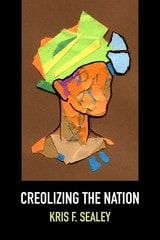
Creolizing the Nation
Kris F. Sealey
Northwestern University Press, 2020
Winner, 2022 Nicolás Cristóbal Guillén Batista Outstanding Book Award
Creolizing the Nation identifies the nation-form as a powerful resource for political struggles against colonialism, racism, and other manifestations of Western hegemony in the Global South even as it acknowledges the homogenizing effects of the politics of nationalism. Drawing on Caribbean, decolonial, and Latina feminist resources, Kris F. Sealey argues that creolization provides a rich theoretical ground for rethinking the nation and deploying its political and cultural apparatus to imagine more just, humane communities.
Analyzing the work of thinkers such as Édouard Glissant, Frantz Fanon, Gloria Anzaldúa, María Lugones, and Mariana Ortega, Sealey shows that a properly creolizing account of the nation provides an alternative imaginary out of which collective political life might be understood. Creolizing practices are always constitutive of anticolonial resistance, and their ongoing negotiations with power should be understood as everyday acts of sabotage. Sealey demonstrates that the conceptual frame of the nation is not fated to re-create colonial instantiations of nationalism but rather can support new possibilities for liberation and justice.
Czecho/Slovakia
Ethnic Conflict, Constitutional Fissure, Negotiated BreakupEric Stein
University of Michigan Press, 2000