Results by title
208 books match the query 'Ohio' and 19 start with c
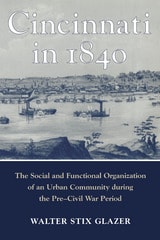
CINCINNATI IN 1840
The Social and Functional Organization of an Urban Community during the Pre-Civil War PeriodWALTER STIX GLAZER
The Ohio State University Press, 1999
During the pre-Civil War period, Cincinnati was the fastest growing and, according to many contemporary observers, most interesting city in America. This classic study, completed in the early 1970s, focuses on the community in 1840 to explain its success but also to suggest some broader patterns in the city’s development and American urbanization.
Using local census records, city directories, tax lists, newspapers, and other contemporary sources, Walter Stix Glazer describes the demographic, social, economic, and political structure of the adult white male population in 1840 and then develops a unified model of its social and functional organizations. This analysis (based on computerized records of thousands of Cincinnatians) also documents some broader trends between 1820 and 1860: the volatility of Cincinnati’s labor force, the career patterns of its homeowners, and the leadership of a small group of successful citizens active in a broad range of voluntary associations.
This statistical analysis is complemented with sections of traditional historical narrative and biographical profiles that illustrate the general themes of the book. Glazer argues that Cincinnati’s success up to 1840 was due to a unified booster vision and a cohesive community elite that gradually broke down, as a result of ethnic and economic division, over the next twenty years. This story has broader implications in terms of the character of Jacksonian democracy and American urbanization.
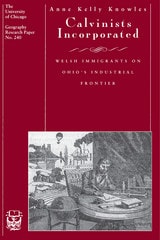
Calvinists Incorporated
Welsh Immigrants on Ohio's Industrial FrontierAnne Kelly Knowles
University of Chicago Press, 1996
capitalist transformation, Anne Kelly Knowles traces a community of
Welsh immigrants to Jackson and Gallia counties in southern Ohio. After
reconstructing the gradual process of community-building, Knowles
focuses on the pivotal moment when the immigrants became involved with
the industrialization of their new region as workers and investors in
Welsh-owned charcoal iron companies. Setting the southern Ohio Welsh in
the context of Welsh immigration as a whole from 1795 to 1850, Knowles
explores how these strict Calvinists responded to the moral dilemmas
posed by leaving their native land and experiencing economic success in
the United States.
Knowles draws on a wide variety of sources, including obituaries and
community histories, to reconstruct the personal histories of over 1,700
immigrants. The resulting account will find appreciative readers not
only among historical geographers, but also among American economic
historians and historians of religion.
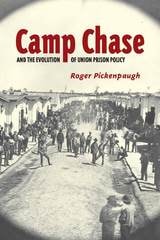
Camp Chase and the Evolution of Union Prison Policy
Roger Pickenpaugh
University of Alabama Press, 2007
Camp Chase was a major Union POW camp and also served at various times as a Union military training facility and as quarters for Union soldiers who had been taken prisoner by the Confederacy and released on parole or exchanged. As such, this careful, thorough, and objective examination of the history and administration of the camp will be of true significance in the literature on the Civil War.
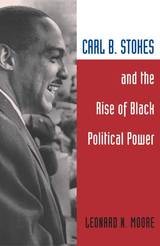
Carl B. Stokes and the Rise of Black Political Power
Leonard N. Moore
University of Illinois Press, 2002
In this wide-ranging political biography, Leonard N. Moore examines the convictions and alliances that brought Stokes to power. Impelled by the problems plaguing Cleveland's ghettos in the decades following World War II, Stokes and other Clevelanders questioned how the sit-ins and marches of the civil rights movement could correct the exclusionary zoning practices, police brutality, substandard housing, and de facto school segregation that African Americans in the country's northern urban centers viewed as evidence of their oppression.
As civil unrest in the country's ghettos turned to violence in the 1960s, Cleveland was one of the first cities to heed the call of Malcolm X's infamous "The Ballot or the Bullet" speech. Understanding the importance of controlling the city's political system, Cleveland's blacks utilized their substantial voting base to put Stokes in office in 1967.
Stokes was committed to showing the country that an African American could be an effective political leader. He employed an ambitious and radically progressive agenda to clean up Cleveland's ghettos, reform law enforcement, move public housing to middle-class neighborhoods, and jump-start black economic power. Hindered by resistance from the black middle class and the Cleveland City Council, spurned by the media and fellow politicians who deemed him a black nationalist, and unable to prove that black leadership could thwart black unrest, Stokes finished his four years in office with many of his legislative goals unfulfilled.
Focusing on Stokes and Cleveland, but attending to themes that affected many urban centers after the second great migration of African Americans to the North, Moore balances Stokes's failures and successes to provide a thorough and engaging portrait of his life and his pioneering contributions to a distinct African American political culture that continues to shape American life.
Cast a Blue Shadow
An Amish Country MysteryP. L. Gaus
Ohio University Press, 2003
In Cast a Blue Shadow, his fourth Amish mystery, P. L. Gaus spins a suspenseful tale of power, pride, and tested faith. As always, Gaus explores the threshold of culture and faith among the Amish sects and their English neighbors, combining it here with the political divisions unique to the academic world.
After an early winter blizzard in Holmes County, Ohio, a wealthy socialite is found murdered in her mansion. That same morning, a troubled student, Martha Lehman, turns up at her psychiatrist’s office, bloody and unable to speak.
Professor Michael Branden and Sheriff Bruce Robertson begin an investigation that threatens to tear Millersburg College apart. Mute for many years as a child, Martha is once again unable (or unwilling) to speak. As Branden wrestles with the murder of the college’s leading benefactor, the real story of Martha Lehman begins to emerge—born Amish, converted to Mennonite, and drawn to the “English” world for the worst of reasons.
This new edition of Cast a Blue Shadow features an exclusive interview with the author, reading group materials, and a detailed map and driving guide to Holmes County, Ohio, with everything one needs to visit the iconic scenes depicted in the story.
Cast a Blue Shadow
An Amish Country MysteryP. L. Gaus
Ohio University Press, 2003
In Cast a Blue Shadow, his fourth Amish mystery, P. L. Gaus spins a suspenseful tale of power, pride, and tested faith. As always, Gaus explores the threshold of culture and faith among the Amish sects and their English neighbors, combining it here with the political divisions unique to the academic world.
After an early winter blizzard in Holmes County, Ohio, a wealthy socialite is found murdered in her mansion. That same morning, a troubled student, Martha Lehman, turns up at her psychiatrist’s office, bloody and unable to speak.
Professor Michael Branden and Sheriff Bruce Robertson begin an investigation that threatens to tear Millersburg College apart. Mute for many years as a child, Martha is once again unable (or unwilling) to speak. As Branden wrestles with the murder of the college’s leading benefactor, the real story of Martha Lehman begins to emerge—born Amish, converted to Mennonite, and drawn to the “English” world for the worst of reasons.
This new edition of Cast a Blue Shadow features an exclusive interview with the author, reading group materials, and a detailed map and driving guide to Holmes County, Ohio, with everything one needs to visit the iconic scenes depicted in the story.
Charisma under Pressure
Joseph Smith, American Prophet, 1831–1839Dan Vogel
Signature Books, 2023
But just who was Joseph Smith? What motivated him? In examining Smith’s life during his Ohio and Missouri sojourns, Vogel seeks to answer those questions. But, Vogel is quick to note, “There are, in fact, many possible constructions of Joseph Smith, and depending on how one assesses the evidence for his truth-claims, a completely different Joseph Smith emerges. But this is probably as Smith wanted it.”
During this period, Smith established a temple, printing presses, additional scripture, expanded church offices, and built a bank—all indicating a sense of permanence and strength for his young church at one level while causing its near collapse at another.
Citizen-General
Jacob Dolson Cox and the Civil War EraEugene D. Schmiel
Ohio University Press, 2014
The wrenching events of the Civil War transformed not only the United States but also the men unexpectedly called on to lead their fellow citizens in this first modern example of total war. Jacob Dolson Cox, a former divinity student with no formal military training, was among those who rose to the challenge. In a conflict in which “political generals” often proved less than competent, Cox, the consummate citizen general, emerged as one of the best commanders in the Union army.
During his school days at Oberlin College, no one could have predicted that the intellectual, reserved, and bookish Cox possessed what he called in his writings the “military aptitude” to lead men effectively in war. His military career included helping secure West Virginia for the Union; jointly commanding the left wing of the Union army at the critical Battle of Antietam; breaking the Confederate supply line and thereby precipitating the fall of Atlanta; and holding the defensive line at the Battle of Franklin, a Union victory that effectively ended the Confederate threat in the West.
At a time when there were few professional schools other than West Point, the self-made man was the standard for success; true to that mode, Cox fashioned himself into a Renaissance man. In each of his vocations and avocations—general, governor, cabinet secretary, university president, law school dean, railroad president, historian, and scientist—he was recognized as a leader. Cox’s greatest fame, however, came to him as the foremost participant historian of the Civil War. His accounts of the conflict are to this day cited by serious scholars and serve as a foundation for the interpretation of many aspects of the war.
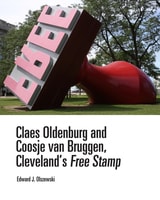
Claes Oldenburg and Coosje van Bruggen, Cleveland’s Free Stamp
Cleveland’s Free StampEdward J. Olszewski
Ohio University Press, 2017
In 1985, the Sohio oil company commissioned Claes Oldenburg and Coosje van Bruggen to design and construct a large outdoor sculpture for its new corporate headquarters in Cleveland, Ohio. The result was Free Stamp, a bold and distinctive installation that captured both a Pop Art sensibility and a connection to the city’s industrial past. Sohio executives approved the design, and work was already underway, when British Petroleum acquired the company. The new owners quickly decided that the sculpture was “inappropriate” for their building and attempted to rid themselves of Free Stamp by donating it to the city of Cleveland—a gift that the city initially had no desire to accept. After much debate and public protest, the sculpture found a home in Willard Park, where it stands today.
This is the first study of any sculpture by Oldenburg and van Bruggen to examine the genesis of their art from conception to installation. Edward J. Olszewski has put together a fascinating narrative based on interviews with the artists, archival material from city records, and in-house corporate memoranda, as well as letters to the editor and political cartoons. He traces the development of the sculpture from the artists’ first sketches and models to the installation of the completed work in its urban environment.
Cleveland Architecture 1890–1930
Building the City BeautifulJeannine deNobel Love
Michigan State University Press, 2020
Cleveland Jews and the Making of a Midwestern Community
Sean Martin
Rutgers University Press, 2020
Clouds Without Rain
An Amish Country MysteryP. L. Gaus
Ohio University Press, 2001
Written in the tradition of Tony Hillerman, in Clouds without Rain, P. L. Gaus once again provides compelling intrigue and insight into Amish culture and tradition alongside contemporary American life.
In the wake of a fatal accident involving an Amish buggy and an eighteen-wheeler, Professor Michael Branden, working with the Holmes County Sheriff’s Department, becomes suspicious about the true nature of the crash. His suspicions only grow when the trustee of the dead man’s estate disappears a few days later.
Faced with Amish teenagers in goat masks robbing buggies on dusty lanes, land swindles involving out-of-town developers, several mysterious deaths, and the disappearance of a bank official, Branden realizes that there is far more to the story than a buggy crash on a sleepy country road.
This new edition of Clouds without Rain features an exclusive interview with the author, reading group materials, and a detailed map and driving guide to Holmes County, Ohio with everything one needs to visit the iconic scenes depicted in the story.
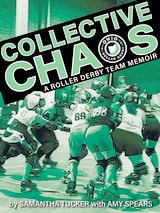
Collective Chaos
A Roller Derby Team MemoirSamantha Tucker
Ohio University Press, 2023
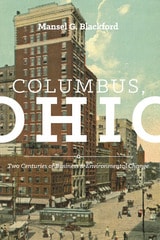
Columbus, Ohio
Two Centuries of Business and Environmental ChangeMansel G. Blackford
The Ohio State University Press, 2016
Precisely because they lived in a midsize, midwestern city, Columbus residents could learn from the earlier experiences of their counterparts in older, larger coastal metropolises, and then go beyond them. Not having large sunk costs in pre-existing water systems, Columbus residents could, for instance, develop new, world-class, state-of-the-art methods for treating water and sewage, steps essential for urban expansion. Columbus, Ohio explores how city residents approached urban challenges—especially economic and environmental ones—and how they solved them.
Columbus, Ohio: Two Centuries of Business and Environmental Change concludes that scholars and policy makers need to pay much more attention to environmental issues in the shaping of cities, and that they need to look more closely at what midwestern metropolises accomplished, as opposed to simply examining coastal cities.
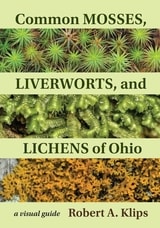
Common Mosses, Liverworts, and Lichens of Ohio
A Visual GuideRobert Klips
Ohio University Press, 2022
This engaging illustrated guidebook reveals the fascinating mosses and lichens that homeowners, outdoorspeople, and nature lovers encounter every day in Ohio and the Midwest.
In this guide to the most common and distinctive moss, liverwort, and lichen species in Ohio, readers will find concise physical descriptions, facts about natural history and ecology, and tips to distinguish look-alike species, all presented in a friendly, conversational tone.
Featuring detailed photographs of the plant and plantlike species in their natural settings, the book covers 106 mosses, thirty liverworts, and one hundred lichens and offers several avenues to match a specimen to its description page. “Where They Grow” chapters spotlight species commonly encountered on field outings, and field keys to help readers quickly identify unfamiliar samples.
While designed primarily as an identification tool, this guide also frames moss and lichen spotting in a scientific context. The two main sections—bryophytes and lichens—detail their respective taxonomic kingdoms, explain their life cycles and means of reproduction, and illustrate variation in the traits used for identification. The book is an introduction to the biology of these intriguing but too-often-overlooked organisms and a means to enjoy, identify, and catalog the biodiversity all around us.

Community In-Between / Urur Dhex Dhexad Ah
Portraits of Somali-Americans in ColumbusQorsho Hassan and Ruth M. Smith
The Ohio State University Press, 2017
A combination of storytelling and research connect each narrative to another, creating a strong framework for capturing the roles of young Somali Americans in community building through innovative initiatives such as designing a mixer bottle, beginning charitable programs, and educating the Somali community on voter rights. Two community artists help to capture the participants in their natural spaces, and their journey, aided by their empowering mentor, Riya Jama, bridges the gap of Somali females and their access to photography.
The portraits, stories, and artifacts throughout the book create a modicum of belonging. This new generation resiliently overcomes challenges such as racism, xenophobia, and Islamophobia while still maintaining their hope in the future. Community In-Between captures their spirit and unwavering faith.
The portraits, stories, and artifacts throughout the book create a modicum of belonging. This new generation resiliently overcomes challenges such as racism, xenophobia, and Islamophobia while still maintaining their hope in the future. Community In-Between captures their spirit and unwavering faith.
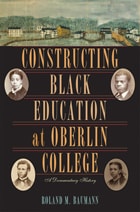
Constructing Black Education at Oberlin College
A Documentary HistoryRoland M. Baumann
Ohio University Press, 2010
In 1835 Oberlin became the first institute of higher education to make a cause of racial egalitarianism when it decided to educate students “irrespective of color.” Yet the visionary college’s implementation of this admissions policy was uneven. In Constructing Black Education at Oberlin College: A Documentary History, Roland M. Baumann presents a comprehensive documentary history of the education of African American students at Oberlin College.
Following the Reconstruction era, Oberlin College mirrored the rest of society as it reduced its commitment to black students by treating them as less than equals of their white counterparts. By the middle of the twentieth century, black and white student activists partially reclaimed the Oberlin legacy by refusing to be defined by race. Generations of Oberlin students, plus a minority of faculty and staff, rekindled the college’s commitment to racial equality by 1970. In time, black separatism in its many forms replaced the integrationist ethic on campus as African Americans sought to chart their own destiny and advance curricular change.
Oberlin’s is not a story of unbroken progress, but rather of irony, of contradictions and integrity, of myth and reality, and of imperfections. Baumann takes readers directly to the original sources by including thirty complete documents from the Oberlin College Archives. This richly illustrated volume is an important contribution to the college’s 175th anniversary celebration of its distinguished history, for it convincinglydocuments how Oberlin wrestled over the meaning of race and the destiny of black people in American society.
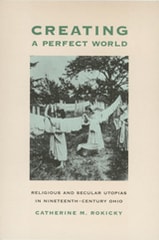
Creating a Perfect World
Religious and Secular Utopias in Nineteenth-Century OhioCatherine M. Rokicky
Ohio University Press, 2002
Powerful currents of religious revival and political and social reform swept nineteenth-century America. Many people expressed their radical religious and social ideals by creating or joining self-contained utopian communities. These utopianists challenged the existing social and economic order with alternative notions about religion, marriage, family, sexuality, property ownership, and wage labor.
Between 1787 and 1919, approximately 270 utopian communities existed in the United States. Due to its unique location on the young nation’s frontier, the state of Ohio was the site of much of this activity.
Creating a Perfect World examines Ohio’s utopian movements, both religious and secular. These include the United Society of Believers in Christ’s Second Coming, or Shakers; the Society of Separatists at Zoar; the Mormons, who stopped in the state for several years on their way west; and several societies based on the philosophies of European social reformers Robert Owen and Charles Fourier.
In this detailed account of a unique and fascinating chapter in Ohio’s history, Catherine M. Rokicky profiles these communities and explores their ideals, how and why they were established, their leaders, and their members’ reasons for joining and sometimes leaving. She also examines the roles men and women played, their approaches to communal living and community property, their economic activities, their relations with surrounding communities and the state, and the various reasons for their success or failure.
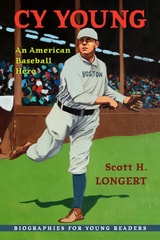
Cy Young
An American Baseball HeroScott H. Longert
Ohio University Press, 2020
Cy Young was one of the hardest-throwing pitchers of all time. He recorded three no-hitters—including a perfect game—and accumulated more than 2,800 strikeouts on his way to the National Baseball Hall of Fame. Scott H. Longert uses Young’s life story to introduce middle-grade readers to the game, explaining balls, strikes, and outs in an easy-to-understand way. Longert narrates each season and each milestone game with an enthusiastic play-by-play that is sure to draw readers into the excitement on the field and in the crowd, fostering a better understanding of and a passion for baseball.
Baseball fans today know Cy Young’s name chiefly through the award given in his honor each year to the best pitcher in the National and the American Leagues. Denton True “Cyclone” Young won more than five hundred games over a career that spanned four decades, a record that no other major league pitcher has come close to matching. In addition to being the winningest pitcher in baseball history, he was also a kind, self-effacing, and generous man. Born into a farm family in rural Ohio, he never lost touch with the small-town values he grew up with.