Results by title
137 books match the query 'Patients' and 7 start with c
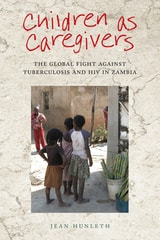
Children as Caregivers
The Global Fight against Tuberculosis and HIV in ZambiaHunleth, Jean
Rutgers University Press, 2017
In Zambia, due to the rise of tuberculosis and the closely connected HIV epidemic, a large number of children have experienced the illness or death of at least one parent. Children as Caregivers examines how well intentioned practitioners fail to realize that children take on active caregiving roles when their guardians become seriously ill and demonstrates why understanding children’s care is crucial for global health policy.
Using ethnographic methods, and listening to the voices of the young as well as adults, Jean Hunleth makes the caregiving work of children visible. She shows how children actively seek to “get closer” to ill guardians by providing good care. Both children and ill adults define good care as attentiveness of the young to adults’ physical needs, the ability to carry out treatment and medication programs in the home, and above all, the need to maintain physical closeness and proximity. Children understand that losing their guardians will not only be emotionally devastating, but that such loss is likely to set them adrift in Zambian society, where education and advancement depend on maintaining familial, reciprocal relationships.
View a gallery of images from the book (https://www.flickr.com/photos/childrenascaregivers)
Download the open access ebook.
Chronicling Idiopathic Pulmonary Fibrosis
A Collection of Personal StoriesSara Whisenant
Michigan Publishing Services, 2016
In “Chronicling Idiopathic Pulmonary Fibrosis: A Collection of Personal Stories,” you’ll hear the voices of real patients and family members as they talk about what worries them, the coping techniques they have tried and the bright spots of beauty they have found in the course of their journey with this disease. Readers will learn what IPF is and what it is not. They will find new resources and even some questions to help guide their own thoughts when reflecting on what an IPF diagnosis means to them.
The author is grateful to the FRIENDS of the University of Michigan Hospitals Patient Education Library for their generous support of this book. Proceeds from this book will be used to improve the patient experience at the University of Michigan Health System.
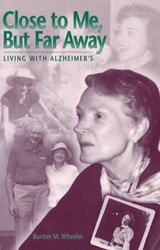
Close to Me, but Far Away
Living with Alzheimer'sBurton M. Wheeler
University of Missouri Press, 2001
Each day Burt Wheeler is plagued by the same question. When did it happen? If he could pinpoint the beginning, then he might begin to make peace with himself. He vividly remembers when the doctor diagnosed Kee, his loving wife of over fifty years, with "Alzheimer-type dementia." But, as hard as he tries, it's impossible for him to determine when his wife's dementia started. He remembers her bout with depression, but that, he thinks, was surely due to her breast cancer. There was their dream vacation to Greece when Kee seemed so tired and indifferent. There were the unopened books, when reading had always been such a source of pleasure to her. And, he recalls, the gradual personality changes with friends, and even with family.
Wheeler started writing this book as a form of self-therapy when he found himself thrust into the role of caretaker to his wife--a role for which he felt unprepared. He wrote in memory of the very special woman his wife had been—a wonderful mother, charming and gracious, as well as a deeply respected psychotherapist. She was also his best friend, and he loved her. So, to some degree, this is a love story—a story about two people who have shared life's ups and downs for over fifty years. It's also about commitment.
In Close to Me, but Far Away, Wheeler provides insight into what a caregiver's day is like, as he shares his most intimate thoughts with us. The book provides a window into the author's personal life as he seeks to confront his own ineptitude and the occasional despair he feels as he deals daily with Alzheimer's. He also touches on the question of what keeps him going through times of exhaustion and frustration. Part of his answer lies in holding tenaciously to memories, and part lies in what he believes is a human's extraordinary capacity to continue plodding along simply because he must. Wheeler also believes in rejoicing in the beauty that can be experienced, and he believes in humor, humor achieved only by distancing ourselves from the events that so deeply engage us. And, of course, there is also the indefinable nature of love.
Alzheimer's is a terrifying and horrible disease, as much for loved ones as for the patient. Those who are caregivers or friends of Alzheimer's patients or caregivers will empathize with Burton Wheeler's story. And some might receive comfort from his words or learn from him. Because Alzheimer's is a disease that could affect anyone, Close to Me, but Far Away is a story that should be read by all.
Coming to My Senses
One Woman's Cochlear Implant JourneyClaire H. Blatchford
Gallaudet University Press, 2014
Complex Sorrow
Reflections on Cancer and an Abbreviated LifeMarianne Paget
Temple University Press, 1993
Confronting AIDS through Literature
The Responsibilities of RepresentationEdited by Judith Laurence Pastore
University of Illinois Press, 1993
Connective Tissue
Factory Accidents and Reconstructive Plastic Surgery in South IndiaLily N. Shapiro
Rutgers University Press, 2025
Connective Tissue revisits scholarship on factory labor by analyzing the accident as constitutive of the experience of work itself, and it refines existing conversations about the body, trauma, and care by introducing an analysis informed by theories of labor and production. Author Lily N. Shapiro argues that care does not happen in spite of or on the margins of capitalism, but rather that capitalism happens in and through care and caring relations. These experiences are intersected by identities of caste, class, and gender, and entangled in state discourse about labor rights, welfare, and industrial law.