212 books match the query 'Peru' and 13 start with c
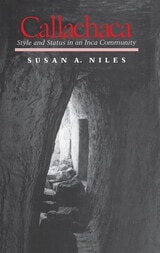
cover of Callachaca: Style Status In Inca Community

Callachaca

Style Status In Inca Community

Susan A. Niles

University of Iowa Press, 1987

Inca constructions, designed to conform to a state aesthetic, reveal the worldview of these masters of social and architectural engineering. In her meticulous analysis of Callachaca—the fifteenth-century estate of the royal Amaro Topa Inca and his retainers near the ancient capital of Cuzco—Susan Niles shows us that the physical order seen in this planned community reflects the Inca vision of an appropriate social order.

Callachaca: Style and Status in an Inca Community will be valuable reading for archaeologists, art historians, geographers, architects with an interest in pre-Columbian cultures, landscape architects, anthropologists, folklorists, and historians with a special interest in the Andes. Since she focuses on all the varied architectural remains at one site in the Inca heartland, Niles provides a unique model for examining royal Inca architecture and society.
[more]
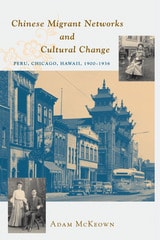
cover of Chinese Migrant Networks and Cultural Change: Peru, Chicago, and Hawaii 1900-1936

Chinese Migrant Networks and Cultural Change

Peru, Chicago, and Hawaii 1900-1936

Adam McKeown

University of Chicago Press, 2001
Inspired by recent work on diaspora and cultural globalization, Adam McKeown asks in this new book: How were the experiences of different migrant communities and hometowns in China linked together through common networks? Chinese Migrant Networks and Cultural Change argues that the political and economic activities of Chinese migrants can best be understood by taking into account their links to each other and China through a transnational perspective. Despite their very different histories, Chinese migrant families, businesses, and villages were connected through elaborate networks and shared institutions that stretched across oceans and entire continents. Through small towns in Qing and Republican China, thriving enclaves of businesses in South Chicago, broad-based associations of merchants and traders in Peru, and an auspicious legacy of ancestors in Hawaii, migrant Chinese formed an extensive system that made cultural and commercial exchange possible.
[more]
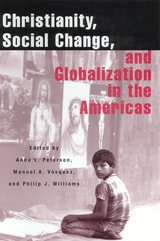
cover of Christianity, Social Change, and Globalization in the Americas

Christianity, Social Change, and Globalization in the Americas

Peterson, Anna L

Rutgers University Press, 2001

This volume resulted from a collaborative research project into responses of Protestant and Catholic religious communities in the Americas to the challenges of globalization. Contributors from the fields of religion, anthropology, political science, and sociology draw on fieldwork in Peru, El Salvador, and the United States to show the interplay of economic globalization, migration, and growing religious pluralism in Latin America.

Organized around three central themes-family, youth, and community; democratization, citizenship, and political participation; and immigration and transnationalism-the book argues that, at the local level, religion helps people, especially women and youths, solidify their identities and confront the challenges of the modern world. Religious communities are seen as both peaceful venues for people to articulate their needs, and forums for building participatory democracies in the Americas. Finally, the contributors examine how religion enfranchises poor women, youths, and people displaced by war or economic change and, at the same time, drives social movements that seek to strengthen family and community bonds disrupted by migration and political violence.
[more]
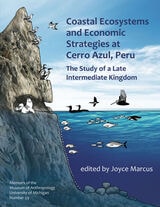
cover of Coastal Ecosystems and Economic Strategies at Cerro Azul, Peru: The Study of a Late Intermediate Kingdom

Coastal Ecosystems and Economic Strategies at Cerro Azul, Peru

The Study of a Late Intermediate Kingdom

Edited by Joyce Marcus

University of Michigan Press, 2016
Cerro Azul, a pre-Inca fishing community in the Kingdom of Huarco, Peru, stood at the interface between a rich marine ecosystem and an irrigated coastal plain. Under the direction of its noble families, Cerro Azul dried millions of fish for shipment to inland communities, from which it received agricultural products and dried llama meat.
[more]
cover of Coastal Lives: Nature, Capital, and the Struggle for Artisanal Fisheries in Peru

Coastal Lives

Nature, Capital, and the Struggle for Artisanal Fisheries in Peru

Maximilian Viatori and Héctor Bombiella

University of Arizona Press, 2019

Peru’s fisheries are in crisis as overfishing and ecological changes produce dramatic fluctuations in fish stocks. To address this crisis, government officials have claimed that fishers need to become responsible producers who create economic advantages by taking better care of the ocean ecologies they exploit.

In Coastal Lives, Maximilian Viatori and Héctor Bombiella argue that this has not made Peru’s fisheries more sustainable. Through a fine-grained ethnographic and historical account of Lima’s fisheries, the authors reveal that new government regimes of entrepreneurial agency have placed overwhelming burdens on the city’s impoverished artisanal fishers to demonstrate that they are responsible producers and have created failures that can be used to justify closing these fishers’ traditional use areas and to deny their historically sanctioned rights. The result is a critical examination of how neoliberalized visions of nature and individual responsibility work to normalize the dispossessions that have enabled ongoing capital accumulation at the cost of growing social dislocations and ecological degradation.

The authors’ innovative approach to the politics of constructing and degrading coastal lives will interest a wide range of scholars in cultural anthropology, environmental humanities, and Latin American studies, as well as policymakers and anyone concerned with inequality, global food systems, and multispecies ecologies.
[more]
cover of Coca Prohibition in Peru: The Historical Debates

Coca Prohibition in Peru

The Historical Debates

Joseph A. Gagliano

University of Arizona Press, 1994
The first book to provide a historical overview of coca. In tracing the arguments of the participants in the coca debates during the last four centuries, it surveys the role of the leaf in Peru's sociopolitical history, focusing on coca usage as a source of controversy for the policy makers among the coastal elites who have dominated Peruvian politics and economics since the Spanish conquest.
[more]
cover of Cocaine: White Gold Rush in Peru

Cocaine

White Gold Rush in Peru

Edmundo Morales

University of Arizona Press, 1989
Cocaine: Much is known about the damage done by this drug in the United States; yet how much is actually known of its impact at its source? Though most processed cocaine comes from Colombia, more than half of the coca paste from which the drug is made originates in the vast jungle slopes shared by Bolivia and Peru. People here have chewed coca leaves for centuries, but only over the last twenty years has coca become a major cash crop. Now it supports local economies, feeds inflation, and affects the social behavior of Peruvians. Edmundo Morales, a Peruvian who is now a drug researcher in the United States, has conducted an extensive study of this underground economy to show how cocaine has changed the social, cultural, economic, and political climate of Peru--and why government efforts are unable to stop it. With statistics on coca agriculture, a description of coca-paste manufacturing, and an examination of the industry's social structure, Morales's book is an inside look at the "white gold rush" that only a Peruvian could have written. It offers a new perspective for understanding a problem that is usually seen only as it affects our own society, and it proposes a new look at policies directed toward its control.
[more]
cover of Colonial Habits: Convents and the Spiritual Economy of Cuzco, Peru

Colonial Habits

Convents and the Spiritual Economy of Cuzco, Peru

Kathryn Burns

Duke University Press, 1999

In Colonial Habits Kathryn Burns transforms our view of nuns as marginal recluses, making them central actors on the colonial stage. Beginning with the 1558 founding of South America’s first convent, Burns shows that nuns in Cuzco played a vital part in subjugating Incas, creating a creole elite, and reproducing an Andean colonial order in which economic and spiritual interests were inextricably fused.
Based on unprecedented archival research, Colonial Habits demonstrates how nuns became leading guarantors of their city’s social order by making loans, managing property, containing “unruly” women, and raising girls. Coining the phrase “spiritual economy” to analyze the intricate investments and relationships that enabled Cuzco’s convents and their backers to thrive, Burns explains how, by the late 1700s, this economy had faltered badly, making convents an emblem of decay and a focal point for intense criticism of a failing colonial regime. By the nineteenth century, the nuns had retreated from their previous roles, marginalized in the construction of a new republican order.
Providing insight that can be extended well outside the Andes to the relationships articulated by convents across much of Europe, the Americas, and beyond, Colonial Habits will engage those interested in early modern economics, Latin American studies, women in religion, and the history of gender, class, and race.
[more]
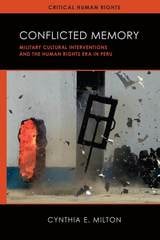
cover of Conflicted Memory: Military Cultural Interventions and the Human Rights Era in Peru

Conflicted Memory

Military Cultural Interventions and the Human Rights Era in Peru

Cynthia E. Milton

University of Wisconsin Press, 2018

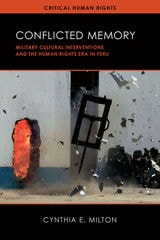
What happens when concepts of "truth," "memory," and "human rights" are taken up and adapted by former perpetrators of violence? Peru has moved from the 1980s–90s conflict between its armed forces and Shining Path militants into an era of open democracy, transitional justice, and truth and reconciliation commissions. Cynthia Milton reveals how Peru's military has engaged in a tactical cultural campaign—via books, films, museums—to shift public opinion, debate, and memories about the nation's violent recent past and its part in it.

Milton calls attention to fabrications of our post-truth era but goes further to deeply explore the ways members of the Peruvian military see their past, how they actively commemorate and curate it in the present, and why they do so. Her nuanced approach upends frameworks of memory studies that reduce military and ex-military to a predictable role of outright denial.
[more]
cover of Conflicted Memory: Military Cultural Interventions and the Human Rights Era in Peru

Conflicted Memory

Military Cultural Interventions and the Human Rights Era in Peru

Cynthia E. Milton

University of Wisconsin Press, 2020
Cynthia E. Milton reveals how Peru's military has engaged in a tactical cultural campaign—via books, films, museums—to shift public opinion, debate, and memories about the role it played in the nation's recent violent past. Milton calls attention to fabrications and goes further to deeply explore the ways members of the Peruvian military see their past, how they actively commemorate and curate it in the present, and why they do so. Her nuanced approach upends frameworks of memory studies that reduce military and ex-military to a predictable role of outright denial.
[more]
cover of Conflicts over Coca Fields in Sixteenth-Century Perú

Conflicts over Coca Fields in Sixteenth-Century Perú

María Rostworowski de Diez Canseco

University of Michigan Press, 1988
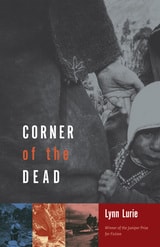
Many archaeologists and ethnohistorians use historic documents to help interpret prehistoric archaeological sequences. A sixteenth-century Spanish document called Justicia 413 has been instrumental in helping researchers understand conflict among the prehistoric polities of coastal Peru. Volume 4 of the subseries Studies in Latin American Ethnohistory & Archaeology.
[more]
cover of Corner of the Dead

Corner of the Dead

Lynn Lurie

University of Massachusetts Press, 2008

This powerful novel depicts the reign of violence perpetrated in Peru in the 1980s by the Shining Path guerrillas, a Maoist-based organization, and the subsequent authoritarian counterattack by the Peruvian government. It explores these horrific events through the eyes of a young American photojournalist and humanitarian worker, Lisette, who bears witness to the genocide of the Peruvian Indians in whose village she has chosen to live.

"I use the camera to block my view," says Lisette. This is the start of her double vision—trying to forget and trying to recall—and her struggle to come to terms with the human capacity for cruelty. But the grim reality in Peru is so overpowering that she carries it with her back to New York and through the rest of her life. Having abandoned a lover along with the fight, she desperately tries to find meaning beyond that of mere survival.
[more]
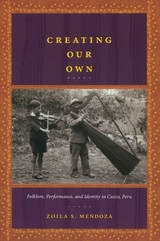
cover of Creating Our Own: Folklore, Performance, and Identity in Cuzco, Peru

Creating Our Own

Folklore, Performance, and Identity in Cuzco, Peru

Zoila S. Mendoza

Duke University Press, 2007

In Creating Our Own, anthropologist Zoila S. Mendoza explores the early-twentieth-century development of the “folkloric arts”—particularly music, dance, and drama—in Cuzco, Peru, revealing the central role that these expressive practices played in shaping ethnic and regional identities. Mendoza argues that the folkloric productions emerging in Cuzco in the early twentieth century were integral to, rather than only a reflection of, the social and political processes underlying the development of the indigenismo movement. By demonstrating how Cuzco’s folklore emerged from complex interactions between artists and intellectuals of different social classes, she challenges the idea that indigenismo was a project of the elites.

Mendoza draws on early-twentieth-century newspapers and other archival documents as well as interviews with key artistic and intellectual figures and their descendants. She offers vivid descriptions of the Peruvian Mission of Incaic Art, a tour undertaken by a group of artists from Cuzco, at their own expense, to represent Peru to Bolivia, Argentina, and Uruguay in 1923–24, as well as of the origins in the 1920s of the Qosqo Center of Native Art, the first cultural institution dedicated to regional and national folkloric art. She highlights other landmarks, including both The Charango Hour, a radio show that contributed to the broad acceptance of rural Andean music from its debut in 1937, and the rise in that same year of another major cultural institution, the American Art Institute of Cuzco. Throughout, she emphasizes the intricate local, regional, national, and international pressures that combined to produce folkloric art, especially the growing importance of national and international tourism in Cuzco.

Please visit the Web site http://nas.ucdavis.edu/creatingbook for samples of the images and music discussed in this book.

[more]