Results by title
2018 books match the query 'Political aspects' and 167 start with c
COVID and...
How to Do Rhetoric in a PandemicEmily Winderman
Michigan State University Press, 2023
Caesar in Gaul and Rome
War in WordsBy Andrew M. Riggsby
University of Texas Press, 2006
Winner, AAP/PSP Award for Excellence, Classics and Ancient History, 2006
Anyone who has even a passing acquaintance with Latin knows "Gallia est omnis divisa in partes tres" ("All Gaul is divided into three parts"), the opening line of De Bello Gallico, Julius Caesar's famous commentary on his campaigns against the Gauls in the 50s BC. But what did Caesar intend to accomplish by writing and publishing his commentaries, how did he go about it, and what potentially unforeseen consequences did his writing have? These are the questions that Andrew Riggsby pursues in this fresh interpretation of one of the masterworks of Latin prose.
Riggsby uses contemporary literary methods to examine the historical impact that the commentaries had on the Roman reading public. In the first part of his study, Riggsby considers how Caesar defined Roman identity and its relationship to non-Roman others. He shows how Caesar opens up a possible vision of the political future in which the distinction between Roman and non-Roman becomes less important because of their joint submission to a Caesar-like leader. In the second part, Riggsby analyzes Caesar's political self-fashioning and the potential effects of his writing and publishing the Gallic War. He reveals how Caesar presents himself as a subtly new kind of Roman general who deserves credit not only for his own virtues, but for those of his soldiers as well. Riggsby uses case studies of key topics (spatial representation, ethnography, virtus and technology, genre, and the just war), augmented by more synthetic discussions that bring in evidence from other Roman and Greek texts, to offer a broad picture of the themes of national identity and Caesar's self-presentation.
California Mission Landscapes
Race, Memory, and the Politics of HeritageElizabeth Kryder-Reid
University of Minnesota Press, 2016
“Nothing defines California and our nation’s heritage as significantly or emotionally,” says the California Mission Foundation, “as do the twenty-one missions that were founded along the coast from San Diego to Sonoma.” Indeed, the missions collectively represent the state’s most iconic tourist destinations and are touchstones for interpreting its history. Elementary school students today still make model missions evoking the romanticized versions of the 1930s. Does it occur to them or to the tourists that the missions have a dark history?
California Mission Landscapes is an unprecedented and fascinating history of California mission landscapes from colonial outposts to their reinvention as heritage sites through the late nineteenth and twentieth centuries. Illuminating the deeply political nature of this transformation, Elizabeth Kryder-Reid argues that the designed landscapes have long recast the missions from sites of colonial oppression to aestheticized and nostalgia-drenched monasteries. She investigates how such landscapes have been appropriated in social and political power struggles, particularly in the perpetuation of social inequalities across boundaries of gender, race, class, ethnicity, and religion. California Mission Landscapes demonstrates how the gardens planted in mission courtyards over the past 150 years are not merely anachronistic but have become potent ideological spaces. The transformation of these sites of conquest into physical and metaphoric gardens has reinforced the marginalization of indigenous agency and diminished the contemporary consequences of colonialism. And yet, importantly, this book also points to the potential to create very different visitor experiences than these landscapes currently do.
Despite the wealth of scholarship on California history, until now no book has explored the mission landscapes as an avenue into understanding the politics of the past, tracing the continuum between the Spanish colonial period, emerging American nationalism, and the contemporary heritage industry.

Calling Memory into Place
Dora Apel
Rutgers University Press, 2021
In this deeply personal work, acclaimed art historian Dora Apel examines how memorials, photographs, artworks, and autobiographical stories can be used to fuel a process of “unforgetting”—reinterpreting the past by recalling the events, people, perspectives, and feelings that get excluded from conventional histories. The ten essays in Calling Memory into Place feature explorations of the controversy over a painting of Emmett Till in the Whitney Biennial and the debates about a national lynching memorial in Montgomery, Alabama. They also include personal accounts of Apel’s return to the Polish town where her Holocaust survivor parents grew up, as well as the ways she found strength in her inherited trauma while enduring treatment for breast cancer.
These essays shift between the scholarly, the personal, and the visual as different modes of knowing, and explore the intersections between racism, antisemitism, and sexism, while suggesting how awareness of historical trauma is deeply inscribed on the body. By investigating the relations among place, memory, and identity, this study shines a light on the dynamic nature of memory as it crosses geography and generations.
Camera Orientalis
Reflections on Photography of the Middle EastAli Behdad
University of Chicago Press, 2016
Considering a range of Western and Middle Eastern archival material from the late nineteenth and early twentieth centuries, Ali Behdad offers a rich account of how photography transformed Europe’s distinctly Orientalist vision into what seemed objective fact, a transformation that proved central to the project of European colonialism. At the same time, Orientalism was useful for photographers from both regions, as it gave them a set of conventions by which to frame exotic Middle Eastern cultures for Western audiences. Behdad also shows how Middle Eastern audiences embraced photography as a way to foreground status and patriarchal values while also exoticizing other social classes.
An important examination of previously overlooked European and Middle Eastern photographers and studios, Camera Orientalis demonstrates that, far from being a one-sided European development, Orientalist photography was the product of rich cultural contact between the East and the West.
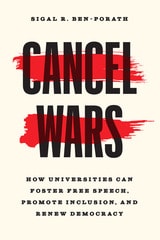
Cancel Wars
How Universities Can Foster Free Speech, Promote Inclusion, and Renew DemocracySigal R. Ben-Porath
University of Chicago Press, 2023
College campuses have become flashpoints of the current culture war and, consequently, much ink has been spilled over the relationship between universities and the cultivation or coddling of young American minds. Philosopher Sigal R. Ben-Porath takes head-on arguments that infantilize students who speak out against violent and racist discourse on campus or rehash interpretations of the First Amendment. Ben-Porath sets out to demonstrate the role of the university in American society and, specifically, how it can model free speech in ways that promote democratic ideals.
In Cancel Wars, she argues that the escalating struggles over “cancel culture,” “safe spaces,” and free speech on campus are a manifestation of broader democratic erosion in the United States. At the same time, she takes a nuanced approach to the legitimate claims of harm put forward by those who are targeted by hate speech. Ben-Porath’s focus on the boundaries of acceptable speech (and on the disproportional impact that hate speech has on marginalized groups) sheds light on the responsibility of institutions to respond to extreme speech in ways that proactively establish conversations across difference. Establishing these conversations has profound implications for political discourse beyond the boundaries of collegiate institutions. If we can draw on the truth, expertise, and reliable sources of information that are within the work of academic institutions, we might harness the shared construction of knowledge that takes place at schools, colleges, and universities against truth decay. Of interest to teachers and school leaders, this book shows that by expanding and disseminating knowledge, universities can help rekindle the civic trust that is necessary for revitalizing democracy.

Cancer Activism
Gender, Media, and Public PolicyKaren M. Kedrowski and Marilyn Stine Sarow
University of Illinois Press, 2010
Cancer Activism explores the interplay between advocacy, the media, and public perception through an analysis of breast cancer and prostate cancer activist groups over a nearly twenty-year period. Despite both diseases having nearly identical mortality and morbidity rates, Karen M. Kedrowski and Marilyn Stine Sarow present evidence from more than 4,200 news articles to show that the different groups have had markedly different impacts. They trace the rise of each movement from its beginning and explore how discussions about the diseases appeared on media, public, and government agendas. In an important exception to the feminist tenet that women as a group hold less power than men, Kedrowski and Sarow demonstrate that the breast cancer movement is not only larger and better organized than the prostate cancer movement, it is also far more successful at shaping media coverage, public opinion, and government policy.
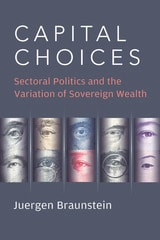
Capital Choices
Sectoral Politics and the Variation of Sovereign WealthJuergen Braunstein
University of Michigan Press, 2019
Sovereign wealth funds are state-controlled pools of capital that hold financial and real assets, including shares of state enterprises, and manage them to grow the nation’s base of sovereign wealth. The dramatic rise of sovereign wealth funds (SWFs) in both number and size—this group is now larger than the size of global private equity and hedge funds, combined—and the fact that most are located in non-OECD countries, has raised concern about the direction of capitalism. Yet SWFs are not a homogenous group of actors. Why do some countries with large current account surpluses, notably China, create SWFs while others, such as Switzerland and Germany, do not? Why do other countries with no macroeconomic justification, such as Senegal and Turkey, create SWFs? And why do countries with similar macroeconomic features, such as Kuwait and Qatar or Singapore and Hong Kong, choose different types of SWFs?
Capital Choices analyzes the creation of different SWFs from a comparative political economy perspective, arguing that different state-society structures at the sectoral level are the drivers for SWF variation. Juergen Braunstein focuses on the early formation period of SWFs, a critical but little understood area given the high levels of political sensitivity and lack of transparency that surround SWF creation. Braunstein’s novel analytical framework provides practical lessons for the business and finance organizations and policymakers of countries that have created, or are planning to create, SWFs.
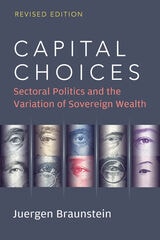
Capital Choices
Sectoral Politics and the Variation of Sovereign WealthJuergen Braunstein
University of Michigan Press, 2022
Sovereign wealth funds are state-controlled pools of capital that hold financial and real assets, including shares of state enterprises, and manage them to grow the nation’s base of sovereign wealth. The dramatic rise of sovereign wealth funds (SWFs) in both number and size—this group is now larger than the size of global private equity and hedge funds, combined—and the fact that most are located in non-OECD countries, has raised concern about the direction of capitalism. Yet SWFs are not a homogenous group of actors. Why do some countries with large current account surpluses, notably China, create SWFs while others, such as Switzerland and Germany, do not? Why do other countries with no macroeconomic justification, such as Senegal and Turkey, create SWFs? And why do countries with similar macroeconomic features, such as Kuwait and Qatar or Singapore and Hong Kong, choose different types of SWFs?
Capital Choices analyzes the creation of different SWFs from a comparative political economy perspective, arguing that different state-society structures at the sectoral level are the drivers for SWF variation. Juergen Braunstein focuses on the early formation period of SWFs, a critical but little understood area given the high levels of political sensitivity and lack of transparency that surround SWF creation. Braunstein’s novel analytical framework provides practical lessons for the business and finance organizations and policymakers of countries that have created, or are planning to create, SWFs.
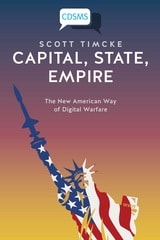
Capital, State, Empire
The New American Way of Digital WarfareScott Timcke
University of Westminster Press, 2017
The United States presents the greatest source of global geo-political violence and instability. Guided by the radical political economy tradition, this book offers an analysis of the USA’s historical impulse to weaponize communication technologies.
Scott Timcke explores the foundations of this impulse and how the militarization of digital society creates structural injustices and social inequalities. He analyses how new digital communication technologies support American paramountcy and conditions for worldwide capital accumulation. Identifying selected features of contemporary American society, Capital, State, Empire undertakes a materialist critique of this digital society and of the New American Way of War. At the same time it demonstrates how the American security state represses activists—such as Black Lives Matter—who resist this emerging security leviathan. The book also critiques the digital positivism behind the algorithmic regulation used to control labour and further diminish prospects for human flourishing for the ‘99%’.
Capital, State, Empire contributes to a broader understanding of the dynamics of global capitalism and political power in the early 21st century.
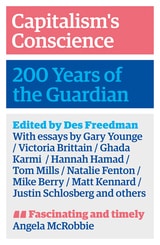
Capitalism's Conscience
200 Years of the GuardianDes Freedman
Pluto Press, 2021
Since its inception in Manchester in 1821 as a response to the 1819 Peterloo Massacre, the Guardian has been a key institution in the definition and development of liberalism. The stereotype of the 'Guardianista', an environmentally-conscious, Labour-voting, progressively-minded public sector worker endures in the popular mythology of British press history.
Yet the title has a complex lineage and occupies an equivocal position between capital and its opponents. It has both fiercely defended the need for fearless, independent journalism and handed over documents to the authorities; it has carved out a niche for itself in the UK media as a progressive voice but has also consistently diminished more radical projects on the left.
Published to coincide with its 200th anniversary, Capitalism's Conscience brings together historians, journalists and activists in an appraisal of the Guardian's contribution to British politics, society and culture - and its distinctive brand of centrism. Contextualising some of the main controversies in which the title has been implicated, the book offers timely insights into the publication's history, loyalties and political values.
Capitol Investments
The Marketability of Political SkillsGlenn R. Parker
University of Michigan Press, 2011
What would you do if, the very day you were hired, you knew you could be unemployed in as little as two years? You'd seek opportunities in your current job to develop a portfolio of skills and contacts in order to make yourself more attractive to future employers. Representatives and senators think about their jobs in Congress in this way, according to Glenn R. Parker.
While in office, members of Congress plan not merely for the next election but for the next stage of their careers. By networking, serving on committees, and championing particular legislation, they deliberately accumulate human capital---expertise, networks, and reputation---which later will give them bargaining power in the job market. Parker's study of the postelective careers of more than 200 former members of Congress, both U.S. representatives and senators, who have left office during the last half century shows that such strategic planning generally succeeds. In most cases, the human capital these politicians amassed while in office increased their occupational mobility and earning power.
Capitol Investments offers a sophisticated yet accessible analysis of the acquisition and marketability of political skills. It suggests that an awareness of the trade in human capital shapes an officeholder's actions as much as the desire to win another election.
Glenn R. Parker is Distinguished Professor in the Department of Political Science at Purdue University.
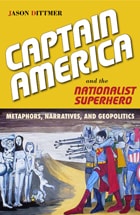
Captain America and the Nationalist Superhero
Metaphors, Narratives, and GeopoliticsJason Dittmer
Temple University Press, 2012
Nationalist superheroes—such as Captain America, Captain Canuck, and Union Jack—often signify the “nation-state” for readers, but how do these characters and comic books address issues of multiculturalism and geopolitical order? In his engaging book Captain America and the Nationalist Superhero, geographer Jason Dittmer traces the evolution of the comic book genre as it adapted to new national audiences. He argues that these iconic superheroes contribute to our contemporary understandings of national identity, the righteous use of power, and the role of the United States, Canada, and Britain in the world.
Tracing the nationalist superhero genre from its World War II origins to contemporary manifestations throughout the world, Captain America and the Nationalist Superhero analyzes nearly one thousand comic books and audience responses to those books. Dittmer also interviews key comic book writers from Stan Lee and J. M. DeMatteis to Steve Englehart and Paul Cornell.
At a time when popular culture is saturated with superheroes and their exploits, Captain America and the Nationalist Superhero highlights the unique relationship between popular culture and international relations.
Caribbean Inhospitality
The Poetics of Strangers at HomeNatalie Lauren Belisle
Rutgers University Press, 2025
Cartographic Mexico
A History of State Fixations and Fugitive LandscapesRaymond B. Craib
Duke University Press, 2004
Cartography and the Political Imagination
Mapping Community in Colonial KenyaJulie MacArthur
Ohio University Press, 2016
After four decades of British rule in colonial Kenya, a previously unknown ethnic name—“Luyia”—appeared on the official census in 1948. The emergence of the Luyia represents a clear case of ethnic “invention.” At the same time, current restrictive theories privileging ethnic homogeneity fail to explain this defiantly diverse ethnic project, which now comprises the second-largest ethnic group in Kenya.
In Cartography and the Political Imagination, which encompasses social history, geography, and political science, Julie MacArthur unpacks Luyia origins. In so doing, she calls for a shift to understanding geographic imagination and mapping not only as means of enforcing imperial power and constraining colonized populations, but as tools for articulating new political communities and dissent. Through cartography, Luyia ethnic patriots crafted an identity for themselves characterized by plurality, mobility, and cosmopolitan belonging.
While other historians have focused on the official maps of imperial surveyors, MacArthur scrutinizes the ways African communities adopted and adapted mapping strategies to their own ongoing creative projects. This book marks an important reassessment of current theories of ethnogenesis, investigates the geographic imaginations of African communities, and challenges contemporary readings of community and conflict in Africa.

Cartophilia
Maps and the Search for Identity in the French-German BorderlandCatherine Tatiana Dunlop
University of Chicago Press, 2015
Turning to a previously undiscovered archive of popular maps, Cartophilia reveals Alsace-Lorraine’s lively world of citizen mapmakers that included linguists, ethnographers, schoolteachers, hikers, and priests. Together, this fresh group of mapmakers invented new genres of maps that framed French and German territory in original ways through experimental surveying techniques, orientations, scales, colors, and iconography. In focusing on the power of “bottom-up” maps to transform modern European identities, Cartophilia argues that the history of cartography must expand beyond the study of elite maps and shift its emphasis to the democratization of cartography in the modern world.
Catastrophe
Law, Politics, and the Humanitarian ImpulseAustin Sarat
University of Massachusetts Press, 2009
At a time when societies are directing an unprecedented level of resources and ingenuity to anticipating and mitigating catastrophic events, Catastrophe: Law, Politics, and the Humanitarian Impulse examines the tests that catastrophe poses to politics and humanitarianism as well as to the law. It explores legal, political, and humanitarian responses during times when the sudden, discontinuous, and disastrous event has become, perhaps paradoxically, a structural component of our political imagination. It asks whether law, politics, and humanitarianism live up to the tests posed by disaster, and the role all of them play in creating a more resilient world.
Taken together the essays in this book ask us to see through and beyond the myths that surround catastrophe and our responses to it. They ask us to rethink our understanding of catastrophe and to imagine new legal, political, and humanitarian responses.
In addition to the editors, contributors include Thomas Birkland, Michele Landis Dauber, Kim Fortun, Edward Rackley, Peter Redfield, Peter H. Schuck, and Susan Sterett.
Celibacies
American Modernism and Sexual LifeBenjamin Kahan
Duke University Press, 2013
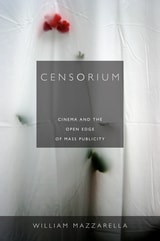
Censorium
Cinema and the Open Edge of Mass PublicityWilliam Mazzarella
Duke University Press, 2013
At the intersection of anthropology, media studies, and critical theory, Censorium is a pathbreaking analysis of Indian film censorship. The book encompasses two moments of moral panic: the consolidation of the cinema in the 1910s and 1920s, and the global avalanche of images unleashed by liberalization since the early 1990s. Exploring breaks and continuities in film censorship across colonial and postcolonial moments, William Mazzarella argues that the censors' obsessive focus on the unacceptable content of certain images and the unruly behavior of particular audiences displaces a problem that they constantly confront yet cannot directly acknowledge: the volatile relation between mass affect and collective meaning. Grounded in a close analysis of cinema regulation in the world's largest democracy, Censorium ultimately brings light to the elusive foundations of political and cultural sovereignty in mass-mediated societies.
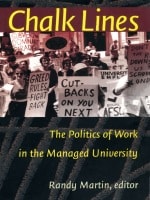
Chalk Lines
The Politics of Work in the Managed UniversityRandy Martin, ed.
Duke University Press, 1999
While tracing the socioeconomic conditions that have led to the present labor situation on campuses, the contributors consider such topics as the political implications of managerialism and the conceptual status of academic labor.
They examine the trend toward restructuring and downsizing, the particular plight of the adjunct professor, the growing emphasis on vocational training in the classroom, and union organizing among university faculty, staff, and graduate students. Placing such issues within the context of the history of labor movements as well as governmental initiatives to train a workforce capable of competing in the global economy, Chalk Lines explores how universities have attempted to remake themselves in the image of the corporate sector. Originally published as an issue of Social Text, this expanded volume, which includes four new essays, offers a broad view of academic labor in the United States.
With its important, timely contribution to debates concerning the future of higher education, Chalk Lines will interest a wide array of academics, administrators, policymakers, and others invested in the state—and fate—of academia.
Contributors. Stanley Aronowitz, Jan Currie, Zelda F. Gamson, Emily Hacker, Stefano Harney, Randy Martin, Bart Meyers, David Montgomery, Frederick Moten, Christopher Newfield, Gary Rhoades, Sheila Slaughter, Jeremy Smith, Vincent Tirelli, William Vaughn, Lesley Vidovich, Ira Yankwitt

Changing Minds or Changing Channels?
Partisan News in an Age of ChoiceKevin Arceneaux and Martin Johnson
University of Chicago Press, 2013
Changing Paths
International Development and the New Politics of InclusionPeter P. Houtzager and Mick Moore, Editors
University of Michigan Press, 2005
The contributors suggest there is little basis for the radical polycentrism that colors so much contemporary development thought. They focus on how the political capabilities of different societal and state actors develop over time and how their development is influenced by state action and a variety of institutional and other factors. The final chapter draws insightful conclusions about the political limitations and opportunities presented by current international discourse on poverty.
Peter P. Houtzager is a Fellow at the Institute of Development Studies, University of Sussex. He has been a visiting scholar at the Center for Latin American Studies, University of California, Berkeley, visiting lecturer at Stanford University, and lecturer at St. Mary's College. A political scientist with broad training in comparative politics and historical-institutional analysis, he has written extensively on the institutional roots of collective action.
Mick Moore is a Fellow at the Institute of Development Studies, University of Sussex, as well as Director of the Centre for the Future State. He has been a visiting professor at the Massachusetts Institute of Technology. His professional interests include political and institutional aspects of poverty reduction and of economic policy and performance, the politics and administration of development, and good government.
Changing the Subject in English Class
Discourse and the Constructions of DesiresMarshall W. Alcorn Jr.
Southern Illinois University Press, 2002
Drawing on the theoretical work of Jacques Lacan, Marshall W. Alcorn Jr. formulates a systematic explanation of the function and value of desire in writing instruction.
Alcorn argues that in changing the subject matter of writing instruction in order to change student opinions, composition instructors have come to adopt an insufficiently complex understanding of subjectivity. This oversimplification hinders attempts to foster cultural change. Alcorn proposes an alternative mode of instruction that makes effective use of students’ knowledge and desire. The resulting freedom in expression—personal as well as political—engenders the recognition, circulation, and elaboration of desire necessary for both human communication and effective politics.
Responding to James Berlin’s reconception of praxis in the classroom, Theresa Ebert’s espousal of disciplined instructions, and Lester Faigley’s introduction of a postmodern theory of subjectivity, Alcorn follows both Lacan and Slavoj Žižek in insisting desire be given free voice and serious recognition. In composition as in politics, desire is the ground of agency. Competing expressions of desire should generate a dialectic in social-epistemic discourse that encourages enlightenment over cynicism and social development over authoritarian demands.
With clarity and personal voice, Alcorn explains how discourse is rooted in primitive psychological functions of desire and responds to complex cultural needs. In its theoretical scope this book describes a new pedagogy that links thought to emotion and the personal to the social.
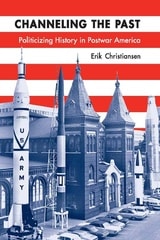
Channeling the Past
Politicizing History in Postwar AmericaErik Christiansen
University of Wisconsin Press, 2013
With insight and wit, Erik Christiansen uncovers in Channeling the Past the ways that powerful corporations rewrote history to strengthen the postwar corporate state, while progressives, communists, and other leftists vied to make their own versions of the past more popular. Christiansen looks closely at several notable initiatives—CBS’s flashback You Are There program; the Smithsonian Museum of American History, constructed in the late 1950s; the Cavalcade of America program sponsored by the Du Pont Company; the History Book Club; and the Freedom Train, a museum on rails that traveled the country from 1947 to 1949 exhibiting historic documents and flags, including original copies of the U.S. Constitution and the Magna Carta.
It is often said that history is written by the victors, but Christiansen offers a more nuanced perspective: history is constantly remade to suit the objectives of those with the resources to do it. He provides dramatic evidence of sophisticated calculations that influenced both public opinion and historical memory, and shows that Americans’ relationships with the past changed as a result.
Cheap Talk
Disability and the Politics of CommunicationJoshua St. Pierre
University of Michigan Press, 2022
Chican@ Artivistas
Music, Community, and Transborder Tactics in East Los AngelesMartha Gonzalez
University of Texas Press, 2020
As the lead singer of the Grammy Award–winning rock band Quetzal and a scholar of Chicana/o and Latina/o studies, Martha Gonzalez is uniquely positioned to articulate the ways in which creative expression can serve the dual roles of political commentary and community building. Drawing on postcolonial, Chicana, black feminist, and performance theories, Chican@ Artivistas explores the visual, musical, and performance art produced in East Los Angeles since the inception of NAFTA and the subsequent anti-immigration rhetoric of the 1990s.
Showcasing the social impact made by key artist-activists on their communities and on the mainstream art world and music industry, Gonzalez charts the evolution of a now-canonical body of work that took its inspiration from the Zapatista movement, particularly its masked indigenous participants, and that responded to efforts to impose systems of labor exploitation and social subjugation. Incorporating Gonzalez’s memories of the Mexican nationalist music of her childhood and her band’s journey to Chiapas, the book captures the mobilizing music, poetry, dance, and art that emerged in pre-gentrification corners of downtown Los Angeles and that went on to inspire flourishing networks of bold, innovative artivistas.
Chicano and Chicana Art
A Critical AnthologyJennifer A. Gonzalez, C. Ondine Chavoya, Chon Noriega, and Terezita Romo, editors
Duke University Press, 2019
Contributors. Carlos Almaraz, David Avalos, Judith F. Baca, Raye Bemis, Jo-Anne Berelowitz, Elizabeth Blair, Chaz Bojóroquez, Philip Brookman, Mel Casas, C. Ondine Chavoya, Karen Mary Davalos, Rupert García, Alicia Gaspar de Alba, Shifra Goldman, Jennifer A. González, Rita Gonzalez, Robb Hernández, Juan Felipe Herrera, Louis Hock, Nancy L. Kelker, Philip Kennicott, Josh Kun, Asta Kuusinen, Gilberto “Magu” Luján, Amelia Malagamba-Ansotegui, Amalia Mesa-Bains, Dylan Miner, Malaquias Montoya, Judithe Hernández de Neikrug, Chon Noriega, Joseph Palis, Laura Elisa Pérez, Peter Plagens, Catherine Ramírez, Matthew Reilly, James Rojas, Terezita Romo, Ralph Rugoff, Lezlie Salkowitz-Montoya, Marcos Sanchez-Tranquilino, Cylena Simonds, Elizabeth Sisco, John Tagg, Roberto Tejada, Rubén Trejo, Gabriela Valdivia, Tomás Ybarra-Frausto, Victor Zamudio-Taylor
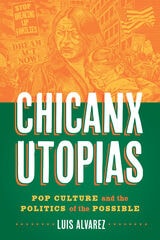
Chicanx Utopias
Pop Culture and the Politics of the PossibleLuis Alvarez
University of Texas Press, 2022
2023 Honorable Mention Best History Book, International Latino Book Awards
Broad and encompassing examination of Chicanx popular culture since World War II and the utopian visions it articulated
Amid the rise of neoliberalism, globalization, and movements for civil rights and global justice in the post–World War II era, Chicanxs in film, music, television, and art weaponized culture to combat often oppressive economic and political conditions. They envisioned utopias that, even if never fully realized, reimagined the world and linked seemingly disparate people and places. In the latter half of the twentieth century, Chicanx popular culture forged a politics of the possible and gave rise to utopian dreams that sprang from everyday experiences.
In Chicanx Utopias, Luis Alvarez offers a broad study of these utopian visions from the 1950s to the 2000s. Probing the film Salt of the Earth, brown-eyed soul music, sitcoms, poster art, and borderlands reggae music, he examines how Chicanx pop culture, capable of both liberation and exploitation, fostered interracial and transnational identities, engaged social movements, and produced varied utopian visions with divergent possibilities and limits. Grounded in the theoretical frameworks of Walter Benjamin, Stuart Hall, and the Zapatista movement, this book reveals how Chicanxs articulated pop cultural utopias to make sense of, challenge, and improve the worlds they inhabited.
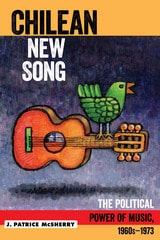
Chilean New Song
The Political Power of Music, 1960s - 1973J Patrice McSherry
Temple University Press, 2015
In Chilean New Song, J. Patrice McSherry deftly combines a political-historical view of Chile with a narrative of its cultural development. She examines the democratizing power of this music and, through interviews with key protagonists, the social roles of politically committed artists who participated in a movement for change. McSherry explores the impact of Chilean New Song and the way this artistic/cultural phenomenon related to contemporary politics to capture the passion, pain, and hope of millions of Chileans.
China and the Internet
Using New Media for Development and Social ChangeSong Shi
Rutgers University Press, 2024
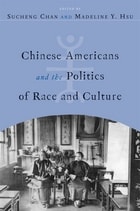
Chinese Americans and the Politics of Race and Culture
Sucheng Chan
Temple University Press, 2008
Sucheng Chan introduces this valuable new anthology with a commanding discussion of the field of Chinese American studies, in which she examines its history and points the way ahead. Here she and Madeline Y. Hsu have brought together leading-edge scholarship from a new generation of thinkers, as useful for scholars as it is for undergraduate readers.
The contributors address a broad range of issues, from the activism of left-wing and Communist Chinese immigrants to the U.S. in the 1920s and early 1930s and humanitarian relief during the Sino-Japanese War to the construction of new Chinese regional identities in New York.
Chinese Domestic Politics and Foreign Policy in the 1970s
Allen S. Whiting
University of Michigan Press, 1979
Chinese Immigrants, African Americans, and Racial Anxiety in the United States, 1848-82
Najia Aarim-Heriot
University of Illinois Press, 2003
The “Chinese question” and the “Negro problem” were bound up with one another in nineteenth-century America. Indeed, the negative stereotypes, exclusionary laws, and incendiary rhetoric employed against both populations bore striking similarities.
Najia Aarim-Heriot forcefully demonstrates that the anti-Chinese sentiment behind the passage of the Chinese Exclusion Act of 1882 is inseparable from the racial double standards applied by mainstream white society toward white and nonwhite groups during the same period. Aarim-Heriot argues that previous studies on American Sinophobia have overemphasized the resentment labor organizations felt toward incoming Chinese workers. As a result, scholars have overlooked the broader ways in which the growing nation sought to define and unify itself through the exclusion and oppression of nonwhite peoples.
A challenge to traditional approaches to Chinese American history, Chinese immigrants, African Americans, and Racial Anxiety in the United States, 1848–82 offers a holistic examination of American Sinophobia and the racialization of national immigration policies.

Chinese Modernism in the Era of Reforms
Cultural Fever, Avant-Garde Fiction, and the New Chinese CinemaXudong Zhang
Duke University Press, 1997
In examining the aesthetic and philosophical formulations of the New Era’s intellectual elites, Zhang first analyzes the intense cultural and intellectual debates, known as the “Great Cultural Discussion” or “Cultural Fever” that took place in Chinese urban centers in the mid- and late 1980s. Chinese literary modernism is then explored, specifically in relation to Deng Xiaoping’s sweeping reforms and with a focus on the changing literary sensibility and avant-garde writers such as Yu Hua, Ge Fei, and Su Tong. Lastly, Zhang looks at the the making of New Chinese Cinema and films such as Yellow Earth, Horse Thief, and King of the Children—films through which Fifth Generation filmmakers first developed a style independent from socialist realism. By tracing the origins and contemporary elaboration of the idea of Chinese modernism, Zhang identifies the discourse of modernism as one of the decisive formal articulations of the social dynamism and cultural possibilities of post-Mao China.
Capturing the historical experience and the cultural vision of China during a crucial decade in its emergence as a world power, Chinese Modernism in the Era of Reforms will interest students and scholars of modernism, Chinese literature and history, film studies, and cultural studies.

Chinese Netizens' Opinions on Death Sentences
An Empirical ExaminationBin Liang and Jianhong Liu
University of Michigan Press, 2021
Few social issues have received more public attention and scholarly debate than the death penalty. While the abolitionist movement has made a successful stride in recent decades, a small number of countries remain committed to the death penalty and impose it with a relatively high frequency. In this regard, the People’s Republic of China no doubt leads the world in both numbers of death sentences and executions. Despite being the largest user of the death penalty, China has never conducted a national poll on citizens’ opinions toward capital punishment, while claiming “overwhelming public support” as a major justification for its retention and use.
Chinese Netizens’ Opinions on Death Sentences: An Empirical Examination uses a forum of public comments to explore and examine Chinese netizens’ opinions on the death penalty. Based on a content analysis of 38,512 comments collected from 63 cases in 2015, this study examines the diversity and rationales of netizens’ opinions, netizens’ interactions, and their evaluation of China’s criminal justice system. In addition, the book discusses China’s social, systemic, and structural problems and critically examines the rationality of netizens’ opinions based on Habermas’s communicative rationality framework. Readers will be able to contextualize Chinese netizens’ discussions and draw conclusions about commonalities and uniqueness of China’s death penalty practice.
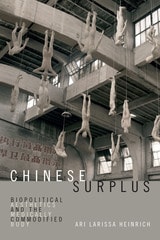
Chinese Surplus
Biopolitical Aesthetics and the Medically Commodified BodyAri Larissa Heinrich
Duke University Press, 2018
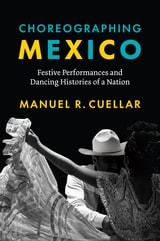
Choreographing Mexico
Festive Performances and Dancing Histories of a NationManuel R. Cuellar
University of Texas Press, 2022
2023 de la Torre Bueno® First Book Award, Dance Studies Association
The impact of folkloric dance and performance on Mexican cultural politics and national identity.
The years between 1910 and 1940 were formative for Mexico, with the ouster of Porfirio Díaz, the subsequent revolution, and the creation of the new state. Amid the upheaval, Mexican dance emerged as a key arena of contestation regarding what it meant to be Mexican. Through an analysis of written, photographic, choreographic, and cinematographic renderings of a festive Mexico, Choreographing Mexico examines how bodies in motion both performed and critiqued the nation.
Manuel Cuellar details the integration of Indigenous and regional dance styles into centennial celebrations, civic festivals, and popular films. Much of the time, this was a top-down affair, with cultural elites seeking to legitimate a hegemonic national character by incorporating traces of indigeneity. Yet dancers also used their moving bodies to challenge the official image of a Mexico full of manly vigor and free from racial and ethnic divisions. At home and abroad, dancers made nuanced articulations of female, Indigenous, Black, and even queer renditions of the nation. Cuellar reminds us of the ongoing political significance of movement and embodied experience, as folklórico maintains an important and still-contested place in Mexican and Mexican American identity today.
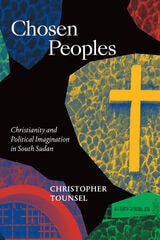
Chosen Peoples
Christianity and Political Imagination in South SudanChristopher Tounsel
Duke University Press, 2021
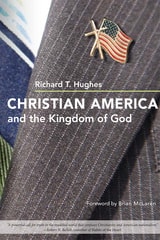
Christian America and the Kingdom of God
Richard T. Hughes
University of Illinois Press, 2012
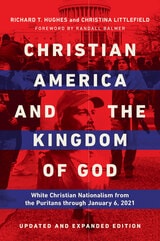
Christian America and the Kingdom of God
White Christian Nationalism from the Puritans through January 6, 2021Richard T. Hughes and Christina Littlefield
University of Illinois Press, 2025
A timely new edition of the acclaimed work, Christian America and the Kingdom of God spotlights how the centuries-long pursuit of a Christian America has bred an aggressive white Christian nationalism that twists faith, unleashes unchristian behavior, and threatens the nation.
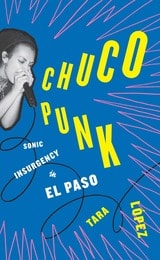
Chuco Punk
Sonic Insurgency in El PasoTara López
University of Texas Press, 2024
2025 Al Lowman Memorial Prize, Texas State Historical Association
An immersive study of the influential and predominantly Chicanx punk rock scene in El Paso, Texas.
Punk rock is known for its daring subversion, and so is the West Texas city of El Paso. In Chuco Punk, Tara López dives into the rebellious sonic history of the city, drawing on more than seventy interviews with punks, as well as unarchived flyers, photos, and other punk memorabilia. Connecting the scene to El Paso's own history as a borderland, a site of segregation, and a city with a long lineage of cultural and musical resistance, López throws readers into the heat of backyard punx shows, the chaos of riots in derelict mechanic shops, and the thrill of skateboarding on the roofs of local middle schools. She reveals how, in this predominantly Chicanx punk rock scene, women forged their own space, sound, and community. Covering the first roots of Chuco punk in the late 1970s through the early 2000s, López moves beyond the breakout bands to shed light on how the scene influenced not only the contours of sound and El Paso but the entire topography of punk rock.
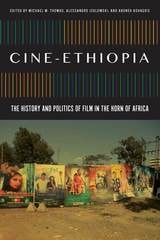
Cine-Ethiopia
The History and Politics of Film in the Horn of AfricaMichael W. Thomas
Michigan State University Press, 2018
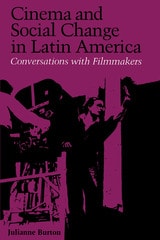
Cinema and Social Change in Latin America
Conversations with FilmmakersEdited by Julianne Burton
University of Texas Press, 1986
Since the late 1960s, films from Latin America have won widening audiences in North America and Europe. Until now, no single book has offered an introduction to the diverse personalities and practices that make up this important regional film movement.
In Cinema and Social Change in Latin America, Julianne Burton presents twenty interviews with key figures of Latin American cinema, covering three decades and ranging from Argentina to Mexico. Interviews with pioneers Fernando Birri, Nelson Pereira dos Santos, and Glauber Rocha, renowned feature filmmakers Tomás Gutiérrez Alea and Carlos Diegues, prize-winning documentarists Patricio Guzmán and Helena Solberg-Ladd, among others, endeavor to balance personal achievement against the backdrop of historical, political, social, and economic circumstances that have influenced each director's career. Presented also are conversations that cast light on the related activities of acting, distribution, theory, criticism, and film-based community organizing.
More than their counterparts in other regions of the world, Latin American artists and intellectuals acknowledge the degree to which culture is shaped by history and politics. Since the mid-1950s, a period of rising nationalism and regional consciousness, talented young artists and activists have sought to redefine the uses of the film medium in the Latin American context. Questioning the studio and star systems of the Hollywood industrial model, these innovators have developed new forms, content, and processes of production, distribution, and reception.
The specific approaches and priorities of the New Latin American Cinema are far from monolithic. They vary from realism to expressionism, from observational documentary to elaborate fictional constructs, from "imperfect cinema" to a cinema that emulates the high production values of the developed sectors, from self-reflexive to "transparent" cinematic styles, from highly industrialized modes of production to purely artisanal ones. What does not vary is the commitment to film as a vehicle for social transformation and the expression of national and regional cultural autonomy.
From early alternative cinema efforts in Argentina, Brazil, and Cuba to a contemporary perspective from within the Mexican commercial industry to the emerging cinema and video production from Central America, Cinema and Social Change in Latin America offers the most comprehensive look at Latin American film available today.
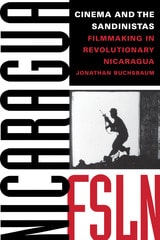
Cinema and the Sandinistas
Filmmaking in Revolutionary NicaraguaBy Jonathan Buchsbaum
University of Texas Press, 2003
Following the Sandinista Revolution in 1979, young bohemian artists rushed to the newly formed Nicaraguan national film institute INCINE to contribute to "the recovery of national identity" through the creation of a national film project. Over the next eleven years, the filmmakers of INCINE produced over seventy films—documentary, fiction, and hybrids—that collectively reveal a unique vision of the Revolution drawn not from official FSLN directives, but from the filmmakers' own cinematic interpretations of the Revolution as they were living it.
This book examines the INCINE film project and assesses its achievements in recovering a Nicaraguan national identity through the creation of a national cinema. Using a wealth of firsthand documentation—the films themselves, interviews with numerous INCINE personnel, and INCINE archival records—Jonathan Buchsbaum follows the evolution of INCINE's project and situates it within the larger historical project of militant, revolutionary filmmaking in Latin America. His research also raises crucial questions about the viability of national cinemas in the face of accelerating globalization and technological changes which reverberate far beyond Nicaragua's experiment in revolutionary filmmaking.
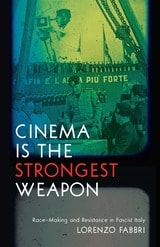
Cinema is the Strongest Weapon
Race-Making and Resistance in Fascist ItalyLorenzo Fabbri
University of Minnesota Press, 2023
A deep dive into Italian cinema under Mussolini’s regime and the filmmakers who used it as a means of antifascist resistance
Looking at Italy’s national film industry under the rule of Benito Mussolini and in the era that followed, Cinema Is the Strongest Weapon examines how cinema was harnessed as a political tool by both the reigning fascist regime and those who sought to resist it. Covering a range of canonical works alongside many of their neglected contemporaries, this book explores film’s mutable relationship to the apparatuses of state power and racial capitalism.
Exploiting realism’s aesthetic, experiential, and affective affordances, Mussolini’s biopolitical project employed cinema to advance an idealized vision of life under fascism and cultivate the basis for a homogenous racial identity. In this book, Lorenzo Fabbri crucially underscores realism’s susceptibility to manipulation from diametrically opposed political perspectives, highlighting the queer, Communist, Jewish, and feminist filmmakers who subverted Mussolini’s notion that “cinema is the regime’s strongest weapon” by developing film narratives and film forms that challenged the prevailing ethno-nationalist ideology.
Focusing on an understudied era of film history and Italian cultural production, Fabbri issues an important recontextualization of Italy’s celebrated neorealist movement and the structural ties it shares with its predecessor. Drawing incisive parallels to contemporary debates around race, whiteness, authoritarianism, and politics, he presents an urgent examination into the broader impact of visual media on culture and society.
Retail e-book files for this title are screen-reader friendly with images accompanied by short alt text and/or extended descriptions.

Cinema of Actuality
Japanese Avant-Garde Filmmaking in the Season of Image PoliticsYuriko Furuhata
Duke University Press, 2013
Cinema, Colonialism, Postcolonialism
Perspectives from the French and Francophone WorldsEdited by Dina Sherzer
University of Texas Press, 1996
In this first major study of French colonial and postcolonial cinema, Dina Sherzer compiles essays by some of the foremost scholars on the subject who interrogate and analyze the realities behind the images of the nation's past and present. Through an examination of France and its colonies, multiethnic contemporary France, and cinematic discourses which have been and are being produced about France's colonial past, these authors explore how the images relay underlying assumptions and their relation to historical and political facts. A variety of subjects and viewpoints inform these studies, which cover the entire range of films on that topic.
The authors expound upon the role French and Francophone films are currently playing in reconstructing and imagining France's colonial past. Not only do the essays examine how French cinema has represented the encounter of French citizens with individuals from former colonies during the colonial era; they examine how French cinema has portrayed and has come to terms with the immigration of former colonial subjects to France. In addition, the book features another postcolonial facet by analyzing films of directors from the former colonies who give their own representation of colonialism and presentation of their culture.
This study is a major contribution to postcolonial research. Race, gender, and geography are central themes throughout this book that presents innovative material that contributes to the history of French cinema and emphasizes how cinema participates in and is a part of national culture.
Cinema, Slavery, and Brazilian Nationalism
By Richard A. Gordon
University of Texas Press, 2015
A unique contribution to film studies, Richard Gordon’s Cinema, Slavery, and Brazilian Nationalism is the first full-length book on Brazilian films about slavery. By studying Brazilian films released between 1976 and 2005, Gordon examines how the films both define the national community and influence viewer understandings of Brazilianness. Though the films he examines span decades, they all communicate their revised version of Brazilian national identity through a cinematic strategy with a dual aim: to upset ingrained ways of thinking about Brazil and to persuade those who watch the films to accept a new way of understanding their national community.
By examining patterns in this heterogeneous group of films, Gordon proposes a new way of delineating how these films attempt to communicate with and change the minds of audience members. Gordon outlines five key aspects that each film incorporates, which describe their shared formula for and role in constructing social identity. These elements include the ways in which the films attempt to create links between the past and the viewers’ present and their methods of encouraging viewers to identify with their protagonists, who are often cast as a prototype for the nation. By aligning themselves with this figure, viewers arrive at a definition of their national identity that, while Afrocentric, also promotes racial and ethnic inclusiveness. Gordon’s innovative analysis transcends the context of his work, and his conclusions can be applied to questions of national identity and film across cultures.
Circumcision and Medicine in Modern Turkey
Oyman Basaran
University of Texas Press, 2023
An investigation of how the expansion of modern medicine in Turkey transformed young boys’ experiences of circumcision.
In Turkey, circumcision is viewed as both a religious obligation and a rite of passage for young boys, as communities celebrate the ritual through gatherings, gifts, and special outfits. Yet the procedure is a potentially painful and traumatic ordeal. With the expansion of modern medicine, the social position of sünnetçi (male circumcisers) became subject to the institutional arrangements of Turkey’s evolving health care and welfare system. In the transition from traditional itinerant circumcisers to low-ranking health officers in the 1960s and hospital doctors in the 1990s, the medicalization of male circumcision has become entangled with state formation, market fetishism, and class inequalities.
Based on Oyman Başaran’s extensive ethnographic and historical research, Circumcision and Medicine in Modern Turkey is a close examination of the socioreligious practice of circumcision in twenty-five cities and their outlying towns and villages in Turkey. By analyzing the changing subjectivity of medical actors who seek to alleviate suffering in male circumcision, Başaran offers a psychoanalytically informed alternate approach to the standard sociological arguments surrounding medicalization and male circumcision.