50 books match the query 'Political campaigns' and 10 start with c
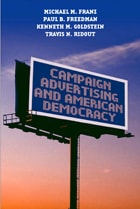
cover of Campaign Advertising and American Democracy

Campaign Advertising and American Democracy

Michael M. Franz, Paul B. Freedman, Kenneth M. Goldstein and Travis N. Ridout

Temple University Press, 2007

It has been estimated that more than three million political ads were televised leading up to the elections of 2004.  More than $800,000,000 was spent on TV ads in the race for the White House alone and presidential candidates, along with their party and interest group allies, broadcast over a million ads -- more than twice the number aired before the 2000 elections.  What were the consequences of this barrage of advertising?

Were viewers turned off by political advertising to the extent that it disuaded them from voting, as some critics suggest?  Did they feel more connected to political issues and the political system or were they alienated?  These are the questions this book answers, based on a unique, robust, and extensive database dedicated to political advertising.

Confronting prevailing opinion, the authors of this carefully researched work find that political ads may actually educate, engage, and mobilize American voters.  Only in the rarest of circumstances do they have negative impacts.
[more]
cover of Campaign Dynamics: The Race for Governor

Campaign Dynamics

The Race for Governor

Thomas M. Carsey

University of Michigan Press, 2001
Campaign Dynamics: The Race for Governor explores the dynamic interaction between candidates and voters that takes place during campaigns. It finds that voters respond in a meaningful way to what candidates say and do during their campaigns.
Candidates for state-wide and national offices spend millions of dollars and thousands of hours trying to convey their messages to voters. Do voters hear them and respond? More specifically, do the issues candidates stress on the campaign trail influence the choices voters make when casting their ballots? The evidence presented in this book suggests that the answer is a resounding yes.
Campaign Dynamics examines more than one hundred gubernatorial elections from 1982 through 1994, beginning with case studies of the gubernatorial races in Virginia and New Jersey in 1993. Combining interviews and observations with empirical analysis of public opinion polls, the case studies develop the basic understanding of how campaigns define the set of important issues in an election. Then the analysis is expanded to consider the abortion issue in thirty-four gubernatorial elections in 1990. Later chapters test these ideas in over one hundred gubernatorial elections, combining exit poll data on upwards of 100,000 voters from dozens of races with measures of campaign themes developed out of a content analysis of newspaper coverage.
This book employs multiple methods and sources of data and represents one of the most comprehensive theoretical and empirical efforts to understand the role of campaigns in voting behavior ever undertaken.
Campaign Dynamics will be of interest to those who study state politics, voting behavior and campaigns, and democratic theory. It should also guide students and scholars interested in performing empirical tests of formal models and those wishing to combine multiple methods in their research.
Thomas M. Carsey is Assistant Professor of Political Science, University of Illinois at Chicago.
[more]
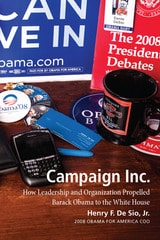
cover of Campaign Inc.: How Leadership and Organization Propelled Barack Obama to the White House

Campaign Inc.

How Leadership and Organization Propelled Barack Obama to the White House

Henry F. De Sio., Jr.

University of Iowa Press, 2014

It takes more than an excellent candidate to win elections; it takes an outstanding campaign organization, too. Campaign Inc. is the story of how leadership and organization propelled Barack Obama to the White House. As the chief operating officer of Obama’s 2008 presidential campaign, Henry F. De Sio, Jr., was positioned to view this historic campaign as few others could. In this fascinating behind-the-scenes account, he whisks readers into Obama’s national election headquarters in Chicago to glimpse the decision-making processes and myriad details critical to running a successful and innovative presidential campaign. From the campaign’s early chaos to the jubilation and drama of winning the Iowa caucus, to the drawn-out Democratic nomination process, to Obama’s eventual election as president of the United States, De Sio guides readers through the challenges faced by the Obama for America campaign in its brief twenty-one-month lifespan.

De Sio shows readers that Obama himself was direct about his vision for the campaign when he instructed his staff to “run it like a business.” Thus, this is less the story of Barack Obama, candidate, and more the story of Barack Obama, CEO. Because campaigns are launched from scratch during every election cycle, they are the ultimate entrepreneurial experience. In the course of the election, the Obama campaign scaled up from a scrappy start-up to a nearly $1 billion operation, becoming a hothouse environment on which the glare of the media spotlight was permanently trained.

Campaign Inc. allows readers to peek behind the curtain at the underdog organization that brought down the Clinton campaign and later went on to defeat the Republican machine, while offering lessons in leadership and organization to innovators, executives, and entrepreneurs.
[more]
cover of Campaign Reform: Insights and Evidence

Campaign Reform

Insights and Evidence

Larry M. Bartels and Lynn Vavreck, Editors

University of Michigan Press, 2000
What is wrong with American political campaigns? How could the campaign process be improved? This volume brings the expertise of leading political scientists to the public debate about campaign reform. These scholars probe the reality behind the conventional wisdom that nasty, vacuous campaigns dominated by big money and cynical media coverage are perverting our political process and alienating our citizenry.
Some of their conclusions will be startling to campaigners and critics alike. For example, "attack" advertisements prove to be no more effective than self-promotional advertisements, but are more substantive. Indeed, candidates in their advertisements and speeches focus more on policy and less on strategy and process than any major news outlet, including the New York Times. The volume suggests that, as a result, prospective voters in 1996 knew more about the candidates' issue positions than in any presidential election in decades, yet turnout and public faith in the electoral process continued to decline.
For aspiring reformers, Bartels and his colleagues provide a bracing reality check. For students and scholars of electoral politics, political communication, and voting behavior, they provide an authoritative summary and interpretation of what we know about the nature and impact of political campaigns. The insights and evidence contained in this volume should be of interest to anyone concerned about the present state and future prospects of American electoral process.
Larry M. Bartels is Professor of Politics and Public Affairs and Stuart Professor of Communications and Public Affairs in the Woodrow Wilson School, Princeton University. Lynn Vavreck is Assistant Professor of Government, Dartmouth College. Other contributors are Bruce Buchanan, Tami Buhr, Ann Crigler, John G. Geer, Kathleen Hall Jamieson, Marion Just, Daron R. Shaw, and John Zaller.
[more]
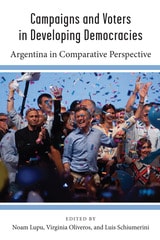
cover of Campaigns and Voters in Developing Democracies: Argentina in Comparative Perspective

Campaigns and Voters in Developing Democracies

Argentina in Comparative Perspective

Edited by Noam Lupu, Virginia Oliveros, and Luis Schiumerini

University of Michigan Press, 2019
Voting behavior is informed by the experience of advanced democracies, yet the electoral context in developing democracies is significantly different. Civil society is often weak, poverty and inequality high, political parties ephemeral and attachments to them weak, corruption rampant, and clientelism widespread. Voting decisions in developing democracies follow similar logics to those in advanced democracies in that voters base their choices on group affiliation, issue positions, valence considerations, and campaign persuasion. Yet developing democracies differ in the weight citizens assign to these considerations. Where few social identity groups are politically salient and partisan attachments are sparse, voters may place more weight on issue voting. Where issues are largely absent from political discourse, valence considerations and campaign effects play a larger role. Campaigns and Voters in Developing Democracies develops a theoretical framework to specify why voter behavior differs across contexts.
[more]
cover of Candidates, Congress, and the American Democracy

Candidates, Congress, and the American Democracy

Linda L. Fowler

University of Michigan Press, 1993

In Candidates, Congress, and the American Democracy Linda L. Fowler provides a wide-ranging examination of candidacy as a source of both stability and change in U.S. politics. An expert on political candidates, she brings a novel perspective to the topic by emphasizing that candidates are necessary instruments for popular control of government.

Fowler maintains that the ambitions of individual candidates are essential to the functioning of the nation's constitutional system and are important factors in its political history. She traces the influence of candidates in fostering electoral competition, promoting the representation of such newly mobilized groups of citizens as women and ethnic minorities, and transforming political institutions and parties. Despite the importance of candidacy, the institution is poorly understood because both scholars and voters tend to limit their focus on candidates to the narrow context of election campaigns. The author argues that a broader view reveals how candidates are linked to a variety of trends and contradictions in contemporary U.S. politics.
[more]
cover of Capturing Campaign Effects

Capturing Campaign Effects

Henry E. Brady and Richard Johnston, eds.

University of Michigan Press, 2006

Capturing Campaign Effects is the definitive study to date of the influence of campaigns on political culture. Comprising a broad exploration of campaign factors (debates, news coverage, advertising, and polls) and their effects (priming, learning, and persuasion), as well as an impressive survey of techniques for the collection and analysis of campaign data, Capturing Campaign Effects examines different kinds of campaigns in the U.S. and abroad and presents strong evidence for significant campaign effects.

"Capturing Campaign Effects is an accessible and penetrating account of modern scholarship on electoral politics. It draws critical insights from a range of innovative analyses."
--Arthur Lupia, University of Michigan

"What a wonderful way to usher in the new era of election studies! This book spotlights fascinating paradoxes in the literature of voting behavior, highlights many promising approaches to resolving those paradoxes, and shows how these strategies can yield important findings with terrific payoffs for our understanding of contemporary democracy. Fasten your seatbelts, folks: scholarship on elections is about to speed up thanks to this collection of great essays."
--Jon Krosnick, Stanford University

"The past decade has seen a renewed interest in understanding campaign effects. How and when do voters learn? Does the election campaign even matter at all? Capturing Campaign Effects draws on leading political scientists to address these matters. The result is a collection that will become the major reference for the study of campaigns. The lesson that emerges is that campaigns do affect voter decision making, usually for the better."
--Robert S. Erikson, Columbia University

Henry E. Brady is Class of 1941 Monroe Deutsch Professor of Political Science and Public Policy, and Director of the Survey Research Center at the University of California, Berkeley.

Richard Johnston is Professor and Head of Political Science and Distinguished University Scholar at the University of British Columbia.
[more]
cover of Choices and Changes: Interest Groups in the Electoral Process

Choices and Changes

Interest Groups in the Electoral Process

Michael M. Franz

Temple University Press, 2008

Choices and Changes is the most comprehensive examination to date of the impact of interest groups on recent American electoral politics. Richly informed, theoretically and empirically, it is the first book to explain the emergence of aggressive interest group electioneering tactics in the mid-1990s—including “soft money” contributions, issue ads, and “527s” (IRS-classified political organizations).

Michael Franz argues that changing political and legal contexts have clearly influenced the behavior of interest groups. To support his argument, he tracks in detail the evolution of campaign finance laws since the 1970s, examines all soft money contributions—nearly $1 billion in total—to parties by interest groups from 1991-2002, and analyzes political action committee (PAC) contributions to candidates and parties from 1983-2002. He also draws on his own interviews with campaign finance leaders.

Based on this rigorous data analysis and a formidable knowledge of its subject, Choices and Changes substantially advances our understanding of the significance of interest groups in U.S. politics.
[more]
cover of Color of Law: A Novel

Color of Law

A Novel

David Milofsky

University Press of Colorado, 2000
This is a rich, absorbing novel about good, evil, and the inability of the legal system to mediate between the two. Two white Milwaukee motorcycle cops pursue and kill a young black man on a bitterly cold winter night in 1959 and with the help of their su
[more]
cover of Crosstalk: Citizens, Candidates, and the Media in a Presidential Campaign

Crosstalk

Citizens, Candidates, and the Media in a Presidential Campaign

Marion R. Just, Ann N. Crigler, Dean E. Alger, Timothy E. Cook, Montague Kern, a

University of Chicago Press, 1996

The most comprehensive portrait of a presidential campaign in more than a decade, Crosstalk focuses on the 1992 U.S. presidential race and looks at how citizens use information in the media to make their voting decisions and how politicians and the media interact to shape that information.

Examining political advertisements, news coverage, ad watches, and talk shows in Los Angeles, Boston, Winston-Salem, and Fargo/Moorhead, the authors chart the impact of different information environments on citizens and show how people developed images of candidates over the course of the campaign. Crosstalk presents persuasive evidence that campaigns do matter, that citizens are active participants in the campaign process, and their perceptions of a candidate's character is the central factor in the voting process.

This innovative study contributes significantly to our understanding of the 1992 presidential campaign and of campaigns in general, and shows how election campaigns can play an important role in the long-term vitality of democracy.
[more]