Results by title
102 books match the query 'Poor' and 5 start with c
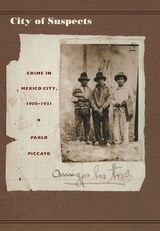
City of Suspects
Crime in Mexico City, 1900–1931Pablo Piccato
Duke University Press, 2001
In City of Suspects Pablo Piccato explores the multiple dimensions of crime in early-twentieth-century Mexico City. Basing his research on previously untapped judicial sources, prisoners’ letters, criminological studies, quantitative data, newspapers, and political archives, Piccato examines the paradoxes of repressive policies toward crime, the impact of social rebellion on patterns of common crime, and the role of urban communities in dealing with transgression on the margins of the judical system.
By investigating postrevolutionary examples of corruption and organized crime, Piccato shines light on the historical foundations of a social problem that remains the main concern of Mexico City today. Emphasizing the social construction of crime and the way it was interpreted within the moral economy of the urban poor, he describes the capital city during the early twentieth century as a contested territory in which a growing population of urban poor had to negotiate the use of public spaces with more powerful citizens and the police. Probing official discourse on deviance, Piccato reveals how the nineteenth-century rise of positivist criminology—which asserted that criminals could be readily distinguished from the normal population based on psychological and physical traits—was used to lend scientific legitimacy to class stratifications and to criminalize working-class culture. Furthermore, he argues, the authorities’ emphasis on punishment, isolation, and stigmatization effectively created cadres of professional criminals, reshaping crime into a more dangerous problem for all inhabitants of the capital.
This unique investigation into crime in Mexico City will interest Latin Americanists, sociologists, and historians of twentieth-century Mexican history.
[more]

Civic Charity in a Golden Age
ORPHAN CARE IN EARLY MODERN AMSTERDAMAnne E. C. McCants
University of Illinois Press, 1997
Using the Amsterdam Municipal Orphanage as a window through which readers
can see the start of profound social and economic changes in early modern
Amsterdam, Civic Charity in a Golden Age explores the connections
between the developing capitalist economy, the functioning of the government,
and the provision of charitable services to orphans in Amsterdam during
the seventeenth and eighteenth centuries, the period of the city's greatest
prosperity and subsequent decline.
Anne McCants skillfully interprets details of the orphanage's expenditures,
especially for food; its population; the work records of those who were
reared there; and the careers of the regents who oversaw it. The establishment
of the orphanage itself was called for by the changing economic needs
of rapidly expanding commercial centers and the potential instability
of a government that depended on taxes from a large, politically powerless
segment of the population.
[more]
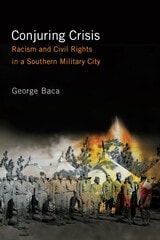
Conjuring Crisis
Racism and Civil Rights in a Southern Military CityBaca, George
Rutgers University Press, 2010
How have civil rights transformed racial politics in America? Connecting economic and social reforms to racial and class inequality, Conjuring Crisis counters the myth of steady race progress by analyzing how the federal government and local politicians have sometimes "reformed" politics in ways that have amplified racism in the post civil-rights era.
In the 1990s at Fort Bragg and Fayetteville, North Carolina, the city's dominant political coalition of white civic and business leaders had lost control of the city council. Amid accusations of racism in the police department, two white council members joined black colleagues in support of the NAACP's demand for an investigation. George Baca's ethnographic research reveals how residents and politicians transformed an ordinary conflict into a "crisis" that raised the specter of chaos and disaster. He explores new territory by focusing on the broader intersection of militarization, urban politics, and civil rights.
In the 1990s at Fort Bragg and Fayetteville, North Carolina, the city's dominant political coalition of white civic and business leaders had lost control of the city council. Amid accusations of racism in the police department, two white council members joined black colleagues in support of the NAACP's demand for an investigation. George Baca's ethnographic research reveals how residents and politicians transformed an ordinary conflict into a "crisis" that raised the specter of chaos and disaster. He explores new territory by focusing on the broader intersection of militarization, urban politics, and civil rights.
[more]
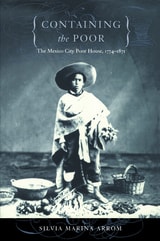
Containing the Poor
The Mexico City Poor House, 1774-1871Silvia Marina Arrom
Duke University Press, 2001
In 1774 Mexico City leaders created the Mexico City Poor House—the centerpiece of a bold experiment intended to eliminate poverty and impose a new work ethic on former beggars by establishing a forcible internment policy for some and putting others to work. In Containing the Poor Silvia Marina Arrom tells the saga of this ill-fated plan, showing how the asylum functioned primarily to educate white orphans instead of suppressing mendicancy and exerting control over the multiracial community for whom it was designed.
For a nation that had traditionally regarded the needy as having the undisputed right to receive alms and whose affluent citizens felt duty-bound to dispense them, the experiment was doomed from the start, explains Arrom. She uses deep archival research to reveal that—much to policymakers’ dismay—the Poor House became an orphanage largely because the government had underestimated the embeddedness of this moral economy of begging. While tracing the course of an eventful century that also saw colonialism give way to republicanism in Mexico, Arrom links the Poor House’s transformation with other societal factors as well, such as Mexican women’s increasing impact on social welfare policies.
With poverty, begging, and homelessness still rampant in much of Latin America today, this study of changing approaches to social welfare will be particularly valuable to student and scholars of Mexican and Latin American society and history, as well as those engaged in the study of social and welfare policy.
[more]
Credit Markets for the Poor
Patrick Bolton
Russell Sage Foundation, 2005
Access to credit is an important means of providing people with the opportunity to make a better life for themselves. Loans are essential for most people who want to purchase a home, start a business, pay for college, or weather a spell of unemployment. Yet many people in poor and minority communities—regardless of their creditworthiness—find credit hard to come by, making the climb out of poverty extremely difficult. How dire are the lending markets in these communities and what can be done to improve access to credit for disadvantaged groups? In Credit Markets for the Poor, editors Patrick Bolton and Howard Rosenthal and an expert team of economists, political scientists, and legal and business scholars tackle these questions with shrewd analysis and a wealth of empirical data. Credit Markets for the Poor opens by examining what credit options are available to poor households. Economist John Caskey profiles how weak credit options force many working families into a disastrous cycle of short-term, high interest loans in order to sustain themselves between paychecks. Löic Sadoulet explores the reasons that community lending organizations, which have been so successful in developing countries, have failed in more advanced economies. He argues the obstacles that have inhibited community lending groups in industrialized countries—such as a lack of institutional credibility and the high cost of establishing lending networks—can be overcome if banks facilitate the community lending process and establish a system of repayment insurance. Credit Markets for the Poor also examines how legal institutions affect the ability of the poor to borrow. Daniela Fabbri and Mario Padula argue that well-meaning provisions making it more difficult for lenders to collect on defaulted loans are actually doing a disservice to the poor in credit markets. They find that in areas with lax legal enforcement of debt agreements, credit markets for the poor are underdeveloped because lenders are unwilling to take risks on issuing credit or will do so only at exorbitant interest rates. Timothy Bates looks at programs that facilitate small-business development and finds that they have done little to reduce poverty. He argues that subsidized business creation programs may lure inexperienced households into entrepreneurship in areas where little profitable investment is possible, hence setting them up for failure. With clarity and insightful analysis, Credit Markets for the Poor demonstrates how weak credit markets are impeding the social and economic mobility of the needy. By detailing the many disadvantages that impoverished people face when seeking to borrow, this important new volume highlights a significant national problem and offers solutions for the future.
[more]