Results by title
391 books match the query 'Public opinion' and 32 start with c

CRIMINAL CONVERSATIONS
Victorian Crimes, Social Panic, and Moral OutrageEdited by Judith Rowbotham and Kim Stevenson
The Ohio State University Press, 2005
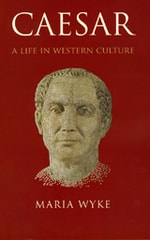
Caesar
A Life in Western CultureMaria Wyke
University of Chicago Press, 2008
Campaign Finance and American Democracy
What the Public Really Thinks and Why It MattersDavid M. Primo and Jeffrey D. Milyo
University of Chicago Press, 2020
Primo and Milyo probe original survey data to determine Americans’ sentiments on the role of money in politics, what drives these sentiments, and why they matter. What Primo and Milyo find is that while many individuals support the idea of reform, they are also skeptical that reform would successfully limit corruption, which Americans believe stains almost every fiber of the political system. Moreover, support for campaign finance restrictions is deeply divided along party lines, reflecting the polarization of our times. Ultimately, Primo and Milyo contend, American attitudes toward money in politics reflect larger fears about the health of American democracy, fears that will not be allayed by campaign finance reform.
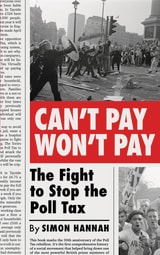
Can't Pay, Won't Pay
The Fight to Stop the Poll TaxSimon Hannah
Pluto Press, 2020
Starting in Scotland where the 'Community Charge' was first trialled, Can't Pay, Won't Pay immerses the reader in the gritty history of the rebellion. Amidst the drama of large scale protests and blockaded estates a number of key figures and groups emerge: Neil Kinnock and Tommy Sheridan; Militant, Class War and the Metropolitan Police.
Assessing this legacy today, Hannah demonstrates the centrality of the Poll Tax resistance as a key chapter in the history of British popular uprisings, Labour Party factionalism, the anti-socialist agenda and failed Tory ideology.
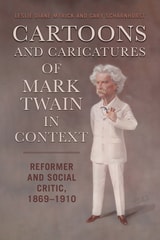
Cartoons and Caricatures of Mark Twain in Context
Reformer and Social Critic, 1869–1910Leslie Diane Myrick and Gary Scharnhorst
University of Alabama Press, 2023
Cartoons and Caricatures of Mark Twain in Context: Reformer and Social Critic, 1869–1910 examines the production, reception, and history of Twain’s reputation as a social and political satirist. Myrick and Scharnhorst trace the evolution of Twain’s depiction throughout his life, career, and even death and across more than seventy illustrations—from portrayals of the famous author as a court jester adorned with cap and bells, to a regally haloed king with a royal train—offering a new perspective on his influence and reputation. Although he was among the most photographed figures of the nineteenth century, Myrick and Scharnhorst focus on a medium that Twain, an expert ofself-promotion and brand management, could not control. As a result, Myrick and Scharnhorst have compiled an innovative and incisive visual reception history.
Cartoons and Caricatures of Mark Twainin Context illustrates the popular and often critical response to many famous and infamous episodes in his career, such as the storm of controversy that surrounded the publication of his anti-imperialist writings at the turn of the twentieth century. Routinely depicted with hair like a fright wig, a beak-like nose, and a cigar in hand, no matter the context or the costume, Twain was instantly recognizable. Yet it was not merely the familiarity of his image that made him a regular feature in visual commentary, but also his willingness to speak out against corruption and to insert himself into controversies of his day.
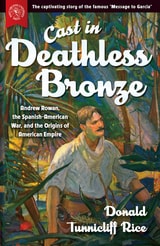
Cast in Deathless Bronze
Andrew Rowan, the Spanish-American War, and the Origins of American EmpireDonald Tunnicliff Rice
West Virginia University Press, 2016
Donald Tunnicliff Rice reveals the facts behind the story of “A Message to García” while using Rowan’s biography as a window into the history of the Spanish-American War, the Philippine War, and the Moro Rebellion. The result is a compellingly written narrative containing many details never before published in any form, and also an accessible perspective on American diplomatic and military history in the late nineteenth and early twentieth centuries.
Changing Minds or Changing Channels?
Partisan News in an Age of ChoiceKevin Arceneaux and Martin Johnson
University of Chicago Press, 2013
Changing Sex
Transsexualism, Technology, and the Idea of GenderBernice L. Hausman
Duke University Press, 1994
Hausman’s inquiry into the development of endocrinology and plastic surgery shows how advances in medical knowledge were central to the establishment of the material and discursive conditions necessary to produce the demand for sex change—that is, to both "make" and "think" the transsexual. She also retraces the hidden history of the concept of gender, demonstrating that the semantic distinction between "natural" sex and "social" gender has its roots in the development of medical treatment practices for intersexuality—the condition of having physical characteristics of both sexes— in the 1950s. Her research reveals the medical institution’s desire to make heterosexual subjects out of intersexuals and indicates how gender operates semiotically to maintain heterosexuality as the norm of the human body. In critically examining medical discourses, popularizations of medical theories, and transsexual autobiographies, Hausman details the elaboration of "gender narratives" that not only support the emergence of transsexualism, but also regulate the lives of all contemporary Western subjects. Changing Sex will change the ways we think about the relation between sex and gender, the body and sexual identity, and medical technology and the idea of the human.
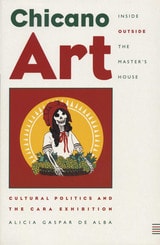
Chicano Art Inside/Outside the Master’s House
Cultural Politics and the CARA ExhibitionBy Alicia Gaspar de Alba
University of Texas Press, 1997
In the early 1990s, a major exhibition Chicano Art: Resistance and Affirmation, 1965-1985 toured major museums around the United States. As a first attempt to define and represent Chicano/a art for a national audience, the exhibit attracted both praise and controversy, while raising fundamental questions about the nature of multiculturalism in the U.S.
This book presents the first interdisciplinary cultural study of the CARA exhibit. Alicia Gaspar de Alba looks at the exhibit as a cultural text in which the Chicano/a community affirmed itself not as a "subculture" within the U.S. but as an "alter-Native" culture in opposition to the exclusionary and homogenizing practices of mainstream institutions. She also shows how the exhibit reflected the cultural and sexual politics of the Chicano Movement and how it serves as a model of Chicano/a popular culture more generally.
Drawing insights from cultural studies, feminist theory, anthropology, and semiotics, this book constitutes a wide-ranging analysis of Chicano/a art, popular culture, and mainstream cultural politics. It will appeal to a diverse audience in all of these fields.
Chiefs, Scribes, and Ethnographers
Kuna Culture from Inside and OutBy James Howe
University of Texas Press, 2009
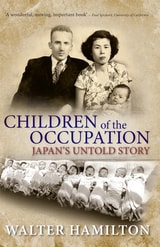
Children of the Occupation
Japan's Untold StoryHamilton, Walter
Rutgers University Press, 2013
Based on interviews with or research on 150 konketsuji—a now-taboo word for "mixed-blood" Japanese—journalist Walter Hamilton presents vivid first-person accounts of these adults as they remember their experiences of childhood loss. Using archival material from organizations dedicated to assisting the children, he combines moving personal tales with historical and political analyses of international race relations and immigration policy, particularly in North America and Australia.
Not only were attitudes and behaviors of the Japanese biased against the mixed-race children, but so were the restrictive and prejudicial immigration policies of the fathers’ native countries. Japan’s racial intolerance was fully matched in the nations it fought against. Hamilton examines how attitudes about race relations have evolved and traces the impact of racial ideology on national policy and cultural identity in Australia, Japan, and the United States.
China as Number One?
The Emerging Values of a Rising PowerYang Zhong and Ronald F. Inglehart
University of Michigan Press, 2024
One of the most significant global events in the last forty years has been the rise of China— economically, technologically, politically, and militarily. The question on people's minds for decades has been whether China will replace the United States as a superpower in the near future. But for China, this power must be comprehensive — having strong economic and militant forces are only two pieces of the puzzle. China must also possess soft power, such as attractive ideologies, values, and culture.
China as Number One? explores China’s soft powers through the eyes of Chinese citizens. Utilizing data from the World Values Survey, the contributors to this collection analyze the potential soft power of a rising China by examining its residents' social values. A comprehensive study of changes and continuities in the political and social values of Chinese citizens, the book examines findings in the context of evolutionary modernization theory and cross-national comparison.
Chinese Netizens' Opinions on Death Sentences
An Empirical ExaminationBin Liang and Jianhong Liu
University of Michigan Press, 2021
Few social issues have received more public attention and scholarly debate than the death penalty. While the abolitionist movement has made a successful stride in recent decades, a small number of countries remain committed to the death penalty and impose it with a relatively high frequency. In this regard, the People’s Republic of China no doubt leads the world in both numbers of death sentences and executions. Despite being the largest user of the death penalty, China has never conducted a national poll on citizens’ opinions toward capital punishment, while claiming “overwhelming public support” as a major justification for its retention and use.
Chinese Netizens’ Opinions on Death Sentences: An Empirical Examination uses a forum of public comments to explore and examine Chinese netizens’ opinions on the death penalty. Based on a content analysis of 38,512 comments collected from 63 cases in 2015, this study examines the diversity and rationales of netizens’ opinions, netizens’ interactions, and their evaluation of China’s criminal justice system. In addition, the book discusses China’s social, systemic, and structural problems and critically examines the rationality of netizens’ opinions based on Habermas’s communicative rationality framework. Readers will be able to contextualize Chinese netizens’ discussions and draw conclusions about commonalities and uniqueness of China’s death penalty practice.
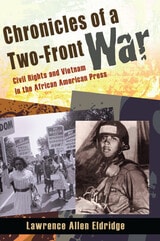
Chronicles of a Two-Front War
Civil Rights and Vietnam in the African American PressLawrence Allen Eldridge
University of Missouri Press, 2011
Eldridge reveals how the black press not only reported the war but also weighed its significance in the context of the civil rights movement.
Eldridge examines not only the role of reporters during the war, but also those of editors, commentators, and cartoonists. Especially enlightening is the research drawn from extensive oral histories by prominent journalist Ethel Payne, the first African American woman to receive the title of war correspondent. She described a widespread practice in black papers of reworking material from major white papers without providing proper credit, as the demand for news swamped the small budgets and limited staffs of African American papers. The author analyzes both the strengths of the black print media and the weaknesses in their coverage.
The black press ultimately viewed the Vietnam War through the lens of African American experience, blaming the war for crippling LBJ’s Great Society and the War on Poverty. Despite its waning hopes for an improved life, the black press soldiered on.
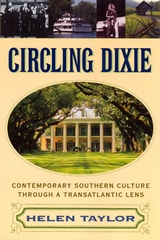
Circling Dixie
Contemporary Southern Culture through a Transatlantic LensHelen Taylor
Rutgers University Press, 2000
Taylor examines some of the South's most significant cultural exports in discussions that range across literature, music, film, television, theater, advertising, and tourism to focus on how and why Southern themes and icons have become so deeply embedded in British cultural life. The enduring legacy of Margaret Mitchell's Gone With the Wind can be seen today in the popularity of sequels, revisions, and reworkings of the novel. The conversation between these cultures is further explored in British responses to Alex Haley's Roots, the British theater's special affection for Tennessee Williams's plays, and the marketing of New Orleans as a preferred destination for European tourists. The transformation of Southern culture--itself a hybrid of the European, African, and American--as it circulates back across the Atlantic suggests not only new views of the history, racial politics, music and art of both Britain and the American South, but also an enhanced understanding of the dynamic flow of culture itself.

Citizen Critics
Literary Public SpheresRosa A. Eberly
University of Illinois Press, 2000
The condition of our public discussions about literary and cultural works has much to say about the state of our democracy. Classrooms, newspapers, magazines, Internet forums, and many other places grant citizens a place to hold public discourses—and claim a voice on national artistic matters.
Rosa A. Eberly looks at four censorship controversies where professionals asserted their authority to deny citizen critics a voice—and effectively removed discussion of literature from the public sphere. Eberly compares the outrage sparked by the publication of James Joyce's Ulysses and Henry Miller's Tropic of Cancer with the relative quiescence that greeted the much more violent and sexually explicit content of Bret Easton Ellis's American Psycho and Andrea Dworkin's Mercy. Through a close reading of letters to the editor, reviews, media coverage, and court cases, Eberly shows how literary critics and legal experts defused censorship debates—and undercut the authority of citizen critics—by shifting the focus from content to aesthetics and from social values to publicity.
Citizen Science in the Digital Age
Rhetoric, Science, and Public EngagementJames Wynn
University of Alabama Press, 2016
James Wynn’s timely investigation highlights scientific studies grounded in publicly gathered data and probes the rhetoric these studies employ. Many of these endeavors, such as the widely used SETI@home project, simply draw on the processing power of participants’ home computers; others, like the protein-folding game FoldIt, ask users to take a more active role in solving scientific problems. In Citizen Science in the Digital Age: Rhetoric, Science, and Public Engagement, Wynn analyzes the discourse that enables these scientific ventures, as well as the difficulties that arise in communication between scientists and lay people and the potential for misuse of publicly gathered data.
Wynn puzzles out the intricacies of these exciting new research developments by focusing on various case studies. He explores the Safecast project, which originated from crowd-sourced mapping for Fukushima radiation dispersal, arguing that evolving technologies enable public volunteers to make concrete, sound, science-based arguments. Additionally, he considers the potential use of citizen science as a method of increasing the public’s identification with the scientific community, and contemplates how more collaborative rhetoric might deepen these opportunities for interaction and alignment. Furthermore, he examines ways in which the lived experience of volunteers may be integrated with expert scientific knowledge, and also how this same personal involvement can be used to further policy agendas.
Precious few texts explore the intersection of rhetoric, science, and the Internet. Citizen Science in the Digital Age fills this gap, offering a clear, intelligent overview of the topic intended for rhetoric and communication scholars as well as practitioners and administrators in a number of science-based disciplines. With the expanded availability of once inaccessible technologies and computing power to laypeople, the practice of citizen science will only continue to grow. This study offers insight into how—given prudent application and the clear articulation of common goals—citizen science might strengthen the relationships between scientists and laypeople.
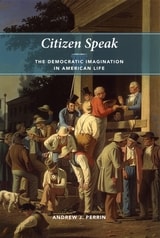
Citizen Speak
The Democratic Imagination in American LifeAndrew J. Perrin
University of Chicago Press, 2006
When we think about what constitutes being a good citizen, routine activities like voting, letter writing, and paying attention to the news spring to mind. But in Citizen Speak, Andrew J. Perrin argues that these activities are only a small part of democratic citizenship—a standard of citizenship that requires creative thinking, talking, and acting.
For Citizen Speak, Perrin met with labor, church, business, and sports organizations and proposed to them four fictive scenarios: what if your senator is involved in a scandal, or your police department is engaged in racial profiling, or a local factory violates pollution laws, or your nearby airport is slated for expansion? The conversations these challenges inspire, Perrin shows, require imagination. And what people can imagine doing in response to those scenarios depends on what’s possible, what’s important, what’s right, and what’s feasible. By talking with one another, an engaged citizenry draws from a repertoire of personal and institutional resources to understand and reimagine responses to situations as they arise. Building on such political discussions, Citizen Speak shows how a rich culture of association and democratic discourse provides the infrastructure for a healthy democracy.
Class War?
What Americans Really Think about Economic InequalityBenjamin I. Page and Lawrence R. Jacobs
University of Chicago Press, 2009
Recent battles in Washington over how to fix America’s fiscal failures strengthened the widespread impression that economic issues sharply divide average citizens. Indeed, many commentators split Americans into two opposing groups: uncompromising supporters of unfettered free markets and advocates for government solutions to economic problems. But such dichotomies, Benjamin Page and Lawrence Jacobs contend, ring false. In Class War? they present compelling evidence that most Americans favor free enterprise and practical government programs to distribute wealth more equitably.
At every income level and in both major political parties, majorities embrace conservative egalitarianism—a philosophy that prizes individualism and self-reliance as well as public intervention to help Americans pursue these ideals on a level playing field. Drawing on hundreds of opinion studies spanning more than seventy years, including a new comprehensive survey, Page and Jacobs reveal that this worldview translates to broad support for policies aimed at narrowing the gap between rich and poor and creating genuine opportunity for all. They find, for example, that across economic, geographical, and ideological lines, most Americans support higher minimum wages, improved public education, wider access to universal health insurance coverage, and the use of tax dollars to fund these programs.
In this surprising and heartening assessment, Page and Jacobs provide our new administration with a popular mandate to combat the economic inequity that plagues our nation.
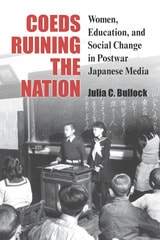
Coeds Ruining the Nation
Women, Education, and Social Change in Postwar Japanese MediaJulia C. Bullock
University of Michigan Press, 2019
This is the first book in English to explore the arguments for and against coeducation as presented in newspaper and magazine articles, cartoons, student-authored school newsletters, and roundtable discussions published in the Japanese press as these reforms were being implemented. It complicates the notion of the postwar years as a moment of rupture, highlighting prewar experiments with coeducation that belied objections that the practice was a foreign imposition and therefore “unnatural” for Japanese culture. It also illustrates a remarkable degree of continuity between prewar and postwar models of femininity, arguing that Occupation-era guarantees of equal educational opportunity were ultimately repurposed toward a gendered division of labor that underwrote the postwar project of economic recovery. Finally, it excavates discourses of gender and sexuality underlying the moral panic surrounding coeducation to demonstrate that claims of rampant sexual deviance and other concerns were employed as disciplinary mechanisms to reinforce an ideology of harmonious gender complementarity and to dissuade women from pursuing conventionally masculine prerogatives.
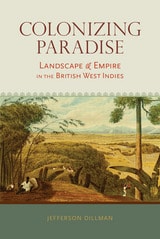
Colonizing Paradise
Landscape and Empire in the British West IndiesJefferson Dillman
University of Alabama Press, 2015
Explores how perceptions and depictions of the physical landscape both reflected and influenced the history of the British colonial Caribbean
In Colonizing Paradise, historian Jefferson Dillman charts the broad spectrum of sentiments that British citizens and travelers held regarding their colonial possessions in the West Indies. Myriad fine degrees of ambivalence separated extreme views of the region as an idyllic archipelago or a nest of Satanic entrapments. Dillman shows the manner in which these authentic or spontaneous depictions of the environment were shaped to form a narrative that undergirded Britain’s economic and political aims in the region.
Because British sentiments in the Caribbean located danger and evil not just in indigenous populations but in Spanish Catholics as well, Dillman’s work begins with the arrival of Spanish explorers and conquistadors. Colonizing Paradise spans the arrival of English ships and continues through the early nineteenth century and the colonial era. Dillman shows how colonial entrepreneurs, travelers, and settlers engaged in a disquieted dialogue with the landscape itself, a dialogue the examination of which sheds fresh light on the culture of the Anglophone colonial Caribbean.
Of particular note are the numerous mythical, metaphorical, and biblical lenses through which Caribbean landscapes were viewed, from early views of the Caribbean landscape as a New World paradise to later depictions of the landscape as a battleground between the forces of Christ and Satan. The ideal of an Edenic landscape persisted, but largely, Dillman argues, as one that needed to be wrested from the forces of darkness, principally through the work of colonization, planting, cataloguing, and a rational ordering of the environment.
Ultimately, although planters and their allies continued to promote pastoral and picturesque views of the Caribbean landscape, the goal of such narratives was to rationalize British rule as well as to mask and obscure emerging West Indian problems such as diseases, slavery, and rebellions. Colonizing Paradise offers much to readers interested in Caribbean, British, and colonial history.
Colored Amazons
Crime, Violence, and Black Women in the City of Brotherly Love, 1880–1910Kali N. Gross
Duke University Press, 2006
Gross draws on prison records, trial transcripts, news accounts, and rare mug shot photographs. Providing an overview of Philadelphia’s black women criminals, she describes the women’s work, housing, and leisure activities and their social position in relation to the city’s native-born whites, European immigrants, and elite and middle-class African Americans. She relates how news accounts exaggerated black female crime, trading in sensationalistic portraits of threatening “colored Amazons,” and she considers criminologists’ interpretations of the women’s criminal acts, interpretations largely based on notions of hereditary criminality. Ultimately, Gross contends that the history of black female criminals is in many ways a history of the rift between the political rhetoric of democracy and the legal and social realities of those marginalized by its shortcomings.
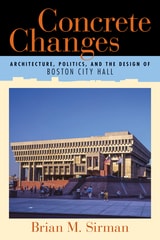
Concrete Changes
Architecture, Politics, and the Design of Boston City HallBrian M. Sirman
University of Massachusetts Press, 2018
And yet Boston City Hall frequently ranks among the country's ugliest buildings. Concrete Changes seeks to answer a common question for contemporary viewers: How did this happen? In a lively narrative filled with big personalities and newspaper accounts, Brian M. Sirman argues that this structure is more than a symbol of Boston's modernization; it acted as a catalyst for political, social, and economic change.
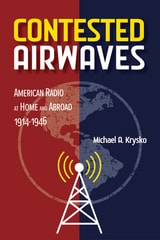
Contested Airwaves
American Radio at Home and Abroad, 1914-1946Michael A. Krysko
University of Illinois Press, 2025
Controversial American-led radio initiatives sparked a kaleidoscope of conflicts and rivalries from the medium’s earliest days through the end of World War II. Michael A. Krysko explores how the medium engaged the knowledge, assumptions, and prejudices that fueled listeners’ and policymakers’ objections to foreign and unwelcome radio content.
Krysko considers Americans’ antagonism toward non-English language broadcasting; issues of identity, geography, and sovereignty that propelled opposition to Mexico’s “border blaster” stations; how a project aimed at helping Cajun-speaking listeners became a French-only celebration of Acadian culture; a failed initiative to teach English to Latin Americans via shortwave broadcasting; enduring US-Panamanian conflicts over the control of radio in and around the Panama Canal; and how farmers from across the Southwest protested a radio treaty’s perceived preferential treatment of Cuba. Paying particular attention to the act of listening, Krysko shows how these initiatives illuminated and solidified divisions rooted in identity, nationalism, and prejudice.
Clear and wide-ranging, Contested Airwaves reveals early radio’s place at the nexus of public programming, transnational relations, and its own evolution as a communication medium.
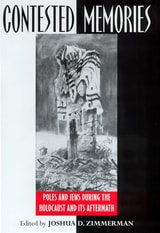
Contested Memories
Poles and Jews during the Holocaust and Its AftermathZimmerman, Joshua D.
Rutgers University Press, 2003
This collection of essays, representing three generations of Polish and Jewish scholars, is the first attempt since the fall of Communism to reassess the existing historiography of Polish-Jewish relations just before, during, and after the Second World War. In the spirit of detached scholarly inquiry, these essays fearlessly challenge commonly held views on both sides of the debates. The authors are committed to analyzing issues fairly and to reaching a mutual understanding. Contributors cover six topics:
1. The prewar legacy
2. The deterioration of Polish-Jewish relations during the first years of the war
3. Institutional Polish responses to the Nazi Final Solution
4. Poles and the Polish nation through Jewish eyes
5. The destruction of European Jewry and Polish popular opinion
6. Polish-Jewish relations since 1945
Contesting Cultural Rhetorics
Public Discourse and Education, 1890-1900Margaret J. Marshall
University of Michigan Press, 1995

Cops and Constables
American and British Fictional PolicemenEdited by Earl F. Bargainnier and George N. Dove
University of Wisconsin Press, 1986
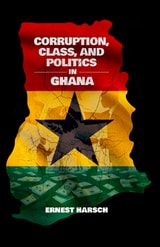
Corruption, Class, and Politics in Ghana
Ernest Harsch
Ohio University Press, 2024
Crime in the Public Mind
Kathlyn Taylor Gaubatz
University of Michigan Press, 1995
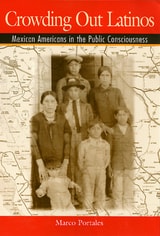
Crowding Out Latinos
Marco Portales
Temple University Press, 2000
As bandidos or gigolos, drug users or unwed mothers, Latinos continue to figure in the public consciousness primarily as undesirables. Despite decades of effort by Spanish-speaking Americans to improve their image in the United States, Mexican Americans and other resident Latinos are still largely perceived by other Americans as poverty-stricken immigrants and second-class citizens. Accordingly, the great majority of Latino citizens receive substandard educations, equipping them for substandard jobs in substandard living environments.
The lives of Mexican Americans and other Latinos, Portales contends, can best be illuminated by looking at the history of Chicanos and particularly Chicano literature, which dramatizes the impact of education and the media on Latinos. Like Irish literature, Chicano literature has sought to articulate and to establish itself as a postcolonial voice that has struggles for national attention. Through psychological and sociopolitical representations, Chicano writers have variously used anger, indifference, fear, accommodation, and other conflicting emotions and attitudes to express how it feels to be seen as an immigrant or a foreigner in one's own country.
Portales looks at four Chicano literary works -- Americo Paredes' George Washington Gomez, Anthony Quinn's The Original Sin, Sandra Cisnero's House on Mango Street, and Ana Castillo's Massacre of the Dreamers -- to focus attention on social issues that impede the progress of Latinos. By doing so, he hopes to engage both Latino and non-Latino Americans in an overdue dialogue about the power of education and the media to form perceptions that can either empower or repress Latino citizens.
Cultural Sutures
Medicine and MediaLester D. Friedman, ed.
Duke University Press, 2004
In this volume, scholars of cinema studies, philosophy, English, sociology, health-care education, women’s studies, bioethics, and other fields demonstrate how the world of medicine engages and permeates the media that surround us. Whether examining the press coverage of the Jack Kevorkian–euthanasia controversy; pondering questions about accessibility, accountability, and professionalism raised by such films as Awakenings, The Doctor, and Lorenzo’s Oil; analyzing the depiction of doctors, patients, and medicine on E.R. and Chicago Hope; or considering the ways in which digital technologies have redefined the medical body, these essays are consistently illuminating and provocative.
Contributors. Arthur Caplan, Tod Chambers, Stephanie Clark-Brown, Marc R. Cohen, Kelly A. Cole, Lucy Fischer, Lester D. Friedman, Joy V. Fuqua, Sander L. Gilman, Norbert Goldfield, Joel Howell, Therese Jones, Timothy Lenoir, Gregory Makoul, Marilyn Chandler McEntyre, Faith McLellan, Jonathan M. Metzl, Christie Milliken, Martin F. Norden, Kirsten Ostherr, Limor Peer, Audrey Shafer, Joseph Turow, Greg VandeKieft, Otto F. Wahl
Culture Shock and Japanese-American Relations
Historical EssaysSadao Asada
University of Missouri Press, 2007
Ever since Commodore Perry sailed into Uraga Channel, relations between the United States and Japan have been characterized by culture shock. Now a distinguished Japanese historian critically analyzes contemporary thought, public opinion, and behavior in the two countries over the course of the twentieth century, offering a binational perspective on culture shock as it has affected their relations.
In these essays, Sadao Asada examines the historical interaction between these two countries from 1890 to 2006, focusing on naval strategy, transpacific racism, and the atomic bomb controversy. For each topic, he offers a rigorous analysis of both American and Japanese perceptions, showing how cultural relations and the interchange of ideas have been complex—and occasionally destructive.
Culture Shock and Japanese-American Relations contains insightful essays on the influence of Alfred Mahan on the Japanese navy and on American images of Japan during the 1920s. Other essays consider the progressive breakdown of relations between the two countries and the origins of the Pacific War from the viewpoint of the Japanese navy, then tackle the ultimate shock of the atomic bomb and Japan’s surrender, tracing changing perceptions of the decision to use the bomb on both sides of the Pacific over the course of sixty years. In discussing these subjects, Asada draws on Japanese sources largely inaccessible to Western scholars to provide a host of eye-opening insights for non-Japanese readers.
After studying in America for nine years and receiving degrees from both Carleton College and Yale University, Asada returned to Japan to face his own reverse culture shock. His insights raise important questions of why people on opposite sides of the Pacific see things differently and adapt their perceptions to different purposes. This book marks a major effort toward reconstructing and understanding the conflicted course of Japanese-American relations during the first half of the twentieth century.