Results by title
74 books match the query 'Public welfare' and 5 start with c

Captains of Charity
The Writing and Wages of Postrevolutionary Atlantic BenevolenceMary Kathleen Eyring
University of New Hampshire Press, 2017
In this thematically rich book, Mary Kathleen Eyring examines authors whose writings were connected with their charitable endeavors, which addressed the worst by-products of the brisk maritime commerce in Atlantic seaport cities in the first half of the nineteenth century. She argues that charitable institutions and societies emerged in this era because they captured and contained the discontent of imperiled and impoverished groups, thereby effectively thwarting the development of a revolutionary class in America.
According to Eyring, the men and women who most successfully wrote about and engaged in benevolent work strategically connected their work with the affluence generated by maritime commerce. The water trades supported the growth of the American publishing industry, but they also generated both vast inequities in wealth and physically and economically hazardous conditions that, in the absence of a welfare state, required the intervention of benevolent societies. Laborers in Atlantic port cities barred from lucrative professions by gender, race, physical ability, or social status found a way to make a living wage by conjoining the literary with the charitable—and attaching both to a profit structure. In so doing, they transformed the nature of American benevolence and gave rise to the nonprofit sector, which has since its inception provided discontented laborers with a forum in which to express their critique of for-profit American enterprise, by imitating it.
In Captains of Charity, Eyring looks at writers who overcame their marginalized status by bringing together the strands of maritime industry, publishing, and benevolence. These include Richard Allen and Absalom Jones, two black clergymen who managed a massive relief effort when refugees fleeing revolution in Haiti transported the yellow fever virus to Philadelphia in 1793; Nancy Prince, a free woman of color who sought her livelihood in the Protestant missions of Jamaica in the years immediately following Britain's emancipation of laborers in its Caribbean colonies; Sarah Josepha Hale, who parlayed the social influence she had gained as the founder of a seaman's aid society in Boston into a role as editor of the hugely popular periodical Godey's Lady's Book; and Sarah Pogson Smith, who donated the proceeds of her writing to such prominent charitable causes as the New York Institution for the Instruction of the Deaf and Dumb and then capitalized on the goodwill this charity work generated among her wealthy friends in New York City, Philadelphia, and Charleston.
Hardcover is un-jacketed.
[more]
Changing Poverty, Changing Policies
Maria Cancian
Russell Sage Foundation, 2009
Poverty declined significantly in the decade after Lyndon Johnson's 1964 declaration of "War on Poverty." Dramatically increased federal funding for education and training programs, social security benefits, other income support programs, and a growing economy reduced poverty and raised expectations that income poverty could be eliminated within a generation. Yet the official poverty rate has never fallen below its 1973 level and remains higher than the rates in many other advanced economies. In this book, editors Maria Cancian and Sheldon Danziger and leading poverty researchers assess why the War on Poverty was not won and analyze the most promising strategies to reduce poverty in the twenty-first century economy. Changing Poverty, Changing Policies documents how economic, social, demographic, and public policy changes since the early 1970s have altered who is poor and where antipoverty initiatives have kept pace or fallen behind. Part I shows that little progress has been made in reducing poverty, except among the elderly, in the last three decades. The chapters examine how changing labor market opportunities for less-educated workers have increased their risk of poverty (Rebecca Blank), and how family structure changes (Maria Cancian and Deborah Reed) and immigration have affected poverty (Steven Raphael and Eugene Smolensky). Part II assesses the ways childhood poverty influences adult outcomes. Markus Jäntti finds that poor American children are more likely to be poor adults than are children in many other industrialized countries. Part III focuses on current antipoverty policies and possible alternatives. Jane Waldfogel demonstrates that policies in other countries—such as sick leave, subsidized child care, and schedule flexibility—help low-wage parents better balance work and family responsibilities. Part IV considers how rethinking and redefining poverty might take antipoverty policies in new directions. Mary Jo Bane assesses the politics of poverty since the 1996 welfare reform act. Robert Haveman argues that income-based poverty measures should be expanded, as they have been in Europe, to include social exclusion and multiple dimensions of material hardships. Changing Poverty, Changing Policies shows that thoughtful policy reforms can reduce poverty and promote opportunities for poor workers and their families. The authors' focus on pragmatic measures that have real possibilities of being implemented in the United States not only provides vital knowledge about what works but real hope for change.
[more]
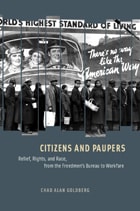
Citizens and Paupers
Relief, Rights, and Race, from the Freedmen's Bureau to WorkfareChad Alan Goldberg
University of Chicago Press, 2008
There was a time when America’s poor faced a stark choice between access to social welfare and full civil rights—a predicament that forced them to forfeit their citizenship in exchange for economic relief. Over time, however, our welfare system improved dramatically. But as Chad Alan Goldberg here demonstrates, its legacy of disenfranchisement persisted. Indeed, from Reconstruction onward, welfare policies have remained a flashpoint for recurring struggles over the boundaries of citizenship.
Citizens and Paupers explores this contentious history by analyzing and comparing three major programs: the Freedmen’s Bureau, the Works Progress Administration, and the present-day system of workfare that arose in the 1990s. Each of these overhauls of the welfare state created new groups of clients, new policies for aiding them, and new disputes over citizenship—conflicts that were entangled in racial politics and of urgent concern for social activists.
This combustible mix of racial tension and social reform continues to influence how we think about welfare, and Citizens and Paupers is an invaluable analysis of the roots of the debate.
[more]
Compassion and Responsibility
Readings in the History of Social Welfare Policy in the United StatesFrank R. Breul and Steven J. Diner
University of Chicago Press, 1985
[more]
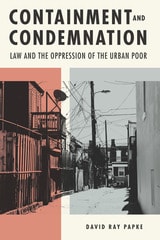
Containment and Condemnation
Law and the Oppression of the Urban PoorDavid Ray Papke
Michigan State University Press, 2019
The populations of American cities have always included poor people, but the predicament of the urban poor has worsened over time. Their social capital, that is, the connections and organizations that traditionally enabled them to form communities, has shredded. Economically comfortable Americans have come to increasingly care less about the plight of the urban poor and to think of them in terms of “us and them.” Considered lazy paupers in the early nineteenth century, the urban poor came to be seen as a violent criminal “underclass” by the end of the twentieth. Living primarily in the nation’s deindustrialized inner cities and making up nearly 15 percent of the population, today’s urban poor are oppressed people living in the midst of American affluence. This book examines how law works for, against, and with regard to the urban poor, with “law” being understood broadly to include not only laws but also legal proceedings and institutions. Law is too complicated and variable to be seen as simply a club used to beat down the urban poor, but it does work largely in negative ways for them. An essential text for both law students and those drawn to areas of social justice, Containment and Condemnation shows how law helps create, expand, and perpetuate contemporary urban poverty.
[more]