Results by title
584 books match the query 'Short Stories (single author)' and 24 start with c
COME BACK IRISH
Wendy Rawlings
The Ohio State University Press, 2001

Cabin, Clearing, Forest
Zach Falcon
University of Alaska Press, 2015

Calvert Casey
The Collected StoriesCalvert Casey
Duke University Press, 1998
Born in the United States, Casey was raised in Cuba and spent most of his life there and in Europe. He chose Spanish as his primary artistic tongue. A member of the intelligentsia surrounding Castro in the early years of the revolution, he was eventually exiled—and in 1969 committed suicide in Rome at the age of forty-five. Although most of his luminous stories are set in Havana, his is not a touristy, picturesque landscape but an often strange and nightmarish theater of human passions, inhabited by figures—silhouettes, really—that live on the edge of normality. This volume, which showcases Casey’s mastery of the skill of indirect and gradual revelation, is the most complete to appear in any language and includes a biographical and critical introduction written by Ilan Stavans, the noted novelist and scholar of Hispanic culture.
Readers interested in the art of fiction and in the complexities of the human psyche will find Casey’s work irresistible.

Camera Lake
Alex Pickett
University of Wisconsin Press, 2024
Carbine
StoriesGreg Mulcahy
University of Massachusetts Press, 2010
Written with keen intelligence and biting humor, Carbine is a book about the ridiculousness of contemporary life—a book about what cannot be said.
Carbon 14
Ann Deagon
University of Massachusetts Press, 1974
Ann Deagon first began writing poetry “vigorously” in 1970, “in some kind of forty-year-old renaissance.” Since then her poems have been published widely and have been received numerous awards.
“When I came to forty
that three-headed dog love death and poetry
took me in its teeth and shook me…”
Carbon 14 is the result, a counterpoint of serious and ironic excavations into the mythic and the personal past of a middle-aged woman. Although these poems have grown from her lifelong involvement in the Classics and are basically classical in their structure and concentration, their strength is not academic.
Ann Deagon's poems interweave past and present, person, place, and event, with unexpected and often violent insights. In “The Sybil's Bath,” for example, the sacrifice of a young girl to a god leads to unprecedented counterviolence and to questions which are both contemporary and absolute.
According to Deagon, “All identity is in some sense a translation from the Greek: it cannot be defined except with hyphens. The meaning hovers precisely at the hyphen.” in Carbon 14 Deagon proclaims her identity as poet-woman, woman-teacher, teacher-poet.
Carnival
Entertainments and Posthumous TalesIsak Dinesen
University of Chicago Press, 1979
"The editors have included only material that will stand easily with her more familiar work and satisfy her large following. . . . The rough drafts and variant treatments have been set aside for scholars."—Joseph McLellan, Washington Post
"The wit, the imagination, the elevated philosophical dialogue mark most of the stories in this volume as vintage Dinesen . . . of special interest to Dinesen fans."—Robert Langbaum, New York Times Book Review
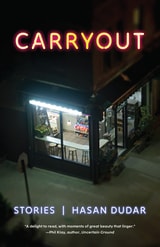
Carryout
Hasan Dudar
University of Iowa Press, 2026
A Poets & Writers First Fiction 2026 Debut Selection
In the late 1970s, Ziad Idilbi, a Palestinian refugee from Lebanon, marries Salma, a Lebanese refugee escaping the war in Beirut. Resolving to start over for the very last time, the couple opens a corner store in Toledo, Ohio, across from the General Motors factory, where Toledo’s Arab community intermingles with the working class. Over the decades, whether it’s bigotry (pre- and post-9/11), financial ruin, or terminal illness, the Idilbis find themselves on life’s outskirts, attempting to build something new.
Achingly poignant and slyly funny, the linked stories in Carryout follow the Idilbis and their children as they teeter on the brink of catastrophe. Walid, the youngest child of Ziad and Salma, navigates the heartbreaks of youth as well as the colorful characters who haunt his parents’ corner store. As he grows up into a writer, Walid’s gaze fixes on his father and the long shadow of displacement and occupation. Mustafa, the eldest son, is forever trying to outrun the disasters that seem to seek him out, while Nawal, the only daughter, is dumped by a friend and hatches a scheme to win her back. Unsure whether to run toward each other or away from each other, the characters in Dudar’s exquisite debut suffer the absurdities and indignities of life in America with wry obstinance and striking wisdom.
Cement Guitar
Michael Carlson
University of Massachusetts Press, 2003
In this striking debut collection, Michael Carlson offers poems that combine the concrete and the musical, while embodying a tendency toward contradiction. He writes by working with rhythms, structures, images, associational leaps, and an obsession with the sound of words, as opposed to narrative. The book begins, “A thing wants to pounce but can't,” and this spirit of hesitation continues throughout the volume.
The first section of the book contains heavily rhythmic poems measured sometimes by syllable, sometimes by stress, dealing with rural landscapes, a struggle with disillusionment, and a reconciliation of knowledge and belief. The second section confronts the terrain and people of Carlson's childhood in Rhode Island, using longer sentences, riskier enjambments, and a more colloquial and emotional language.
The poems in the third section—which range from Manhattan to Florida, Vietnam, and Paris—share a tendency to be more fantastic and are formal in weird ways. They include an homage to Ezra Pound borrowing the vocabulary of his first book and the syntax of his last, a nod to John Donne borrowing some of his stanza shapes, a sonnet whose constraint is that each of its fourteen lines contains a piece of armor, and a sestina composed of four syllable lines with four end words that rhyme. In the fourth section, Carlson returns to Brooklyn, speaks from the present, and resolves his stances in a brief notational way that is reminiscent of Chinese poetry.
Chicano Sketches
Short Stories by Mario SuárezMario Suárez; Edited by Francisco A. Lomelí, Cecilia Cota-Robles Suárez, and Juan Casillas-Núñez
University of Arizona Press, 2004
A key figure in the foundation of Chicano literature, Mario Suárez (1923–1998) was among the first writers to focus not only on Chicano characters but also on the multicultural space in which they live, whether a Tucson barbershop or a Manhattan boxing ring. Many of his stories have received wide acclaim through publication in periodicals and anthologies; this book presents those eleven previously published stories along with eight others from the archive of his unpublished work. It also includes a biographical introduction and a critical analysis of the stories that will broaden readers’ appreciation for his place in Chicano literature.
In most of his stories, Suárez sought to portray people he knew from Tucson’s El Hoyo barrio, a place usually thought of as urban wasteland when it is thought of at all. Suárez set out to fictionalize this place of ignored men and women because he believed their human stories were worth telling, and he hoped that through his depictions American literature would recognize their existence. By seeking to record the so-called underside of America, Suárez was inspired to pay close attention to people’s mannerisms, language, and aspirations. And by focusing on these barrio characters he also crafted a unique, mild-mannered realism overflowing with humor and pathos.
Along with Fray Angélico Chávez, Suárez stands as arguably the mid-twentieth century’s most important short story writer of Mexican descent. Chicano Sketches reclaims Suárez as a major figure of the genre and offers lovers of fine fiction a chance to rediscover this major talent.
Childhood and Other Neighborhoods
StoriesStuart Dybek
University of Chicago Press, 2003
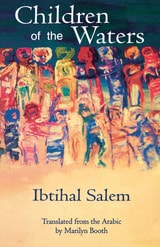
Children of the Waters
By Ibtihal Salem
University of Texas Press, 2002
Ibtihal Salem's writing provides an excellent forum for studying both everyday life in Egypt and current literary experimentation in the Middle East. Her poignant pieces hover between the structure of story-telling, the visuality of vignettes, and the compression of poetry. They both record and evoke a literary ferment going on in Egypt today.
Salem's writing of the last thirty years is lauded for its social messages also. Finding the expression of sexuality necessary to explicate problems of Egyptian identity, Salem often links poverty to gender marginality. Her heroines, however, celebrate the heritages that have shaped them, even as they resist certain aspects of them. Like many writers in Egypt, Salem honors traditional folktales, even as she deals with contemporary problems from class and economic perspectives.
Marilyn Booth, one of the best translators of Arabic fiction working today, has dealt in her introduction to this collection with the unusual experimental form by examining Salem's craft as well as the contextual history surrounding the stories. Since Salem is writing "across genres," Booth helps the reader also by opening each piece with an explanatory comment, often quoting the author, and thus further illuminating Salem's portrayals of lives bounded by Egypt's waters—the Canal, the Nile, and the Mediterranean.
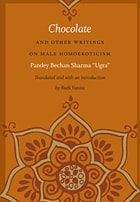
Chocolate and Other Writings on Male Homoeroticism
Pandey Bechan Sharma
Duke University Press, 2009
The stories depict male homoeroticism in quotidian situations: a man brings a lover to his disapproving friend’s house; a good-looking young man becomes the object of desire at his school. The love never ends well, but the depictions are not always unsympathetic. Although Ugra claimed that the stories were aimed at suppressing homosexuality by exposing it, Vanita highlights the ambivalence of his characterizations. Cosmopolitan, educated, and hedonistic, the Hindu and Muslim men he portrayed quote Hindi and Urdu poetry to express their love, and they justify same-sex desire by drawing on literature, philosophy, and world history. Vanita’s introduction includes anecdotal evidence that Chocolate was enthusiastically received by India’s homosexual communities.
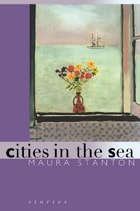
Cities in the Sea
Maura Stanton
University of Michigan Press, 2003
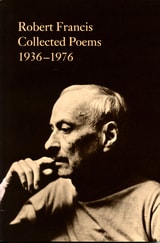
Collected Poems, 1936-1976
Robert Francis
University of Massachusetts Press, 1976
Gathered here in their entirety are the seven previous volumes of Robert Francis poetry—Stand with Me Here, Valhalla and Other Poems, The Sound I Listened For, The Face against the Glass, The Orb Weaver, Come Out into the Sun, and Like Ghosts of Eagles—together with a group of recent poems, many not previously published but “saved” to end this volume on a note of newness.
Because the original seven volumes are kept in chronological order, the reader can follow the author's journey from his quiet early work to poetry of greater color, warmth, vitality, vivacity, and sportiveness; and can note just when and where Francis' style becomes more and more diversified, with word-count, fragmented surface, and the celebration of words themselves.
The book is graced with eight wood engravings by Wang Hui-Ming.
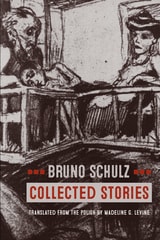
Collected Stories
Bruno Schulz, Translated from the Polish by Madeline G. Levine Foreword by Rivka Galchen
Northwestern University Press, 2018
Collected Stories is an authoritative new translation of the complete fiction of Bruno Schulz, whose work has influenced writers as various as Salman Rushdie, Cynthia Ozick, Jonathan Safran Foer, Philip Roth, Danilo Kiš, and Roberto Bolaño.
Schulz’s prose is renowned for its originality. Set largely in a fictional counterpart of his hometown of Drohobych, his stories merge the real and the surreal. The most ordinary objects—the wind, an article of clothing, a plate of fish—can suddenly appear unfathomably mysterious and capable of illuminating profound truths. As Father, one of his most intriguing characters, declaims: “Matter has been granted infinite fecundity, an inexhaustible vital force, and at the same time, a seductive power of temptation that entices us to create forms.”
This comprehensive volume brings together all of Schulz's published stories—Cinnamon Shops, his most famous collection (sometimes titled The Street of Crocodiles in English), The Sanatorium under the Hourglass, and an additional four stories that he did not include in either of his collections. Madeline G. Levine’s masterful new translation shows contemporary readers how Schulz, often compared to Proust and Kafka, reveals the workings of memory and consciousness.
Complete Works and Other Stories
By Augusto Monterroso
University of Texas Press, 1995
Augusto Monterroso is widely known for short stories characterized by brilliant satire and wit. Yet behind scathing allusions to the weaknesses and defects of the artistic and intellectual worlds, they show his generous and expansive sense of compassion.
This book brings together for the first time in English the volumes Complete Works (and Other Stories) (Obras completas [y otros cuentos] 1959) and Perpetual Motion (Movimiento perpetuo 1972). Together, they reveal Monterroso as a foundational author of the new Latin American narrative.
Compulsory Happiness
Norman Manea
Northwestern University Press, 1994
Confabulario and Other Inventions
By Juan José Arreola
University of Texas Press, 1964
This biting commentary on the follies of humankind by a noted Mexican author cuts deeply yet leaves readers laughing—at themselves as well as at others. With his surgical intelligence, Juan José Arreola exposes the shams and hypocrisies, the false values and vices, the hidden diseases of society. Confabulario total, 1941–1961, of which this book is a translation, combines three earlier books—Varia invención (1949), Confabulario (1952), Punta de plata (1958)—and numerous later pieces.
Although some of the pieces have a noticeably Mexican orientation, most of them transcend strictly regional themes to interpret the social scene in aspects common to all civilized cultures. Arreola’s view is not limited; much of his sophistication comes from his broad, deep, and varied knowledge of present and past, and from his almost casual use both of this knowledge and of his insight into its meaning for humanity. His familiarity with many little-known arts and sciences, numerous literatures, history, anthropology, and psychology, and his telling allusions to this rich lode of fact, increase the reader’s delight in his learned but witty, scalding but poetic, satire.
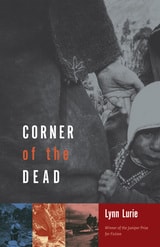
Corner of the Dead
Lynn Lurie
University of Massachusetts Press, 2008
"I use the camera to block my view," says Lisette. This is the start of her double vision—trying to forget and trying to recall—and her struggle to come to terms with the human capacity for cruelty. But the grim reality in Peru is so overpowering that she carries it with her back to New York and through the rest of her life. Having abandoned a lover along with the fight, she desperately tries to find meaning beyond that of mere survival.

Cottonlandia
Rebecca Black
University of Massachusetts Press, 2005
The poems in Rebecca Black's first volume, Cottonlandia, move through myth and landscape, beginning in the deep South's “shimmer and tar” and ending in the “soot and orange dolor” of the California desert. Cottonlandia conjures a proto-continent where fashionable golems pose for antique photographs and nineteenth-century naturalists wander into the melee of the civil rights struggle in the South.
By turns haunting and comic, Black's poems describe the archaeology of the apocalypse. Countesses leave behind poisonous snapshots, lovers examine their shapes in the mirror, and Seminoles return for skeletons arranged illegally in exhibits, even as floods force antebellum coffins to rise.
In the title poem, reproduced on this page, the lines of a spiritual splinter and circle through a loose narrative, evoking the delirium of class and race in the author's Georgia hometown. Throughout the volume, poems quarrel with primal forces, threading the needle of historical oblivion with a dark, intelligent, and incantatory voice.
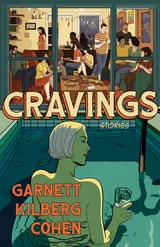
Cravings
Garnett Kilberg Cohen
University of Wisconsin Press, 2023
Kilberg Cohen’s captivating and vulnerable characters often recognize their shortcomings and past mistakes, but cannot always rise above them. One woman learns to forgive her husband’s ex; another fears her love of salty snacks caused a family tragedy. A stoic rural community drives a newcomer out of town; a young man’s entire life is colored by a traumatic childhood event at a zoo. Focusing on the specific, unforgettable moments that reveal our connections to one another, Cravings offers an expansive vision of humanity that lingers long after the final page is turned.
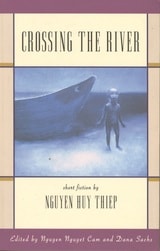
Crossing the River
Short Fiction by Nguyen Huy ThiepNguyen Huy Thiep
Northwestern University Press, 2002
Crossing the River presents a wide range of Nguyen Huy Thiep's short fiction, both realistic stories in contemporary settings and retellings of folk myths that serve as contemporary parables. When Thiep's stories first appeared in the 1980s, they set off a chain of debate, not only within intellectual and political circles, but also within the society at large. Typically, the struggles of his characters were about survival, not survival in the context of war or revolution, but survival in the context of the emotional and psychological strength it takes to live within the harsh confines of post-war Vietnamese society. Thiep captured the emotional quality of Vietnamese life in a way no other author had done, and his importance can be recognized today by his enormous influence on younger writers.

Cómo Salir con un Mexicano Volador
Relatos Nuevos y EscogidosDaniel A. Olivas
University of Nevada Press, 2023
La colección se compone de los relatos favoritos de Daniel A. Olivas, previamente publicados, junto con dos nuevos relatos, uno distópico y otro mítico, que desafían la retórica y las políticas anti-inmigración de la administración Trump. Los lectores se encontrarán con un mundo lleno tanto de lo mágico como de lo cotidiano: un hombre con doce dedos que se encuentra a sí mismo en una cita mística con una mujer; Dios, que se aparece en forma de gallina raquítica; una mujer que lucha con valentía contra su maltratador; y dioses aztecas en busca de relevancia tras la conquista española—solo por nombrar algunos de los singulares personajes que pueblan estas páginas. El libro reúne algunos de los cuentos más extraños e inolvidables de Olivas, permitiendo a los lectores experimentar su muy distintiva, y muy Chicana, ficción.