Results by title
201 books match the query 'Social movements' and 17 start with c
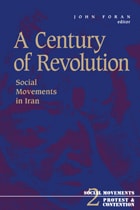
Century Of Revolution
Social Movements in IranJohn Foran
University of Minnesota Press, 1994
Provides insight into the political currents that led to the Iranian revolution.
Before late 1978 Iran did not occupy a large place in the public mind, mass media, or academic pursuits. With the massive upheaval of the next few months, all this changed-and the world is still trying to catch up with the dramatic events that brought Iran to its attention. This volume offers a much needed look into the historical, social, and political developments leading up to the Iranian revolution. Bringing together a group of scholars, historians, and social scientists, most of them Iranian in origin, the book documents an extraordinary revolutionary heritage that predates this century.
Each contributor examines a critical moment in Iranian social history-on its own terms as well as within a larger theoretical and comparative context. The topics they take up include: • the Tobacco Rebellion of 1890-91 • the Constitutional Revolution of 1905-11 • the rise of Reza Khan between 1921 and 1925• the autonomy movement in Azerbaijan and Kurdistan after World War II• the oil nationalization movement under Musaddiq between 1951and 1953• the unrest of the 1960-63 period• the Iranian revolution of 1977-79 • the state of Iran since the revolution Thoughout, common themes emerge, especially the heterogeneous bases of Iranian social movements with respect to class, gender, and ethnicity, as well as the diverse discourses-nationalist, Islamic, socialist, populist, and radical-that have animated these movements. Representing a wide variety of perspectives and approaches, this volume provides crucial insight into the widely watched but poorly understood phenomenon of present-day Iran.Contributors: Janet Afary, Purdue University; John Foran, University of California, Santa Barbara; Amir Hassanpour, Uppsala University; Mansoor Moaddel, Eastern Michigan University; Val Moghadam, United Nations University; Misgah Parsa, Dartmouth College; Sussan Siavoshi, Trinity University; Michael Zirinsky, Boise State University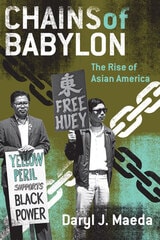
Chains of Babylon
The Rise of Asian AmericaDaryl J. Maeda
University of Minnesota Press, 2009
In Chains of Babylon, Daryl J. Maeda presents a cultural history of Asian American activism in the late 1960s and early 1970s, showing how the movement created the category of "Asian American" to join Asians of many ethnicities in racial solidarity. Drawing on the Black Power and antiwar movements, Asian American radicals argued that all Asians in the United States should resist assimilation and band together to oppose racism within the country and imperialism abroad.
As revealed in Maeda's in-depth work, the Asian American movement contended that people of all Asian ethnicities in the United States shared a common relationship to oppression and exploitation with each other and with other nonwhite peoples. In the early stages of the civil rights era, the possibility of assimilation was held out to Asian Americans under a model minority myth. Maeda insists that it was only in the disruption of that myth for both African Americans and Asian Americans in the 1960s and 1970s that the full Asian American culture and movement he describes could emerge. Maeda challenges accounts of the post-1968 era as hopelessly divisive by examining how racial and cultural identity enabled Asian Americans to see eye-to-eye with and support other groups of color in their campaigns for social justice.
Asian American opposition to the war in Vietnam, unlike that of the broader antiwar movement, was predicated on understanding it as a racial, specifically anti-Asian genocide. Throughout he argues that cultural critiques of racism and imperialism, the twin "chains of Babylon" of the title, informed the construction of a multiethnic Asian American identity committed to interracial and transnational solidarity.
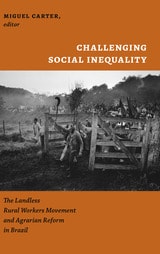
Challenging Social Inequality
The Landless Rural Workers Movement and Agrarian Reform in BrazilMiguel Carter, editor
Duke University Press, 2012
Contributors. José Batista Gonçalves Afonso, Sonia Maria P..P. Bergamasco, Sue Branford, Elena Calvo-González, Miguel Carter, Horacio Martins de Carvalho, Guilherme Costa Delgado, Bernardo Mançano Fernandes, Leonilde Sérvolo de Medeiros, George Mészáros, Luiz Antonio Norder, Gabriel Ondetti, Ivo Poletto, Marcelo Carvalho Rosa, Lygia Maria Sigaud, Emmanuel Wambergue, Wendy Wolford
Changing Minds
Social Movements’ Cultural ImpactsFrancesca Polletta
Russell Sage Foundation, 2025
Polletta and Amenta examine the trajectories of U.S. social movements, including the old-age pension movements of the 1930s and 1940s, the Black rights movement of the 1950s and 1960s, the women’s movement of the 1970s, right-wing movements in the 1980s and 1990s, and the environmental movement up to the present, to determine when, why, and how social movements change culture. They find that influential movements are featured in the news, but not only in the news. Movement perspectives may appear also in opinion and commentary outlets, on television talk shows and dramas, in movies, stand-up comedy, and viral memes. Popular culture producers remake movement messages as they transmit them, sometimes in ways that make those messages compelling. For example, while the news largely ignored feminists’ challenge to inequality in the home, popular cultural outlets turned “liberation” into a resonant demand for women’s right to self-fulfillment outside the home and within it. Widespread attention to the movement may lead people to change their minds individually. But more substantial change is likely when companies, schools, and other organizations outside government strive to get out in front of a newly legitimate issue, whether environmental sustainability or racial equity, by adopting movement-supportive norms and practices. Eventually, ideas associated with a movement may become a new common sense—though not always the ideas that the movement intended.
Throughout Changing Minds, Polletta and Amenta provide activists with strategies for getting their message heard and acted on. They suggest how movement actors can get into the news as political players or experts rather than lawbreakers or zealots. They show when it makes sense for activists to work with popular cultural producers and when they should create their own cultural outlets. They explain why the routes to cultural influence have changed and why urging people to take one easy step to save the planet can do more harm than good.
Changing Minds is a fascinating exploration of why and how some social movements have caused profound shifts in society.

Cities Contested
Urban Politics, Heritage, and Social Movements in Italy and West Germany in the 1970sEdited by Martin Baumeister, Bruno Bonomo, and Dieter Schott
Campus Verlag, 2017
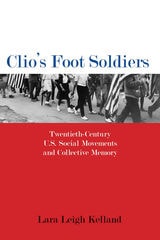
Clio's Foot Soldiers
Twentieth-Century U.S. Social Movements and Collective MemoryLara Leigh Kelland
University of Massachusetts Press, 2018
In Clio's Foot Soldiers, Lara Leigh Kelland investigates these questions by examining 1960s and 1970s social movements comprised of historically marginalized peoples: Civil Rights, Black Power, Women's and Gay Liberation, and American Indian. These movements sought ownership over their narratives to create historical knowledge reflective of their particular experiences. To accomplish their goals, activists generated new forms of adult education, published movement newspapers, and pursued campus activism and speeches, public history efforts and community organizations. Through alternative means, marginalized communities developed their own historical discourses to mobilize members, define movement goals, and become culturally sovereign. In so doing, they provided a basis for achieving political liberation and changed the landscape of liberal cultural institutions.
Co-Motion
Re-Thinking Power, Subjects, and Feminist and Queer AlliancesPaola Bacchetta
Duke University Press, 2026
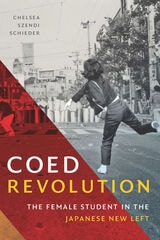
Coed Revolution
The Female Student in the Japanese New LeftChelsea Szendi Schieder
Duke University Press, 2021
Conceptual Activism
Radical Sense-Making and the Struggle for GenderDavina Cooper
Duke University Press, 2026
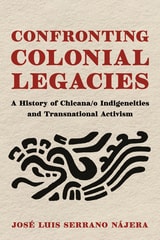
Confronting Colonial Legacies
A History of Chicana/o Indigeneities and Transnational ActivismJosé Luis Serrano Nájera
University of Arizona Press, 2026
This work offers a groundbreaking account of how Chicana/o activists have engaged in sustained efforts to reclaim Indigenous identity through political struggle, cultural expression, and transnational solidarity.
Author José Luis Serrano Nájera takes an in-depth look at the history of Chicana/o indigeneity, starting with the Chicana/o Movement of the 1960s and 1970s and through twenty-first century transnational activism and solidarity movements. Serrano Nájera reveals how claims to indigeneity were rooted in reciprocal relationships with Indigenous communities and driven by a shared commitment to decolonization. Through chapters on visual and performing arts, ceremony, education, and grassroots organizing, this book challenges reductive narratives of cultural appropriation and instead foregrounds the complex and historically grounded nature of Chicana/o indigeneity.
Drawing on extensive archival research, Serrano Nájera demonstrates how Chicana/o indigeneity has contributed to broader Indigenous rights movements, including efforts that culminated in the 2007 United Nations Declaration on the Rights of Indigenous Peoples. This work highlights the intercontinental dimensions of Chicana/o activism and offers a vital source for scholars and students in Chicana/o studies, Indigenous studies, ethnic studies, history, and political science. Confronting Colonial Legacies is a compelling call to rethink the politics of identity, sovereignty, and solidarity across the Americas.
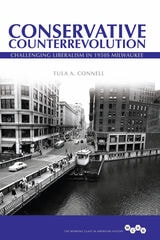
Conservative Counterrevolution
Challenging Liberalism in 1950s MilwaukeeTula A. Connell
University of Illinois Press, 2016
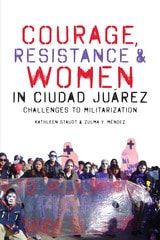
Courage, Resistance, and Women in Ciudad Juárez
Challenges to MilitarizationBy Kathleen Staudt and Zulma Y. Méndez
University of Texas Press, 2015
Ciudad Juárez has recently become infamous for its murder rate, which topped 3,000 in 2010 as competing drug cartels grew increasingly violent and the military responded with violence as well. Despite the atmosphere of intimidation by troops, police, and organized criminals, women have led the way in civil society activism, spurring the Juárez Resistance and forging powerful alliances with anti-militarization activists.
An in-depth examination of la Resistencia Juarense, Courage, Resistance, and Women in Ciudad Juárez draws on ethnographic research to analyze the resistance’s focus on violence against women, as well as its clash with the war against drugs championed by Mexican President Felipe Calderón with the support of the United States. Through grounded insights, the authors trace the transformation of hidden discourses into public discourses that openly challenge the militarized border regimes. The authors also explore the advocacy carried on by social media, faith-based organizations, and peace-and-justice activist Javier Sicilia while Calderón faced U.S. political schisms over the role of border trade in this global manufacturing site.
Bringing to light on-the-ground strategies as well as current theories from the fields of sociology, political anthropology, and human rights, this illuminating study is particularly significant because of its emphasis on the role of women in local and transnational attempts to extinguish a hot zone. As they overcome intimidation to become game-changing activists, the figures featured in Courage, Resistance, and Women in Ciudad Juárez offer the possibility of peace and justice in the wake of seemingly irreconcilable conflict.
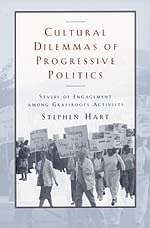
Cultural Dilemmas of Progressive Politics
Styles of Engagement among Grassroots ActivistsStephen Hart
University of Chicago Press, 2001
Through case studies of grassroots movements—particularly the economic justice work carried on by congregation-based community organizing and the pursuit of human rights by local members of Amnesty International—Hart shows how these groups develop distinctive ways of talking about politics and create characteristic stories, ceremonies, and practices. According to Hart, the way people engage in politics matters just as much as the content of their ideas: when activists make the moral basis for their activism clear, engage issues with passion, and articulate a unified social vision, they challenge the recent ascendancy of conservative discourse.
On the basis of these case studies, Hart addresses currently debated topics such as individualism in America and whether strains of political thought strongly informed by religion and moral values are compatible with tolerance and liberty.
Cultural Politics
edited by Marcy Darnovsky, Barbara Epstein and Richard Flacks
Temple University Press, 1995
Bridging the worlds of activism and academia-social movement theory informed with the real experiences of activists-this volume of accessible essays brings together insights from European New Social Movement theorists, U.S. scholars of social movements, and activists involved in social movements from the 1960s to the 1990s.
Contributors: Alice Echols, Barbara Epstein, Richard A. Cloward, Marcy Darnovsky, Jeffrey Escoffier, Ilene Rose Feinman, Richard Flacks, Cynthia Hamilton, Allen Hunter, L. A. Kauffman, Rebecca E. Klatch, Margit Mayer, Alberto Melucci, Bronislaw Misztal, Osha Neumann, Frances Fox Piven, Craig Reinarman, Roland Roth, Arlene Stein, Mindy Spatt, Andrew Szasz, Noél Sturgeon, Howard Winant.
Cultural Studies in the Interregnum
Edited by Robert F. Carley, Anne Donlon, Beenash Jafri, Laura J. Kwak, Eero Laine, SAJ, and Chris Alen Sula
Temple University Press, 2025
Covering queer and feminist studies, critical disability studies, and critical race and ethnic studies, the essays in Cultural Studies in the Interregnum reflect on our shared political pasts and futures. Using examples ranging from media and literature to sex work, policing, and university systems, this exciting volume probes what cultural studies means in moments of social transformation.
Contributors include: Sean Johnson Andrews, C.M. Kaliko Baker, Mary Tuti Baker, James Bliss, Jorge E. Cuéllar, John R. Decker, Brian Dolber, Candace Fujikane, Evyn Lê Espiritu Gandhi, Chris Hall, Rachel Lim, Alexis Pauline Gumbs, Anna Karthika, Manu Karuka, Najwa Mayer, Kyle Mays, Andrew Ó Baoill, Yumi Pak, Therí A. Pickens, Sami Schalk, Leanne Betasamosake Simpson, Tia Trafford, and the editors
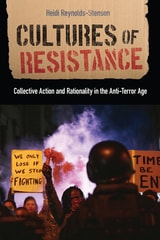
Cultures of Resistance
Collective Action and Rationality in the Anti-Terror AgeHeidi Reynolds-Stenson
Rutgers University Press, 2022
Cultures of Resistance provides new insight on a long-standing question: whether government efforts to repress social movements produce a chilling effect on dissent, or backfire and spur greater mobilization. In recent decades, the U.S. government’s repressive capacity has expanded dramatically, as the legal, technological, and bureaucratic tools wielded by agents of the state have become increasingly powerful. Today, more than ever, it is critical to understand how repression impacts the freedom to dissent and collectively express political grievances. Through analysis of activists’ rich and often deeply moving experiences of repression and resistance, the book uncovers key group processes that shape how individuals understand, experience, and weigh these risks of participating in collective action. Qualitative and quantitative analyses demonstrate that, following experiences of state repression, the achievement or breakdown of these group processes, not the type or severity of repression experienced, best explain why some individuals persist while others disengage. In doing so, the book bridges prevailing theoretical divides in social movement research by illuminating how individual rationality is collectively constructed, mediated, and obscured by protest group culture.
Curiosity and Power
The Politics of InquiryPerry Zurn
University of Minnesota Press, 2021
A trailblazing exploration of the political stakes of curiosity
Curiosity is political. Who is curious, when, and how reflects the social values and power structures of a given society. In Curiosity and Power, Perry Zurn explores the political philosophy of curiosity, staking the groundbreaking claim that it is a social force—the heartbeat of political resistance and a critical factor in social justice. He argues that the very scaffolding of curiosity is the product of political architectures, and exploring these values and architectures is crucial if we are to better understand, and more ethically navigate, the struggle over inquiry in an unequal world.
Curiosity and Power explores curiosity through the lens of political philosophy—weaving in Nietzsche, Foucault, and Derrida in doing so—and the experience of political marginalization, demonstrating that curiosity is implicated equally in the maintenance of societies and in their transformation. Curiosity plays as central a role in establishing social institutions and fields of inquiry as it does in their deconstruction and in building new forms of political community. Understanding curiosity is critical to understanding politics, and understanding politics is critical to understanding curiosity.
Drawing not only on philosophy and political theory but also on feminist theory, race theory, disability studies, and trans studies, Curiosity and Power tracks curiosity in the structures of political marginalization and resistance—from the Civil Rights Movement to building better social relationships. Curiosity and Power insists that the power of curiosity be recognized and engaged responsibly.