Results by title
97 books match the query 'United States. Congress' and 18 start with c
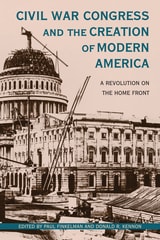
Civil War Congress and the Creation of Modern America
A Revolution on the Home FrontPaul Finkelman
Ohio University Press, 2018
Most literature on the Civil War focuses on soldiers, battles, and politics. But for every soldier in the United States Army, there were nine civilians at home. The war affected those left on the home front in many ways. Westward expansion and land ownership increased. The draft disrupted families while a shortage of male workers created opportunities for women that were previously unknown.
The war also enlarged the national government in ways unimagined before 1861. The Homestead Act, the Land Grant College Act, civil rights legislation, the use of paper currency, and creation of the Internal Revenue Service to collect taxes to pay for the war all illustrate how the war fundamentally, and permanently, changed the nation.
The essays in this book, drawn from a wide range of historical expertise and approaching the topic from a variety of angles, explore the changes in life at home that led to a revolution in American society and set the stage for the making of modern America.
Contributors: Jean H. Baker, Jenny Bourne, Paul Finkelman, Guy Gugliotta, Daniel W. Stowell, Peter Wallenstein, Jennifer L. Weber.
Committees and the Decline of Lawmaking in Congress
Jonathan Lewallen
University of Michigan Press, 2020
He finds that because party leaders have more control over the legislative agenda, committees have spent more of their time conducting oversight instead. Partisanship alone does not explain this trend; changes in institutional rules and practices that empowered party leaders have created more uncertainty for committees and contributed to a shift in their policy activities. The shift toward oversight at the committee level combined with party leader control over the voting agenda means that many members of Congress are effectively cut out of many of the institution’s policy decisions. At a time when many, including Congress itself, are considering changes to modernize the institution and keep up with a stronger executive branch, the findings here suggest that strengthening Congress will require more than running different candidates or providing additional resources.
Competing Principals
Committees, Parties, and the Organization of CongressForrest Maltzman
University of Michigan Press, 1997
Concordance
Black Lawmaking in the U.S. Congress from Carter to ObamaKatherine Tate
University of Michigan Press, 2014
During the height of the civil rights movement, Blacks were among the most liberal Americans. Since the 1970s, however, increasing representation in national, state, and local government has brought about a more centrist outlook among Black political leaders.
Focusing on the Congressional Black Caucus (CBC), Katherine Tate studies the ways in which the nation’s most prominent group of Black legislators has developed politically. Organized in 1971, the CBC set out to increase the influence of Black legislators. Indeed, over the past four decades, they have made progress toward the goal of becoming recognized players within Congress. And yet, Tate argues, their incorporation is transforming their policy preferences. Since the Clinton Administration, CBC members—the majority of whom are Democrats—have been less willing to oppose openly congressional party leaders and both Republican and Democratic presidents. Tate documents this transformation with a statistical analysis of Black roll-call votes, using the important Poole-Rosenthal scores from 1977 to 2010. While growing partisanship has affected Congress as a whole, not just minority caucuses, Tate warns that incorporation may mute the independent voice of Black political leaders.
Concordance
Black Lawmaking in the U.S. Congress from Carter to ObamaKatherine Tate
University of Michigan Press, 2020
Focusing on the Congressional Black Caucus (CBC), Katherine Tate studies the ways in which the nation’s most prominent group of Black legislators has developed politically. Organized in 1971, the CBC set out to increase the influence of Black legislators. Indeed, over the past four decades, they have made progress toward the goal of becoming recognized players within Congress. And yet, Tate argues, their incorporation is transforming their policy preferences. Since the Clinton Administration, CBC members—the majority of whom are Democrats—have been less willing to oppose openly congressional party leaders and both Republican and Democratic presidents. Tate documents this transformation with a statistical analysis of Black roll-call votes, using the important Poole-Rosenthal scores from 1977 to 2010. While growing partisanship has affected Congress as a whole, not just minority caucuses, Tate warns that incorporation may mute the independent voice of Black political leaders.
Congress Overwhelmed
The Decline in Congressional Capacity and Prospects for ReformEdited by Timothy M. LaPira, Lee Drutman, and Kevin R. Kosar
University of Chicago Press, 2020
The essays in Congress Overwhelmed assess Congress’s declining capacity and explore ways to upgrade it. Some provide broad historical scope. Others evaluate the current decay and investigate how Congress manages despite the obstacles. Collectively, they undertake the most comprehensive, sophisticated appraisal of congressional capacity to date, and they offer a new analytical frame for thinking about—and improving—our underperforming first branch of government.
Congress Responds to the Twentieth Century
Edited by Sunil Ahuja and Robert E. Dewhirst
The Ohio State University Press, 2003
Congress and the Constitution
Neal Devins and Keith E. Whittington, eds.
Duke University Press, 2005
Several contributors offer wide-ranging accounts of the workings of Congress. They look at lawmakers’ attitudes toward Congress’s role as a constitutional interpreter, the offices within Congress that help lawmakers learn about constitutional issues, Congress’s willingness to use its confirmation power to shape constitutional decisions by both the executive and the courts, and the frequency with which congressional committees take constitutional questions into account. Other contributors address congressional deliberation, paying particular attention to whether Congress’s constitutional interpretations are sound. Still others examine how Congress and the courts should respond to one another’s decisions, suggesting how the courts should evaluate Congress’s work and considering how lawmakers respond to Court decisions that strike down federal legislation. While some essayists are inclined to evaluate Congress’s constitutional interpretation positively, others argue that it could be improved and suggest institutional and procedural reforms toward that end. Whatever their conclusions, all of the essays underscore the pervasive and crucial role that Congress plays in shaping the meaning of the Constitution.
Contributors. David P. Currie, Neal Devins, William N. Eskridge Jr.. John Ferejohn, Louis Fisher, Elizabeth Garrett, Michael J. Gerhardt, Michael J. Klarman, Bruce G. Peabody, J. Mitchell Pickerill, Barbara Sinclair, Mark Tushnet, Adrian Vermeule, Keith E. Whittington, John C. Yoo
Congress and the Crisis of the 1850s
Paul Finkelman
Ohio University Press, 2011
During the long decade from 1848 to 1861 America was like a train speeding down the track, without an engineer or brakes. The new territories acquired from Mexico had vastly increased the size of the nation, but debate over their status—and more importantly the status of slavery within them—paralyzed the nation. Southerners gained access to the territories and a draconian fugitive slave law in the Compromise of 1850, but this only exacerbated sectional tensions. Virtually all northerners, even those who supported the law because they believed that it would preserve the union, despised being turned into slave catchers. In 1854, in the Kansas-Nebraska Act, Congress repealed the ban on slavery in the remaining unorganized territories. In 1857, in the Dred Scott case, the Supreme Court held that all bans on slavery in the territories were unconstitutional. Meanwhile, northern whites, free blacks, and fugitive slaves resisted the enforcement of the 1850 fugitive slave law. In Congress members carried weapons and Representative Preston Brooks assaulted Senator Charles Sumner with a cane, nearly killing him. This was the decade of the 1850s and these were the issues Congress grappled with.
This volume of new essays examines many of these issues, helping us better understand the failure of political leadership in the decade that led to the Civil War.
Contributors
Spencer R. Crew
Paul Finkelman
Matthew Glassman
Amy S. Greenberg
Martin J. Hershock
Michael F. Holt
Brooks D. Simpson
Jenny Wahl
Congress and the Emergence of Sectionalism
From the Missouri Compromise to the Age of JacksonPaul Finkelman
Ohio University Press, 2008
Congress and the First Civil Rights Era, 1861-1918
Jeffery A. Jenkins and Justin Peck
University of Chicago Press, 2021
The authors examine in detail how the Republican Party slowly withdrew its support for a meaningful civil rights agenda, as well as how Democrats and Republicans worked together to keep civil rights off the legislative agenda at various points. In doing so, Jenkins and Peck show how legal institutions can be used both to liberate and protect oppressed minorities and to assert the power of the white majority against those same minority groups.
Congress and the Nuclear Freeze
An Inside Look at the Politics of a Mass MovementDouglas Waller
University of Massachusetts Press, 1987
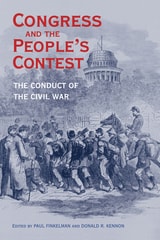
Congress and the People’s Contest
The Conduct of the Civil WarPaul Finkelman
Ohio University Press, 2018
Congress and the Rent-Seeking Society
Glenn R. Parker
University of Michigan Press, 1996
Skillfully blending historical data with microeconomic theory, Glenn Parker argues that the incentives for congressional service have declined over the years, and that with that decline has come a change in the kind of person who seeks to enter Congress. The decline in the attractiveness of Congress is a consequence of congressional careerists and of the growth in the rent-seeking society, a term which describes the efforts of special interests to obtain preferential treatment by using the machinery of government--legislation and regulations.
Parker provides a fresh and controversial perspective to the debate surrounding the relative merits of career or amateur politicians. He argues that driving career politicians from office can have pernicious effects on the political system: it places the running of Congress in the hands of amateur politicians, who stand to lose little if they are found engaging in illegal or quasi-legal practices. On the other hand, career legislators risk all they have invested in their long careers in public service if they engage in unsavory practices. As Parker develops this controversial argument, he provides a fresh perspective on the debate surrounding the value of career versus amateur politicians.
Little attention has been given to the long-term impact of a rent-seeking society on the evolution of political institutions. Parker examines empirically and finds support for hypotheses that reflect potential symptoms of adverse selection in the composition of Congress: (1) rent-seeking politicians are more inclined than others to manipulate institutional arrangements for financial gain; (2) the rent-seeking milieu of legislators are more likely to engage in rent-seeking activity than earlier generations; (3) and the growth of rent-seeking activity has hastened the departure of career legislators.
Glenn R. Parker is Distinguished Research Professor, Florida State University.
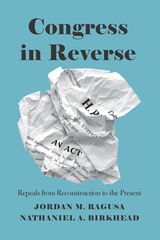
Congress in Reverse
Repeals from Reconstruction to the PresentJordan M. Ragusa and Nathaniel A. Birkhead
University of Chicago Press, 2020
Congress in Reverse is the first book to attempt to answer these questions. Jordan M. Ragusa and Nathaniel A. Birkhead examine when and why existing statutes are successfully “undone,” arguing that repeals are most common when the parties are united on the issue—which was not the case when it came to Obamacare for the Republican Party—and the majority party wins control of Congress after a long stint in the minority. By shifting focus from the making of laws to their un-making, Congress in Reverse opens up a new arena for studying legislative activity in Congress.
Congress on Display, Congress at Work
William T. Bianco, Editor
University of Michigan Press, 2000
Congressional Communication
Content and ConsequencesDaniel Lipinski
University of Michigan Press, 2004
--Bruce Oppenheimer, Vanderbilt University
"The communication between representatives and their constituents is where election strategy and policy explanations are merged and, until now, we have had only anecdotal evidence. Lipinski's book sheds light on this important part of American political life."
--David Brady, Stanford University
Congressional Communication challenges the notion that legislators "run against Congress" by routinely denigrating the institution. Using a unique, systematic analysis of the communication from members of Congress to their constituents over a five-year period, Daniel Lipinski challenges this notion, demonstrating key partisan differences in representatives' portrayals of congressional activities. While members of the majority party tend to report that the institution-and, hence, their party-is performing well, members of the minority party are more likely to accuse Congress of doing a poor job.
The findings in Congressional Communication offer the first strong empirical evidence from the electoral arena in support of controversial party government theories. Moving beyond previous studies that look only at legislators' messages, Lipinski's research also reveals the effects of these politically strategic claims on voters, whose interpretations don't necessarily bear out the legislators' intended effects.
Daniel Lipinski is Assistant Professor of Political Science at the University of Tennessee.
Contesting the Constitution
Congress Debates the Missouri Crisis, 1819-1821William S. Belko
University of Missouri Press, 2021
The larger question with which the legislators grappled were the limits of the Constitution’s provisions granting Congress the authority to affect the institution of slavery—both where it already existed and where it could expand. The issue—what would come to be known as the Missouri Crisis—severely tested the still young republic and, some four decades later, would all but rend it asunder. This timely collection of original essays thoughtfully engages the intersections of history and constitutional law, and is certain to find eager readers among historians, legal scholars, political scientists, as well as many who call Missouri home.
Contributing Authors:
William S. Belko
Christopher Childers
John Eastman
Brook Poston
John R. Van Atta