Results by title
130 books match the query 'Women's rights' and 7 start with c
Citizenship, Faith, and Feminism
Jewish and Muslim Women Reclaim Their RightsJan Feldman
Brandeis University Press, 2011
Religious women in liberal democracies are “dual citizens” because of their contrasting status as members of both a civic community (in which their gender has no impact on their constitutional guarantee of equal rights) and a traditional religious community (which distributes roles and power based on gender). This book shows how these “dual citizens”—Orthodox Jewish women in Israel, Muslim women in Kuwait, and women of both those faiths in the U.S.—have increasingly deployed their civic citizenship rights in attempts to reform and not destroy their religions. For them, neither “exit” nor acquiescence to traditional religious gender norms is an option. Instead, they use the narrative of civic citizenship combined with a more authentic, if alternative reading of their faith tradition to improve their status.
[more]
Claiming Union Widowhood
Race, Respectability, and Poverty in the Post-Emancipation SouthBrandi Clay Brimmer
Duke University Press, 2020
In Claiming Union Widowhood, Brandi Clay Brimmer analyzes the US pension system from the perspective of poor black women during and after the Civil War. Reconstructing the grassroots pension network in New Bern, North Carolina, through a broad range of historical sources, she outlines how the mothers, wives, and widows of black Union soldiers struggled to claim pensions in the face of evidentiary obstacles and personal scrutiny. Brimmer exposes and examines the numerous attempts by the federal government to exclude black women from receiving the federal pensions that they had been promised. Her analyses illustrate the complexities of social policy and law administration and the interconnectedness of race, gender, and class formation. Expanding on previous analyses of pension records, Brimmer offers an interpretive framework of emancipation and the freedom narrative that places black women at the forefront of demands for black citizenship.
[more]

Coed Revolution
The Female Student in the Japanese New LeftChelsea Szendi Schieder
Duke University Press, 2021
In the 1960s, a new generation of university-educated youth in Japan challenged forms of capitalism and the state. In Coed Revolution Chelsea Szendi Schieder recounts the crucial stories of Japanese women's participation in these protest movements led by the New Left through the early 1970s. Women were involved in contentious politics to an unprecedented degree, but they and their concerns were frequently marginalized by men in the movement and the mass media, and the movement at large is often memorialized as male and masculine. Drawing on stories of individual women, Schieder outlines how the media and other activists portrayed these women as icons of vulnerability and victims of violence, making women central to discourses about legitimate forms of postwar political expression. Schieder disentangles the gendered patterns that obscured radical women's voices to construct a feminist genealogy of the Japanese New Left, demonstrating that student activism in 1960s Japan cannot be understood without considering the experiences and representations of these women.
[more]
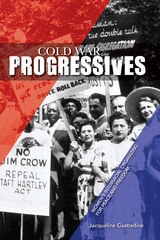
Cold War Progressives
Women's Interracial Organizing for Peace and FreedomJacqueline Castledine
University of Illinois Press, 2012
In recognizing the relation between gender, race, and class oppression, American women of the postwar Progressive Party made the claim that peace required not merely the absence of violence, but also the presence of social and political equality. For progressive women, peace was the essential thread that connected the various aspects of their activist agendas. This study maps the routes taken by postwar popular front women activists into peace and freedom movements of the 1960s and 1970s. Historian Jacqueline Castledine tells the story of their decades-long effort to keep their intertwined social and political causes from unraveling and to maintain the connections among peace, feminism, and racial equality.
Postwar progressive women and their allies often saw themselves as members of a popular front promoting the rights of workers, women, and African Americans under the banner of peace. However, the Cold War indelibly shaped the contours of their activism. Following the Progressive Party's demise in the 1950s, these activists reentered social and political movements in the early 1960s and met the inescapable reality that their agenda was a casualty of the left-liberal political division of the early Cold War era. Many Americans now viewed peace as a leftist concern associated with Soviet sympathizers and civil rights as the favored cause of liberals. Faced with the dilemma of working to reunite these movements or choosing between them, some progressive women chose to lead such New Left organizations as the Jeannette Rankin Brigade while others became leaders of liberal "second wave" feminist movements.
Whether they committed to affiliating with groups that emphasized one issue over others or attempted to found groups with broad popular-front type agendas, Progressive women brought to their later work an understanding of how race, class, and gender intersect in women's organizing. These women's stories demonstrate that the ultimate result of Cold War-era McCarthyism was not the defeat of women's activism, but rather its reconfiguration.
[more]
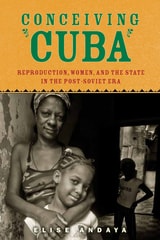
Conceiving Cuba
Reproduction, Women, and the State in the Post-Soviet EraAndaya, Elise
Rutgers University Press, 2014
Received an Honorable Mention for the 2015 First Michelle Rosaldo Prize for a First Book in Feminist Anthropology from the Association for Feminist Anthropology
Winner of the Adele E. Clarke Book Award from ReproNetwork
After Cuba’s 1959 revolution, the Castro government sought to instill a new social order. Hoping to achieve a new and egalitarian society, the state invested in policies designed to promote the well-being of women and children. Yet once the Soviet Union fell and Cuba’s economic troubles worsened, these programs began to collapse, with serious results for Cuban families.
Conceiving Cuba offers an intimate look at how, with the island’s political and economic future in question, reproduction has become the subject of heated public debates and agonizing private decisions. Drawing from several years of first-hand observations and interviews, anthropologist Elise Andaya takes us inside Cuba’s households and medical systems. Along the way, she introduces us to the women who wrestle with the difficult question of whether they can afford a child, as well as the doctors who, with only meager resources at their disposal, struggle to balance the needs of their patients with the mandates of the state.
Andaya’s groundbreaking research considers not only how socialist policies have profoundly affected the ways Cuban families imagine the future, but also how the current crisis in reproduction has deeply influenced ordinary Cubans’ views on socialism and the future of the revolution. Casting a sympathetic eye upon a troubled state, Conceiving Cuba gives new life to the notion that the personal is always political.
[more]

Considering Emma Goldman
Feminist Political Ambivalence and the Imaginative ArchiveClare Hemmings
Duke University Press, 2018
In Considering Emma Goldman Clare Hemmings examines the significance of the anarchist activist and thinker for contemporary feminist politics. Rather than attempting to resolve the tensions and problems that Goldman's thinking about race, gender, and sexuality pose for feminist thought, Hemmings embraces them, finding them to be helpful in formulating a new queer feminist praxis. Mining three overlapping archives—Goldman's own writings, her historical and theoretical legacy, and an imaginative archive that responds creatively to gaps in those archives —Hemmings shows how serious engagement with Goldman's political ambivalences opens up larger questions surrounding feminist historiography, affect, fantasy, and knowledge production. Moreover, she explores her personal affinity for Goldman to illuminate the role that affective investment plays in shaping feminist storytelling. By considering Goldman in all her contradictions and complexity, Hemmings presents a queer feminist response to the ambivalences that also saturate contemporary queer feminist race theories.
[more]
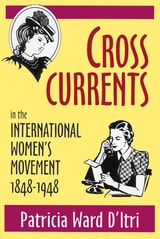
Cross Currents in the International Women’s Movement, 1848–1948
Patricia Ward D'Itri
University of Wisconsin Press, 1999
This study portrays individuals, organizations, and events that contributed to the development of the world movement for women's rights between 1848 and 1948.
[more]