Results by title
21 books match the query 'Surveillance'

Computers, Surveillance, and Privacy
David Lyon and Elia Zureik, Editors
University of Minnesota Press, 1996
Computers, Surveillance, and Privacy was first published in 1996. Minnesota Archive Editions uses digital technology to make long-unavailable books once again accessible, and are published unaltered from the original University of Minnesota Press editions.
From computer networks to grocery store checkout scanners, it is easier and easier for governments, employers, advertisers, and individuals to gather detailed and sophisticated information about each of us. In this important new collection, the authors question the impact of these new technologies of surveillance on our privacy and our culture.
Although surveillance-literally some people "watching over" others-is as old as social relationships themselves, with the advent of the computer age this phenomenon has acquired new and distinctive meanings. Technological advances have made it possible for surveillance to become increasingly global and integrated-both commercial and government-related personal data flows more frequently across national boundaries, and the flow between private and public sectors has increased as well.
Addressing issues of the global integration of surveillance, social control, new information technologies, privacy violation and protection, and workplace surveillance, the contributors to Computers, Surveillance, and Privacy grapple with the ramifications of these concerns for society today. Timely and provocative, this collection will be of vital interest to anyone concerned with resistance to social control and incursions into privacy.
Contributors: Jonathan P. Allen, Colin J. Bennett, Simon G. Davies, Oscar H. Gandy Jr., Calvin C. Gotlieb, Rob Kling, Gary T. Marx, Abbe Mowshowitz, Judith A. Perrolle, Mark Poster, Priscilla M. Regan, James B. Rule.
David Lyon is professor of sociology at Queen's University, Canada. His previous books include The Electronic Eye: The Rise of Surveillance Society (Minnesota, 1994). Elia Zureik is also professor of sociology at Queen's University, Canada, and coedited (with Dianne Hartling) The Social Context of the New Information and Communication Technologies (1987).
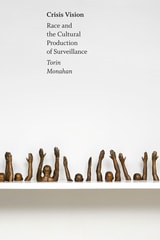
Crisis Vision
Race and the Cultural Production of SurveillanceTom Monahan
Duke University Press, 2022
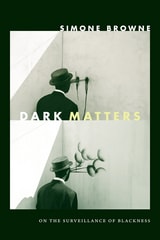
Dark Matters
On the Surveillance of BlacknessSimone Browne
Duke University Press, 2015

Disobedient Aesthetics
Surveillance, Bodies, ControlAnthony Stagliano
University of Alabama Press, 2024
A compelling inquiry into the rhetorical and aesthetic techniques that subvert contemporary regimes of digital surveillance, embodiment, and control.
The contemporary world bristles with tools of observation and manipulation. Security cameras, social media, data mining, biometric scans, and other instruments ensnare the individual in a web of surveillance. In Disobedient Aesthetics, Anthony Stagliano exposes the use of human lives as sites of data exploitation and outlines paths of resistance. From the thermal-vision systems used on military drones, which use human body heat itself as a media object, to facial recognition platforms that use human faces as data mines, and from law enforcement tools of DNA analysis to data-driven urban governance, the realm of algorithmic surveillance and control is wide and subtle.
Disobedient Aesthetics outlines interventions into the technical systems subtending data-driven surveillance and control. Stagliano maps not only the surveillant regimes afforded by recent networked technologies, but also the inventive, artistic research into ways of undermining, upending, or redirecting such technologies. The concluding chapter examines creative, critical, and collective efforts to democratize access to the technology that undergirds such scrutiny and enables ways to detect and contest its power.
In a fascinating epilogue, Stagliano revisits current theories of control and offers an alternative reading of Gilles Deleuze’s oft-cited thesis on control societies: namely that it is not a matter of “finding new weapons” to undermine control but developing new techniques, new designs, new prototypes, and new modes of creative escape.

Inside Tenement Time
Suss, Spirit, and SurveillanceKezia Page
Rutgers University Press, 2025
Inside Tenement Time is the first comprehensive treatment of literary and cultural texts on surveillance in the Caribbean. Covering the long historical arc of the twentieth to the twenty-first centuries, Inside Tenement Time uses Jamaica as a case study to examine moments of crisis and particular spaces, especially urban yard enclaves and their environs, in the Caribbean encounter with surveillance. Making the argument that the Caribbean situation reveals flexible hegemonies rather than provinces of exclusive control, the book demonstrates the countervailing force of sussveillance and spiritveillance, Afro-Indigenous variations on surveillance. Sussveillance and spiritveillance are exemplars of vernacular arts and sciences that operate at and within the frangible borders of state power, exposing the unique dynamics of surveillance in the region and marshalling the acts of imagination with which it contends. For example, the Smile Jamaica concert of 1976, headlined by reggae Superstar Bob Marley, and the reputedly US government-backed 2010 Tivoli Gardens incursion in West Kingston, both moments that have dramatic, even mythic residue in Caribbean and global memory, are among the real-life events brought into conversation with literary representations of this history.
Monitored
Business and Surveillance in a Time of Big DataPeter Bloom
Pluto Press, 2019
What does this technocratic ideology and surveillance-heavy culture reveal about the deeper reality of modern society? Monitored investigates the history and implications of this modern accountability paradox. Peter Bloom reveals pervasive monitoring practices which mask how at its heart, the elite remains socially and ethically out of control.
Challenging their exploitive 'accounting power', Bloom demands that the systems that administer our lives are oriented to social liberation and new ways of being in the world.
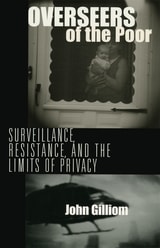
Overseers of the Poor
Surveillance, Resistance, and the Limits of PrivacyJohn Gilliom
University of Chicago Press, 2001
This powerful book lets us in on the conversations of low-income mothers from Appalachian Ohio as they talk about the welfare bureaucracy and its remarkably advanced surveillance system. In their struggle to care for their families, these women are monitored and assessed through a vast network of supercomputers, caseworkers, fraud control agents, and even grocers and neighbors.
In-depth interviews show that these women focus less on the right to privacy than on a critique of surveillance that lays bare the personal and political conflicts with which they live. And, while they have little interest in conventional forms of politics, we see widespread patterns of everyday resistance as they subvert the surveillance regime when they feel it prevents them from being good parents. Ultimately, Overseers of the Poor demonstrates the need to reconceive not just our understanding of the surveillance-privacy debate but also the broader realms of language, participation, and the politics of rights.
We all know that our lives are being watched more than ever before. As we struggle to understand and confront this new order, Gilliom argues, we need to spend less time talking about privacy rights, legislatures, and courts of law and more time talking about power, domination, and the ongoing struggles of everyday people.

People's Pornography
Sex and Surveillance on the Chinese InternetKatrien Jacobs
Intellect Books, 2012
Since its establishment in 1949, the People's Republic of China has upheld a nationwide ban on pornography, imposing harsh punishments on those caught purchasing, producing, or distributing materials deemed a violation of public morality. A provocative contribution to Chinese media studies by a well-known international media researcher, People’s Pornography offers a wide-ranging overview of the political controversies surrounding the ban, as well as a fascinating glimpse into the many distinct media subcultures that have gained widespread popularity on the Chinese Internet as a result. Rounding out this exploration of the many new tendencies in digital citizenship, pornography, and activist media cultures in the greater China region are thought-provoking interviews with individuals involved.
Performance, Transparency, and the Cultures of Surveillance
James M. Harding
University of Michigan Press, 2018

Spectatorship in the Age of Surveillance
Miriam Felton-Dansky, Jacob Gallagher-Ross, and Tom Sellar, special issue editors
Duke University Press, 2018
Contributors: David Bruin, Annie Dorsen, Shonni Enelow, Miriam Felton-Dansky, Jacob Gallagher-Ross, Caden Manson, John H. Muse, Jemma Nelson, Jennifer Parker-Starbuck, Alexandro Segade, Tom Sellar

Surveillance and Diagnostics of Next Generation Nuclear Reactors
Imre Pázsit
The Institution of Engineering and Technology, 2025

Surveillance and Spies in the Civil War
Exposing Confederate Conspiracies in America’s HeartlandStephen E. Towne
Ohio University Press, 2015
Surveillance in the Time of Insecurity
Monahan, Torin
Rutgers University Press, 2010
Surveillance in the Time of Insecurity fuses advanced theoretical accounts of state power and neoliberalism with original research from the social settings in which insecurity dynamics play out in the new century. Torin Monahan explores the counterterrorism-themed show 24, Rapture fiction, traffic control centers, security conferences, public housing, and gated communities, and examines how each manifests complex relationships of inequality, insecurity, and surveillance. Alleviating insecurity requires that we confront its mythic dimensions, the politics inherent in new configurations of security provision, and the structural obstacles to achieving equality in societies.
Surveillance, Privacy, and the Law
Employee Drug Testing and the Politics of Social ControlJohn Gilliom
University of Michigan Press, 1996
Surveillance, Transparency, and Democracy
Public Administration in the Information AgeAkhlaque Haque
University of Alabama Press, 2015
Exploring the delicate balance between technological innovation, government transparency, and democratic freedom.
In this well-informed yet anxious age, public administrators have constructed vast cisterns that collect and interpret a meteoric shower of facts. Akhlaque Haque demonstrates that this pervasive use and increasing dependence on information technology (IT) enables sophisticated and well-intentioned public services that nevertheless risk deforming public policy decision-making and sees a contradiction inherent in a public that seeks services that require a level of data collection that in turn triggers fears of a tyrannical police state.
The author posits that IT’s potential as a tool for human development depends on how civil servants and citizens actively engage in identifying desired outcomes, map IT solutions to those outcomes, and routinize the applications of those solutions. This leads to his call for the development of entrepreneurs who generate innovative solutions to critical human needs and problems. In his powerful summary, he recaps possible answers to the question: What is the best way a public institution can apply technology to improving the human condition?
Engrossing, challenging, and timely, Surveillance, Transparency, and Democracy is essential reading for both policy makers as well as the great majority of readers and citizens engaged in contemporary arguments about the role of government, public health and security, individual privacy, data collection, and surveillance.
Surveillance, Volume 23
Richard Maxwell
Duke University Press, 0
One article looks at the emergence of the biometrics industries and its effect on surveillance systems and businesses. Another addresses the labor of surveillance and how surveillance work and policy affect the homeland security workforce. Various geographic areas are highlighted in several essays, including those on sex workers in Bengal, local surveillance in Turkey, and welfare surveillance and resistance in Appalachian Ohio. Additional themes include historical modes of surveillance, processes of legitimation for intensifying surveillance, and cultural representations of surveillance.
Contributors. Kelly A. Gates, Swati Ghosh, John Gilliom, Margaret Morganroth Gullette, Richard Maxwell, Laikwan Pang, David J. Phillips, Michael J. Shapiro, Çagatay Topal
The Compassionate Court?
Support, Surveillance, and Survival in Prostitution Diversion ProgramsCorey S. Shdaimah, Chrysanthi S. Leon, and Shelly A. Wiechelt
Temple University Press, 2023
The authors of The Compassionate Court? provide case studies of such programs and draw upon interviews and observations conducted over a decade to reveal how participants and professionals perceive court-affiliated PDPs, clients, and staff. Considering the motivations, vision, and goals of these programs as well as their limitations—the inequity and disempowerment of their participants—the authors also present their own changing perspectives on prostitution courts, diversion programs, and criminalization of sex work.

The Intensification of Surveillance
Crime, Terrorism and Warfare in the Information AgeEdited by Kirstie Ball and Frank Webster
Pluto Press, 2003

The Seventies Now
Culture as SurveillanceStephen Paul Miller
Duke University Press, 1999
The concept of surveillance and its attendant social ramifications have been powerful agents in U.S. culture for many decades, but in describing how during the 1970s Americans learned to “survey” themselves, Miller shines surprising new light on such subjects as the women’s movement, voting rights enforcement, the Ford presidency, and environmental legislation. He illuminates the significance of what he terms “microperiods” and analyzes relevant themes in many of the decade’s major films—such as The Deer Hunter, Network, Jaws, Star Wars, and Apocalypse Now—and in the literature of writers including John Ashbery, Toni Morrison, Adrienne Rich, and Sam Shepard. In discussing the reverberations of the 1969 Stonewall riots, technological innovations, the philosophy of Michel Foucault, and a host of documents and incidents, Miller shows how the 1970s marked an important period of transition, indeed a time of many transitions, to the world we confront at the end of the millennium.
The Seventies Now will interest students and scholars of cultural studies, American history, theories of technology, film and literature, visual arts, and gay and lesbian studies.
Unsettled Borders
The Militarized Science of Surveillance on Sacred Indigenous LandFelicity Amaya Schaeffer
Duke University Press, 2022
Windows into the Soul
Surveillance and Society in an Age of High TechnologyGary T. Marx
University of Chicago Press, 2016
In this landmark book, Marx sums up a lifetime of work on issues of surveillance and social control by disentangling and parsing the empirical richness of watching and being watched. Using fictional narratives as well as the findings of social science, Marx draws on decades of studies of covert policing, computer profiling, location and work monitoring, drug testing, caller identification, and much more, Marx gives us a conceptual language to understand the new realities and his work clearly emphasizes the paradoxes, trade-offs, and confusion enveloping the field. Windows into the Soul shows how surveillance can penetrate our social and personal lives in profound, and sometimes harrowing, ways. Ultimately, Marx argues, recognizing complexity and asking the right questions is essential to bringing light and accountability to the darker, more iniquitous corners of our emerging surveillance society.
For more information, please see www.garymarx.net.