Results by title
25 books match the query 'Objects'
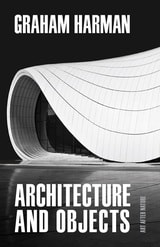
Architecture and Objects
Graham Harman
University of Minnesota Press, 2022
Thinking through object-oriented ontology—and the work of architects such as Rem Koolhaas and Zaha Hadid—to explore new concepts of the relationship between form and function
Object-oriented ontology has become increasingly popular among architectural theorists and practitioners in recent years. Architecture and Objects, the first book on architecture by the founder of object-oriented ontology (OOO), deepens the exchange between architecture and philosophy, providing a new roadmap to OOO’s influence on the language and practice of contemporary architecture and offering new conceptions of the relationship between form and function.
Graham Harman opens with a critique of Heidegger, Derrida, and Deleuze, the three philosophers whose ideas have left the deepest imprint on the field, highlighting the limits of their thinking for architecture. Instead, Harman contends, architecture can employ OOO to reconsider traditional notions of form and function that emphasize their relational characteristics—form with a building’s visual style, function with its stated purpose—and constrain architecture’s possibilities through literalism. Harman challenges these understandings by proposing de-relationalized versions of both (zero-form and zero-function) that together provide a convincing rejoinder to Immanuel Kant’s dismissal of architecture as “impure.”
Through critical engagement with the writings of Peter Eisenman and fresh assessments of buildings by Rem Koolhaas, Frank Gehry, and Zaha Hadid, Architecture and Objects forwards a bold vision of architecture. Overcoming the difficult task of “zeroing” function, Harman concludes, would place architecture at the forefront of a necessary revitalization of exhausted aesthetic paradigms.
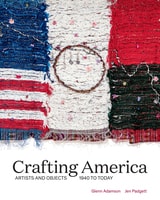
Crafting America
Artists and Objects, 1940 to TodayJen Padgett
University of Arkansas Press, 2020
Craft is a diverse, democratic art form practiced by Americans of every gender, age, ethnicity, and class. Crafting America traces this expansive range of skilled making in a variety of forms, from ceramics and wood to performance costume and community-based practice. In exploring the intertwining of craft and American experience, this volume reveals how artists leverage their craft to realize the values of life, liberty, and the pursuit of happiness.
Accompanying an exhibition of the same title organized by Crystal Bridges Museum of American Art, Crafting America features contributions from scholars that illuminate craft’s relationship to ritual and memory, personal independence, abstraction, and Native American histories. The richly illustrated catalog section—with more than a hundred color images accompanied by lively commentary—presents a vivid picture of American craft over the past eight decades, offering fresh insights on the relationships between objects.
Building upon recent advances in craft scholarship and encouraging more inclusive narratives, Crafting America presents a bold statement on the vital role of craft within the broader context of American art and identity.
Empire of Objects
Iurii Trifonov and the Material World of Soviet CultureBenjamin M. Sutcliffe
University of Wisconsin Press, 2023
Scholars have both neglected Trifonov in recent years and focused their limited attention on the author’s most famous works, produced in the 1960s through 1980s. Yet almost half of his output was written before then. In Empire of Objects, Benjamin Sutcliffe takes care to consider the author’s entire oeuvre. Trifonov’s work reflects the paradoxes of a culture that could neither honestly confront the past nor create a viable future, one that alternated between trying to address and attempting to obscure the trauma of Stalinism. He became increasingly incensed by what he perceived as the erosion of sincerity in public and private life, by the impact of technology, and by the state’s tacit support of greed and materialism. Trifonov’s work, though fictional, offers a compelling window into Soviet culture.
Exhibiting Scotland
Objects, Identity, and the National MuseumAlima Bucciantini
University of Massachusetts Press, 2018
In Exhibiting Scotland, Alima Bucciantini traces how these collections have helped tell the changing stories of this country for centuries and how the museum reflects the Scots' continuing negotiation of their place within modern Britain.
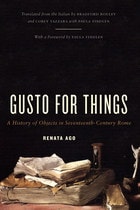
Gusto for Things
A History of Objects in Seventeenth-Century RomeRenata Ago
University of Chicago Press, 2013
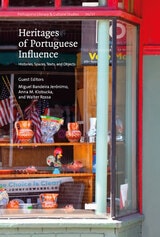
Heritages of Portuguese Influence
Histories, Spaces, Texts, and ObjectsGuest edited by Miguel Bandeira Jerónimo, Anna M. Klobucka, and Walter Rossa
Tagus Press, 2022
Identifying Consumption
Subjects and Objects in Consumer SocietyRobert G. Dunn
Temple University Press, 2008
Identifying Consumption illustrates how an individual’s buying habits are shaped by the dynamics of the consumer marketplace—and thus how consumption and identity inform each other. Robert Dunn brings together the various theories of spending and develops a mode of analysis concentrating on the individual subjectivity of consumption. By doing so, he addresses how we spend and its relationship with status and lifestyle.
Dunn provides a comprehensive guide to the study of modern consumer behavior before summarizing and critiquing the major theories of consumption. At this juncture, he proposes a method of analysis that focuses on the significance of status and lifestyle in social relations that can help explain how the consumer marketplace is shaped. He concludes by raising issues about different ways of consuming and the relationship between consumption and identity.
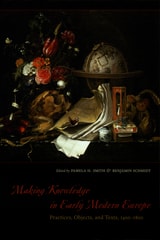
Making Knowledge in Early Modern Europe
Practices, Objects, and Texts, 1400 - 1800Edited by Pamela H. Smith and Benjamin Schmidt
University of Chicago Press, 2008
Composed by scholars in disciplines ranging from the history of science to art history to religious studies, the pieces collected here look at the production and consumption of knowledge as a social process within many different communities. They focus, in particular, on how the methods employed by scientists and intellectuals came to interact with the practices of craftspeople and practitioners to create new ways of knowing. Examining the role of texts, reading habits, painting methods, and countless other forms of knowledge making, this volume brilliantly illuminates the myriad ways these processes affected and were affected by the period’s monumental shifts in culture and learning.
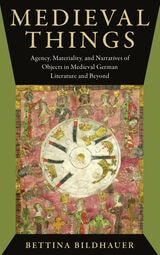
Medieval Things
Agency, Materiality, and Narratives of Objects in Medieval German Literature and BeyondBettina Bildhauer
The Ohio State University Press, 2020
Michael Faraday's 'Chemical Notes, Hints, Suggestions and Objects of Pursuit' of 1822
Ryan D. Tweney
The Institution of Engineering and Technology, 1991
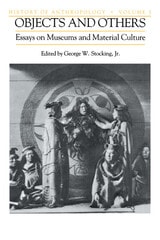
Objects and Others
Essays on Museums and Material CultureEdited by George W. Stocking, Jr.
University of Wisconsin Press, 1988
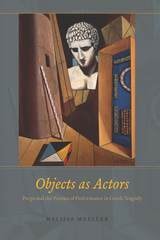
Objects as Actors
Props and the Poetics of Performance in Greek TragedyMelissa Mueller
University of Chicago Press, 2015
As Mueller shows, props such as weapons, textiles, and even letters were often fully integrated into a play’s action. They could provoke surprising plot turns, elicit bold viewer reactions, and provide some of tragedy’s most thrilling moments. Whether the sword of Sophocles’s Ajax, the tapestry in Aeschylus’s Agamemnon, or the tablet of Euripides’s Hippolytus, props demanded attention as a means of uniting—or disrupting—time, space, and genre.
Insightful and original, Objects as Actors offers a fresh perspective on the central tragic texts—and encourages us to rethink ancient theater as a whole.
Objects in Air
Artworks and Their Outside around 1900Margareta Ingrid Christian
University of Chicago Press, 2021
Writers created an early theory of unbounded form that described what Christian calls an artwork’s ecstasis or its ability to stray outside its limits and engender its own space. Objects viewed in this perspective complicate the now-fashionable discourse of empathy aesthetics, the attention to self-projecting subjects, and the idea of the modernist self-contained artwork. For example, Christian invites us to historicize the immersive spatial installations and “environments” that have arisen since the 1960s and to consider their origins in turn-of-the-twentieth-century aesthetics. Throughout this beautifully written work, Christian offers ways for us to rethink entrenched narratives of aesthetics and modernism and to revisit alternatives.
Objects of Empire
The Ceramic Tradition of the Imperial Inca StateTamara L. Bray
University of Texas Press, 2025
A comparative, empire-wide study of the ceramics associated with the imperial Inca state, theorizing the role of these highly recognizable vessel forms in legitimizing Inca rule and establishing imperial identities.
The beautiful polychrome ceramics of the imperial Inca state have long been noted for their seemingly repetitive nature but little considered beyond this basic observation. The widespread distribution and general uniformity of the Inca pottery, however, hints at its larger importance to the imperial project. Moving beyond the pervasive "seen one, seen 'em all" mentality, Objects of Empire brings to light the variability and rich semiotic content of imperial Inca vessels. Taking a comparative, empire-wide approach, Tamara Bray identifies the parameters and significance of this variability, and defines the core elements of the imperial state style. She then investigates where, when, and why differences and deviations from the perceived norm occur.
This study illuminates the strategies of territorial expansion and political control that lay at the heart of the Inca juggernaut, as well as the role of objects in the calculus of would-be rulers and subjects. Based on a unique and extensive database of imperial Inca pottery developed through detailed study of archaeologically recovered and museum-based collections, Objects of Empire reveals how power and legitimacy were produced and reproduced under the Inca through the material culture of everyday life.
Objects of Hunger
E. C. Belli
Southern Illinois University Press, 2019
Objects of Hunger explores in reflective, raw lyrics the dread and beauty of our inner worlds as expressed through our struggles against the self and the other. Each poem is a slender organism that speaks its own mind, unafraid of pathos; the emotions here have been tried on and lived in, and the work accrues, lyric after lyric, page after page. In the second section, World War I poems are broken down and dismantled, as the voices of that era’s poets meld with that of a postpartum mother, exposing a shared vernacular among these disparate experiences. Other poems in the collection explore the unraveling and entrapments of the domestic, but with tenacity in place of softness, using a lexicon gathered from Virginia Woolf’s The Waves and Djuna Barnes’s Nightwood, among others.
What emerges is a finely chiseled portrait of intimacy, one that takes seriously love and all discord, the fracas of reticence and familiarity. Belli gives this world to us by way of a throbbing asceticism, in an exploration of resignation, concession, persistence, and monstrosity. This collection tells what it is to need with abandon.
Objects of Liberty
British Women Writers and Revolutionary SouvenirsPamela Buck
University of Delaware Press, 2024
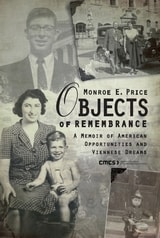
Objects of Remembrance
A Memoir of American Opportunities and Viennese DreamsMonroe E. Price
Central European University Press, 2009
This is a memoir about the power of American assimilation and opportunity in the face of persisting refugee realities. Like Isaac Bashevis Singer, Monroe Price recounts the continuing impact of European identities as families, cast from their homes by the rise of Hitler and the Third Reich, struggle to find their way in a new and challenging environment.
In a series of reflections, Price, who was born to a Jewish family in Vienna in 1938 and left when he was seven months old, seeks to create the Vienna of his infancy, including Jewish life, anti-Semitism, the Anschluss, and Kristallnacht (during which his father was arrested). He shifts to scenes of American socialization in the places he moved with his parents:: Macon, Georgia, Cincinnati, Ohio, and the experience of New York City. Through these reflections, Price illuminates ideas about family, religion, friends and schooling as well as deeply personal issues such as home, food and intimacy.
Price’s memoir weaves complicated strands—his Viennese origins, campaigns to distribute Jewish refugees away from New York City, the special qualities of Midwestern Ohio life in the 1950s—and the contrasting patterns of adjustment by different generations in his family in the American landscape. As he traces the particular path of his own life, Price reveals a more universal story of adjustment, and the relationship between a marginal community and the drama of American citizenship.
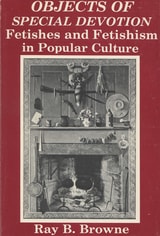
Objects of Special Devotion
Fetishes and Fetishism in Popular CultureRay B. Browne
University of Wisconsin Press, 1982
This book demonstrates the importance of the study of fetishes and fetishism in the study of popular culture. Some of the essays cover rather "conventional" manifestations in the world today; others demonstrate the fetishistic qualities of some unusual items. But all illustrate without any doubt that, like the icon, the ritual, and many other items in society, fetishes, fetishism and fetishists must be studied and understood before we can begin to understand the complexity of present-day society.
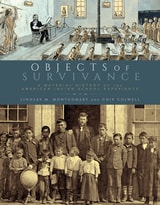
Objects of Survivance
A Material History of the American Indian School ExperienceLindsay M. Montgomery
University Press of Colorado, 2019
This visual and material archive serves as a lens through which to view a key moment in US history—when Native Americans were sequestered onto reservation lands, forced into unfamiliar labor economies, and attacked for their religious practices. Education, the government hoped, would be the final tool to permanently transform Indigenous bodies through moral instruction in Western dress, foodways, and living habits. Yet Lindsay Montgomery and Chip Colwell posit that Bratley’s collection constitutes “objects of survivance”—things and images that testify not to destruction and loss but to resistance and survival. Interwoven with documents and interviews, Objects of Survivance illuminates how the US government sought to control Native Americans and how Indigenous peoples endured in the face of such oppression.
Rejecting the narrative that such objects preserve dying Native cultures, Objects of Survivance reframes the Bratley Collection, showing how tribal members have reconnected to these items, embracing them as part of their past and reclaiming them as part of their contemporary identities. This unique visual and material record of the early American Indian school experience and story of tribal perseverance will be of value to anyone interested in US history, Native American studies, and social justice.
Co-published with the Denver Museum of Nature & Science
On Learning
A General Theory of Objects and Object-RelationsDavid Scott
University College London, 2021
What is learning? This book is a philosophical work that develops a general theory of ontological objects and object-relations, examining concepts as acquired dispositions. David Scott answers a series of questions about concepts in general and the concept of learning in particular. This volume offers a counterargument to empiricist conceptions of learning, rejecting the propagation of simple messages about learning, knowledge, curriculum, and assessment. Instead, Scott argues that values are central to understanding how we live, permeating our descriptions of the world, the attempts we make at creating better futures, and our relations with other people.

Realist Magic
Objects, Ontology, CausalityTimothy Morton
Michigan Publishing Services, 2013
The Afterlife of Objects
Dan Chiasson
University of Chicago Press, 2002
The Democracy of Objects
Levi R. Bryant
Michigan Publishing Services, 2011
The Lives of Objects
Material Culture, Experience, and the Real in the History of Early ChristianityMaia Kotrosits
University of Chicago Press, 2020
Maia Kotrosits offers a fresh perspective on objects, looking beyond physical material to consider how collective imagination shapes the formation of objects and the experience of reality. Bringing a psychoanalytic approach to the analysis of material culture, she examines objects of attachment—relationships, ideas, and beliefs that live on in the psyche—and illustrates how people across time have anchored value systems to the materiality of life. Engaging with classical studies, history, anthropology, and literary, gender, and queer studies, Kotrosits shows how these disciplines address historical knowledge and how an expanded definition of materiality can help us make connections between antiquity and the contemporary world.
The Secret Life of Things
Animals, Objects, and It-Narratives in Eighteenth-Century EnglandMark Blackwell
Bucknell University Press, 2023
Published by Bucknell University Press.
Distributed worldwide by Rutgers University Press.