Results by title
8812 books match the query 'Political Science' and 698 start with c
Cores, Peripheries, and Globalization
Peter Hanns Reill
Central European University Press, 2011
Cornerstone at the Confluence
Navigating the Colorado River Compact's Next CenturyEdited by Jason Anthony Robison
University of Arizona Press, 2022
No fewer than forty million people have come to rely on the Colorado River system in modern times—a river system immersed in an unprecedented, unrelenting megadrought for more than two decades. Attempting to navigate this “new normal,” policymakers are in the midst of negotiating new management rules for the river system, a process coinciding with the compact’s centennial that must be completed by 2026.
Animated by this remarkable confluence of events, Cornerstone at the Confluence leverages the centennial year to reflect on the compact and broader “Law of the River” to envision the future. It is a volume inviting dialogue about how the Colorado River system’s flows should be apportioned given climate change, what should be done about environmental issues such as ecosystem restoration and biodiversity protection, and how long-standing issues of water justice facing Native American communities should be addressed.
In one form or another, all these topics touch on the concept of “equity” embedded within the compact—a concept that tees up what is perhaps the foundational question confronted by Cornerstone at the Confluence: Who should have a seat at the table of Colorado River governance?

Cornerstones of Peace
Jewish Identity Politics and Democratic TheoryBrettschneider, Marla
Rutgers University Press, 1996
Throughout the seventies, the idea of being “pro-Israel” was traditionally equated with support for the Israeli government and was central to an understanding of American Jewish identity. It was so central, argues Marla Brettschneider, that even committed activists who took issue with such a monolithic stance were silenced by mainstream Jewish organizations. But during the 1980s, a change took place. An explosion of new Jewish groups intent on challenging the dominant definition of the pro-Israel attitude transformed an increasingly closed Jewish community into one more democratic and inclusive.
In Cornerstones of Peace, Marla Brettschneider skillfully combines a lucid review of contemporary Liberal political theory and its understanding of the role of groups in the political process, a sophisticated analysis of Hobbesian philosophy, and a rich history of “alternative” Jewish activist groups like Breira and Americans for Peace Now (APN) to ask: What can we learn about identity and democratic theory from the changes that have taken place in the Jewish community? Through an insightful exploration of how small, activist groups have reclaimed pro-Israel identity politics as a collective multilayered process, Brettschneider adds her voice to the growing number of political theorists envisioning a pro-diversity alternative to Liberal political thought. She theorizes about a new democratic theory, showing theorists and activists how to envision and enact more vibrant, inclusive democratic politics.
Coronavirus Politics
The Comparative Politics and Policy of COVID-19Scott L. Greer, Elizabeth J. King, Elize Massard da Fonseca, André Peralta-Santos, Editors
University of Michigan Press, 2021

Corporate Complicity in Israel's Occupation
Evidence from the London Session of the Russell Tribunal on PalestineEdited by Asa Winstanley and Frank Barat
Pluto Press, 2011
The Russell Tribunal on Palestine is a people’s tribunal in the spirit of the Tribunal on Vietnam that was set up by Bertrand Russell in the 1960s. This book contains a selection of the most vital evidence and testimonies presented at the London session. It includes the papers submitted to the tribunal, written by expert witnesses, based on their detailed research into the companies that prop-up Israeli occupation.
Examining the involvement of corporations in the illegal occupation of Palestinian land by Israel, the tribunal of 2010 generated widespread media coverage. The book identifies companies and corporations participating in such illegality and possibilities for legal action against them are discussed.
Released to coincide with the South Africa session at the end of 2011, Corporate Complicity in Israel's Occupation is a vital resource to lawyers, journalists and activists hoping to take informed action against Israeli war crimes and occupation.
Corporate Dreams
Big Business in American Democracy from the Great Depression to the Great RecessionHoopes, James
Rutgers University Press, 2011
Public trust in corporations plummeted in the wake of the 2008 financial crisis, when “Lehman Brothers” and “General Motors” became dirty words for many Americans. In Corporate Dreams, James Hoopes argues that Americans still place too much faith in corporations and, especially, in the idea of “values-based leadership” favored by most CEOs. The danger of corporations, he suggests, lies not just in their economic power, but also in how their confused and undemocratic values are infecting Americans’ visions of good governance.
Corporate Dreams proposes that Americans need to radically rethink their relationships with big business and the government. Rather than buying into the corporate notion of “values-based leadership,” we should view corporate leaders with the same healthy suspicion that our democratic political tradition teaches us to view our political leaders. Unfortunately, the trend is moving the other way. Corporate notions of leadership are invading our democratic political culture when it should be the reverse.
To diagnose the cause and find a cure for our toxic attachment to corporate models of leadership, Hoopes goes back to the root of the problem, offering a comprehensive history of corporate culture inAmerica, from the Great Depression to today’s Great Recession. Combining a historian’s careful eye with an insider’s perspective on the business world, this provocative volume tracks changes in government economic policy, changes in public attitudes toward big business, and changes in how corporate executives view themselves.
Whether examining the rise of Leadership Development programs or recounting JFK’s Pyrrhic victory over U.S. Steel, Hoopes tells a compelling story of how America lost its way, ceding authority to the policies and values of corporate culture. But he also shows us how it’s not too late to return to our democratic ideals—and that it’s not too late to restore the American dream.
Corporate Nature
An Insider's Ethnography of Global ConservationSarah Milne
University of Arizona Press, 2022
Sarah Milne spent more than a decade working for and observing global conservation projects in Cambodia. During this time, she saw how big environmental NGOs can operate rather like corporations. Their core practice involves rolling out appealing and deceptively simple policy ideas, like Payments for Ecosystem Services (PES). Yet, as policy ideas prove hard to implement, NGOs must also carefully curate evidence from the field to give the impression of success and effectiveness.
In Corporate Nature, Milne delves inside the black box of mainstream global conservation. She reveals how big international NGOs struggle in the face of complexity—especially in settings where corruption and political violence prevail. She uses the case of Conservation International’s work in Cambodia to illustrate how apparently powerful NGOs can stumble in practice: policy ideas are transformed on the ground, while perverse side effects arise, like augmented authoritarian power, illegal logging, and Indigenous dispossession.
The real power of global conservation NGOs is therefore not in their capacity to control what happens in the field but in their capacity to ignore or conceal failings. Milne argues that this produces an undesirable form of socionature, called corporate nature, that values organizational success over diverse knowledges and ethical conduct.
Corporate Sovereignty
Law and Government under CapitalismJoshua Barkan
University of Minnesota Press, 2013
Refinery explosions. Accounting scandals. Bank meltdowns. All of these catastrophes—and many more—might rightfully be blamed on corporations. In response, advocates have suggested reforms ranging from increased government regulation to corporate codes of conduct to stop corporate abuses. Joshua Barkan writes that these reactions, which view law as a limit on corporations, misunderstand the role of law in fostering corporate power.
In Corporate Sovereignty, Barkan argues that corporate power should be rethought as a mode of political sovereignty. Rather than treating the economic power of corporations as a threat to the political sovereignty of states, Barkan shows that the two are ontologically linked. Situating analysis of U.S., British, and international corporate law alongside careful readings in political and social theory, he demonstrates that the Anglo-American corporation and modern political sovereignty are founded in and bound together through a principle of legally sanctioned immunity from law. The problems that corporate-led globalization present for governments result not from regulatory failures as much as from corporate immunity that is being exported across the globe.
For Barkan, there is a paradox in that corporations, which are legal creations, are given such power that they undermine the sovereignty of states. He notes that while the relationship between states and corporations may appear adversarial, it is in fact a kind of doubling in which state sovereignty and corporate power are both conjoined and in conflict. Our refusal to grapple with the peculiar nature of this doubling means that some of our best efforts to control corporations unwittingly reinvest the sovereign powers they oppose.
Corrupt Illinois
Patronage, Cronyism, and CriminalityThomas J. Gradel and Dick Simpson
University of Illinois Press, 2015
In Corrupt Illinois, veteran political observers Thomas J. Gradel and Dick Simpson take aim at business-as-usual. Naming names, the authors lead readers through a gallery of rogues and rotten apples to illustrate how generations of chicanery have undermined faith in, and hope for, honest government. From there, they lay out how to implement institutional reforms that provide accountability and eradicate the favoritism, sweetheart deals, and conflicts of interest corroding our civic life.
Corrupt Illinois lays out a blueprint to transform our politics from a pay-to-play–driven marketplace into what it should be: an instrument of public good.
Corruption and Reform in the Teamsters Union
David Witwer
University of Illinois Press, 2002
Almost since its creation, recurring problems with corruption bedeviled the Teamsters Union. David Witwer provides the first in-depth historical study of the forces that contributed to the Teamsters' troubled past and the mechanisms the union employed--from top-down directives to grassroots measures--to combat corruption.
Witwer draws on the perspectives of rank-and-file members, union leaders, and the criminal element to explain the processes that allowed organized crime to seize power inside the union. His account includes the infamous links between the Mafia and union head Jimmy Hoffa, but he also tells the little-known story of the McClellan Committee investigation that first brought those links to light. Witwer also examines how anti-labor forces used the Teamsters' unsavory reputation to influence popular and legislative opinion in a broad attack on workers' rights.
Corruption in Cuba
Castro and BeyondBy Sergio Díaz-Briquets and Jorge Pérez-López
University of Texas Press, 2006
While Fidel Castro maintained his longtime grip on Cuba, revolutionary scholars and policy analysts turned their attention from how Castro succeeded (and failed), to how Castro himself would be succeeded—by a new government. Among the many questions to be answered was how the new government would deal with the corruption that has become endemic in Cuba. Even though combating corruption cannot be the central aim of post-Castro policy, Sergio Díaz-Briquets and Jorge Pérez-López suggest that, without a strong plan to thwart it, corruption will undermine the new economy, erode support for the new government, and encourage organized crime. In short, unless measures are taken to stem corruption, the new Cuba could be as messy as the old Cuba.
Fidel Castro did not bring corruption to Cuba; he merely institutionalized it. Official corruption has crippled Cuba since the colonial period, but Castro's state-run monopolies, cronyism, and lack of accountability have made Cuba one of the world's most corrupt states. The former communist countries in Eastern Europe were also extremely corrupt, and analyses of their transitional periods suggest that those who have taken measures to control corruption have had more successful transitions, regardless of whether the leadership tilted toward socialism or democracy. To that end, Díaz-Briquets and Pérez-López, both Cuban Americans, do not advocate any particular system for Cuba's next government, but instead prescribe uniquely Cuban policies to minimize corruption whatever direction the country takes after Castro. As their work makes clear, averting corruption may be the most critical obstacle in creating a healthy new Cuba.

Corruption, Class, and Politics in Ghana
Ernest Harsch
Ohio University Press, 2024
Corruption
Anthropological PerspectivesEdited by Dieter Haller and Cris Shore
Pluto Press, 2005
Taking a more grounded, empirical and holistic perspective, this text reveals how corruption operates through informal rules, personal connections and the wider social contexts that govern everyday practices. It looks at corruption in transitional societies such as post-Soviet Russia, and also explores efforts to reform or regulate institutions that are perceived to have a potential for corruption, such as the European Commission. The book also covers the Enron and WorldCom scandals.
Cosmopolitan Imaginaries and International Disorder
Aaron C. McKeil
University of Michigan Press, 2025
2026 Sussex International Theory Prize Honorable Mention
While the idea of a cosmopolitan order embracing all humankind is ancient, after the Cold War it was widely believed to be an emerging future. As global interdependence and interaction through new technologies increased, literature of cosmopolitan globalization argued that these changes were setting the stage for a structural transformation of world politics. Yet, a revolt against globalism and increasingly divisive and unstable international order has dramatically contradicted this idea. This presents a puzzle for International Relations theory: Why have attempts to construct cosmopolitan order struggled to emerge in the modern global world?
Cosmopolitan Imaginaries and International Disorder argues that advocacy for cosmopolitan order reform in the modern world has struggled to recognize the political identities of states and populations and to legitimize its proposed political hierarchies. As a result, these efforts have been overwhelmed by states shoring up their power and remobilizing exclusionary nationalist identities, especially when struggles are intensified in contexts of international instability and economic turmoil. In developing a theory to explain these patterns of cosmopolitan politics, this book offers insight into the limits and role of cosmopolitanism in a dividing international order after liberal globalism.
Cosmopolitanism
Carol A. Breckenridge, Sheldon Pollock, Homi K. Bhabha, and Dipesh Chakrabarty, eds.
Duke University Press, 2002
By examining new archives, proposing new theoretical formulations, and suggesting new possibilities of political practice, the contributors critically probe the concept of cosmopolitanism. On the one hand, cosmopolitanism may be taken to promise a form of supraregional political solidarity, but on the other, these essays argue, it may erode precisely those intimate cultural differences that derive their meaning from particular places and traditions. Given that most cosmopolitan political formations—from the Roman empire and European imperialism to contemporary globalization—have been coercive and unequal, can there be a noncoercive and egalitarian cosmopolitan politics? Finally, the volume asks whether cosmopolitanism can promise any universalism that is not the unwarranted generalization of some Western particular.
Contributors. Ackbar Abbas, Arjun Appadurai, Homi K. Bhabha, T. K. Biaya, Carol A. Breckenridge, Dipesh Chakrabarty, Ousame Ndiaye Dago, Mamadou Diouf, Wu Hung, Walter D. Mignolo, Sheldon Pollock, Steven Randall

Cosmopolitanism
Millennial Quartet IV, Volume 12Dipesh Chakrabarty
Duke University Press, 0
Cosmopolitics
Thinking and Feeling beyond the NationPheng Cheah
University of Minnesota Press, 1998
Could it Happen Here?
The Day a Prime Minister Refuses to ResignPeter Hennessy
Haus Publishing, 2025
In light of the resurgence of the far Right across Europe and some of the rhetoric of the 2024 General Election, which carried whiffs of political authoritarianism, Could It Happen Here? explores the possible consequences of a British prime minister refusing to leave office. Mapping out the processes that might occur after such an eventuality, the responsibilities of key players in the United Kingdom’s democratic system, and the integrity of that system after years of stress, Peter Hennessy and Andrew Blick analyze the United Kingdom’s “unwritten” constitution and provide a crucial recommendation for protecting and strengthening the resilience of its parliamentary democracy.
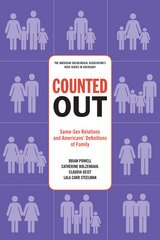
Counted Out
Same-Sex Relations and Americans' Definitions of FamilyBrian Powell
Russell Sage Foundation, 2011
Counter-History of the Present
Untimely Interrogations into Globalization, Technology, DemocracyGabriel Rockhill
Duke University Press, 2017
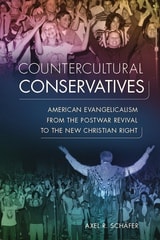
Countercultural Conservatives
American Evangelicalism from the Postwar Revival to the New Christian RightAxel R. Schäfer
University of Wisconsin Press, 2012
In the mid-twentieth century, far more evangelicals supported such “liberal” causes as peace, social justice, and environmental protection. Only gradually did the conservative evangelical faction win dominance, allying with the Republican Party of Ronald Reagan and, eventually, George W. Bush.
In Countercultural Conservatives Axel Schäfer traces the evolution of a diffuse and pluralistic movement into the political force of the New Christian Right. In forging its complex theological and political identity, evangelicalism did not simply reject the ideas of 1960s counterculture, Schäfer argues. For all their strict Biblicism and uncompromising morality, evangelicals absorbed and extended key aspects of the countercultural worldview.
Carefully examining evangelicalism’s internal dynamics, fissures, and coalitions, this book offers an intriguing reinterpretation of the most important development in American religion and politics since World War II.
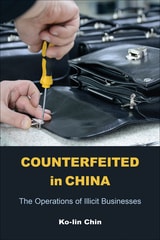
Counterfeited in China
The Operations of Illicit BusinessesKo-lin Chin
Temple University Press, 2025
In his illuminating study, Counterfeited in China, Ko-lin Chin investigates this lucrative industry and its emergence in China. His face-to-face interviews with counterfeiters — business owners, workers, facilitators, and key informants — in the hub of Guangzhou, China reveal how businesses that design, produce, and distribute fake and unauthorized luxury goods manage the risks inherent in their business.
Counterfeited in China examines the individual and group characteristics of counterfeiters and their relationships with organized crime; analyzes the economic aspects of counterfeiting; assesses the relationships among counterfeiting, violence, and corruption; and seeks to understand the demand for counterfeit goods. Chin also discusses the role of Chinese authorities and other parties in the war against counterfeiting.
Assessing the state of the industry and its future, Chin provides fascinating new insights into the modus operandi of counterfeiters.
Counterfeiting Labor's Voice
William A. A. Carsey and the Shaping of American Reform PoliticsMark A. Lause
University of Illinois Press, 2024
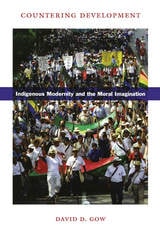
Countering Development
Indigenous Modernity and the Moral ImaginationDavid D. Gow
Duke University Press, 2008
Through ethnographic fieldwork conducted annually in Cauca from 1995 through 2002, Gow compares the development plans of the three communities, looking at both the planning processes and the plans themselves. In so doing, he demonstrates that there is no single indigenous approach to development and modernity. He describes differences in how each community defined and employed the concept of culture, how they connected a concern with culture to economic and political reconstruction, and how they sought to assert their own priorities while engaging with the existing development resources at their disposal. Ultimately, Gow argues that the moral vision advanced by the indigenous movement, combined with the growing importance attached to human rights, offers a fruitful way to think about development: less as a process of integration into a rigidly defined modernity than as a critical modernity based on a radical politics of inclusive citizenship.
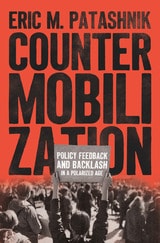
Countermobilization
Policy Feedback and Backlash in a Polarized AgeEric M. Patashnik
University of Chicago Press, 2023
An essential look at how and why backlash movements are inherent to US policymaking.
The most successful policies not only solve problems. They also build supportive coalitions. Yet, sometimes, policies trigger backlash and mobilize opposition. Although backlash is not a new phenomenon, today’s political landscape is distinguished by the frequency and pervasiveness of backlash in nearly every area of US policymaking, from abortion rights to the Affordable Care Act.
Eric M. Patashnik develops a policy-centered theory of backlash that illuminates how policies stimulate backlashes by imposing losses, overreaching, or challenging existing arrangements to which people are strongly attached. Drawing on case studies of issues from immigration and trade to healthcare and gun control, Countermobilization shows that backlash politics is fueled by polarization, cultural shifts, and negative feedback from the activist government itself. It also offers crucial insights to help identify and navigate backlash risks.
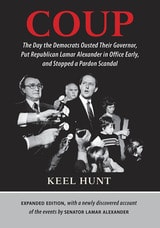
Coup
The Day the Democrats Ousted Their Governor, Put Republican Lamar Alexander in Office Early, and Stopped a Pardon ScandalKeel Hunt
Vanderbilt University Press, 2017
On January 17, 1979, driven by new information that some of the worst criminals in the state's penitentiaries were about to be released (and fears that James Earl Ray might be one of them), a small bipartisan group chose to take charge. Senior Democratic leaders, friends of the sitting governor, together with the Republican governor-elect Lamar Alexander (now US Senator from Tennessee), agreed to oust Blanton from office before another night fell. It was a maneuver unique in American political history.
Expanded edition, with a newly discovered account of the events by Senator Lamar Alexander:
"In December 2015 something unexpected happened. Keel [Hunt] delivered to my Nashville office a brown three-ring binder. He had only recently discovered it in a box that had been in storage for thirty years." —Senator Lamar Alexander
This binder contained the forgotten typescript, written in 1985, of Alexander's recollections of the events leading up to his early inauguration on January 17, 1979. In this expanded edition of Coup, the Senator's 22,000-word text has been added as a lost footnote to Hunt's definitive account.
From the foreword by John L. Seigenthaler:
"The individual stories of those government officials involved in the coup—each account unique, but all of them intersecting—were scattered like disconnected pieces of a jigsaw puzzle on the table of history until the author conceived this book. Perhaps because it happened so quickly, and without major disagreement, protest, or dissent, this truly historic moment has been buried in the public mind. In unearthing the drama in gripping detail, Keel Hunt assures that the 'dark day' will be remembered as a bright one in which conflicted politicians came together in the public interest."

Couplets
Travels in Speculative PragmatismBrian Massumi
Duke University Press, 2021
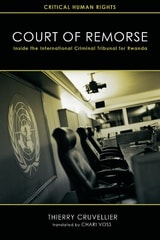
Court of Remorse
Inside the International Criminal Tribunal for RwandaThierry Cruvellier
University of Wisconsin Press, 2010
Fascinated by the Tribunal’s rich complexities, journalist Thierry Cruvellier came back day after day to watch the proceedings, spending more time there than any other outside observer. Gradually he gained the confidence of the victims, defendants, lawyers, and judges. Drawing on interviews with these protagonists and his close observations of their interactions, Cruvellier takes readers inside the courtroom to witness the motivations, mechanisms, and manipulations of justice as it unfolded on the stage of high-stakes, global politics. It is this ground-level view that makes his account so valuable—and so absorbing. A must-read for those who want to understand the dynamics of international criminal tribunals, Court of Remorse reveals both the possibilities and the challenges of prosecuting human rights violations.
Best Books for General Audiences, selected by the American Association for School Libraries and the Public Library Association
Best Books for High Schools, selected by the American Association for School Libraries
Courting Desire
Litigating for Love in North IndiaRama Srinivasan
Rutgers University Press, 2020
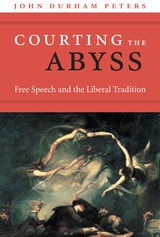
Courting the Abyss
Free Speech and the Liberal TraditionJohn Durham Peters
University of Chicago Press, 2005
A mesmerizing account of the role of public communication in the Anglo-American world, Courting the Abyss shows that liberty's earliest advocates recognized its fraternal relationship with wickedness and evil. While we understand freedom of expression to mean "anything goes," John Durham Peters asks why its advocates so often celebrate a sojourn in hell and the overcoming of suffering. He directs us to such well-known sources as the prose and poetry of John Milton and the political and philosophical theory of John Locke, Adam Smith, John Stuart Mill, and Oliver Wendell Holmes Jr., as well as lesser-known sources such as the theology of Paul of Tarsus. In various ways they all, he shows, envisioned an attitude of self-mastery or self-transcendence as a response to the inevitable dangers of free speech, a troubled legacy that continues to inform ruling norms about knowledge, ethical responsibility, and democracy today.
A world of gigabytes, undiminished religious passion, and relentless scientific discovery calls for a fresh account of liberty that recognizes its risk and its splendor. Instead of celebrating noxious doctrine as proof of society's robustness, Courting the Abyss invites us to rethink public communication today by looking more deeply into the unfathomable mystery of liberty and evil.
Courts Liberalism And Rights
Gay Law And Politics In The United States and CanadaJason Pierceson
Temple University Press, 2005
At a time when most gay and lesbian politics focuses only on the issue of gay marriage, Courts, Liberalism, and Rights guides readers through a nuanced discussion of liberalism, court rulings on sodomy laws and same-sex marriage, and the comparative progress gays and lesbians have made via the courts in Canada.
As debates continue about the ability of courts to affect social change, Jason Pierceson argues that this is possible. He claims that the greatest opportunity for reform via the judiciary exists when a judiciary with broad interpretive powers encounters a political culture that endorses a form of liberalism based on broadly conceived individual rights; not a negative set of rights to be held against the state, but a set of rights that recognizes the inherent dignity and worth of every individual.
Courts and Bureaucracies
Renewing the Rule of Law in Our TimesRobert P. Burns
University of Chicago Press, 2027
A novel meditation on how courts and bureaucracies function today and how they can be made better.
We live in a highly bureaucratic society, so much so that we often don’t even see it. Although we think of bureaucracies and courtrooms as different kinds of institutions, as Robert P. Burns argues in Courts and Bureaucracies, their functions and everyday operations often blur together. Today, courts are being used to address numerous social problems that the government is unable or unwilling to tackle, and consequently, the courts frequently emphasize bureaucratic goals—such as efficiency and social control—over the adjudicatory functions that they are supposed to embody.
Drawing on social theory, philosophy, public administration, and law, Burns clarifies the role of courts in today’s bureaucratic society and considers the distinctive contributions that specifically legal procedures can bring. After exploring the competing first principles of adjudication, Burns then examines our current administrative, civil, and criminal processes and describes new and looming changes to rules and practices that should affect our thinking about the rule of law and the role of the courts.
A broad reassessment—both philosophical and practical—of how criminal, civil, and administrative practices differ from one another and what benefits each bestows, Courts and Bureaucracies offers concrete suggestions for how we can better achieve the ideals already implicit in our judicial traditions and practices.
Courts
A Comparative and Political AnalysisMartin Shapiro
University of Chicago Press, 1981
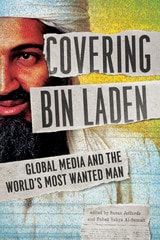
Covering Bin Laden
Global Media and the World's Most Wanted ManEdited by Susan Jeffords and Fahed Yahya Al-Sumait
University of Illinois Press, 2015
In Covering Bin Laden, editors Susan Jeffords and Fahed Yahya Al-Sumait collect perspectives from global scholars exploring a startling premise: that media depictions of Bin Laden not only diverge but often contradict each other, depending on the media provider and format, the place in which the depiction is presented, and the viewer's political and cultural background. The contributors analyze the representations of the many Bin Ladens, ranging from Al Jazeera broadcasts to video games. They examine the media's dominant role in shaping our understanding of terrorists and why/how they should be feared, and they engage with the ways the mosaic of Bin Laden images and narratives have influenced policies and actions around the world.
Contributors include Fahed Al-Sumait, Saranaz Barforoush, Aditi Bhatia, Purnima Bose, Ryan Croken, Simon Ferrari, Andrew Hill, Richard Jackson, Susan Jeffords, Joanna Margueritte-Giecewicz, Noha Mellor, Susan Moeller, Brigitte Nacos, Courtney C. Radsch, and Alexander Spencer.
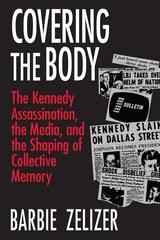
Covering the Body
The Kennedy Assassination, the Media, and the Shaping of Collective MemoryBarbie Zelizer
University of Chicago Press, 1992
Covering the Body (the title refers to the charge given journalists to follow a president) is a powerful reassessment of the media's role in shaping our collective memory of the assassination—at the same time as it used the assassination coverage to legitimize its own role as official interpreter of American reality. Of the more than fifty reporters covering Kennedy in Dallas, no one actually saw the assassination. And faced with a monumentally important story that was continuously breaking, most journalists had no time to verify leads or substantiate reports. Rather, they took discrete moments of their stories and turned them into one coherent narrative, blurring what was and was not "professional" about their coverage.
Through incisive analyses of the many accounts and investigations in the years since the shooting, Zelizer reveals how journalists used the assassination not just to relay the news but to address the issues they saw as central to the profession and to promote themselves as cultural authorities. Indeed, argues Zelizer, these motivations are still alive and are at the core of the controversy surrounding Oliver Stone's movie, JFK.
At its heart, Covering the Body raises serious questions about the role of the media in defining our reality, and shaping our myths and memories. In tracing how journalists attempted to answer questions that still trouble most Americans, Zelizer offers a fascinating analysis of the role of the media as cultural authorities.
Crack Capitalism
John Holloway
Pluto Press, 2010
Crack Capitalism, argues that radical change can only come about through the creation, expansion and multiplication of 'cracks' in the capitalist system. These cracks are ordinary moments or spaces of rebellion in which we assert a different type of doing.
John Holloway's previous book, Change the World Without Taking Power, sparked a world-wide debate among activists and scholars about the most effective methods of going beyond capitalism. Now Holloway rejects the idea of a disconnected array of struggles and finds a unifying contradiction - the opposition between the capitalist labour we undertake in our jobs and the drive towards doing what we consider necessary or desirable.
Clearly and accessibly presented in the form of 33 theses, Crack Capitalism is set to reopen the debate among radical scholars and activists seeking to break capitalism now.
Cracked Coverage
Television News, The Anti-Cocaine Crusade, and the Reagan LegacyJimmie L. Reeves and Richard Campbell
Duke University Press, 1994
The authors persuasively argue, for example, that powder cocaine in the early Reagan years was understood and treated very differently on television and by the state than was crack cocaine, which was discovered by the news media in late 1985. In their critical analysis of 270 news stories broadcast between 1981 and 1988, Reeves and Campbell demonstrate a disturbing disparity between the earlier presentation of the middle- and upper-class "white" drug offender, for whom therapeutic recovery was an available option, and the subsequent news treatment of the inner-city "black" drug delinquent, often described as beyond rehabilitation and subject only to intensified strategies of law and order. Enlivened by provocative discussions of Nancy Reagan’s antidrug activism, the dramatic death of basketball star Len Bias, and the myth of the crack baby, the book argues that Reagan’s war on drugs was at heart a political spectacle that advanced the reactionary agenda of the New and Religious Right—an agenda that dismissed social problems grounded in economic devastation as individual moral problems that could simply be remedied by just saying "no."
Wide ranging and authoritative, Cracked Coverage: Television News, the Anti-Cocaine Crusade, and the Reagan Legacy is a truly interdisciplinary work that will attract readers across the humanities and social sciences in addition to students, scholars, journalists, and policy makers interested in the media and drug-related issues.

Cracked Coverage
Television News, The Anti-Cocaine Crusade, and the Reagan LegacyJimmie L. Reeves and Richard Campbell
Duke University Press, 0
The authors persuasively argue, for example, that powder cocaine in the early Reagan years was understood and treated very differently on television and by the state than was crack cocaine, which was discovered by the news media in late 1985. In their critical analysis of 270 news stories broadcast between 1981 and 1988, Reeves and Campbell demonstrate a disturbing disparity between the earlier presentation of the middle- and upper-class "white" drug offender, for whom therapeutic recovery was an available option, and the subsequent news treatment of the inner-city "black" drug delinquent, often described as beyond rehabilitation and subject only to intensified strategies of law and order. Enlivened by provocative discussions of Nancy Reagan’s antidrug activism, the dramatic death of basketball star Len Bias, and the myth of the crack baby, the book argues that Reagan’s war on drugs was at heart a political spectacle that advanced the reactionary agenda of the New and Religious Right—an agenda that dismissed social problems grounded in economic devastation as individual moral problems that could simply be remedied by just saying "no."
Wide ranging and authoritative, Cracked Coverage: Television News, the Anti-Cocaine Crusade, and the Reagan Legacy is a truly interdisciplinary work that will attract readers across the humanities and social sciences in addition to students, scholars, journalists, and policy makers interested in the media and drug-related issues.
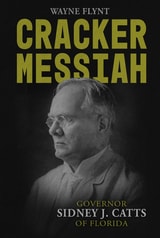
Cracker Messiah
Governor Sidney J. Catts of FloridaWayne Flynt
University of Alabama Press, 1977
The definitive biography of Sidney J. Catts—Florida’s fiery governor who fused pulpit rhetoric with populist politics in the early twentieth century.
Cracker Messiah by Wayne Flynt is a riveting portrait of Sidney J. Catts, one of the most controversial figures in Southern political history. Catts rose from Baptist pulpits and Chautauqua stages to Florida’s governor’s mansion in 1916, riding a wave of rural populism, prohibition fervor, and anti-Catholic rhetoric. His fiery oratory and outsider persona electrified “Florida crackers” at a time when industrial and urban forces were reshaping the South. Yet Catts was more than a demagogue. His administration championed progressive reforms—good roads, penal improvements, vocational education, and even women’s political participation—while his career oscillated between idealism and opportunism.
Wayne Flynt’s meticulously documented biography illuminates this complicated politician, tracing Catts’s battles with the Democratic establishment, his failed Senate bid, and his later flirtations with gambling and real estate during Florida’s boom years. Drawing on interviews, archival sources, and legislative records, Cracker Messiah illuminates the tensions between nativism and reform, faith and hypocrisy, populism and progressivism in the early twentieth-century South. This new edition will appeal to readers of Southern history, political biography, and Progressive Era studies, as well as anyone interested in the roots of American populism and the enduring complexities of cultural and political identity in the Deep South.
Cracks in the Wall
Beyond Apartheid in Palestine/IsraelBen White
Pluto Press, 2018
But while the situation on the ground is bleak, Ben White argues that there are widening cracks in Israel's traditional pillars of support. Opposition to Israeli policies and even critiques of Zionism are growing in Jewish communities, as well as amongst Western progressives. The election of Donald Trump has served as a catalyst for these processes, including the transformation of Israel from a partisan issue into one that divides the US establishment. Meanwhile, the Palestinian-led boycott campaign is gathering momentum, prompting a desperate backlash by Israel and its allies.
With sharp analysis, Ben White says now is the time to plot a course that avoids the mistakes of the past - a way forward beyond apartheid in Palestine. The solution is not partition and ethnic separation, but equality and self-determination - for all.

Cradle of Conservation
An Environmental History of PennsylvaniaAllen Dieterich-Ward
Temple University Press, 2024
Cradle of Conservation moves across time and place, from the Haudenosaunee people of the Susquehanna Valley, to the iron furnaces of nineteenth-century Pittsburgh, to the diesel trucks on the twentieth-century Pennsylvania Turnpike. In addition, Dieterich-Ward explores the histories of Philadelphia’s Schuylkill River and the state’s anthracite region and traces the environmental movements and crises that have led to public policy changes in the face of climate change.
Cradle of Conservation deepens our understanding of how Pennsylvanians have conserved and consumed.
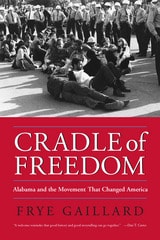
Cradle of Freedom
Alabama and the Movement That Changed AmericaFrye Gaillard
University of Alabama Press, 2006
Cradle of Freedom puts a human face on the story of the black American struggle for equality in Alabama during the 1960s.
While exceptional leaders such as Martin Luther King Jr., Rosa Parks, Fred Shuttlesworth, Ralph Abernathy, John Lewis, and others rose up from the ranks and carved their places in history, the burden of the movement was not carried by them alone. It was fueled by the commitment and hard work of thousands of everyday people who decided that the time had come to take a stand.
Cradle of Freedom is tied to the chronology of pivotal events occurring in Alabama the Montgomery bus boycott, the Freedom Rides, the Letter from the Birmingham Jail, the bombing of the 16th Street Baptist Church, Bloody Sunday, and the Black Power movement in the Black Belt. Gaillard artfully interweaves fresh stories of ordinary people with the familiar ones of the civil rights icons. We learn about the ministers and lawyers, both black and white, who aided the movement in distinct ways at key points. We meet Vernon Johns, King's predecessor at the Dexter Avenue Baptist Church in Montgomery, who first suggested boycotting the buses and who wrote later, "It is a heart strangely un-Christian that cannot thrill with joy when the least of men begin to pull in the direction of the stars." We hear from John Hulett who tells how terror of lynching forced him down into ditches whenever headlights appeared on a night road. We see the Edmund Pettus Bridge beatings from the perspective of marcher JoAnne Bland, who was only a child at the time. We learn of E. D. Nixon, a Pullman porter who helped organize the bus boycott and who later choked with emotion when, for the first time in his life, a white man extended his hand in greeting to him on a public street.
How these ordinary people rose to the challenges of an unfair system with a will and determination that changed their times forever is a fascinating and extraordinary story that Gaillard tells with his hallmark talent. Cradle of Freedom unfolds with the dramatic flow of a novel, yet it is based on meticulous research. With authority and grace, Gaillard explains how the southern state deemed the cradle of the Confederacy became with great struggle, some loss, and much hope the cradle of freedom.
Crafting Equality
America's Anglo-African WordCeleste Michelle Condit and John Louis Lucaites
University of Chicago Press, 1993
Drawing upon little studied speeches, newspapers, magazines, and other public discourse, Condit and Lucaites survey the shifting meaning of equality from 1760 to the present as a process of interaction and negotiation among different social groups in American politics and culture. They make a powerful case for the critical role of black Americans in actively shaping what equality has come to mean in our political conversation by chronicling the development of an African-American rhetorical community. The story they tell supports a vision of equality that embraces both heterogeneity and homogeneity as necessary for maintaining the balance between liberty and property.
A compelling revision of an important aspect of America's history, Crafting Equality will interest anyone wanting to better understand the role public discourse plays in affecting the major social and political issues of our times. It will also interest readers concerned with the relationship between politics and culture in America's increasingly multi-cultural society.

Crash Course
From the Good War to the Forever WarFranklin, H. Bruce
Rutgers University Press, 2024
Now, after fifty years as a renowned cultural historian, Franklin offers a set of hard-learned lessons about modern American history. Crash Course is essential reading for anyone who wonders how America ended up where it is today: with a deeply divided and disillusioned populace, led by a dysfunctional government, and mired in unwinnable wars. It also finds startling parallels between America’s foreign military exploits and the equally brutal tactics used on the home front to crush organized labor, antiwar, and civil rights movements.
More than just a memoir or a history book, Crash Course gives readers a unique firsthand look at the building of the American empire and the damage it has wrought. Shocking and gripping as any thriller, it exposes the endless deception of the American public, and reveals from inside how and why many millions of Americans have been struggling for decades against our own government in a fight for peace and justice.
Created Unequal
The Crisis in American PayJames K. Galbraith
University of Chicago Press, 2000
"Created Unequal is not light reading, but Galbraith's elegant arguments, passionate exposition, and profound conclusions make it worth the trouble. . . . [Galbraith] remind[s] us that the economy is and ought to be run by humans, not humans by the economy."—Joanna Ciulla, Los Angeles Times Book Review
"Created Unequal is a lucid and wise explanation of why America seems to be prospering while most Americans aren't. James Galbraith takes steady aim at a variety of widely accepted economic myths and hits most of them dead center. This book will tell you a lot about the way your economic world really works."—Jeff Faux, President of the Economic Policy Institute
"[A] brilliant and iconoclastic examination of the major social trend of our time."—Michael Lind, Washington Monthly
Creating Chaos Online
Disinformation and Subverted Post-PublicsAsta Zelenkauskaite
University of Michigan Press, 2022
With the prevalence of disinformation geared to instill doubt rather than clarity, Creating Chaos Online unmasks disinformation when it attempts to pass as deliberation in the public sphere and distorts the democratic processes. Asta Zelenkauskaitė finds that repeated tropes justifying Russian trolling were found to circulate across not only all analyzed media platforms’ comments but also across two analyzed sociopolitical contexts suggesting the orchestrated efforts behind messaging. Through a dystopian vision of publics that are expected to navigate in the sea of uncertain both authentic and orchestrated content, pushed by human and nonhuman actors, Creating Chaos Online offers a concept of post-publics. The idea of post-publics is reflected within the continuum of treatment of public, counter public, and anti-public. This book argues that affect-instilled arguments used in public deliberation in times of uncertainty, along with whataboutism constitute a playbook for chaos online.
Creating Citizens
Liberal Arts, Civic Engagement, and the Land-Grant TraditionEdited by Brigitta R. Brunner
University of Alabama Press, 2016
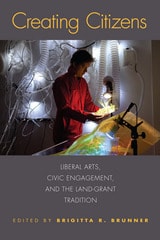
Creating Citizens is a collection of essays about Community and Civic Engagement (CCE) learning at land-grant universities.
In Creating Citizens, professors and administrators at Auburn University’s College of Liberal Arts recount valuable, first-hand experiences teaching Community and Civic Engagement (CCE). They demonstrate that, contrary to many expectations, CCE instruction both complements the mission of liberal arts curricula and powerfully advances the fundamental mission of American land-grand institutions.
The nine essays in Creating Citizens offer structures for incorporating CCE initiatives into university programs, instructional methods and techniques, and numerous case studies and examples undertaken at Auburn University but applicable at any university. Many contributors describe their own rewarding experiences with CCE and emphasize the ways outreach efforts reinvigorate their teaching or research.
Creating Citizens recounts the foundation of land-grant institutions by the Morrill Act of 1862. Their mission is to instruct in agriculture, military science, and mechanics, but these goals augmented rather than replaced an education in the classics, or liberal arts. Land-grant institutions, therefore, have a special calling to provide a broad spectrum of society with an education that not only enriched the personal lives of their students, but the communities they are a part of. Creating Citizens demonstrates the important opportunities CCE instruction represents to any university but are especially close to the heart of the mission of land-grant colleges.
In open societies, the role and mission of public institutions of higher learning that are supported by public subsidies are perennial subjects of interest and debate. Creating Citizens provides valuable insights of interest to educators, education administrators, students, and policy makers involved in the field of higher education.
Creating Conservatism
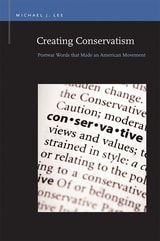
Postwar Words that Made an American MovementMichael J. Lee
Michigan State University Press, 2014

Creating Germans Abroad
Cultural Policies and National Identity in NamibiaDaniel Joseph Walther
Ohio University Press, 2002
When World War I brought an end to German colonial rule in Namibia, much of the German population stayed on. The German community, which had managed to deal with colonial administration, faced new challenges when the region became a South African mandate under the League of Nations in 1919. One of these was the issue of Germanness, which ultimately resulted in public conversations and expressions of identity.
In Creating Germans Abroad, Daniel Walther examines this discourse and provides striking new insights into the character of the German populace in both Germany and its former colony, Southwest Africa, known today as Namibia. In addition to German colonialism, Walther considers issues of race, class, and gender and the activities of minority groups. He offers new perspectives on German cultural and national identity during the Empire, the Weimar Republic, and the Third Reich.
In a larger context, Creating Germans Abroad acts as a model for investigating the strategies and motivations of groups and individuals engaged in national or ethnic engineering and demonstrates how unforeseen circumstances can affect the nature and outcome of these endeavors.
Creating Political Presence
The New Politics of Democratic RepresentationEdited by Dario Castiglione and Johannes Pollak
University of Chicago Press, 2018
In Creating Political Presence, a diverse and international group of scholars explores the implications of such a turn. Two broad, overlapping perspectives emerge. In the first section, the contributions investigate how political representation relates to empowerment, either facilitating or interfering with the capacity of citizens to develop autonomous judgment in collective decision making. Contributions in the second section look at representation from the perspective of inclusion, focusing on how representative relationships and claims articulate the demands of those who are excluded or have no voice. The final section examines political representation from a more systemic perspective, exploring its broader environmental conditions and the way it acquires democratic legitimacy.