Results by title
3576 books match the query 'American' and 225 start with c
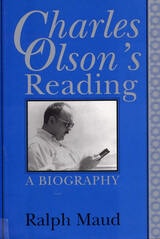
Charles Olson's Reading
A BiographyRalph Maud
Southern Illinois University Press, 1996
In this narrative account of the life and work of Charles Olson, Ralph Maud focuses on what the poet read as a basis for understanding the work he produced.
To an extraordinary degree, Olson’s reading and life were coextensive, according to Maud, who notes that Olson saw his written output over his lifetime as a total cosmology. An individual who rarely traveled, this major American poet explored the world and its history as well as the furthest reaches of the thought of his day through books.
Maud builds upon George Butterick’s annotated listing of Olson’s library, bought by the University of Connecticut after the poet’s death in 1970. The present volume, however, adds categories of books Butterick deliberately omitted: Olson’s childhood books and poetry by his own contemporaries.
Linking Olson’s books to his intellectual and poetic development at each stage of his career, Maud reveals such little-known but important connections as the contracted book project "Operation Red, White and Black" and Olson’s plan for the long poem "West"—two unrealized projects much later shaped into The Maximus Poems.
Maud also outlines the surprisingly multiple role of the painter Corrado Cagli, who brought home to Olson the significance of the Holocaust and introduced him both to the Tarot and to the theories of non-Euclidean geometry that Olson variously incorporated into his poems and essays. In discussing Olson’s relationship to Ezra Pound, Maud defines in some detail what Olson gained from Pound and what he repudiated.
Maud refutes the notion that Olson’s intellectual and creative powers declined during the last years of his life, demonstrating that during these years Olson developed his Jungian interest, his attention to early Greek thought, and a new concern for Northern mythology.
This chronicle of Olson’s reading from childhood to deathbed constitutes a critical biography of the larger-than-life author of Call Me Ishmael and The Maximus Poems. No modern poet is more revealed in his sources than Olson. Maud’s comprehensive and complete study provides a basis for new and fresh modes of thinking about Olson’s great achievement.
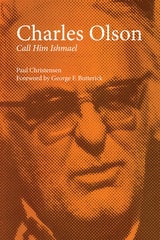
Charles Olson
Call Him IshmaelBy Paul Christensen
University of Texas Press, 1979
Charles Olson was an important force behind the raucous, explicit, jaunty style of much of twentieth-century poetry in America. This study makes a major contribution to our understanding of his life and work.
Paul Christensen draws upon a wide variety of source materials—from letters, unpublished essays, and fragments and sketches from the Olson Archives to the full range of Olson's published prose and poetry. Under Christensen's critical examination, Olson emerges as a stunning theorist and poet, whose erratic and often unfinished writings obscured his provocative intellect and the coherence of his perspective on the arts.
Soon after World War II, Olson emerged as one of America's leading poets with his revolutionary document on poetics, "Projective Verse," and his now-classic poem, "The Kingfishers," both of which declared a new set of techniques for verse composition. Throughout the 1950s Olson wrote many polemical essays on literature, history, aesthetics, and philosophy that outlined a new stance to experience he called objectism.
A firm advocate of spontaneous self-expression in the arts, Olson regarded the poet's return to an intense declaration of individuality as a force to combat the decade's insistence on conformity. Throughout his life Olson fought against the depersonalization of the artist in the modern age; his resources, raw verve and unedited tumultuous lyricism, were weapons he used against generalized life and identity.
This volume begins with an overview of Olson's life from his early years as a student at Harvard through his short-lived political career, his rectorship at Black Mountain College, and his retirement to Gloucester to finish writing the Maximus poems. Christensen provides a systematic review of Olson's prose works, including a close examination of his brilliant monograph on Melville, Call Me Ishmael.
Considerable attention is devoted to Olson's theory of projectivism, the themes and techniques of his short poems, and the strategies and content of his major work, the Maximus series. In addition, there is a critical survey of the works of Robert Creeley, Robert Duncan, Denise Levertov, Paul Blackburn, and other poets who show Olson's influence in their own innovative, self-exploratory poetry.
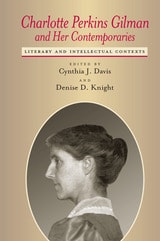
Charlotte Perkins Gilman and Her Contemporaries
Literary and Intellectual ContextsEdited by Cynthia J. Davis and Denise D. Knight
University of Alabama Press, 2004
Considers Gilman’s place in American literary and social history by examining her relationships to other prominent intellectuals of her era
By placing Charlotte Perkins Gilman in the company of her contemporaries, this collection seeks to correct misunderstandings of the feminist writer and lecturer as an isolated radical. Gilman believed and preached that no life is ever led in isolation; indeed, the cornerstone of her philosophy was the idea that “humanity is a relation.”Gilman's highly public and combative stances as a critic and social activist brought her into contact and conflict with many of the major thinkers and writers of the period, including Mary Austin, Margaret Sanger, Ambrose Bierce, Grace Ellery Channing, Lester Ward, Inez Haynes Gillmore, William Randolph Hearst, Karen Horney, William Dean Howells, Catharine Beecher, George Bernard Shaw, and Owen Wister. Gilman wrote on subjects as wide ranging as birth control, eugenics, race, women's rights and suffrage, psychology, Marxism, and literary aesthetics. Her many contributions to social, intellectual, and literary life at the turn of the 20th century raised the bar for future discourse, but at great personal and professional cost.
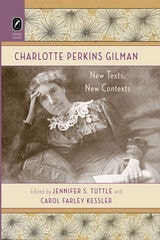
Charlotte Perkins Gilman
New Texts, New ContextsJennifer S. Tuttle and Carol Farley Kessler
The Ohio State University Press, 2011
Charlotte Perkins Gilman
Optimist ReformerJill Rudd
University of Iowa Press, 1999
Chasing the White Whale
The Moby-Dick Marathon; or, What Melville Means TodayDavid Dowling
University of Iowa Press, 2010
The experimental artist Peter Fischli once observed, “There’s certainly a subversive pleasure in occupying yourself with something for an unreasonable length of time.” In this same spirit, David Dowling takes it upon himself to attend and report on the all-consuming annual Moby-Dick Marathon reading at the New Bedford Whaling Museum.
The twenty-five-hour nonstop reading of Melville’s titanic epic has inspired this fresh look at Moby-Dick in light of its most devoted followers at the moment of their high holy day, January 3, 2009. With some trepidation, Dowling joined the ranks of the Melvillians, among the world’s most obsessive literary aficionados, to participate in the event for its full length, from “Call Me Ishmael” to the destruction of the Pequod. Dowling not only survived to tell his tale, but does so with erudition, humor, and a keen sense for the passions of his fellow whalers.
The obsession of participants at the marathon reading is startling, providing evidence of Ishmael’s remark that “all men live enveloped in whale-lines. All are born with halters round their necks; but it is only when caught in the swift, sudden turn of death, that mortals realize the silent, subtle, ever-present perils of life.” Dowling organizes his savvy analysis of the novel from its romantic departure to its sledge-hammering seas, detailing the culture of the top brass to the common crew and scrutinizing the inscrutable in and through Melville’s great novel.
Chasing the White Whale offers a case study of the reading as a barometer of how Melville lives today among his most passionate and enthusiastic disciples, who include waterfront workers, professors, naval officers, tattooed teens, and even a member of Congress. Dowling unearths Moby-Dick’s central role in these lives, and by going within the local culture he explains how the novel could have developed such an ardent following and ubiquitous presence in popular culture within our technology-obsessed, quick-fix contemporary world.
Chattahoochee
PoemsPatrick Phillips
University of Arkansas Press, 2004
Winner of the 2005 Kate Tufts Discovery Award.
From the author of Blood at the Root: A Racial Cleansing in America and the National Book Award finalist Elegy for a Broken Machine: Poems, here is the first collection from award-winning poet Patrick Phillips.
A river runs through Patrick Phillips’s collection Chattahoochee, and through a family saga as powerful and poignant as the landscape in which it unfolds. Here are tales of a vanished South, elegies for the lost, and glimpses of what Flannery O’Connor called the “action of grace in territory held largely by the devil.” In language delicate and muscular, tender and raw-boned, Phillips writes of family, place, and that mythic conjunction of the two we call home.
Cheap Rooms and Restless Hearts
A Study of Formula in the Urban Tales of William Sydney PorterKaren Charmaine Blansfield
University of Wisconsin Press, 1988
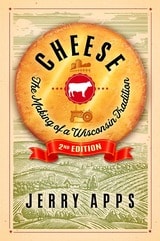
Cheese
The Making of a Wisconsin TraditionJerry Apps
University of Wisconsin Press, 2020
In this updated edition of a classic, Apps examines tumultuous changes in the business over the past twenty years, including the impacts of corporate megafarms and the rise of artisanal producers. Vivid historical photographs and striking portraits of modern family-operated factories reveal the delicate balance between art and science that goes into the process of turning ordinary milk into a wide variety of flavors, from the ubiquitous cheddar to sublime delicacies. Through these stories, we can come to better appreciate the remarkable farmers and producers that shaped cheesemaking into the thriving industry it is today.
Chic Ironic Bitterness
R. Jay Magill, Jr.
University of Michigan Press, 2009
A brilliant and timely reflection on irony in contemporary American culture
“This book is a powerful and persuasive defense of sophisticated irony and subtle humor that contributes to the possibility of a genuine civic trust and democratic life. R. Jay Magill deserves our congratulations for a superb job!”
—Cornel West, University Professor, Princeton University
“A well-written, well-argued assessment of the importance of irony in contemporary American social life, along with the nature of recent misguided attacks and, happily, a deep conviction that irony is too important in our lives to succumb. The book reflects wide reading, varied experience, and real analytical prowess.”
—Peter Stearns, Provost, George Mason University
“Somehow, Americans—a pragmatic and colloquial lot, for the most part—are now supposed to speak the Word, without ironic embellishment, in order to rebuild the civic culture. So irony’s critics decide it has become ‘worthy of moral condemnation.’ Magill pushes back against this new conventional wisdom, eloquently defending a much livelier American sensibility than the many apologists for a somber ‘civic culture’ could ever acknowledge."
—William Chaloupka, Chair and Professor, Department of Political Science, Colorado State University
The events of 9/11 had many pundits on the left and right scrambling to declare an end to the Age of Irony. But six years on, we're as ironic as ever. From The Simpsons and Borat to The Daily Show and The Colbert Report, the ironic worldview measures out a certain cosmopolitan distance, keeping hypocrisy and threats to personal integrity at bay.
Chic Ironic Bitterness is a defense of this detachment, an attitude that helps us preserve values such as authenticity, sincerity, and seriousness that might otherwise be lost in a world filled with spin, marketing, and jargon. And it is an effective counterweight to the prevailing conservative view that irony is the first step toward cynicism and the breakdown of Western culture.
R. Jay Magill, Jr., is a writer and illustrator whose work has appeared in American Prospect, American Interest, Atlantic Monthly, Foreign Policy, International Herald Tribune, New York Times, Wall Street Journal, and Print, amongother periodicals and books. A former Harvard Teaching Fellow and Executive Editor of DoubleTake, he holds a Ph.D. in American Studies from the University of Hamburg in Germany. This is his first book.
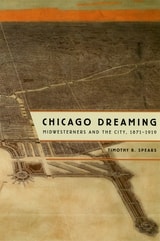
Chicago Dreaming
Midwesterners and the City, 1871-1919Timothy B. Spears
University of Chicago Press, 2005
Through innovative readings of Theodore Dreiser, Willa Cather, and Richard Wright, Spears argues that the migratory perspective was crucial to the rise of Chicago's emerging literary culture. In following the paths of several well-known migrants, including Jane Addams, cartoonist John T. McCutcheon, and businessman John Glessner, Spears also shows how the view from the hinterland permeated urban culture and informed the development of key Chicago institutions. Further exploring the notion of dreaming, he brings to light the internal desires that lured Midwestern migrants to the city as well as the nostalgia that led them to dream of the homes they left behind.
With this fascinating new take on the rise of Chicago, Chicago Dreaming blurs the line between country and city to reveal the provincial character of modern urban culture.
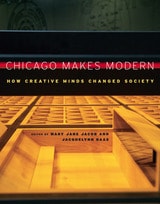
Chicago Makes Modern
How Creative Minds Changed SocietyEdited by Mary Jane Jacob and Jacquelynn Baas
University of Chicago Press, 2012
Chicago is a city dedicated to the modern—from the skyscrapers that punctuate its skyline to the spirited style that inflects many of its dwellings and institutions, from the New Bauhaus to Hull-House. Despite this, the city has long been overlooked as a locus for modernism in the arts, its rich tradition of architecture, design, and education disregarded. Still the modern in Chicago continues to thrive, as new generations of artists incorporate its legacy into fresh visions for the future. Chicago Makes Modern boldly remaps twentieth-century modernism from our new-century perspective by asking an imperative question: How did the modern mind—deeply reflective, yet simultaneously directed—help to dramatically alter our perspectives on the world and make it new?
Returning the city to its rightful position at the heart of a multidimensional movement that changed the face of the twentieth century, Chicago Makes Modern applies the missions of a brilliant group of innovators to our own time. From the radical social and artistic perspectives implemented by Jane Addams, John Dewey, and Buckminster Fuller to the avant-garde designs of László Moholy-Nagy and Mies van der Rohe, the prodigious offerings of Chicago's modern minds left an indelible legacy for future generations. Staging the city as a laboratory for some of our most heralded cultural experiments, Chicago Makes Modern reimagines the modern as a space of self-realization and social progress—where individual visions triggered profound change. Featuring contributions from an acclaimed roster of contemporary artists, critics, and scholars, this book demonstrates how and why the Windy City continues to drive the modern world.

Chicago Poems
Carl Sandburg
University of Illinois Press, 1992
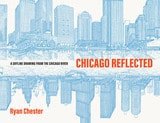
Chicago Reflected
A Skyline Drawing from the Chicago RiverRyan Chester
University of Chicago Press, 2023
As completed, Chester’s two-foot-high, fifty-five-foot-long drawing is a unique vision. In addition to dozens of accurately depicted buildings, Chester included pieces of Chicago’s past, including the Union Station Concourse Building that was demolished in 1969 and the immense SS Eastland, which sank in the river in 1915, killing hundreds of people. Recent architecture is featured as well, including Studio Gang’s St. Regis Chicago tower and the Bank of America Tower by Goettsch Partners.
An essay by acclaimed writer Thomas Dyja accompanies the accordion-fold presentation of Chester’s drawing, enhancing this remarkable volume that will delight any fan of Chicago, architecture, or art. Chicago Reflected opens up fresh vistas of the stunning, ever-evolving architectural landscape that can be found only in Chicago.
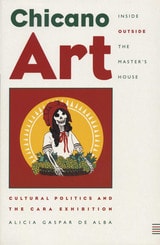
Chicano Art Inside/Outside the Master’s House
Cultural Politics and the CARA ExhibitionBy Alicia Gaspar de Alba
University of Texas Press, 1997
In the early 1990s, a major exhibition Chicano Art: Resistance and Affirmation, 1965-1985 toured major museums around the United States. As a first attempt to define and represent Chicano/a art for a national audience, the exhibit attracted both praise and controversy, while raising fundamental questions about the nature of multiculturalism in the U.S.
This book presents the first interdisciplinary cultural study of the CARA exhibit. Alicia Gaspar de Alba looks at the exhibit as a cultural text in which the Chicano/a community affirmed itself not as a "subculture" within the U.S. but as an "alter-Native" culture in opposition to the exclusionary and homogenizing practices of mainstream institutions. She also shows how the exhibit reflected the cultural and sexual politics of the Chicano Movement and how it serves as a model of Chicano/a popular culture more generally.
Drawing insights from cultural studies, feminist theory, anthropology, and semiotics, this book constitutes a wide-ranging analysis of Chicano/a art, popular culture, and mainstream cultural politics. It will appeal to a diverse audience in all of these fields.
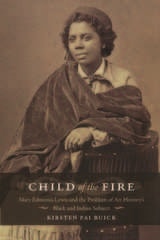
Child of the Fire
Mary Edmonia Lewis and the Problem of Art History's Black and Indian SubjectKirsten Pai Buick
Duke University Press, 2010
Buick considers the institutions and people that supported Lewis’s career—including Oberlin College, abolitionists in Boston, and American expatriates in Italy—and she explores how their agendas affected the way they perceived and described the artist. Analyzing four of Lewis’s most popular sculptures, each created between 1866 and 1876, Buick discusses interpretations of Hiawatha in terms of the cultural impact of Henry Wadsworth Longfellow’s epic poem The Song of Hiawatha; Forever Free and Hagar in the Wilderness in light of art historians’ assumptions that artworks created by African American artists necessarily reflect African American themes; and The Death of Cleopatra in relation to broader problems of reading art as a reflection of identity.
Childcare
Rob Schlegel
Four Way Books, 2023
Crackling with the hypervigilance of parenthood, Childcare explores the paradox at the root of raising kids: the joy of new life accompanies an awareness of potential loss. Rob Schlegel’s fourth collection observes the tangled emotions of fatherhood; even as he wonders at the strange intelligence of youth, he elegizes the present moment. The longitudinal wisdom of this collection appears in the choreography of its leaps — how it moves from the aside “[My son] needs my love the most when he least deserves it / Is something I read” to the reflection that “Death / Names my shape. I keep my clothes / From dust and ghosts and time. / I’m angry at my father for aging.” From Schlegel’s relentless curiosity and keen observations, the artistic crisis driving the book emerges: does poetry memorialize the ephemeral moment, saving something for us, or does it remove us from experience? The duality of language’s role — that it, ultimately, has the capacity to do both — doubles the significance of “childcare” in this collection, which comes to represent not just the work of child rearing but the dutiful care by adult children for their parents. Perhaps nothing can convey the scope and quality of family life like the concatenated dependencies of “(Un)conditional,” which terminate here: “If the cut draws blood / If life ends in desire // If it begins in love.”
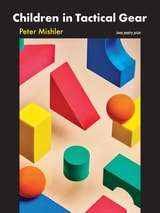
Children in Tactical Gear
Peter Mishler
University of Iowa Press, 2024

Children of the Albatross
Anaïs Nin
Ohio University Press, 1959
Children of the Albatross is divided into two sections: “The Sealed Room” focuses on the dancer Djuna and a set of characters, chiefly male, who surround her; “The Café” brings together a cast of characters already familiar to Nin’s readers, but it is their meeting place that is the focal point of the story.
As always, in Children of the Albatross, Nin’s writing is inseparable from her life. From Djuna’s story, told in “The Sealed Room” through hints and allusions, hazy in their details and chronology, the most important event to emerge is her father’s desertion (like Nin’s) when she was sixteen. By rejecting realistic writing for the experience and intuitions she drew from her diary, Nin was able to forge a novelistic style emphasizing free association, spontaneity, and improvisation, a technique that finds its parallel in the jazz music performed at the café where Nin’s characters meet.
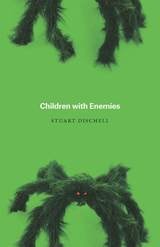
Children with Enemies
Stuart Dischell
University of Chicago Press, 2017
Chinese American Literature since the 1850s
Xiao-huang Yin
University of Illinois Press, 2000
The writings of immigrants from China and their descendants in the United States reflect the changes and continuity in the Chinese American experience. Xiao-huang Yin combines literary and historical scholarship to trace the origins and development of this extensive, neglected body of literature.
Chinese American Literature since the 1850s covers representative works from the 1850s to the present. Selections include journalism and autobiography by nineteenth-century Chinese authors; writings on the walls of Angel Island, the main Asian immigrant arrival point on the West Coast; writings of late-nineteenth and early-twentieth-century "cultivated Chinese," students and scholars who came to America to advance their educations; important writing by immigrants such as Chen Ruoxi, Yu Lihua, and Zhang Xiguo; and the works of more recent authors like Sui Sin Far, Jade Snow Wong, Frank Chin, Maxine Hong Kingston, and Amy Tan.
An essential introduction and guide to the field, Chinese American Literature since the 1850s enlarges the available body of literature and provides new insights into the Chinese American immigrant experience and the writing inspired by it.
Choosing Books for Children
A COMMONSENSE GUIDEBetsy Hearne with Deborah Stevenson
University of Illinois Press, 1999
If you have ever stood in the children's section of a bookstore or library wondering how to go about matching a book to the age, abilities, and interests of a particular child, Choosing Children's Books is for you. Renowned children's librarian and children's book review editor Betsy Hearne offers practical guidance on sorting through the bewildering array of picture books, pop-up books, books for beginning readers, young adult titles, classics, poetry, folktales, and factual books. Each chapter includes an annotated list of recommended titles.
A gold mine of commonsense, sound advice, this newly revised and completely updated edition of Betsy Hearne's classic guide is an indispensable tool for choosing books for children of all ages.
Newly available in paperback, this revised and updated third edition of Betsy Hearne's classic guide stands as the lodestar for navigating through the bewildering array of books for young readers. Hearne surveys everything from picture books, pop-up books, classics, and books for beginning readers to young adult titles, poetry, folktales, and factual books, with an annotated list of recommended titles accompanying each chapter. A gold mine of common sense and sound advice, her guide remains an indispensable tool for choosing books for children of all ages.
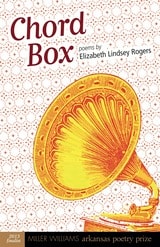
Chord Box
PoemsElizabeth Lindsey Rogers
University of Arkansas Press, 2013
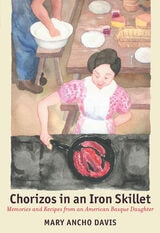
Chorizos in an Iron Skillet
Memories and Recipes from an American Basque DaughterMary Ancho Davis
University of Nevada Press, 2001
Chuck Wagon Cookbook
Beth McElfresh
Ohio University Press, 1960
No chuck wagon feed is complete without its basic ingredients of beans, beef, hot biscuits, apple pie, and lots of coffee. Beth McElfresh shows you how to host the all–time chuck wagon feed with easy–to–follow recipes.
Included are original recipes for boiled apple dumplings, lima beans baked with steak, and general, everyday useful tips, all from the renowned Western cook, Hi Pockets. She describes various health remedies learned from the old–timers on the range, that are as useful today as they were then.
Also included are recipes showing you how to create actual hand lotion and soaps like those used in the rugged west; wines, tea, punch, even candy and ice cream are included.
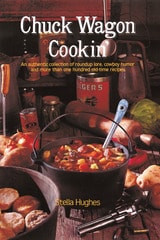
Chuck Wagon Cookin'
Stella Hughes
University of Arizona Press, 1974
"This is a splendid collection of cowcamp cook tales and 112 authentic old-time dutch oven recipes." —Books of the Southwest
"It is a delightful combination of yarns, history, nostalgia, and solid information—all ingeniously brewed up and spiced by a lady who knows what she is about." —Journal of Arizona History
"We haven't had a book that was so much fun to read in a long time." —Journal of the West
"If you want a good change in your eating, this is the book for you." —True West
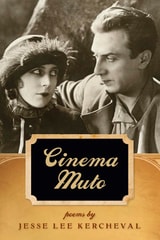
Cinema Muto
Jesse Lee Kercheval
Southern Illinois University Press, 2009
In Cinema Muto, Jesse Lee Kercheval examines the enduring themes of time, mortality, and love as revealed through the power of silent film. Following the ten days of the annual Le Giornate del Cinema Muto in Italy, this collection of ekphrastic poems are love letters to the evocative power of silent cinema. Kercheval’s poems elegantly capture the allure of these rare films, which compel hundreds of pilgrims from around the world—from scholars and archivists, to artists and connoisseurs—to flock to Italy each autumn. Cinema Muto celebrates the flickering tales of madness and adventure, drama and love, which are all too often left to decay within forgotten vaults. As reels of Mosjoukine and D. W. Griffith float throughout the collection, a portrait also emerges of the simple beauty of Italy in October and of two lovers who are drawn together by their mutual passion for an extinct art. Together they revel in recapturing “the black and white gestures of a lost world.”
Cinema Muto is a tender tribute to the brief yet unforgettable reign of silent film. Brimming with stirring images of dreams, desire, and the ghosts of cinema legends gone by, Kercheval’s verse is a testament to the mute beauty and timeless lessons that may still be discovered in a fragile roll of celluloid.
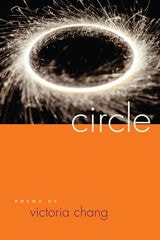
Circle
Victoria Chang
Southern Illinois University Press, 2005
Taking its concept of concentricity from the eponymous Ralph Waldo Emerson essay, Circle, the first collection from Victoria Chang, adopts the shape as a trope for gender, family, and history. These lyrical, narrative, and hybrid poems trace the spiral trajectory of womanhood and growth and plot the progression of self as it ebbs away from and returns to its roots in an Asian American family and context. Locating human desire within the helixes of politics, society, and war, Chang skillfully draws arcs between T’ang Dynasty suicides and Alfred Hitchcock leading ladies, between the Hong Kong Flower Lounge and an all-you-can-eat Sunday brunch, the Rape of Nanking and civilian casualties in Iraq.
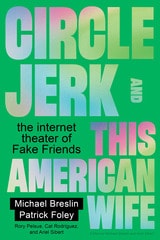
Circle Jerk and This American Wife
the internet theater of Fake FriendsMichael Breslin, Patrick Foley, Rory Pelsue, Cat Rodríguez, and Ariel Sibert, edited by Michael Breslin and Ariel Sibert
Northwestern University Press, 2026
Two plays along with process essays on the cacophonous world of pop culture, politics, and personal testimony that we call the internet
In March 2020, the New York theater company Fake Friends was pushed off the stage and into the land of the internet. This book marks the first publication of two of their deliciously absurd and toxically serious internet plays, Circle Jerk (the first-ever work in digital theater to be shortlisted for the Pulitzer Prize in Drama) and This American Wife. Circle Jerk tells the social media–infused tale of gay white supremacists creating an AI-influencer to dominate the global discourse, and This American Wife spins a surrealist web of queer devotion to the stars and performance strategies of reality television; both plays are unapologetically theatrical and digitally native, born out of the exigencies of the pandemic. This collection features an electrifying visual archive as well as individual essays from each company member reflecting on the practical and interpersonal processes of bringing these award-winning plays to life in our ever-more online, political, and personal world.
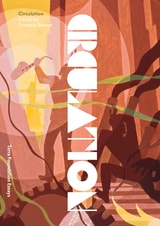
Circulation
Edited by François Brunet
Terra Foundation for American Art, 2017
The third volume in the Terra Foundation Essays series, Circulation brings together an international and interdisciplinary team of scholars, including Thierry Gervais, Tom Gunning, J. M. Mancini, Frank Mehring, and Hélène Valance, who map the multiple planes where artistic meaning has been produced by the circulation of art from the eighteenth century to the present. The book looks at both broad historical trends and the successes and failures of particular works of art from a wide variety of artists and styles. Together, the contributions significantly expand the conceptual and methodological terrain of scholarship on American art.
Citizen Critics
Literary Public SpheresRosa A. Eberly
University of Illinois Press, 2000
The condition of our public discussions about literary and cultural works has much to say about the state of our democracy. Classrooms, newspapers, magazines, Internet forums, and many other places grant citizens a place to hold public discourses—and claim a voice on national artistic matters.
Rosa A. Eberly looks at four censorship controversies where professionals asserted their authority to deny citizen critics a voice—and effectively removed discussion of literature from the public sphere. Eberly compares the outrage sparked by the publication of James Joyce's Ulysses and Henry Miller's Tropic of Cancer with the relative quiescence that greeted the much more violent and sexually explicit content of Bret Easton Ellis's American Psycho and Andrea Dworkin's Mercy. Through a close reading of letters to the editor, reviews, media coverage, and court cases, Eberly shows how literary critics and legal experts defused censorship debates—and undercut the authority of citizen critics—by shifting the focus from content to aesthetics and from social values to publicity.
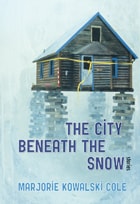
City Beneath the Snow
StoriesMarjorie Kowalski Cole
University of Alaska Press, 2012
"Marjorie Kowalski Cole's characters live, work, and struggle in interior Alaska, and she depicts life here with a keen eye and with compassion. We see the daughter of a Fairbanks junkyard owner struggling with her isolation. We meet a bartender at Circle Hot Springs who's also a certified nurse's assistant at Fairbanks Memorial Hospital. . . . These are inner lives, revealed with care and with skill, the true material of good literature."—Peggy Shumaker, Alaska State Writer Laureate
City Dog
EssaysW.S. Di Piero
Northwestern University Press, 2009
City Water, City Life
Water and the Infrastructure of Ideas in Urbanizing Philadelphia, Boston, and ChicagoCarl Smith
University of Chicago Press, 2013
City of Bones
A TestamentKwame Dawes
Northwestern University Press, 2017
As if convinced that all divination of the future is somehow a re-visioning of the past, Kwame Dawes reminds us of the clairvoyance of haunting. The lyric poems in City of Bones: A Testament constitute a restless jeremiad for our times, and Dawes’s inimitable voice peoples this collection with multitudes of souls urgently and forcefully singing, shouting, groaning, and dreaming about the African diasporic present and future.
As the twentieth collection in the poet’s hallmarked career, City of Bones reaches a pinnacle, adding another chapter to the grand narrative of invention and discovery cradled in the art of empathy that has defined his prodigious body of work. Dawes’s formal mastery is matched only by the precision of his insights into what is at stake in our lives today. These poems are shot through with music from the drum to reggae to the blues to jazz to gospel, proving that Dawes is the ambassador of words and worlds.
Civic Jazz
American Music and Kenneth Burke on the Art of Getting AlongGregory Clark
University of Chicago Press, 2015
Jazz music, Clark argues, demonstrates how this aesthetic rhetoric of identification can bind people together through their shared experience in a common project. While such shared experience does not demand agreement—indeed, it often has an air of competition—it does align people in practical effort and purpose. Similarly, Clark shows, Burke considered Americans inhabitants of a persistently rhetorical situation, in which each must choose constantly to identify with some and separate from others. Thought-provoking and path-breaking, Clark’s harmonic mashup of music and rhetoric will appeal to scholars across disciplines as diverse as political science, performance studies, musicology, and literary criticism.
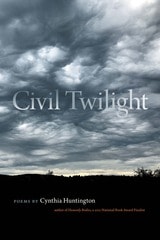
Civil Twilight
Cynthia Huntington, 2012 National Book Award Finalist
Southern Illinois University Press, 2024
New collection from National Book Award finalist
Civil twilight is the astronomical term for the minutes just before sunrise and just after sunset. If one took a snapshot, it would be impossible to tell whether the light was increasing or diminishing. The poems in Civil Twilight arise in this liminal space. With luminous precision, Cynthia Huntington examines the civil twilight we live in now, unsure of whether the darkness is closing in or whether the light is about to break.
Here the poet is both skeptic and seeker, for any hope worth discovering needs to withstand the facts at hand. Is everything getting worse, or are things about to improve? Or is this the way things have always been, both hopeful and terrifying, and it is our questions that need to change? In part one, the speaker strives for balance by maintaining light and warmth in a cold season. In part two, American scenes of construction and destruction are set beside moments from history: Rome, the British Empire, and American immigration. Part three enfolds questions of history and power within winter scenes and the artist’s imagination. In part four, the speaker looks back and admits answers remain elusive, yet points to the new ways of thinking and feeling about survival that have resulted from the work. And here, the half-light shifts. In a world teetering on the edge of collapse, Civil Twilight wrestles hard-won hope from disquiet, coming to rest in what is.
Claims for Poetry
Donald Hall, Editor
University of Michigan Press, 1982

Clambake
A History and Celebration of an American TraditionKatherine D. Neustadt
University of Massachusetts Press, 1992
An appreciative examination of the New England clambake, Neustadt divides her study into three parts: historical (social, economic, political, regional, and cultural) influences on the clambake; a close focus on the Allen's Neck clambake as a cultural phenomenon in its own right; and a critical examination of the central elements of the clambaking tradition—food, ritual, and festival.
The author views the clambake as a unique American folk tradition with interesting connections and rich resonances with other aspects of American culture and history.
Clarel
A Poem and Pilgrimage in the Holy LandHerman Melville
Northwestern University Press, 2008
Melville’s long poem Clarel: A Poem and Pilgrimage in the Holy Land (1876) was the last full-length book he published. Until the mid-twentieth century even the most partisan of Melville’s advocates hesitated to endure a four-part poem of 150 cantos and almost 18,000 lines about a naive American named Clarel, on pilgrimage through the Palestinian ruins with a provocative cluster of companions.
But modern critics have found Clarel a much better poem than was ever realized. Robert Penn Warren called it a precursor of The Waste Land. It abounds with revelations of Melville’s inner life. Most strikingly, it is argued that the character Vine is a portrait of Melville’s friend Nathaniel Hawthorne. Clarel is one of the most complex theological explorations of faith and doubt in all of American literature, and this edition brings Melville’s poem to new life.
Clarel
Volume Twelve, Scholarly EditionHerman Melville
Northwestern University Press, 1991
But modern critics have found Clarel a much better poem than was ever realized. Robert Penn Warren called it a precursor of The Waste Land. It abounds with revelations of Melville's inner life. Most strikingly, it is argued that the character Vine is a portrait of Melville's friend Hawthorne. Based on the only edition published during Melville's lifetime, this scholarly edition adopts thirty-nine corrections from a copy marked by Melville and incorporates 154 emendations by the present editors, an also includes a section of related documents and extensive discussions.
This scholarly edition is an Approved Text of the Center for Editions of American Authors (Modern Language Association of America).
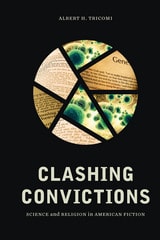
Clashing Convictions
Science and Religion in American FictionAlbert H. Tricomi
The Ohio State University Press, 2016
With chapters on James Lane Allen’s The Reign of Law, Harold Frederic’s The Damnation of Theron Ware, William Dean Howells’s The Leatherwood God, Sinclair Lewis’s Arrowsmith and Elmer Gantry, Jerome Lawrence and Robert E. Lee’s Inherit the Wind, and James Scott Bell’s The Darwin Conspiracy, Tricomi offers new readings emphasizing how this canon represents science and religion as in deep, if not irreconcilable, conflict. Tricomi’s sweeping study, with its emphasis on the twentieth century, thus reveals from several directions the processes of secularism even as it identifies the emergence of what some have come to describe as the current “postsecular” moment in America.
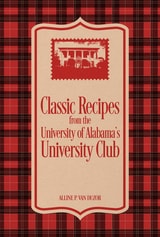
Classic Recipes from the University of Alabama's University Club
Alline P. Van Duzor, Foreword by Camille Maxwell Elebash
University of Alabama Press, 2010
250 Recipes from the University of Alabama’s famed University Club in Tuscaloosa
The historic mansion at the corner of University Boulevard and Queen City Avenue in Tuscaloosa, Alabama has been home to the University of Alabama University Club since 1944. In its early years, the Club took shape around the vision and culinary expertise of the formidable Atlantan Alline P. Van Duzor, still remembered in Tuscaloosa for her impeccable and exacting standards. This book reveals her most beloved recipes.
Commissioned in the early 1960s by a New York publisher, this collection of her gastronomic creations sold through more than eight printings, further spreading her reputation.
The more than 250 favorite Southern recipes in this now-classic cookbook are written in Van Duzor’s straight-forward style, using common fresh and store-bought ingredients. This new edition has been augmented by a guide to portions and food brand names, an index to the recipes, and an appendix of past presidents of the University Club Board.
Cookbook collectors, local history buffs, the university community, and happy cooks everywhere will welcome this reissue of a popular cookbook that has won decades of fans.
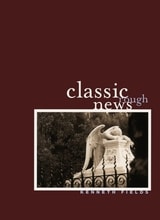
Classic Rough News
Kenneth Fields
University of Chicago Press, 2005
Classic Rough News follows a skeptical, cosmopolitan, intelligent, poetic presence aware that its carefully constructed veneer could crumble at any moment. In poems that mine interior dialogue for the discovery of great truths, Fields conveys feelings of awkwardness, incompleteness, conflict, and insanity-all in finely crafted verse. Ironic and skeptical, the voice in these poems records the flux of the mind, ruefully acknowledging how easy it is to deceive oneself with mixed emotions. Fully mature and unconcerned about impressions, Classic Rough News is grounded in erudition and humor, revealing how tradition and talent can push one another in unexpected directions.
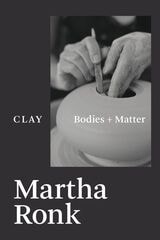
Clay
Martha Ronk
Omnidawn, 2025
The poems in Clay look to the process of forming clay on a potter’s wheel to examine our sense of touch and texture, emptiness, fragility, and the nature of time. Martha Ronk moves through the steps of creating a pot that must be formed, dried, bisque-fired, glazed, and fired again. This practice is paralleled in Ronk’s process-oriented language that addresses how we read texture and color, the ways history and landscapes appear in glazes, Mimbres bowls that covered the faces of the dead, and Giorgio Morandi’s still life paintings of ceramic forms.
For Ronk, pottery raises questions about the value of repetition, inevitable failure, and how we may become one with matter. As the potter’s hands ache and age, the bowl seems to age as it slumps or breaks. Clay includes observations from other potters and writers as well as small photographs of pots.
Clayfeld Holds On
Robert Pack
University of Chicago Press, 2015
Beneath this mellow harvest moon,
I can still picture you—a boy content
just fishing with his father from a ledge
above a foaming stream. The flailing trout
you caught is packed in gleaming ice;
the pink stripe all along its side
is smeared across black shiny dots
that seem to shine with their own light.
I’m sure that you can picture me
with equal vividness, and though we’re not
identical, there is a sense
in which I am inventing you
as much as you’re inventing me.
In Clayfeld Holds On, Robert Pack offers his readers a comprehensive portrait of his longtime protagonist Clayfeld, who is also Pack’s doppelgänger, his alternate self, enacting both the life that the poet has lived and the life he might have lived, given his proclivities and appetites. Poet and protagonist, taken together, are self and consciousness of self, the historical self and the embellished story of that literal self.
Written with a masterly ear for rhythm, and interweaving narrative and lyrical passages, the poems recount Clayfeld’s formative memories while exploring concepts such as loyalty, generosity, commitment, as well as cosmic phenomena such as the big bang theory and black holes. Through all of this, Pack attempts to find purpose and meaning in an indifferent universe, and to explore the labyrinth of his own proliferating identity.
Clear-Cutting Eden
Ecology and the Pastoral in Southern LiteratureChristopher Rieger
University of Alabama Press, 2009
Examines how Southern literary depictions of the natural world were influenced by the historical, social, and ecological changes of the 1930s and 1940s
Rieger studies the ways that nature is conceived of and portrayed by four prominent Southern writers of the era: Erskine Caldwell, Marjorie Kinnan Rawlings, Zora Neale Hurston, and William Faulkner. Specifically, he argues that these writers created new versions of an old literary mode—the pastoral—in response to the destabilizing effects of the Great Depression, the rise of Southern modernism, and the mechanization of agricultural jobs.
Mass deforestation, soil erosion, urban development, and depleted soil fertility are issues that come to the fore in the works of these writers. In response, each author depicts a network model of nature, where humans are part of the natural world, rather than separate, over, or above it, as in the garden pastorals of the Old South, thus significantly revising the pastoral mode proffered by antebellum and Reconstruction-era writers.
Each writer, Rieger finds, infuses the pastoral mode with continuing relevance, creating new versions that fit his or her ideological positions on issues of race, class, and gender. Despite the ways these authors represent nature and humankind’s place in it, they all illustrate the idea that the natural environment is more than just a passive background against which the substance of life, or fiction, is played out.
Close Reading
The ReaderFrank Lentricchia and Andrew DuBois, eds.
Duke University Press, 2003
From a 1938 essay by John Crowe Ransom through the work of contemporary scholars, Close Reading highlights the interplay between critics—the ways they respond to and are influenced by others’ works. To facilitate comparisons of methodology, the collection includes discussions of the same primary texts by scholars using different critical approaches. The essays focus on Hamlet, “Lycidas,” “The Rape of the Lock,” Ulysses, Invisible Man, Beloved, Jane Austen, John Keats, and Wallace Stevens and reveal not only what the contributors are reading, but also how they are reading.
Frank Lentricchia and Andrew DuBois’s collection is an essential tool for teaching the history and practice of close reading.
Contributors. Houston A. Baker Jr., Roland Barthes, Homi Bhabha, R. P. Blackmur, Cleanth Brooks, Kenneth Burke, Paul de Man, Andrew DuBois, Stanley Fish, Catherine Gallagher, Sandra Gilbert, Stephen Greenblatt, Susan Gubar, Fredric Jameson, Murray Krieger, Frank Lentricchia, Franco Moretti, John Crowe Ransom, Eve Kosofsky Sedgwick, Helen Vendler

Closet Writing/Gay Reading
The Case of Melville's PierreJames Creech
University of Chicago Press, 1994
In Closet Writing/Gay Reading, Creech shows how a literary critic can be receptive to implicit and closeted sexual content. Forcefully advocating a tactic of identification and projection in literary analysis, he lends renewed currency to the kind of "sentimental" response to literature that continental theory—particularly deconstruction—has sought to discredit.
In the second half of his book, Creech sets out to analyze what he considers the exemplary novel of the nineteenth-century closet, Melville's Pierre, or: The Ambiguities. By approaching Pierre as the gay man Melville longed to have as its reader, Creech is able to decipher the novel's "encrypted erotics" and to reveal that Melville's apparent tale of incest is actually a homosexual novel in disguise. The closeted "address" to queer-sensitive readers that Pierre disseminates finally receives a critical reading that strives to be explicit, shareable, and public.
Closing Arguments
Clarence Darrow on Religion, Law, and SocietyClarence Darrow
Ohio University Press, 2005
Clarence Darrow, son of a village undertaker and coffinmaker, rose to become one of America’s greatest attorneys—and surely its most famous. The Ohio native gained renown for his central role in momentous trials, including his 1924 defense of Leopold and Loeb and his defense of Darwinian principles in the 1925 Scopes “Monkey Trial.” Some have traced Darrow’s lifelong campaign against capital punishment to his boyhood terror at seeing a Civil War soldier buried—and no client of Darrow’s was ever executed, not even black men who were accused of murder for killing members of a white mob.
Closing Arguments: Clarence Darrow on Religion, Law, and Society collects, for the first time, Darrow’s thoughts on his three main preoccupations, revealing a carefully conceived philosophy expressed with delightful pungency and clarity. His thoughts on social issues, especially on the dangers of religious fundamentalism, are uncannily prescient. A dry humor infuses his essays, and his reflections on himself and his philosophy reveal a quiet dignity at the core of a man better known for provoking Americans during an era of unprecedented tumult. From the wry “Is the Human Race Getting Anywhere?” to the scornful “Patriotism” and his elegiac summing up, “At Seventy-two,” Darrow’s writing still stimulates, pleases and challenges.
A rebel who always sided intellectually and emotionally with the minority, Darrow remains a figure to contend with sixty-seven years after his death. “Inside every lawyer is the wreck of a poet,” Darrow once said. Closing Arguments demonstrates that, in his case, that statement is true.