917 books match the query 'Economics' and 56 start with c
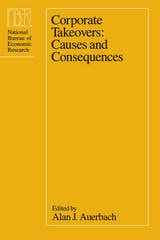
cover of Corporate Takeovers: Causes and Consequences

Corporate Takeovers

Causes and Consequences

Edited by Alan J. Auerbach

University of Chicago Press, 1988
The takeover boom that began in the mid-1980s has exhibited many phenomena not previously observed, such as hostile takeovers and takeover defenses, a widespread use of cash as a means of payment for targeted firms, and the acquisitions of companies ranking among the largest in the country. With the aim of more fully understanding the implications of such occurances, contributors to this volume consider a broad range of issues as they analyze mergers and acquisitions and study the takeoveer process itself.
[more]
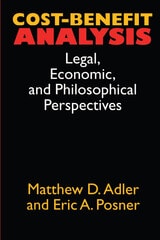
cover of Cost-Benefit Analysis: Economic, Philosophical, and Legal Perspectives

Cost-Benefit Analysis

Economic, Philosophical, and Legal Perspectives

Edited by Matthew D. Adler and Eric A. Posner

University of Chicago Press, 2001

Cost-benefit analysis is a widely used governmental evaluation tool, though academics remain skeptical. This volume gathers prominent contributors from law, economics, and philosophy for discussion of cost-benefit analysis, specifically its moral foundations, applications and limitations.

This new scholarly debate includes not only economists, but also contributors from philosophy, cognitive psychology, legal studies, and public policy who can further illuminate the justification and moral implications of this method and specify alternative measures.

These articles originally appeared in the Journal of Legal Studies.

Contributors:
- Matthew D. Adler - Gary S. Becker
- John Broome - Robert H. Frank
- Robert W. Hahn - Lewis A. Kornhauser
- Martha C. Nussbaum - Eric A. Posner
- Richard A. Posner - Henry S. Richardson
- Amartya Sen - Cass R. Sunstein
- W. Kip Viscusi
[more]
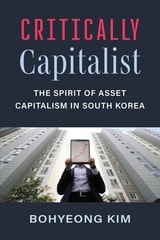
cover of Critically Capitalist: The Spirit of Asset Capitalism in South Korea

Critically Capitalist

The Spirit of Asset Capitalism in South Korea

Bohyeong Kim

University of Michigan Press, 2025

Critically Capitalist presents an ethnography of South Korea’s asset seekers, including amateur stock investors, real estate enthusiasts, and money coaches, to demonstrate how financialized asset capitalism is sustained. As they hunt for profit margins, rent, and dividends, they simultaneously critique capitalism and posit their pursuit of assets as a form of resistance. Bohyeong Kim theorizes this new spirit of capitalism in South Korea as “critical capitalism,” arguing that it reflects the popular discontent with both national development and financial neoliberalism. As a paradoxical critique and legitimation, Bohyeong Kim argues that critical capitalism valorizes the capitalist economy not through a triumphant narrative, but by highlighting the emotional wounds, destroyed communities, and oppressive tactics of modern capitalism. 

Drawing on multi-sited ethnography and in-depth interviews with a broad community of aspiring millionaires, Critically Capitalist illuminates how contemporary capitalism thrives by channeling discontent into financial and real estate markets, which in turn has cemented critical capitalism as the cultural and affective backbone of South Korea’s economy.
[more]
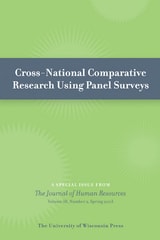
cover of Cross-National Comparative Research Using Panel Surveys: Special Issue of Journal of Human Resources 38:2 (Spring 2003)

Cross-National Comparative Research Using Panel Surveys

Special Issue of Journal of Human Resources 38:2 (Spring 2003)

Edited by James P. Smith, Frank Stafford, and James R. Walker

University of Wisconsin Press, 2010

This special issue revises and expands on presentations given at a conference on comparative research using international panel surveys held in Ann Arbor, Michigan. Five of the articles explicitly or implicitly examine international differences in savings behavior and wealth accumulation. The final two articles use international comparisons to assess the status of young children.
[more]
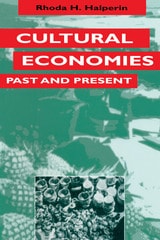
cover of Cultural Economies Past and Present

Cultural Economies Past and Present

By Rhoda H. Halperin

University of Texas Press, 1994

When anthropologists and other students of culture want to compare different societies in such areas as the organization of land, labor, trade, or barter, they often discover that individual researchers use these concepts inconsistently and from a variety of theoretical approaches, so that data from one society cannot be compared with data from another.

In this book, Rhoda Halperin offers an analytical tool kit for studying economic processes in all societies and at all times. She uniquely organizes the book around key concepts: economy, ecology, equivalencies, householding, storage, and time and the economy. These concepts are designed to facilitate the understanding of similarities, differences, and changes between contemporary and past economies. While this is not only a "how-to" book or handbook, it can be used as such. It will be of great value to scholars and students of archaeology and history, as well as to ethnographers and economists.
[more]
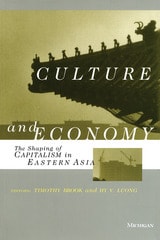
cover of Culture and Economy: The Shaping of Capitalism in Eastern Asia

Culture and Economy

The Shaping of Capitalism in Eastern Asia

Timothy Brook and Hy Van Luong, Editors

University of Michigan Press, 1999

In recent years, most of the economies of Eastern Asia have been absorbed into global capitalism. Capitalism has transformed these economies, but the process has not been one-way. The cultures of Eastern Asia have in turn shaped how capitalism organizes labor, capital, and markets in ways that could not have been anticipated even ten years ago. On the basis of rich empirical analyses of East and Southeast Asia, and with theoretical insights from different approaches in the social sciences, Culture and Economy addresses these issues in both macroscopic and microscopic terms. Specific topics discussed range from the use and reinvention of Confucian and Islamic legacies in South Korea and Malaysia to promote a particular vision of the economy, to the role of family- and network-structured firms and the reliance on trust-based personal networks in Southeast Asia, to the cultures of labor and management in Chinese village enterprises and Vietnamese ceramics firms, as well as in South Korean export processing zones and the current Chinese labor market. These careful case studies suggest that it is inevitable that Eastern Asia will shape, even remake, capitalism into a system of production and consumption beyond its original definition. Timothy Brook is Professor of History, Stanford University. Hy V. Luong is Professor of Anthropology, University of Toronto.
[more]