Results by title
783 books match the query 'History & Theory' and 56 start with c
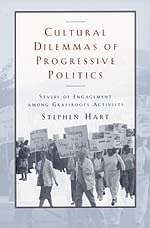
Cultural Dilemmas of Progressive Politics
Styles of Engagement among Grassroots ActivistsStephen Hart
University of Chicago Press, 2001
Through case studies of grassroots movements—particularly the economic justice work carried on by congregation-based community organizing and the pursuit of human rights by local members of Amnesty International—Hart shows how these groups develop distinctive ways of talking about politics and create characteristic stories, ceremonies, and practices. According to Hart, the way people engage in politics matters just as much as the content of their ideas: when activists make the moral basis for their activism clear, engage issues with passion, and articulate a unified social vision, they challenge the recent ascendancy of conservative discourse.
On the basis of these case studies, Hart addresses currently debated topics such as individualism in America and whether strains of political thought strongly informed by religion and moral values are compatible with tolerance and liberty.

Cultural Revolution and Revolutionary Culture
Alessandro Russo
Duke University Press, 2020
Culture Troubles
Politics and the Interpretation of MeaningPatrick Chabal and Jean-Pascal Daloz
University of Chicago Press, 2005
Culture Troubles is a systematic reevaluation of the role of culture in political analysis. Here, Patrick Chabal and Jean-Pascal Daloz contend that it is unwise to compare different societies without taking into account culture, which in their interpretation is not a system of values, but rather a system of inherited meanings and symbols. This cultural approach, they argue, can attribute meaning to political comparison, and they outline the shape of that approach, one that draws from an eclectic range of sources. Illustrating the sharpness and acuity of their methods, they proceed with a comparative study of the state and political representation in three very different nations—France, Nigeria, and Sweden—to untangle the many ways that culture informs our understanding of political events. As a result, Culture Troubles offers a rational starting point from which we may begin to understand foreign politics.
Cultures of Democracy, Volume 19
Dilip Parameshwar Gaonkar, ed.
Duke University Press, 0
The essays look at examples of democracy in a variety of spheres. One examines how the chewing of khat leaves in public gatherings in Yemen acts as a democratic practice by creating spontaneous forums for political discussion. Another considers the events of the 2003 municipal elections in Buenos Aires, when the center Right secured a record number of votes from an electorate jaded by political corruption by forming strategic alliances with local football clubs, ultimately leading to the election of the president of one popular club. And another essay explores the Indian government’s reaction when the political methods used to achieve the nation’s independence—defiance of the law, hunger strikes, demonstrations, and the destruction of public property—were used to challenge the government in the postcolonial period. Taken as a whole, the essays argue that democracy might be productively viewed as a cultural system inclusive of many cultures of democracy.
Contributors. Arjun Appadurai, Craig Calhoun, Dipesh Chakrabarty, Jean Comaroff, Carlos Forment, Dilip Parameshwar Gaonkar, Claudio Lomnitz , Manar Shorbagy, Charles Taylor, Lisa Wedeen
Cyberwar and Revolution
Digital Subterfuge in Global CapitalismNick Dyer-Witheford
University of Minnesota Press, 2019
Uncovering the class conflicts, geopolitical dynamics, and aggressive capitalism propelling the militarization of the internet
Global surveillance, computational propaganda, online espionage, virtual recruiting, massive data breaches, hacked nuclear centrifuges and power grids—concerns about cyberwar have been mounting, rising to a fever pitch after the alleged Russian hacking of the U.S. presidential election and the Cambridge Analytica scandal. Although cyberwar is widely discussed, few accounts undertake a deep, critical view of its roots and consequences.
Analyzing the new militarization of the internet, Cyberwar and Revolution argues that digital warfare is not a bug in the logic of global capitalism but rather a feature of its chaotic, disorderly unconscious. Urgently confronting the concept of cyberwar through the lens of both Marxist critical theory and psychoanalysis, Nick Dyer-Witheford and Svitlana Matviyenko provide a wide-ranging examination of the class conflicts and geopolitical dynamics propelling war across digital networks.
Investigating the subjectivities that cyberwar mobilizes, exploits, and bewilders, and revealing how it permeates the fabric of everyday life and implicates us all in its design, this book also highlights the critical importance of the emergent resistance to this digital militarism—hacktivism, digital worker dissent, and off-the-grid activism—for effecting different, better futures.

Czechoslovak Diplomacy and the Gulag
Deportation of Czechoslovak Citizens to the USSR and the Negotiation for their Repatriation, 1945-1953Milada Polisenská
Central European University Press, 2016