Results by title
4743 books match the query 'Religion' and 302 start with c
Champions of Buddhism
Weikza Cults in Contemporary BurmaEdited by Bénédicte Brac de la Perrière, Guillaume Rozenberg, and Alicia Turner
National University of Singapore Press, 2014
Chance or Dance
An Evaluation of DesignJimmy H. Davis
Templeton Press, 2008
Chance or Dance provides an overview of design and clarification of the controversial Intelligent Design (ID) movement and ultimately concludes there is no scientific proof behind Intelligent Design. As the controversy over Intelligent Design has grown over the past few years, there is a tendency to confuse all statements about design with the Intelligent Design movement and to confuse any affirmation of creation with Scientific Creationism. Davis and Poe begin with a brief historical perspective of the design argument and then examine the significant breakthroughs in cosmology, math, physics, chemistry, and biology that have provided renewed speculation in design.
The authors discuss that the idea of design is far more expansive than the ID movement’s version of it, evaluate Dawkins’ interpretation of genetic determinism, include a chapter that explores the tendency since Darwin to assume that the presence of an observable cause excludes the possibility of divine involvement; and introduce further reflections on wonder and awe that take into account the recent surge of interest in this area. The book concludes with an argument for the correlation between faith and sensory experience and suggests that science has successfully described processes but failed to explain origins.
Chance or Dance is ideal for students and general readers interested in understanding how modern science gives evidence for nature’s creation by the Bible’s God.
Changes in Sacred Texts and Traditions
Methodological Encounters and DebatesMartti Nissinen
SBL Press, 2024
Changing Masters
Spirit Possession and Identity Construction among the Descendants of Slaves in the SudanG.P. Makris
Northwestern University Press, 2000
Makris engages the tumbura devotees of the area of Greater Khartoum in an animated discussion of their understanding of themselves and their world. Using oral histories, songs associated with the various spirits, and accounts of ceremonies he witnessed, he shows tumbura to be a response to victimization first in slavery and later by subordination. It functions as a counterdiscourse challenging the dominant discourse of the ex-slaveholding classes and enables its practitioners to assert a separate, alternative identity. This assertion, embodied in the idiom of possession, is achieved through a continuous reworking of meaning as it is imparted by religion, descent, and historical consciousness.

Chaos to Cosmos
Studies in Biblical Patterns of CreationSusan Niditch
SBL Press, 2000
Now Available from Duke University Press
A fresh look at Genesis 1:11 from the perspectives of comparative literature and cultural anthropology. Susan Niditch reveals how Hebrew narratives of chaos, creation, and cosmos structure a mythic-literary world and create an order for human existence. Both the scholar and the student will find Niditch’s imaginative interpretation illuminating.
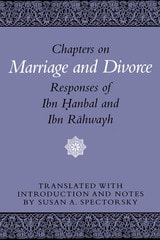
Chapters on Marriage and Divorce
Responses of Ibn Hanbal and Ibn RahwayhTranslated with introduction and notes by Susan A. Spectorsky
University of Texas Press, 1993
While western-derived legal codes have superseded Islamic law in many parts of the Muslim world, Islamic, Koran-based law still retains its force in the area of marriage and family relations, the area that is key to the status of women. This work makes available for the first time in English three compilations of responses to questions about family law given by two prominent Muslim jurists of the ninth century (third century of Islam)—Ahmad b. Hanbal, the eponymous founder of the Hanbali rite of Sunni Islam (the one dominant in Saudi Arabia), and Ishaq b. Rahwayh. These compilations are basic sources for the study of the development of legal thinking in Islam.
The introduction to the translation locates the compilations in a historical context and elucidates how the various issues of family law are treated. An appendix contains a collation of the significant variants among the manuscripts and printed versions of the Arabic texts. The volume concludes with a topical index and an index of names.
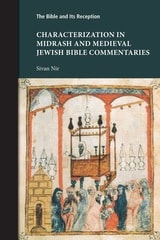
Characterization in Midrash and Medieval Jewish Bible Commentaries
Sivan Nir
SBL Press, 2024
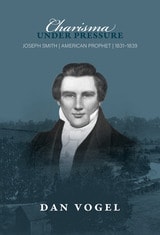
Charisma under Pressure
Joseph Smith, American Prophet, 1831–1839Dan Vogel
Signature Books, 2023
But just who was Joseph Smith? What motivated him? In examining Smith’s life during his Ohio and Missouri sojourns, Vogel seeks to answer those questions. But, Vogel is quick to note, “There are, in fact, many possible constructions of Joseph Smith, and depending on how one assesses the evidence for his truth-claims, a completely different Joseph Smith emerges. But this is probably as Smith wanted it.”
During this period, Smith established a temple, printing presses, additional scripture, expanded church offices, and built a bank—all indicating a sense of permanence and strength for his young church at one level while causing its near collapse at another.
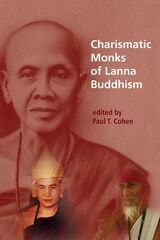
Charismatic Monks of Lanna Buddhism
Edited by Paul T. Cohen
National University of Singapore Press, 2017
Charity and Religion in Medieval Europe
James William Brodman
Catholic University of America Press, 2009
Charles Ellis Johnson and the Erotic Mormon Image
Mary Campbell
University of Chicago Press, 2016
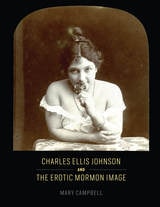
Mary Campbell tells the story of this remarkable religious transformation in Charles Ellis Johnson and the Erotic Mormon Image. One of the church’s favorite photographers, Johnson (1857–1926) spent the 1890s and early 1900s taking pictures of Mormonism’s most revered figures and sacred sites. At the same time, he did a brisk business in mail-order erotica, creating and selling stereoviews that he referred to as his “spicy pictures of girls.” Situating these images within the religious, artistic, and legal culture of turn-of-the-century America, Campbell reveals the unexpected ways in which they worked to bring the Saints into the nation’s mainstream after the scandal of polygamy.
Engaging, interdisciplinary, and deeply researched, Charles Ellis Johnson and the Erotic Mormon Image demonstrates the profound role pictures played in the creation of both the modern Church of Jesus Christ of Latter-day Saints and the modern American nation.
Charming Cadavers
Horrific Figurations of the Feminine in Indian Buddhist Hagiographic LiteratureLiz Wilson
University of Chicago Press, 1996
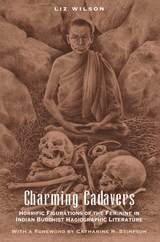
Liz Wilson investigates first-millennium Buddhist notions of
spirituality. She argues that despite the marginal role women played in
monastic life, they occupied a very conspicuous place in Buddhist
hagiographic literature. In narratives used for the edification of
Buddhist monks, women's bodies in decay (diseased, dying, and after
death) served as a central object for meditation, inspiring spiritual
growth through sexual abstention and repulsion in the immediate world.
Taking up a set of universal concerns connected with the representation
of women, Wilson displays the pervasiveness of androcentrism in Buddhist
literature and practice. She also makes persuasive use of recent
historical work on the religious lives of women in medieval
Christianity, finding common ground in the role of miraculous
afflictions.
This lively and readable study brings provocative new tools and insights
to the study of women in religious life.
Chicago Católico
Making Catholic Parishes MexicanDeborah E. Kanter
University of Illinois Press, 2020
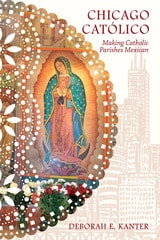
Deborah E. Kanter tells the story of neighborhood change and rebirth in Chicago's Mexican American communities. She unveils a vibrant history of Mexican American and Mexican immigrant relations as remembered by laity and clergy, schoolchildren and their female religious teachers, parish athletes and coaches, European American neighbors, and from the immigrant women who organized as guadalupanas and their husbands who took part in the Holy Name Society. Kanter shows how the newly arrived mixed memories of home into learning the ways of Chicago to create new identities. In an ever-evolving city, Mexican immigrants and Mexican Americans’ fierce devotion to their churches transformed neighborhoods such as Pilsen.
The first-ever study of Mexican-descent Catholicism in the city, Chicago Católico illuminates a previously unexplored facet of the urban past and provides present-day lessons for American communities undergoing ethnic integration and succession.
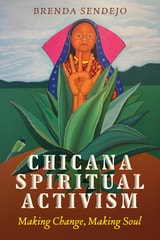
Chicana Spiritual Activism
Making Change, Making SoulBrenda Sendejo
University of Arizona Press, 2026
This book explores the profound impact of spiritual activism within the Chicana feminist movement in Texas. It illuminates how a cohort of Texas Chicanas embraced spiritual activism in pursuit of social change during the movement and into the present day.
The book draws on an array of qualitative methodologies—including interviews, autoethnography, testimonio, pláticas, and archival analysis—to develop what the author formulates as “methodologies of the spirit.” Focusing on the lived experiences, histories, and spiritual activism of sixteen Chicanas/Tejanas, Sendejo shows how these trailblazing women confronted the enduring impacts and repercussions of colonial legacies in Texas through their involvement in movement initiatives such as electoral politics through Mujeres Por La Raza, the cultural arts movement, developing Chicana feminist thought, and the establishment of bilingual education and Chicana/o studies programs.
The activists highlighted in the book include well-known figures such as Santa Barraza, Norma E. Cantú, Rosie Castro, Martha P. Cotera, Inés Hernández-Ávila, and others. Through their work, these activists emerged as architects of their own healing and transformation. Simultaneously, they opened avenues for others to embark on similar journeys reshaping religious practices and unearthing and disseminating spiritual, feminist, and ancestral knowledges.
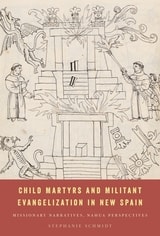
Child Martyrs and Militant Evangelization in New Spain
Missionary Narratives, Nahua PerspectivesStephanie Schmidt
University of Texas Press, 2025
Examines the many iterations of a story of child martyrdom in colonial Mexico.
A cornerstone of the evangelization of early New Spain was the conversion of Nahua boys, especially the children of elites. They were to be emissaries between Nahua society and foreign missionaries, hastening the transmission of the gospel. Under the tutelage of Franciscan friars, the boys also learned to act with militant zeal. They sermonized and smashed sacred objects. Some went so far as to kill a Nahua religious leader. For three boys from Tlaxcala, the reprisals were just as deadly.
In Child Martyrs and Militant Evangelization in New Spain, Stephanie Schmidt sheds light on a rare manuscript about Nahua child converts who were killed for acts of zealotry during the late 1520s. This is the Nahuatl version of an account by an early missionary-friar, Toribio de Benavente Motolinía. To this day, Catholics venerate the slain boys as Christian martyrs who suffered for their piety. Yet Franciscan accounts of the boys’ sacrifice were influenced by ulterior motives, as the friars sought to deflect attention from their missteps in New Spain. Illuminating Nahua perspectives on this story and period, Schmidt leaves no doubt as to who drove this violence as she dramatically expands the knowledgebase available to students of colonial Latin America.
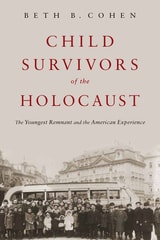
Child Survivors of the Holocaust
The Youngest Remnant and the American ExperienceCohen, Beth B
Rutgers University Press, 2018
The majority of European Jewish children alive in 1939 were murdered during the Holocaust. Of 1.5 million children, only an estimated 150,000 survived. In the aftermath of the Shoah, efforts by American Jews brought several thousand of these child survivors to the United States. In Child Survivors of the Holocaust, historian Beth B. Cohen weaves together survivor testimonies and archival documents to bring their story to light. She reveals that even as child survivors were resettled and “saved,” they struggled to adapt to new lives as members of adoptive families, previously unknown American Jewish kin networks, or their own survivor relatives. Nonetheless, the youngsters moved ahead. As Cohen demonstrates, the experiences both during and after the war shadowed their lives and relationships through adulthood, yet an identity as “survivors” eluded them for decades. Now, as the last living link to the Holocaust, the voices of Child Survivors are finally being heard.
Children and Childhood in American Religions
Browning, Don S
Rutgers University Press, 2009
- How the Catholic Church confronts the tension between its teachings about children and actual practic
- The Oglala Lakota's struggle to preserve their spiritual tradition
- The impact of modernity on Hinduism
Only by discussing the unique challenges faced by all religions, and their followers, can we take the first step toward a greater understanding for all of us.
Children and Childhood in World Religions
Primary Sources and TextsBrowning, Don S
Rutgers University Press, 2009
Each of six chapters, edited by world-class scholars, focuses on one religious tradition and includes an introduction and a selection of primary texts ranging from legal to liturgical and from the ancient to the contemporary. Through both the scholarly introductions and the primary sources, this comprehensive volume addresses a range of topics, from the sanctity of birth to a child's relationship to evil, showing that issues regarding children are central to understanding world religions and raising significant questions about our own conceptions of children today.
Children in New Religions
Palmer, Susan J
Rutgers University Press, 1999
Children of God in the World
Paul O'Callaghan
Catholic University of America Press, 2016
China's Quest for Liberty
A Personal History of FreedomPromise Hsu
St. Augustine's Press, 2014
It is about a world whose dimensions have been basically obscured not only in China but also in the global public square, and walk with this young journalist, step by step, to find, paradoxically, the hope in the depth of hopelessness, the strength in acknowledging weakness, the change in substance by, among other things, keeping the form unchanged for at least a while, the youth in growing up despite growing old, the invisible in the visible, the imperishable in the perishable, the reality in the shadow of numerous fake realities, and the freedom gained not mainly through human efforts but as mercy and grace from the one who created humans and other beings.
As well as digging out the overlooked Christian background in the rise of the sanctity of human life, creative culture, constitutionalism, work as a vocation, modern management, servant leadership, and catchphrases like “the global village” and “The medium is the message”, the author tells of insider observations about the rise of Christianity in China generally and about Shouwang Church in particular. Through sharing these findings, this book aims to show how the one who made the universe rules the world and how this creator sets his creatures free by himself.
China’s Quest for Liberty is a fascinating work of nuance and surprise.
Chinese Thought from Confucius to Mao Tse-tung
Herrlee Glessner Creel
University of Chicago Press, 1971
"There exists nowhere else such a well-written presentation of the main trends in Chinese thought in so brief a space. The text is not cluttered with Chinese names and the pages are not weighed down with footnotes—but the references are there for those who want them, with suggestions for further readings. This is a book which can be understood by those who have never read anything else about China."—The New York Times Book Review
Chinese Ways of Being Muslim
Negotiating Ethnicity and Religiosity in IndonesiaHew Wai Weng
National University of Singapore Press, 2018
Choctaw Prophecy
A Legacy for the FutureTom Mould
University of Alabama Press, 2002
Explores the power and artistry of prophecy among the Mississippi Band of Choctaw Indians, who use predictions about the future to interpret the world around them
This book challenges the common assumption that American Indian prophecy was an anomaly of the 18th and 19th centuries that resulted from tribes across the continent reacting to the European invasion. Tom Mould’s study of the contemporary prophetic traditions of the Mississippi Band of Choctaw Indians reveals a much larger system of prophecy that continues today as a vibrant part of the oral tradition.
Mould shows that Choctaw prophecy is more than a prediction of the future; it is a way to unite the past, present, and future in a moral dialogue about how one should live. Choctaw prophecy, he argues, is stable and continuous; it is shared in verbal discourse, inviting negotiation on the individual level; and, because it is a tradition of all the people, it manifests itself through myriad visions with many themes. In homes, casinos, restaurants, laundromats, day care centers, and grocery stores, as well as in ceremonial and political situations, people discuss current events and put them into context with traditional stories that govern the culture. In short, recitation is widely used in everyday life as a way to interpret, validate, challenge, and create the world of the Choctaw speaker.
Choctaw Prophecy stands as a sound model for further study into the prophetic traditions of not only other American Indian tribes but also communities throughout the world. Weaving folklore and oral tradition with ethnography, this book will be useful to academic and public libraries as well as to scholars and students of southern Indians and the modern South.
Chosen Capital
The Jewish Encounter with American CapitalismKobrin, Rebecca
Rutgers University Press, 2012
Surveying such diverse topics as Jews’ participation in the real estate industry, the liquor industry, and the scrap metal industry, as well as Jewish political groups and unions bent on reforming American capital, such as the American Labor Party and the International Ladies’ Garment Workers’ Union, contributors to this volume provide a new prism through which to view the Jewish encounter with America. The volume also lays bare how American capitalism reshaped Judaism itself by encouraging the mass manufacturing and distribution of foods like matzah and the transformation of synagogue cantors into recording stars. These essays force us to rethink not only the role Jews played in American economic development but also how capitalism has shaped Jewish life and Judaism over the course of the twentieth century.
Contributors:
Marni Davis, Georgia State University
Phyllis Dillon, independent documentary producer, textile conservator, museum curator
Andrew Dolkart, Columbia University
Andrew Godley, Henley Business School, University of Reading
Jonathan Karp, executive director, American Jewish Historical Society
Daniel Katz, Empire State College, State University of New York
Ira Katznelson, Columbia University
David S. Koffman, New York University
Eli Lederhendler, Hebrew University, Jerusalem
Jonathan Z. S. Pollack, University of Wisconsin—Madison
Jonathan D. Sarma, Brandeis University
Jeffrey Shandler, Rutgers University
Daniel Soyer, Fordham University
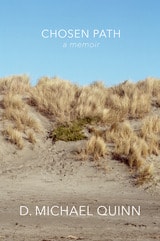
Chosen Path
A MemoirD. Michael Quinn
Signature Books, 2022
From the age of nine, Quinn felt convicted he would one day serve as an apostle of the Church of Jesus Christ of Latter-day Saints. He chose the path he believed would take him there, eventually living as a straight LDS family man in a mixed-orientation marriage. In the 1970s and 1980s he became a BYU professor and one of Mormonism’s most promising, prolific, and respected historians. But his uncompromising commitment to total honesty about his religion’s history, along with his homosexuality, set him on a collision course with church leaders and the end of his seemingly idyllic Mormon life. Throughout his telling, Quinn unflinchingly opens up about his feelings and experiences that shaped his enigmatic life.
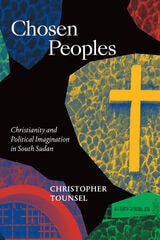
Chosen Peoples
Christianity and Political Imagination in South SudanChristopher Tounsel
Duke University Press, 2021
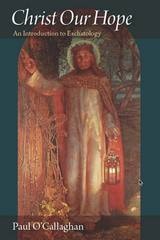
Christ Our Hope
An Introduction to EschatologyPaul O'Callaghan
Catholic University of America Press, 2011
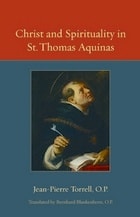
Christ and Spirituality in St. Thomas Aquinas
Jean-Pierre Torrell
Catholic University of America Press, 2011

Christ and the Moral Life
James M. Gustafson
University of Chicago Press, 1979
Christ the Educator
Catholic University of America Press, 1954
Christ's Subversive Body
Practices of Religious Rhetoric in Culture and PoliticsOlga V. Solovieva; Foreword by Haun Saussy
Northwestern University Press, 2018
Solovieva’s survey includes the iconoclastic polemics of Epiphanius at the moment of struggles for supremacy between the Roman state and the Christian church, the mystical theologico-political alchemy of an anonymous treatise circulated at the Council of Constance, Lavater’s counter-Enlightenment visions of the afterlife expressd through physiognomy, Dostoevsky’s refashioning of ethical communities, Pier Paolo Pasolini’s attempts to provoke the “scandal” of Jesus’s mission once more in the modern world, and the elaboration of a political theology subordinating democratic dissent to the higher unity of a corporately conceived “unitary executive” in early twenty-first-century America.
Solovieva presents her findings not as an entry into theological or Christological debates but rather as a study in comparative discourse analysis. She demonstrates how these uses of Christ’s body are triggered by moments of epistemological, political, and representational crisis in the history of Western civilization.
Christ, Crime, and Moral Judgment
Nemeth
St. Augustine's Press, 2025
Nemeth traces the modern shift in considering God as judge to the God who just wants to wipe away tears. If we look in Scripture, there are harsh words for the person who dismisses moral action as less than a continual call to evaluation and conversion. One also sees the detrimental effect of granting political underpinnings to all interpretations of the Bible and its indications of what righteous action is. Nemeth asserts that not only is the measure of law worthless without a kind of hardness toward offenders, but charity itself has no backbone without justice. Restoration requires judgment, but the Judge who speaks harshly is the one who cultivates the desire for his softness. Post-modern scholars don't worry about receiving God's mercy, but they really ought to define the parameters of human responsibility. Any human attempt to define mercy and compassion on the part of God will always fall short, we ought to save our energies to live up to the moral life and take Christ as a perfect example and proof of the possibility.
Christian America and the Kingdom of God
Richard T. Hughes
University of Illinois Press, 2012
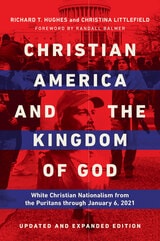
Christian America and the Kingdom of God
White Christian Nationalism from the Puritans through January 6, 2021Richard T. Hughes and Christina Littlefield
University of Illinois Press, 2025
A timely new edition of the acclaimed work, Christian America and the Kingdom of God spotlights how the centuries-long pursuit of a Christian America has bred an aggressive white Christian nationalism that twists faith, unleashes unchristian behavior, and threatens the nation.
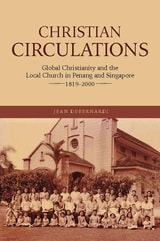
Christian Circulations
Global Christianity and the Local Church in Penang and Singapore, 1819-2000Jean DeBernardi
National University of Singapore Press, 2020
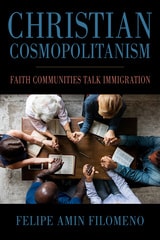
Christian Cosmopolitanism
Faith Communities Talk ImmigrationFelipe Amin Filomeno
Temple University Press, 2024
Christian Cosmopolitanism shows that mutual understanding can result when people share their personal stories, feelings, and thoughts about immigration. They reflect and deliberate on collaborative action to advance common interests and shared values, which can unleash the cosmopolitan potential of the Christian community.
Including practical tools for church leaders, Christian Cosmopolitanism promotes dialogue as a cultural practice that can help diverse communities overcome segregation and become socially cohesive.
Christian Demonology and Popular Mythology
Éva Pócs
Central European University Press, 2006
Christian Humanism in Shakespeare
A Study in Religion and LiteratureLee Oser
Catholic University of America Press, 2022
Christian Instruction; Admonition and Grace; The Christian Combat; Faith, Hope and Charity
Saint Augustine
Catholic University of America Press, 1950
Christian Internationalism and German Belonging
The Salvation Army from Imperial Germany to NazismRebecca Carter-Chand
University of Wisconsin Press, 2025
In this groundbreaking reevaluation, Rebecca Carter-Chand argues that the Salvation Army was able to emphasize different aspects of its identity to bolster and repair its reputation as needed in varied political contexts, highlighting the variability of Nazi practices of inclusion and exclusion. In that way, the organization was similar to other Christian groups in Germany. Counter to common hypotheses that minority religious groups are more likely to show empathy to other minorities, dynamics within Nazi Germany reveal that many religious minorities sought acceptance from the state in an effort to secure self-preservation.
Christian Metaphysics and Neoplatonism
Albert Camus, Translated & Intro by Ronald D. Srigley
University of Missouri Press, 2007
Contemporary scholarship tends to view Albert Camus as a modern, but he himself was conscious of the past and called the transition from Hellenism to Christianity “the true and only turning point in history.” For Camus, modernity was not fully comprehensible without an examination of the aspirations that were first articulated in antiquity and that later received their clearest expression in Christianity. These aspirations amounted to a fundamental reorientation of human life in politics, religion, science, and philosophy.
Understanding the nature and achievement of that reorientation became the central task of Christian Metaphysics and Neoplatonism. Primarily known through its inclusion in a French omnibus edition, ithas remained one of Camus’ least-read works, yet it marks his first attempt to understand the relationship between Greek philosophy and Christianity as he charted the movement from the Gospels through Gnosticism and Plotinus to what he calls Augustine’s “second revelation” of the Christian faith.
Ronald Srigley’s translation of this seminal document helps illuminate these aspects of Camus’ work. His freestanding English edition exposes readers to an important part of Camus’ thought that is often overlooked by those concerned primarily with the book’s literary value and supersedes the extant McBride translation by retaining a greater degree of literalness.
Srigley has fully annotated Christian Metaphysics to include nearly all of Camus’ original citations and has tracked down many poorly identified sources. When Camus cites an ancient primary source, whether in French translation or in the original language, Srigley substitutes a standard English translation in the interest of making his edition accessible to a wider range of readers. His introduction places the text in the context of Camus’ better-known later work, explicating its relationship to those mature writings and exploring how its themes were reworked in subsequent books.
Arguing that Camus was one of the great critics of modernity through his attempt to disentangle the Greeks from the Christians, Srigley clearly demonstrates the place of Christian Metaphysics in Camus’ oeuvre. As the only stand-alone English version of this important work—and a long-overdue critical edition—his fluent translation is an essential benchmark in our understanding of Camus and his place in modern thought.
Christian Networks in the Ottoman Empire
A Transnational HistoryYura Konstantinova
Central European University Press, 2024
Observers and historians continue to marvel at the diversity and complexity of the Ottoman Empire. This book explores the significant and multifaceted role that Orthodox Christian networks played in the sultan’s realm from the 17th century until WWI. These multi-ethnic, multi-lingual, and multi-confessional formations contributed fundamentally to the political, economic, social, and cultural development of the Empire as well as to its gradual disintegration.
Bringing together scholars from most Balkan countries, Christian Networks in the Ottoman Empire describes the variety of Orthodox Christian networks under Ottoman rule. The examples examined include commercial relations, intellectual networks, educational systems, religious dynamics, consular activities, and revolutionary movements, and involve Muslims and Christians, Romanians and Serbs, Bulgarians and Greeks, Albanians and Turks. The contributions show that the Christian populations and their elites were an integral part of Ottoman society.
The geographical spread of the formal and informal networks enriches our understanding of the terms ‘center’ and ‘periphery.’ They were either centered within the official Ottoman borders and extended their activities to other states and empires, or vice versa, located elsewhere, but also active in the Ottoman Empire. A common feature of these formations is their constant fluctuation, which enables a dynamic understanding of Ottoman history.
Christian Origins and the Language of the Kingdom of God
Michael L. Humphries. Foreword by Burton L. Mack
Southern Illinois University Press, 1999
Traditionally, scholars have traced the origin of Christianity to a single source—the kingdom of God as represented in the message of the historical Jesus. Through a rhetorical critical analysis of one of the most important texts in early Christian literature (the Beelzebul controversy), Michael L. Humphries addresses the issue of Christian origins, demonstrating how the language of the kingdom of God is best understood according to its locative or taxonomic effect where the demarcation of social and cultural boundaries contributes to the emergence of this new social foundation.
The Beelzebul controversy exists in two versions— Q and Mark—and thereby allows the study to engage the import of the kingdom language at the point of juxtaposition between two distinct textual representations. This makes it possible to deal directly with the issue of the disparity of texts in the synoptic tradition. Humphries suggests that these two versions of the same controversy indicate two distinct social trajectories wherein the kingdom of God comes to mean something quite different in each case but that nevertheless they demonstrate a similarity in theoretical effect where the language contributes to the emergence of relatively distinct social formations.
Humphries establishes the Q and Markan versions of the Beelzebul controversy as relatively sophisticated compositions that are formally identified as elaborate chreiai (a literary form used in the teaching of rhetoric at the secondary and post-secondary level of GrecoRoman education) and that offer an excellent example of the rhetorical manipulation of language in the development of social and cultural identity.
Christian and Pagan in the Roman Empire
Robert Sider
Catholic University of America Press, 2001
Christian faith & human understanding
studies on the Eucharist, Trinity, and the human personRobert Sokolowski
Catholic University of America Press, 2006
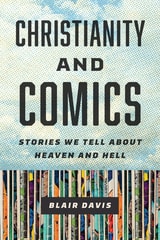
Christianity and Comics
Stories We Tell about Heaven and HellBlair Davis
Rutgers University Press, 2024
Christianity and Comics presents an 80-year history of the various ways that the comics industry has drawn from biblical source material. It explores how some publishers specifically targeted Christian audiences with titles like Catholic Comics, books featuring heroic versions of Oral Roberts and Billy Graham, and special religious-themed editions of Archie. But it also considers how popular mainstream comics like Daredevil, The Sandman, Ghost Rider, and Batman are infused with Christian themes and imagery.
Comics scholar Blair Davis pays special attention to how the medium’s unique use of panels, word balloons, captions, and serialized storytelling have provided vehicles for telling familiar biblical tales in new ways. Spanning the Golden Age of comics to the present day, this book charts how comics have both reflected and influenced Americans’ changing attitudes towards religion.
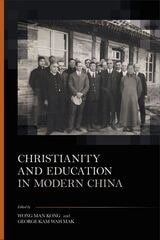
Christianity and Education in Modern China
Edited by Man Kong Wong and George Kam Wah Mak
Hong Kong University Press, 2025
In Christianity and Education in Modern China, the contributors demonstrate how Christianity served as a driving force in the development of modern education in China. Each essay offers new insights into Christian influence on education in modern China while examining how Christian missionaries and Chinese Christian educators interacted with China's social, cultural, and political contexts. They also explore how the legacies of Christian higher education affected higher education in mainland China, Taiwan, and Asia at large. On the whole, this volume compares the Western missionary and Chinese Christian perspectives with rich historiographical acumen by offering original case studies to examine Christianity’s impact on education in modern China.

Christianity and Islam
The Struggling DialogueRichard Rousseau
University of Scranton Press, 1985
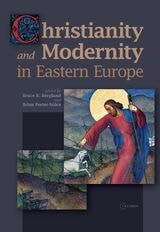
Christianity and Modernity in Eastern Europe
Bruce R. Berglund
Central European University Press, 2010