Results by title
28167 books match the query 'History' and 1913 start with c
Collisions With History
Latin American Fiction and Social Science from “El Boom” to the New World OrderFrederick M. Nunn
Ohio University Press, 2001
Latin American intellectuals have traditionally debated their region’s history, never with so much agreement as in the fiction, commentary, and scholarship of the late twentieth century. Collisions with History shows how “fictional histories” of discovery and conquest, independence and early nationhood, and the recent authoritarian past were purposeful revisionist collisions with received national versions. These collisions occurred only because of El Boom, thus making Latin America’s greatest literary movement a historical phenomenon as well. Frederick M. Nunn discusses the cataclysmic view of history conveyed in Boom novels and examines the thought and self-perception of selected authors whose political activism enhanced the appeal of their works—historical and otherwise: Alejo Carpentier, Carlos Fuentes, Gabriel García Márquez, and Augusto Roa Bastos; Julio Cortázar, Isabel Allende, Mario Vargas Llosa, and Darcy Ribeiro.
Collisions with History demonstrates how their commentary on history, literature, politics, and international affairs reveals a conscious sense of purpose. From between the lines of their nonfiction emerges a consensus that outside forces have defined as well as controlled Latin America’s history.
Professor Nunn also suggests that, with novelists now no longer very interested in colliding with history, it may fall to social scientists to speak for what remains of the region’s past in the New World Order.
Colonel Benjamin Stephenson and the History of Early Illinois
Sidney G. Denny, with a foreword by Jason Stacy
Southern Illinois University Press, 2025
WINNER, Certificate of Excellence in “Scholarly Publications” from the Illinois State Historical Society’s 2026 Best of Illinois History Awards!
Rediscovering a forgotten Illinois founding father
In early 2024, the Director of the Colonel Benjamin Stephenson House in Edwardsville, Illinois, discovered an unpublished manuscript among the files of Sidney G. Denny, a longtime Friends of the Colonel Benjamin Stephenson House Board member who had passed away just months before. The manuscript compiled the materials from a decade’s worth of articles Denny had written for the House’s newsletter, the Spectator, on the history of the House, Benjamin Stephenson, and early Illinois—history that, without Denny, would have been lost to time.
Colonel Benjamin Stephenson, a founding father of both the city of Edwardsville and the state of Illinois, played a crucial role in the emergence of Illinois from a territory into the nation’s twenty-first state in 1818. Informed by a treasure trove of primary sources, Colonel Benjamin Stephenson and the History of Early Illinois traces Stephenson from his childhood in 18th-century Pennsylvania to his experiences on the Illinois frontier and, eventually, to his final residence, which is now a museum of his life and times in Edwardsville. The volume also provides a detailed chronicle that connects early Illinois history to the history of westward settlement and to the American Revolution itself.
Denny explores the rich history of Madison County and delves into the complexities of early Illinois and its pioneering leaders, weaving together the lives of various families to reveal the interconnected nature of early Illinois society. His meticulously researched work showcases how the impact of those early days is still visible today.
Colonel Greene and the Copper Skyrocket
The Spectacular Rise and Fall of William Cornell Greene: Copper King, Cattle Baron, and Promoter Extraordinary in Mexico, the American Southwest, and the New York Financial DistrictC. L. Sonnichsen
University of Arizona Press, 1974
"A solid account of a southwestern 'character' who has flitted in and out of frontier and economic history."—American Historical Review
"A creditable work on a fascinating individual. In delightful writing style he has reconstructed Greene's life, explaining the ambitions as well as the frailties of this extraordinary entrepreneur."—History
"A rewarding study of the later days of mining."—Arizona and the West

Colonel Sanders and the American Dream
By Josh Ozersky
University of Texas Press, 2012
From Aunt Jemima and Uncle Ben to the Jolly Green Giant and Ronald McDonald, corporate icons sell billions of dollars’ worth of products. But only one of them was ever a real person—Colonel Sanders of Kentucky Fried Chicken/KFC. From a 1930s roadside café in Corbin, Kentucky, Harland Sanders launched a fried chicken business that now circles the globe, serving “finger lickin’ good” chicken to more than twelve million people every day. But to get there, he had to give up control of his company and even his own image, becoming a mere symbol to people today who don’t know that Colonel Sanders was a very real human being. This book tells his story—the story of a dirt-poor striver with unlimited ambition who personified the American Dream.
Acclaimed cultural historian Josh Ozersky defines the American Dream as being able to transcend your roots and create yourself as you see fit. Harland Sanders did exactly that. Forced at age ten to go to work to help support his widowed mother and sisters, he failed at job after job until he went into business for himself as a gas station/café/motel owner and finally achieved a comfortable, middle-class life. But then the interstate bypassed his business and, at sixty-five, Sanders went broke again. Packing his car with a pressure cooker and his secret blend of eleven herbs and spices, he began peddling the recipe for “Colonel Sanders’ Kentucky Fried Chicken” to small-town diners in exchange for a nickel for each chicken they sold. Ozersky traces the rise of Kentucky Fried Chicken from this unlikely beginning, telling the dramatic story of Sanders’ self-transformation into “The Colonel,” his truculent relationship with KFC management as their often-disregarded goodwill ambassador, and his equally turbulent afterlife as the world’s most recognizable commercial icon.
Colonial Angels
Narratives of Gender and Spirituality in Mexico, 1580-1750By Elisa Sampson Vera Tudela
University of Texas Press, 2000
Spain's attempt to establish a "New Spain" in Mexico never fully succeeded, for Spanish institutions and cultural practices inevitably mutated as they came in contact with indigenous American outlooks and ways of life. This original, interdisciplinary book explores how writing by and about colonial religious women participated in this transformation, as it illuminates the role that gender played in imposing the Spanish empire in Mexico.
The author argues that the New World context necessitated the creation of a new kind of writing. Drawing on previously unpublished writings by and about nuns in the convents of Mexico City, she investigates such topics as the relationship between hagiography and travel narratives, male visions of the feminine that emerge from the reworking of a nun's letters to her confessor into a hagiography, the discourse surrounding a convent's trial for heresy by the Inquisition, and the reports of Spanish priests who ministered to noble Indian women. This research rounds out colonial Mexican history by revealing how tensions between Spain and its colonies played out in the local, daily lives of women.
Colonial Arkansas, 1686-1804
A Social and Cultural HistoryMorris S. Arnold
University of Arkansas Press, 1993
Colonial Cataclysms
Climate, Landscape, and Memory in Mexico’s Little Ice AgeBradley Skopyk
University of Arizona Press, 2020
The contiguous river basins that flowed in Tlaxcala and San Juan Teotihuacan formed part of the agricultural heart of central Mexico. As the colonial project rose to a crescendo in the sixteenth and seventeenth centuries, the Indigenous farmers of central Mexico faced long-term problems standard historical treatments had attributed to drought and soil degradation set off by Old World agriculture. Instead, Bradley Skopyk argues that a global climate event called the Little Ice Age brought cold temperatures and elevated rainfall to the watersheds of Tlaxcala and Teotihuacan. With the climatic shift came cataclysmic changes: great floods, human adaptations to these deluges, and then silted wetlands and massive soil erosion.
This book chases water and soil across the colonial Mexican landscape, through the fields and towns of New Spain’s Native subjects, and in and out of some of the strongest climate anomalies of the last thousand or more years. The pursuit identifies and explains the making of two unique ecological crises, the product of the interplay between climatic and anthropogenic processes. It charts how Native farmers responded to the challenges posed by these ecological rifts with creative use of plants and animals from the Old and New Worlds, environmental engineering, and conflict within and beyond the courts. With a new reading of the colonial climate and by paying close attention to land, water, and agrarian ecologies forged by farmers, Skopyk argues that colonial cataclysms—forged during a critical conjuncture of truly unprecedented proportions, a crucible of human and natural forces—unhinged the customary ways in which humans organized, thought about, and used the Mexican environment.
This book inserts climate, earth, water, and ecology as significant forces shaping colonial affairs and challenges us to rethink both the environmental consequences of Spanish imperialism and the role of Indigenous peoples in shaping them.
Colonial Crucible
Empire in the Making of the Modern American StateEdited by Alfred W. McCoy and Francisco A. Scarano
University of Wisconsin Press, 2009
Moving well beyond theory, this volume takes the next step, adding a fine-grained, empirical texture to the study of U.S. imperialism by analyzing its specific consequences. Across a broad range of institutions—policing and prisons, education, race relations, public health, law, the military, and environmental management—this formative experience left a lasting institutional imprint. With each essay distilling years, sometimes decades, of scholarship into a concise argument, Colonial Crucible reveals the roots of a legacy evident, most recently, in Washington’s misadventures in the Middle East.
Colonial Debts
The Case of Puerto RicoRocío Zambrana
Duke University Press, 2021
Colonial Encounters in Ancient Iberia
Phoenician, Greek, and Indigenous RelationsEdited by Michael Dietler and Carolina López-Ruiz
University of Chicago Press, 2009
During the first millennium BCE, complex encounters of Phoenician and Greek colonists with natives of the Iberian Peninsula transformed the region and influenced the entire history of the Mediterranean.
One of the first books on these encounters to appear in English, this volume brings together a multinational group of contributors to explore ancient Iberia’s colonies and indigenous societies, as well as the comparative study of colonialism. These scholars—from a range of disciplines including classics, history, anthropology, and archaeology—address such topics as trade and consumption, changing urban landscapes, cultural transformations, and the ways in which these issues played out in the Greek and Phoenician imaginations. Situating ancient Iberia within Mediterranean colonial history and establishing a theoretical framework for approaching encounters between colonists and natives, these studies exemplify the new intellectual vistas opened by the engagement of colonial studies with Iberian history.
Colonial Fantasies, Imperial Realities
Race Science and the Making of Polishness on the Fringes of the German Empire, 1840–1920Lenny A. Ureña Valerio
Ohio University Press, 2019
In Colonial Fantasies, Imperial Realities, Lenny Ureña Valerio offers a transnational approach to Polish-German relations and nineteenth-century colonial subjectivities. She investigates key cultural dynamics in the history of medicine, colonialism, and migration that bring Germany and Prussian Poland closer to the colonial and postcolonial worlds in Africa and Latin America. She also analyzes how Poles in the German Empire positioned themselves in relation to Germans and native populations in overseas colonies. She thus recasts Polish perspectives and experiences, allowing new insights into identity formation and nationalist movements within the German Empire.
Crucially, Ureña Valerio also studies the medical projects and scientific ideas that traveled from colonies to the German metropole, and vice versa, which were influential not only in the racialization of Slavic populations, but also in bringing scientific conceptions of race to the everydayness of the German Empire. As a whole, Colonial Fantasies, Imperial Realities illuminates nested imperial and colonial relations using sources that range from medical texts and state documents to travel literature and fiction. By studying these scientific and political debates, Ureña Valerio uncovers novel ways to connect medicine, migration, and colonialism and provides an invigorating model for the analysis of Polish history from a global perspective.
Colonial Fantasies
Conquest, Family, and Nation in Precolonial Germany, 1770-1870Susanne Zantop
Duke University Press, 1997
From as early as the sixteenth century, Germans preoccupied themselves with an imaginary drive for colonial conquest and possession that eventually grew into a collective obsession. Zantop illustrates the gendered character of Germany’s colonial imagination through critical readings of popular novels, plays, and travel literature that imagine sexual conquest and surrender in colonial territory—or love and blissful domestic relations between colonizer and colonized. She looks at scientific articles, philosophical essays, and political pamphlets that helped create a racist colonial discourse and demonstrates that from its earliest manifestations, the German colonial imagination contained ideas about a specifically German national identity, different from, if not superior to, most others.
Colonial Genocide in Indigenous North America
Andrew Woolford, Jeff Benvenuto and Alexander Laban Hinton, eds.
Duke University Press, 2014
Contributors. Jeff Benvenuto, Robbie Ethridge, Theodore Fontaine, Joseph P. Gone, Alexander Laban Hinton, Tasha Hubbard, Margaret D. Jabobs, Kiera L. Ladner, Tricia E. Logan, David B. MacDonald, Benjamin Madley, Jeremy Patzer, Julia Peristerakis, Christopher Powell, Colin Samson, Gray H. Whaley, Andrew Woolford
Colonial Habits
Convents and the Spiritual Economy of Cuzco, PeruKathryn Burns
Duke University Press, 1999
Based on unprecedented archival research, Colonial Habits demonstrates how nuns became leading guarantors of their city’s social order by making loans, managing property, containing “unruly” women, and raising girls. Coining the phrase “spiritual economy” to analyze the intricate investments and relationships that enabled Cuzco’s convents and their backers to thrive, Burns explains how, by the late 1700s, this economy had faltered badly, making convents an emblem of decay and a focal point for intense criticism of a failing colonial regime. By the nineteenth century, the nuns had retreated from their previous roles, marginalized in the construction of a new republican order.
Providing insight that can be extended well outside the Andes to the relationships articulated by convents across much of Europe, the Americas, and beyond, Colonial Habits will engage those interested in early modern economics, Latin American studies, women in religion, and the history of gender, class, and race.
Colonial Inscriptions
Race, Sex, and Class in KenyaCarolyn Martin Shaw
University of Minnesota Press, 1995
In Kenyan colonialist imagery, the Kikuyu were vilified as deceitful servants while the Maasai were romanticized as noble savages in a fashion similar to American representation of the Black slave and the "wild" Indian. Carolyn Martin Shaw examines this imagery in the works of historians and ethnographers, as well as in novels and films.
Through the works of Louis Leakey, Jomo Kenyatta, Elspeth Huxley, and Isak Dinesen, along with her own ethnographic research, Martin Shaw investigates the discourses that shaped inequalities, rivalries, and fantasies in colonial Kenya. She explores narratives of domination and subordination, arguing that Europeans brought to Africa long-established ideas of difference that influenced racial inequalities in the colonial situation. Including discussion of the controversial practice of female genital mutilation, Colonial Inscriptions presents an African American woman's views of how images of African colonialism have been influenced by European and American racism and sexual fantasies.
Colonial Itineraries of Contemporary Mexico
Literary and Cultural InquiriesEdited by Oswaldo Estrada and Anna M. Nogar
University of Arizona Press, 2014
Through a transformative interdisciplinary lens, this book studies the ultra-contemporary chronicles of Carlos Monsiváis, the poetry of Carmen Boullosa and Luis Felipe Fabre, and the novels of Enrique Serna, Héctor de Mauleón, Mónica Lavín, and Pablo Soler Frost, among others. The book also pays close attention to a good sample of recent children’s literature that revisit Mexico’s colonia. It includes the transatlantic perspective of Spanish novelist Inma Chacón, and a detailed analysis of the strategies employed by Laura Esquivel in the creation of a best seller. Other chapters are devoted to the study of transnational film productions, a play by Flavio González Mello, and a set of novels set in the nineteenth-century colonia that problematize static notions of both personal and national identity within specific cultural palimpsests. Taken together, these incisive readings open broader conversations about Mexican coloniality as it continues well into the twenty-first century.
Colonial Law Making
Cambodia under the FrenchSally Frances Low
National University of Singapore Press, 2023
Covering a previously neglected area of Cambodian history, Colonial Law Making explores the structural forces and contingent exchanges that shaped colonial law in Cambodia and examines its post-independence colonial legacy.
The court of King Norodom and the temples of Angkor Wat became orientalist icons in the French colonial imagination, perpetuating an image of the Protectorate (1863–1953) as special and worthy of preservation. This contributed to exceptionalism in the way the Kingdom was colonized, including through law. Drawing on previously unexamined archival material, Sally Low presents a comparative case study of French approaches to colonial law, jurisdiction, and protection. Although the voices of non-elite Cambodians are largely absent from the archives, their influence on colonial law is evident as they resisted efforts to regulate their lives and their land. Low argues that the result was a set of state legal institutions and an indigenous jurisdiction that blended Cambodian and French notions of patronage and royal power as the source and authority for law.
This work is a case study of colonial law as an instrument of control and administration in an indirectly ruled colony. It adds depth to our understanding of the impact of European colonial law and the significance of different forms of colonial rule—direct, indirect, and unofficial. It is easily accessible for non-lawyers and is a must-read for those interested in the recent past of Southeast Asia and the countries that were previously colonized as French Indochina.
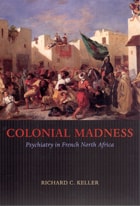
Colonial Madness
Psychiatry in French North AfricaRichard C. Keller
University of Chicago Press, 2007
Nineteenth-century French writers and travelers imagined Muslim colonies in North Africa to be realms of savage violence, lurid sexuality, and primitive madness. Colonial Madness traces the genealogy and development of this idea from the beginnings of colonial expansion to the present, revealing the ways in which psychiatry has been at once a weapon in the arsenal of colonial racism, an innovative branch of medical science, and a mechanism for negotiating the meaning of difference for republican citizenship.
Drawing from extensive archival research and fieldwork in France and North Africa, Richard Keller offers much more than a history of colonial psychology. Colonial Madness explores the notion of what French thinkers saw as an inherent mental, intellectual, and behavioral rift marked by the Mediterranean, as well as the idea of the colonies as an experimental space freed from the limitations of metropolitan society and reason. These ideas have modern relevance, Keller argues, reflected in French thought about race and debates over immigration and France’s postcolonial legacy.
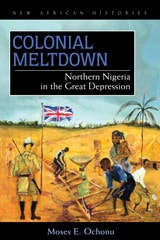
Colonial Meltdown
Northern Nigeria in the Great DepressionMoses E. Ochonu
Ohio University Press, 2009
Historians of colonial Africa have largely regarded the decade of the Great Depression as a period of intense exploitation and colonial inactivity. In Colonial Meltdown, Moses E. Ochonu challenges this conventional interpretation by mapping the determined, at times violent, yet instructive responses of Northern Nigeria’s chiefs, farmers, laborers, artisans, women, traders, and embryonic elites to the British colonial mismanagement of the Great Depression. Colonial Meltdown explores the unraveling of British colonial power at a moment of global economic crisis.
Ochonu shows that the economic downturn made colonial exploitation all but impossible and that this dearth of profits and surpluses frustrated the colonial administration which then authorized a brutal regime of grassroots exactions and invasive intrusions. The outcomes were as harsh for Northern Nigerians as those of colonial exploitation in boom years.
Northern Nigerians confronted colonial economic recovery measures and their agents with a variety of strategies. Colonial Meltdown analyzes how farmers, women, laborers, laid-off tin miners, and NorthernNigeria’s emergent elite challenged and rebelled against colonial economic recovery schemes with evasive trickery, defiance, strategic acts of revenge, and criminal self-help and, in the process, exposed the weak underbelly of the colonial system.
Combined with the economic and political paralysis of colonial bureaucrats in the face of crisis, these African responses underlined the fundamental weakness of the colonial state, the brittleness of its economicmission, and the limits of colonial coercion and violence. This atmosphere of colonial collapse emboldened critics of colonial policies who went on to craft the rhetorical terms on which the anticolonial struggle of the post–World War II period was fought out.
In the current climate of global economic anxieties, Ochonu’s analysis will enrich discussions on the transnational ramifications of economic downturns. It will also challenge the pervasive narrative of imperial economic success.
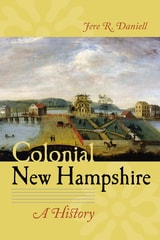
Colonial New Hampshire
A HistoryJere R. Daniell
University Press of New England, 2015
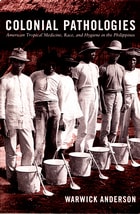
Colonial Pathologies
American Tropical Medicine, Race, and Hygiene in the PhilippinesWarwick Anderson
Duke University Press, 2006
A vivid sense of a colonial culture characterized by an anxious and assertive white masculinity emerges from Anderson’s description of American efforts to treat and discipline allegedly errant Filipinos. His narrative encompasses a colonial obsession with native excrement, a leper colony intended to transform those considered most unclean and least socialized, and the hookworm and malaria programs implemented by the Rockefeller Foundation in the 1920s and 1930s. Throughout, Anderson is attentive to the circulation of intertwined ideas about race, science, and medicine. He points to colonial public health in the Philippines as a key influence on the subsequent development of military medicine and industrial hygiene, U.S. urban health services, and racialized development regimes in other parts of the world.
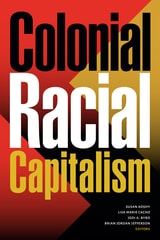
Colonial Racial Capitalism
Susan Koshy, Lisa Marie Cacho, Jodi A. Byrd, and Brian Jordan Jefferson, editors
Duke University Press, 2022
Contributors. Joanne Barker, Jodi A. Byrd, Lisa Marie Cacho, Michael Dawson, Iyko Day, Ruth Wilson Gilmore, Alyosha Goldstein, Cheryl I. Harris, Kimberly Kay Hoang, Brian Jordan Jefferson, Susan Koshy, Marisol LeBrón, Jodi Melamed, Laura Pulido
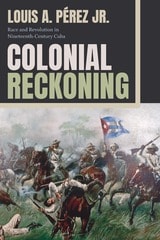
Colonial Reckoning
Race and Revolution in Nineteenth-Century CubaLouis A. Pérez Jr.
Duke University Press, 2023
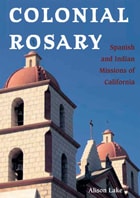
Colonial Rosary
The Spanish and Indian Missions of CaliforniaAlison Lake
Ohio University Press, 2006
California would be a different place today without the imprint of Spanish culture and the legacy of Indian civilization. The colonial Spanish missions that dot the coast and foothills between Sonoma and San Diego are relics of a past that transformed California’s landscape and its people.
In a spare and accessible style, Colonial Rosary looks at the complexity of California’s Indian civilization and the social effects of missionary control. While oppressive institutions lasted in California for almost eighty years under the tight reins of royal Spain, the Catholic Church, and the government of Mexico, letters and government documents reveal the missionaries’ genuine concern for the Indian communities they oversaw for their health, spiritual upbringing, and material needs.
With its balanced attention to the variety of sources on the mission period, Colonial Rosary illuminates ongoing debates over the role of the Franciscan missions in the settlement of California.
By sharing the missions’ stories of tragedy and triumph, author Alison Lake underlines the importance of preserving these vestiges of California’s prestatehood period. An illustrated tour of the missions as well as a sensitive record of their impact on California history and culture, Colonial Rosary brings the story of the Spanish missions of California alive.
Colonial Search For A Southern Eden
Louis B. Wright
University of Alabama Press, 2008
European imperialists began to dream of other kinds of wealth besides gold in the New World
The Colonial Search for a Southern Eden compiles three insightful lectures delivered by renowned historian Louis B. Wright at the Dancy Foundation in 1951. Wright explores the 17th‑century English colonial vision for the American South—not as a gold rush, but as a fertile terrain primed for economic prosperity through well‑planned plantations and commercial crops.
Across its concise 75 pages, Wright charts the transformation of settlers’ aspirations—from hopes of quick wealth to cultivated visions of tobacco, silk, sugar, and cotton plantations meant to create a utopian "Southern Eden". These were carefully cultivated not just for their profitability but to establish structured, enduring societies complementary to English economic goals.
Wright—a Guggenheim Fellow, Benjamin Franklin Medalist, and former director of the Folger Shakespeare Library—brings scholarly precision and elegant prose to this study, making it accessible to both historians and general readers. Publishers and reviewers have praised it as “extremely interesting and well written,” highlighting its focused yet comprehensive interpretation of colonial Southern motivations and their long-term implications. This work stands as a pivotal contribution to early American economic and colonial history—offering a nuanced understanding of how idealistic and ideological goals shaped plantation culture and southern development in the Atlantic colonies.
With its concise structure and authoritative voice, The Colonial Search for a Southern Eden is ideal for historians, students, and enthusiasts seeking to understand the ideological underpinnings of colonial Southern society.
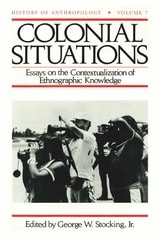
Colonial Situations
Essays on the Contextualization of Ethnographic KnowledgeEdited by George W. Stocking, Jr.
University of Wisconsin Press, 1993
As European colonies in Asia and Africa became independent nations, as the United States engaged in war in Southeast Asia and in covert operations in South America, anthropologists questioned their interactions with their subjects and worried about the political consequences of government-supported research. By 1970, some spoke of anthropology as “the child of Western imperialism” and as “scientific colonialism.” Ironically, as the link between anthropology and colonialism became more widely accepted within the discipline, serious interest in examining the history of anthropology in colonial contexts diminished.
This volume is an effort to initiate a critical historical consideration of the varying “colonial situations” in which (and out of which) ethnographic knowledge essential to anthropology has been produced. The essays comment on ethnographic work from the middle of the nineteenth century to nearly the end of the twentieth, in regions from Oceania through southeast Asia, the Andaman Islands, and southern Africa to North and South America.
The “colonial situations” also cover a broad range, from first contact through the establishment of colonial power, from District Officer administrations through white settler regimes, from internal colonialism to international mandates, from early “pacification” to wars of colonial liberation, from the expropriation of land to the defense of ecology. The motivations and responses of the anthropologists discussed are equally varied: the romantic resistance of Maclay and the complicity of Kubary in early colonialism; Malinowski’s salesmanship of academic anthropology; Speck’s advocacy of Indian land rights; Schneider’s grappling with the ambiguities of rapport; and Turner’s facilitation of Kaiapo cinematic activism.
“Provides fresh insights for those who care about the history of science in general and that of anthropology in particular, and a valuable reference for professionals and graduate students.”—Choice
“Among the most distinguished publications in anthropology, as well as in the history of social sciences.”—George Marcus, Anthropologica
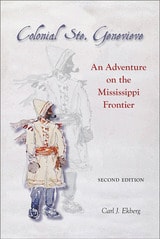
Colonial Ste. Genevieve
An Adventure on the Mississippi FrontierCarl J. Ekberg
Southern Illinois University Press, 1996
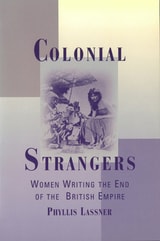
Colonial Strangers
Women Writing the End of the British EmpireLassner, Phyllis
Rutgers University Press, 2004
Drawing on memoirs, fiction, reportage, and film adaptations, Colonial Strangers explores the critical perspectives of writers who correct prevailing stereotypes of British women as agents of imperialism. They also question their own participation in British claims of moral righteousness and British politics of cultural exploitation. These authors take center stage in debates about connections between the racist ideologies of the Third Reich and the British Empire.
Colonial Strangers reveals how the literary responses of key artists represent not only compelling reading, but also a necessary intervention in colonial and postcolonial debates and the canons of modern British fiction.
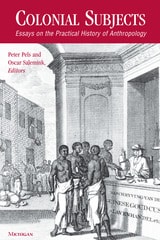
Colonial Subjects
Essays on the Practical History of AnthropologyPeter Pels and Oscar Salemink, Editors
University of Michigan Press, 2000
The essays in this volume share the assumption that "ethnography," far from being the unique purview of anthropology, is a broader field of practice out of which and alongside which anthropology attempted to distinguish itself as a scientific discipline. They explore a variety of situations in colonial South and Southeast Asia and Africa and in the treatment of the indigenous inhabitants of North America and Australia to provide genealogies of present-day anthropological practices, tracing them back to the subjects of colonial ethnography.
This book introduces into the history of anthropology many of the insights developed in recent studies in history, cultural studies, and the anthropology of colonialism. It can serve as a course book in the history of anthropology and the anthropology of colonialism, while at the same time addressing a much larger audience of students of colonial history, of the history of science and modernity, and of globalization.
Peter Pels is Lecturer in Anthropology, University of Amsterdam. Oscar Salemink is Program Officer for Social Sciences and Humanities, The Ford Foundation-Vietnam.
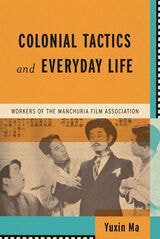
Colonial Tactics and Everyday Life
Workers of the Manchuria Film AssociationYuxin Ma
University of Wisconsin Press, 2023
By focusing on the daily challenges and experiences of the Chinese workers at the corporation, Ma examines how life was actually lived by people navigating between practical and ideological concerns. She illustrates how the inhabitants of Manchukuo navigated social opportunities, economic depression, educational reforms, fascist rule, commercial interests, practical daily needs, and more—and reveals ways in which these conflicting preoccupations sometimes manifested as tension and ambiguity on screen. In the battle between repression and expression, these Chinese actors, directors, writers, and technicians adopted defensive and opportunistic tactics. They did so in colonial spaces, often rejecting modernist representations of Manchukuo in favor of venerating traditional Chinese culture and values. The expertise, skills, and professional networks they developed extended well beyond the occupation into the postwar period, and may individuals reestablished themselves as cinema professionals in the socialist era.
Colonial Transactions
Imaginaries, Bodies, and Histories in GabonFlorence Bernault
Duke University Press, 2019
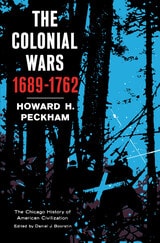
Colonial Wars, 1689-1762
Howard H. Peckham
University of Chicago Press, 1965
Mr. Peckham chronicles the events of these wars, summarizing the struggle for empire in America among France, England, and Spain. He indicates how the colonists applied the experience they gained from fighting Indians to their engagements with European powers. And what they learned from the colonial wars they translated into a political philosophy that led to independence and self-government.
The ready involvement of the colonies in European ambitions, the success and failure of co-operation between colony and mother country, the efforts of the English colonies together, and the growing differences between them and Britain give the narrative continuity and rising excitement.
Colonial Wars, 1689-1762
Howard H. Peckham
University of Chicago Press, 1965
Although the colonial wars consisted of almost continuous raids and skirmishes between the English and French colonists and their Indian allies and enemies, they can be separated into four major conflicts, corresponding to four European wars of which they were, in varying degrees, a part: King William's War (1689-97) (War of the League of Augsburg); Queen Anne's War (1702-13) (War of the Spanish Succession); King George's War (1744-48) (War of the Austrian Succession); and The French and Indian War (1755-62) (Seven Years' War).
Mr. Peckham chronicles the events of these wars, summarizing the struggle for empire in America among France, England, and Spain. He indicates how the colonists applied the experience they gained from fighting Indians to their engagements with European powers. And what they learned from the colonial wars they translated into a political philosophy that led to independence and self-government.
The ready involvement of the colonies in European ambitions, the success and failure of co-operation between colony and mother country, the efforts of the English colonies together, and the growing differences between them and Britain give the narrative continuity and rising excitement.
Colonialism Experienced
Vietnamese Writings on Colonialism, 1900-1931Truong Buu Lam
University of Michigan Press, 2000
Colonialism Is Crime
Marianne Nielsen
Rutgers University Press, 2019
Colonialism and Christianity in Mandate Palestine
By Laura Robson
University of Texas Press, 2011
Drawing on a rich base of British archival materials, Arabic periodicals, and secondary sources, Colonialism and Christianity in Mandate Palestine brings to light the ways in which the British colonial state in Palestine exacerbated sectarianism. By transforming Muslim, Christian, and Jewish religious identities into legal categories, Laura Robson argues, the British ultimately marginalized Christian communities in Palestine. Robson explores the turning points that developed as a result of such policies, many of which led to permanent changes in the region's political landscapes. Cases include the British refusal to support Arab Christian leadership within Greek-controlled Orthodox churches, attempts to avert involvement from French or Vatican-related groups by sidelining Latin and Eastern Rite Catholics, and interfering with Arab Christians' efforts to cooperate with Muslims in objecting to Zionist expansion. Challenging the widespread but mistaken notion that violent sectarianism was endemic to Palestine, Colonialism and Christianity in Mandate Palestine shows that it was intentionally stoked in the wake of British rule beginning in 1917, with catastrophic effects well into the twenty-first century.
Colonialism and Culture
Nicholas B. Dirks, Editor
University of Michigan Press, 1992
Colonialism and Science
Saint Domingue and the Old RegimeJames E. McClellan III
University of Chicago Press, 2010
How was the character of science shaped by the colonial experience? In turn, how might we make sense of how science contributed to colonialism? Saint Domingue (now Haiti) was the world’s richest colony in the eighteenth century and home to an active society of science—one of only three in the world, at that time. In this deeply researched and pathbreaking study of the colony, James E. McClellan III first raised his incisive questions about the relationship between science and society that historians of the colonial experience are still grappling with today. Long considered rare, the book is now back in print in an English-language edition, accompanied by a new foreword by Vertus Saint-Louis, a native of Haiti and a widely-acknowledged expert on colonialism. Frequently cited as the crucial starting point in understanding the Haitian revolution, Colonialism and Science will be welcomed by students and scholars alike.
“By deftly weaving together imperialism and science in the story of French colonialism, [McClellan] . . . brings to light the history of an almost forgotten colony.”—Journal of Modern History
“McClellan has produced an impressive case study offering excellent surveys of Saint Domingue’s colonial history and its history of science.”—Isis
Colonialism in the Congo Basin, 1880–1940
Samuel H. Nelson
Ohio University Press, 1993
Colonialism, Antisemitism, and Germans of Jewish Descent in Imperial Germany
Christian S. Davis
University of Michigan Press, 2012
Colonialism, Antisemitism, and Germans of Jewish Descent in Imperial Germany examines the relationship between the colonial and antisemitic movements of modern Germany from 1871 to 1918, examining the complicated ways in which German antisemitism and colonialism fed off of and into each other in the decades before the First World War. Author Christian S. Davis studies the significant involvement with and investment in German colonialism by the major antisemitic political parties and extra-parliamentary organizations of the day, while also investigating the prominent participation in the colonial movement of Jews and Germans of Jewish descent and their tense relationship with procolonial antisemites.
Working from the premise that the rise and propagation of racial antisemitism in late-nineteenth-century Germany cannot be separated from the context of colonial empire, Colonialism, Antisemitism, and Germans of Jewish Descent in Imperial Germany is the first work to study the dynamic and evolving interrelationship of the colonial and antisemitic movements of the Kaiserreich era. It shows how individuals and organizations who originated what would later become the ideological core of National Socialism---racial antisemitism---both influenced and perceived the development of a German colonial empire predicated on racial subjugation. It also examines how colonialism affected the contemporaneous German antisemitic movement, dividing it over whether participation in the nationalist project of empire building could furnish patriotic credentials to even Germans of Jewish descent. The book builds upon the recent upsurge of interest among historians of modern Germany in the domestic impact and character of German colonialism, and on the continuing fascination with the racialization of the German sense of self that became so important to German history in the twentieth century.
Coloniality at Large
Latin America and the Postcolonial DebateMabel Moraña, Enrique Dussel, and Carlos A. Jáuregui, eds.
Duke University Press, 2008
Written by internationally renowned scholars based in Latin America, the United States, and Europe, the essays reflect multiple disciplinary and ideological perspectives. Some are translated into English for the first time. The collection includes theoretical reflections, literary criticism, and historical and ethnographic case studies focused on Ecuador, Guatemala, Mexico, Brazil, the Andes, and the Caribbean. Contributors examine the relation of Marxist thought, dependency theory, and liberation theology to Latin Americans’ experience of and resistance to coloniality, and they emphasize the critique of Occidentalism and modernity as central to any understanding of the colonial project. Analyzing the many ways that Latin Americans have resisted imperialism and sought emancipation and sovereignty over several centuries, they delve into topics including violence, identity, otherness, memory, heterogeneity, and language. Contributors also explore Latin American intellectuals’ ambivalence about, or objections to, the “post” in postcolonial; to many, globalization and neoliberalism are the contemporary guises of colonialism in Latin America.
Contributors: Arturo Arias, Gordon Brotherston, Santiago Castro-Gómez, Sara Castro-Klaren, Amaryll Chanady, Fernando Coronil, Román de la Campa, Enrique Dussel, Ramón Grosfoguel, Russell G. Hamilton, Peter Hulme, Carlos A. Jáuregui, Michael Löwy, Nelson Maldonado-Torres, José Antonio Mazzotti, Eduardo Mendieta, Walter D. Mignolo, Mario Roberto Morales, Mabel Moraña, Mary Louise Pratt, Aníbal Quijano, José Rabasa, Elzbieta Sklodowska, Catherine E. Walsh
Coloniality, Religion, and the Law in the Early Iberian World
Santa Arias
Vanderbilt University Press, 2013
Hispanic Issues Series
Nicholas Spadaccini, Editor-in-Chief
Hispanic Issues Online
hispanicissues.umn.edu/online_main.html
Colonization After Emancipation
Lincoln and the Movement for Black ResettlementPhillip W. Magness and Sebastian N. Page
University of Missouri Press, 2011
Colonization after Emancipation: Lincoln and the Movement for Black Resettlement explores the previously unknown truth about Lincoln’s attitude toward colonization. Scholars Phillip W. Magness and Sebastian N. Page combed through extensive archival materials, finding evidence, particularly within British Colonial and Foreign Office documents, which exposes what history has neglected to reveal—that Lincoln continued to pursue colonization for close to a year after emancipation. Their research even shows that Lincoln may have been attempting to revive this policy at the time of his assassination.
Using long-forgotten records scattered across three continents—many of them untouched since the Civil War—the authors show that Lincoln continued his search for a freedmen’s colony much longer than previously thought. Colonization after Emancipation reveals Lincoln’s highly secretive negotiations with the British government to find suitable lands for colonization in the West Indies and depicts how the U.S. government worked with British agents and leaders in the free black community to recruit emigrants for the proposed colonies. The book shows that the scheme was never very popular within Lincoln’s administration and even became a subject of subversion when the president’s subordinates began battling for control over a lucrative “colonization fund” established by Congress.
Colonization after Emancipation reveals an unexplored chapter of the emancipation story. A valuable contribution to Lincoln studies and Civil War history, this book unearths the facts about an ill-fated project and illuminates just how complex, and even convoluted, Abraham Lincoln’s ideas about the end of slavery really were.
Colonizing Paradise
Landscape and Empire in the British West IndiesJefferson Dillman
University of Alabama Press, 2015
Explores how perceptions and depictions of the physical landscape both reflected and influenced the history of the British colonial Caribbean
In Colonizing Paradise, historian Jefferson Dillman charts the broad spectrum of sentiments that British citizens and travelers held regarding their colonial possessions in the West Indies. Myriad fine degrees of ambivalence separated extreme views of the region as an idyllic archipelago or a nest of Satanic entrapments. Dillman shows the manner in which these authentic or spontaneous depictions of the environment were shaped to form a narrative that undergirded Britain’s economic and political aims in the region.
Because British sentiments in the Caribbean located danger and evil not just in indigenous populations but in Spanish Catholics as well, Dillman’s work begins with the arrival of Spanish explorers and conquistadors. Colonizing Paradise spans the arrival of English ships and continues through the early nineteenth century and the colonial era. Dillman shows how colonial entrepreneurs, travelers, and settlers engaged in a disquieted dialogue with the landscape itself, a dialogue the examination of which sheds fresh light on the culture of the Anglophone colonial Caribbean.
Of particular note are the numerous mythical, metaphorical, and biblical lenses through which Caribbean landscapes were viewed, from early views of the Caribbean landscape as a New World paradise to later depictions of the landscape as a battleground between the forces of Christ and Satan. The ideal of an Edenic landscape persisted, but largely, Dillman argues, as one that needed to be wrested from the forces of darkness, principally through the work of colonization, planting, cataloguing, and a rational ordering of the environment.
Ultimately, although planters and their allies continued to promote pastoral and picturesque views of the Caribbean landscape, the goal of such narratives was to rationalize British rule as well as to mask and obscure emerging West Indian problems such as diseases, slavery, and rebellions. Colonizing Paradise offers much to readers interested in Caribbean, British, and colonial history.
Colonizing Trick
National Culture And Imperial Citizenship In Early AmericaDavid Kazanjian
University of Minnesota Press, 2003
An illuminating look at the concepts of race, nation, and equality in eighteenth- and nineteenth-century America
The idea that “all men are created equal” is as close to a universal tenet as exists in American history. In this hard-hitting book, David Kazanjian interrogates this tenet, exploring transformative flash points in early America when the belief in equality came into contact with seemingly contrary ideas about race and nation. The Colonizing Trick depicts early America as a white settler colony in the process of becoming an empire-—one deeply integrated with Euro-American political economy, imperial ventures in North America and Africa, and pan-American racial formations.
Kazanjian traces tensions between universal equality and racial or national particularity through theoretically informed critical readings of a wide range of texts: the political writings of David Walker and Maria Stewart, the narratives of black mariners, economic treatises, the personal letters of Thomas Jefferson and Phillis Wheatley, Charles Brockden Brown’s fiction, congressional tariff debates, international treaties, and popular novelettes about the U.S.–Mexico War and the Yucatán’s Caste War. Kazanjian shows how emergent racial and national formations do not contradict universalist egalitarianism; rather, they rearticulate it, making equality at once restricted, formal, abstract, and materially embodied.
Color in the Ancestral Pueblo Southwest
Edited by Marit K. Munson and Kelley Hays-Gilpin
University of Utah Press, 2019
Beginning with the technical and practical concerns of acquiring pigments and using them to create paints, the authors explore how connections to landscapes and sacred places are embodied by many colorful materials. Contributors examine the development of polychromes and their juxtaposition with black-on-white vessels; document how color was used in rock paintings and architecture; and consider the inherent properties of materials, arguing that shell, minerals, and stone were valued not only for color but for other visual properties as well. The book concludes by considering the technological, economic, social, and ideological factors at play and demonstrates the significant role color played in aesthetic choices.

Color me...Cherry & White
A Temple University Coloring BookTemple University Press, 2018
The first ever Temple University adult coloring book, Color Me...Cherry & White contains more than twenty iconic Temple University landmarks. From the magnificent Baptist Temple with its ornate stained glass windows, to Hooter the Owl, the campus food trucks, and the SEPTA rail station, students, parents, and alumni—even future Owls—now have a personal campus canvas to color with markers, pencils or crayons.
The images in Color Me...Cherry & White were created from photographs from the University Photography Department and crafted into pages for amateur artists to beautify. The designs will stoke memories as well as provide stress relief as artists create their own impressions of the campus. Moreover, this keepsake will make the perfect gift and provide memories for the worldwide Temple community.
Colorado Day by Day
Derek Everett
University Press of Colorado, 2019
Colorado Day by Day is an engaging, this-day-in-history approach to the key figures and forces that have shaped Colorado from ancient times to the present. Historian Derek R. Everett presents a vignette for each day of the calendar year, exploring Colorado’s many facets through distilled tales of people, places, events, and trends.
Entries incorporate tales from each of the state’s sixty-four counties and feature both well-known and obscure cultural moments, including events in Native American, African American, Asian American, Hispano, and women’s history. Allowing the reader to explore the state’s heritage as individual threads or as part of the greater tapestry, Colorado Day by Day recovers much lost history and will be an entertaining and useful source of lore for anyone who enjoys or is curious about Colorado history.
Colorado Profiles
Men and Women Who Shaped the Centennial StateJohn H. Monnett
University Press of Colorado, 1996

Colorado River Reader
Richard F. Fleck
University of Utah Press, 2000
"This canyon world where water yearns toward the ocean is a place so large I can’t take it in. Instead, I am taken in, traveling a near dream as we journey by water, contained by rock walls. In order to see this shorn-away world, I narrow my vision to the small and nearly secret. Never mind the stone’s illusion of permanence or the great strength of water. I look to the most fragile of things here, to the plant world of the canyon. The other river travelers seem taken in by stone, time, and water, and do not see the small things that tempt my attention, the minute fern between stones, the tiny black snails in a pond of water. I am drawn in by the growing life and not by the passing."
- from 'Plant Journey' by Linda Hogan
The mystique of the Colorado River is no less enduring and powerful than is its physical presence in the landscape of the West. Little wonder that narratives about the Colorado still arouse and intrigue readers, or that the river continues to inspire new writing among contemporary authors. What is surprising is that no anthology offering a comprehensive introduction to these works existed - until now.
A Colorado River Reader spans hundreds of years and many cultures and voices to capture an array of responses to this mighty river and tributaries. The collection opens with a Paiute creation myth set in the Grand Canyon and progresses through time, encompassing the Spanish and American exploration narratives of the eighteenth and nineteenth centuries and culminating in the adventure and nature writings of the twentieth.
This is a book that deserves a place next to every armchair and in a pocket of every backpack.