Results by title
22279 books match the query 'Social Science' and 1700 start with c

Connective Tissue
Factory Accidents and Reconstructive Plastic Surgery in South IndiaLily N. Shapiro
Rutgers University Press, 2025
Connective Tissue revisits scholarship on factory labor by analyzing the accident as constitutive of the experience of work itself, and it refines existing conversations about the body, trauma, and care by introducing an analysis informed by theories of labor and production. Author Lily N. Shapiro argues that care does not happen in spite of or on the margins of capitalism, but rather that capitalism happens in and through care and caring relations. These experiences are intersected by identities of caste, class, and gender, and entangled in state discourse about labor rights, welfare, and industrial law.
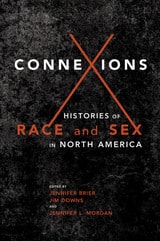
Connexions
Histories of Race and Sex in North AmericaEdited by Jennifer Brier, Jim Downs, and Jennifer L. Morgan
University of Illinois Press, 2016

Conquering Heroines
How Women Fought Sex Bias at Michigan and Paved the Way for Title IXSara Fitzgerald
University of Michigan Press, 2020
Galvanized by their shared experiences with sex discrimination, the Ann Arbor women organized a group called FOCUS on Equal Employment for Women, led by activist Jean Ledwith King. Working with Bernice Sandler of the Women’s Equity Action League, they developed a strategy to unleash the power of another powerful institution—the federal government—to demand change at U-M and, they hoped, across the world of higher education. Prompted by a complaint filed by FOCUS, the U.S. Department of Health, Education, and Welfare soon documented egregious examples of discrimination in Michigan’s practices toward women and threatened to withhold millions of dollars in contracts unless the school adopted remedies. Among the hundreds of similar complaints filed against U.S. colleges in 1970–1971, the one brought by the Michigan women achieved the breakthrough that provided the historic template for settlements with other institutions.
Drawing on oral histories from archives as well as new interviews with living participants, Conquering Heroines chronicles this pivotal period in the histories of the University of Michigan and the women’s movement. An incredible story of grassroots activism and courageous women, the book highlights the kind of relentless effort that has helped make inclusivity an ongoing goal at U-M.
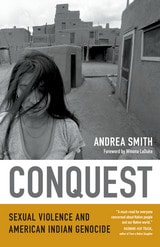
Conquest
Sexual Violence and American Indian GenocideAndrea Smith
Duke University Press, 2005
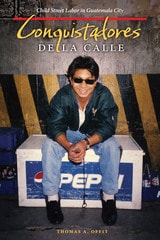
Conquistadores de la Calle
Child Street Labor in Guatemala CityBy Thomas A. Offit
University of Texas Press, 2008
The first comprehensive, book-length study of its kind, Conquistadores de la Calle presents the findings of nearly two years of ethnographic research on the streets of Guatemala City, toppling conventional wisdom that the region's youth workers are solely victims, or that their labor situations are entirely the result of poverty and family breakdown.
Documenting the voices and experiences of the city's working children, this fascinating study reveals counterintuitive motivations for those who choose to abandon schooling in favor of participating more fully in their families' economies. The processes of developing skills and planning for their social and economic futures are covered in depth, presenting evidence that many members of this population operate well above survival level and are decidedly not marginalized or members of an underclass. Conquistadores de la Calle also makes important distinctions between these young workers—a generation of Maya and Ladino boys and girls—and the homeless children or gang youth who have been so much more widely studied.
Contextualizing a variety of data, ranging from detailed ethnographic portraits of the children's lives and the monthly income of children engaged in common street vocations (such as shining shoes or serving as porters) to educational histories and socialization activities, Thomas Offit has produced a rich trove of findings in a significant segment of urban economics that is tremendously important for anthropologists, Latin Americanists, and those interested in the lives and labors of children in the cities of the developing world.
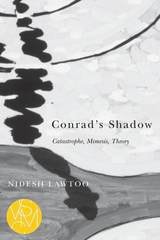
Conrad's Shadow
Catastrophe, Mimesis, TheoryNidesh Lawtoo
Michigan State University Press, 2016
Consequences of Growing Up Poor
Greg J. Duncan
Russell Sage Foundation, 1997
Conservation Biology and Applied Zooarchaeology
Edited by Steve Wolverton and R. Lee Lyman
University of Arizona Press, 2012
The case studies, which utilize palaeozoological data, cover a variety of animals and environments, including the marine ecology of shellfish and fish, potential restoration sites for Sandhill Cranes, freshwater mussel biogeography and stream ecology, conservation of terrestrial mammals such as American black bears, and even a consideration of the validity of the Pleistocene “rewilding” movement. The volume closes with an important new essay on the history, value, and application of applied zooarchaeology by R. Lee Lyman, which updates his classic 1996 paper that encouraged zooarchaeologists to apply their findings to present-day environmental challenges.
Each case study provides detailed analysis using the approaches of zooarchaeology and concludes with precise implications for conservation biology. Essays also address issues of political and social ecology, which have frequently been missing from the discussions of conservation scientists. As the editors note, all conservation actions occur in economic, social, and political contexts. Until now, however, the management implications of zooarchaeological research have rarely been spelled out so clearly.

Conservation Is Our Government Now
The Politics of Ecology in Papua New GuineaPaige West
Duke University Press, 2006
West reveals how every aspect of the Crater Mountain Wildlife Management Area—including ideas of space, place, environment, and society—was socially produced, created by changing configurations of ideas, actions, and material relations not only in Papua New Guinea but also in other locations around the world. Complicating many of the assumptions about nature, culture, and development underlying contemporary conservation efforts, Conservation Is Our Government Now demonstrates the unique capacity of ethnography to illuminate the relationship between the global and the local, between transnational processes and individual lives.
Conservation is not Enough
Rethinking Relationships with Water in the Arid SouthwestJanine Schipper
University of Wyoming Press, 2025
Using an exploratory and qualitative approach, the book draws on more than ninety-five interviews conducted over three years, revealing the complex relationships people have with water in the Southwest, and prominently features the voices of participants, effectively illustrating multiple perspectives and diverse ways of thinking about and relating to water. Schipper highlights various perspectives—including a water manager making conservation decisions, a Hopi elder emphasizing our connection to the water cycle, and a ski instructor reflecting on human-made snow—and interweaves personal experiences and reflections on her own relationship with water and conservation efforts.
Conservation Is Not Enough encourages readers to reflect on their personal connections to water and consider new possibilities, and it also urges readers to think beyond conventional conservation approaches. This book helps to transform the collective approach to water and cultivate fresh ways of engaging with and relating to water and is of great interest to scholars, students, and residents concerned with water issues in the Colorado River Basin.
Conservation of Natural and Cultural Heritage in Kenya
Edited by Anne-Marie Deisser and Mugwima Njuguna
University College London, 2016
Conservative Innovators
How States Are Challenging Federal PowerBen Merriman
University of Chicago Press, 2019
Conservative Innovators traces the activity of far-right conservatives in Kansas who have in the past decade used the powers of state-level offices to fight federal regulation on a range of topics from gun control to voting processes to Medicaid. Telling their story, Ben Merriman then expands the scope of the book to look at the tactics used by conservative state governments across the country to resist federal regulations, including coordinated lawsuits by state attorneys general, refusals to accept federal funds and spending mandates, and the creation of programs designed to restrict voting rights. Through this combination of state-initiated lawsuits and new administrative practices, these state officials weakened or halted major parts of the Obama Administration’s healthcare, environmental protection, and immigration agendas and eroded federal voting rights protections. Conservative Innovators argues that American federalism is entering a new, conflict-ridden era that will make state governments more important in American life than they have been at any time in the past century.
Considering Emma Goldman
Feminist Political Ambivalence and the Imaginative ArchiveClare Hemmings
Duke University Press, 2018
Considering Watchmen
Poetics, Property, Politics: New edition with full color illustrationsHoberek, Andrew
Rutgers University Press, 2017
Demonstrating a keen eye for historical detail, Considering Watchmen gives readers a new appreciation of just how radical Moore and Gibbons’s blend of gritty realism and formal experimentation was back in 1986. The book also considers Watchmen’s place in the history of the comics industry, reading the graphic novel’s playful critique of superhero marketing alongside Alan Moore’s public statements about the rights to the franchise. Andrew Hoberek examines how Moore and Gibbons engaged with the emerging discourses of neoconservatism and neoliberal capitalism, ideologies that have only become more prominent in subsequent years.
Watchmen’s influences on the superhero comic and graphic novel are undeniable, but Hoberek reveals how it has also had profound effects on literature as a whole. He suggests that Watchmen not only proved that superhero comics could rise to the status of literature—it also helped to inspire a generation of writers who are redefining the boundaries of the literary, from Jonathan Lethem to Junot Díaz. Hoberek delivers insight and analysis worthy of satisfying serious readers of the genre while shedding new light on Watchmen as both an artistic accomplishment and a book of ideas.
Consolations of Humor and Other Folklore Essays
Elliott Oring
Utah State University Press, 2023
While recognizing the study of jokes and other forms of folklore as a humanistic endeavor, Oring believes in the relevance of a scientific perspective to the enterprise. He values clear definitions, tests of hypotheses and theories, empirical evidence, experiment, and the search for laws. Written in a sophisticated yet accessible style, The Consolations of Humor and Other Folklore Essays stimulates both scholars and students alike and contributes to the creation of a more robust folkloristics in the twenty-first century.
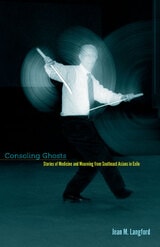
Consoling Ghosts
Stories of Medicine and Mourning from Southeast Asians in ExileJean M. Langford
University of Minnesota Press, 2013
In conversation with emigrants from Laos and Cambodia, Jean M. Langford repeatedly met with spirits: the wandering souls of the seriously ill, dangerous ghosts of those who died by violence, restless ancestors displaced from their homes. For these emigrants, the dead not only appear in memories, safely ensconced in the past, but also erupt with a physical force into the daily life and dreams of the present.
Inspired by these conversations, Consoling Ghosts is a sustained contemplation of relationships with the dying and the dead. At their heart, as Langford’s work reveals, emigrants’ stories are parables not of cultural difference but rather of life and death. Langford inquires how and why spirits become implicated in remembering and responding to violence, whether the bloody violence of war or the more structural violence of social marginalization and poverty. What is at stake, she asks, when spirits break out of their usual confinement as symbolic figures for history, heritage, or trauma to haunt the corridors of hospitals and funeral homes? Emigrants’ theories and stories of ghosts, Langford suggests, inherently question the metaphorical status of spirits, in the process challenging both contemporary bioethics of dying and dominant styles of mourning. Consoling Ghosts explores the possibilities opened up by a more literal existence of ghosts, from the confrontation of shades of past violence through bodily ritual to rites of mourning that unfold in acts of material care for the dead instead of memorialization.
Ultimately the book invites us to consider alternate ways of facing death, conducting relationships with the dead and dying, and addressing the effects of violence that continue to reverberate in bodies and social worlds.
Conspiracies of Conspiracies
How Delusions Have Overrun AmericaThomas Milan Konda
University of Chicago Press, 2019
In this sweeping book, Thomas Milan Konda traces the country’s obsession with conspiratorial thought from the early days of the republic to our own anxious moment. Conspiracies of Conspiracies details centuries of sinister speculations—from antisemitism and anti-Catholicism to UFOs and reptilian humanoids—and their often incendiary outcomes. Rather than simply rehashing the surface eccentricities of such theories, Konda draws from his unprecedented assemblage of conspiratorial writing to crack open the mindsets that lead people toward these self-sealing worlds of denial. What is distinctively American about these theories, he argues, is not simply our country’s homegrown obsession with them but their ongoing prevalence and virulence. Konda proves that conspiracy theories are no harmless sideshow. They are instead the dark and secret heart of American political history—one that is poisoning the bloodstream of an increasingly sick body politic.
Conspiracy Narratives from Postcolonial Africa
Freemasonry, Homosexuality, and Illicit EnrichmentRogers Orock and Peter Geschiere
University of Chicago Press, 2024
In this book, anthropologists Rogers Orock and Peter Geschiere examine the moral panic over a perceived rise in homosexuality that engulfed Cameroon and Gabon beginning in the early twenty-first century. As they uncover the origins of the conspiratorial narratives that fed this obsession, they argue that the public’s fears were grounded in historically situated assumptions about the entanglement of same-sex practices, Freemasonry, and illicit enrichment.
This specific panic in postcolonial Central Africa fixated on high-ranking Masonic figures thought to lure younger men into sex in exchange for professional advancement. The authors’ thorough account shows how attacks on elites as homosexual predators corrupting the nation became a powerful outlet for mounting populist anger against the excesses and corruption of the national regimes. Unraveling these tensions, Orock and Geschiere present a genealogy of Freemasonry, taking readers from London through Paris to francophone Africa and revealing along the way how the colonial past shapes present-day anxieties linking same-sex practices to enrichment.

Conspiracy Theories and the Failure of Intellectual Critique
Kurtis Hagen
University of Michigan Press, 2022
Conspiracy Theories and the Failure of Intellectual Critique argues that conspiracy theories, including those that conflict with official accounts and suggest that prominent people in Western democracies have engaged in appalling behavior, should be taken seriously and judged on their merits and problems on a case-by-case basis. It builds on the philosophical work on this topic that has developed over the past quarter century, challenging some of it, but affirming the emerging consensus: each conspiracy theory ought to be judged on its particular merits and faults.
The philosophical consensus contrasts starkly with what one finds in the social science literature. Kurtis Hagen argues that significant aspects of that literature, especially the psychological study of conspiracy theorists, has turned out to be flawed and misleading. Those flaws are not randomly directed; rather, they consistently serve to disparage conspiracy theorists unfairly. This suggests that there may be a bias against conspiracy theorists in the academy, skewing “scientific” results. Conspiracy Theories and the Failure of Intellectual Critique argues that social scientists who study conspiracy theories and/or conspiracy theorists would do well to better absorb the implications of the philosophical literature.
Conspiracy/Theory
Joseph Masco and Lisa Wedeen, editors
Duke University Press, 2024
Contributors. Nadia Abu El-Haj, Hussein Ali Agrama, Kathleen Belew, Elizabeth Anne Davis, Joseph Dumit, Faith Hillis, Lochlann Jain, Demetra Kasimis, Susan Lepselter, Darryl Li, Louisa Lombard, Joseph Masco, Robert Meister, Timothy Melley, Rosalind C. Morris, George Shulman, Lisa Wedeen
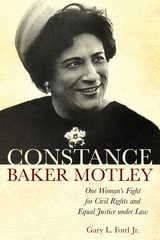
Constance Baker Motley
One Woman's Fight for Civil Rights and Equal Justice under LawGary L. Ford Jr.
University of Alabama Press, 2017
The story of NAACP’s sole female attorney. She shaped civil rights history as lead strategist and litigator from 1946–1964, arguing landmark desegregation cases and defending Martin Luther King Jr. and countless freedom fighters.
Constance Baker Motley was an African American woman; the daughter of immigrants from Nevis, British West Indies; a wife; and a mother who became a pioneer and trailblazer in the legal profession. She broke down barriers, overcame gender constraints, and operated outside the boundaries placed on black women by society and the civil rights movement. In Constance Baker Motley: One Woman’s Fight for Civil Rights and Equal Justice under Law, Gary L. Ford Jr. explores the key role Motley played in the legal fight to desegregate public schools as well as colleges, universities, housing, transportation, lunch counters, museums, libraries, parks, and other public accommodations.
The only female attorney at the NAACP Legal Defense and Educational Fund, Inc., Motley was also the only woman who argued desegregation cases in court during much of the civil rights movement. From 1946 through 1964, she was a key litigator and legal strategist for landmark civil rights cases including the Montgomery Bus Boycott and represented Martin Luther King Jr. as well as other protesters arrested and jailed as a result of their participation in sit-ins, marches, and freedom rides.
Motley was a leader who exhibited a leadership style that reflected her personality traits, skills, and strengths. She was a visionary who formed alliances and inspired local counsel to work with her to achieve the goals of the civil rights movement. As a leader and agent of change, she was committed to the cause of justice and she performed important work in the trenches in the South and behind the scene in courts that helped make the civil rights movement successful.
"Highly recommended."
—CHOICE
Constellating Home
Trans and Queer Asian American RhetoricsV. Jo Hsu
The Ohio State University Press, 2022
Winner of the 2024 Winifred Bryan Horner Outstanding Book Award
Winner of the 2023 NCA Diamond Anniversary Book Award
Winner of the Innovations in Community Writing Book Award from the Conference on Community Writing
Constellating Home: Trans and Queer Asian American Rhetorics explores how race, migration, gender, and disability entwine in conceptions of deserving citizens. V. Jo Hsu explores three archives of trans and queer Asian American (QTAPI) rhetorics, considering a range of texts including oral histories, photography, personal essays, and performance showcases. To demonstrate how QTAPI use personal narrative to critique and revise the conditions of their exclusion, Hsu forwards a critical approach to storytelling, homing, which deliberately engages sites of alienation and belonging. Through a practice of diasporic listening, Hsu tracks confluences among seemingly divergent journeys and locates trans and queer Asian American experiences within broader US and global politics.
The stories at the heart of Constellating Home center the voices of trans and nonbinary people, disabled people, and others often overlooked in conceptions of US citizenry. Hsu’s analyses demonstrate the inextricability of Asian American activism from queer politics, disability activism, and racial justice, and they consider how stories network individual experiences with resonant histories and struggles. Finding unlikely intimacies among individual and communal histories, Constellating Home provides tools for fostering mutual care, revealing harmful social patterns, and orienting shared values and politics.
Constellations of Inequality
Space, Race, and Utopia in BrazilSean T. Mitchell
University of Chicago Press, 2017
In 1982, the Brazilian Air Force arrived on the Alcântara peninsula to build a state-of-the-art satellite launch facility. They displaced some 1,500 Afro-Brazilians from coastal land to inadequate inland villages, leaving many more threatened with displacement. Completed in 1990, this vast undertaking in one of Brazil’s poorest regions has provoked decades of conflict and controversy.
Constellations of Inequality tells this story of technological aspiration and the stark dynamics of inequality it laid bare. Sean T. Mitchell analyzes conflicts over land, ethnoracial identity, mobilization among descendants of escaped slaves, military-civilian competition in the launch program, and international intrigue. Throughout, he illuminates Brazil’s changing politics of inequality and examines how such inequality is made, reproduced, and challenged. How people conceptualize and act on the unequal conditions in which they find themselves, he shows, is as much a cultural and historical matter as a material one. Deftly broadening our understanding of race, technology, development, and political consciousness on local, national, and global levels, Constellations of Inequality paints a portrait of contemporary Brazil that will interest a broad spectrum of readers.
Constituting Central American–Americans
Transnational Identities and the Politics of DislocationCárdenas, Maritza E
Rutgers University Press, 2018
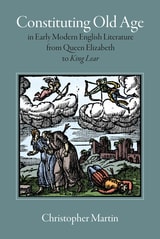
Constituting Old Age in Early Modern English Literature, from Queen Elizabeth to King Lear
Christopher Martin
University of Massachusetts Press, 2012
How did Shakespeare and his contemporaries, whose works mark the last quarter century of Elizabeth I's reign as one of the richest moments in all of English literature, regard and represent old age? Was late life seen primarily as a time of withdrawal and preparation for death, as scholars and historians have traditionally maintained? In this book, Christopher Martin examines how, contrary to received impressions, writers and thinkers of the era—working in the shadow of the kinetic, long-lived queen herself—contested such prejudicial and dismissive social attitudes.
In late Tudor England, Martin argues, competing definitions of and regard for old age established a deeply conflicted frontier between external, socially “constituted” beliefs and a developing sense of an individual's “constitution” or physical makeup, a usage that entered the language in the mid-1500s. This space was further complicated by internal divisions within the opposing camps. On one side, reverence for the elder's authority, rooted in religious and social convention, was persistently challenged by the discontents of an ambitious younger underclass. Simultaneously, the aging subject grounded an enduring social presence and dignity on a bodily integrity that time inevitably threatened. In a historical setting that saw both the extended reign of an aging monarch and a resulting climate of acute generational strife, this network of competition and accommodation uniquely shaped late Elizabethan literary imagination. Through fresh readings of signature works, genres, and figures, Martin redirects critical attention to this neglected aspect of early modern studies.
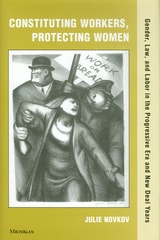
Constituting Workers, Protecting Women
Gender, Law and Labor in the Progressive Era and New Deal YearsJulie Novkov
University of Michigan Press, 2001
During the Progressive Era and New Deal, courts often invalidated generalized protective legislation, but frequently upheld measures that limited women's terms and conditions of labor. The book explores the reasoning in such cases that were decided between 1873 and 1937. By analyzing all reported opinion on the state and federal level, as well as materials from the women's movement and briefs filed in the U.S. Supreme Court, the study demonstrates that considerations of cases involving women's measures ultimately came to drive the development of doctrine.
The study combines historical institutionalism and feminism to address constitutional interpretation, showing that an analysis of conflict over the meaning of legal categories provides a deeper understanding of constitutional development. In doing so, it rejects purely political interpretations of the so-called Lochner era, in which the courts invalidated many legislative efforts to ameliorate the worst effects of capitalism. By addressing the dynamic interactions among interested laypersons, attorneys, and judges, it demonstrates that no individuals or institutions have complete control over the generation of constitutional meaning.
Julie Novkov is Assistant Professor of Political Science, University of Oregon

Constituting Workers, Protecting Women
Gender, Law and Labor in the Progressive Era and New Deal YearsJulie Novkov
University of Michigan Press, 0
During the Progressive Era and New Deal, courts often invalidated generalized protective legislation, but frequently upheld measures that limited women's terms and conditions of labor. The book explores the reasoning in such cases that were decided between 1873 and 1937. By analyzing all reported opinion on the state and federal level, as well as materials from the women's movement and briefs filed in the U.S. Supreme Court, the study demonstrates that considerations of cases involving women's measures ultimately came to drive the development of doctrine.
The study combines historical institutionalism and feminism to address constitutional interpretation, showing that an analysis of conflict over the meaning of legal categories provides a deeper understanding of constitutional development. In doing so, it rejects purely political interpretations of the so-called Lochner era, in which the courts invalidated many legislative efforts to ameliorate the worst effects of capitalism. By addressing the dynamic interactions among interested laypersons, attorneys, and judges, it demonstrates that no individuals or institutions have complete control over the generation of constitutional meaning.
Julie Novkov is Assistant Professor of Political Science, University of Oregon
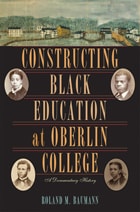
Constructing Black Education at Oberlin College
A Documentary HistoryRoland M. Baumann
Ohio University Press, 2010
In 1835 Oberlin became the first institute of higher education to make a cause of racial egalitarianism when it decided to educate students “irrespective of color.” Yet the visionary college’s implementation of this admissions policy was uneven. In Constructing Black Education at Oberlin College: A Documentary History, Roland M. Baumann presents a comprehensive documentary history of the education of African American students at Oberlin College.
Following the Reconstruction era, Oberlin College mirrored the rest of society as it reduced its commitment to black students by treating them as less than equals of their white counterparts. By the middle of the twentieth century, black and white student activists partially reclaimed the Oberlin legacy by refusing to be defined by race. Generations of Oberlin students, plus a minority of faculty and staff, rekindled the college’s commitment to racial equality by 1970. In time, black separatism in its many forms replaced the integrationist ethic on campus as African Americans sought to chart their own destiny and advance curricular change.
Oberlin’s is not a story of unbroken progress, but rather of irony, of contradictions and integrity, of myth and reality, and of imperfections. Baumann takes readers directly to the original sources by including thirty complete documents from the Oberlin College Archives. This richly illustrated volume is an important contribution to the college’s 175th anniversary celebration of its distinguished history, for it convincinglydocuments how Oberlin wrestled over the meaning of race and the destiny of black people in American society.
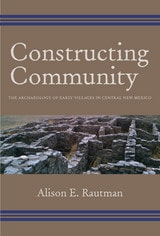
Constructing Community
The Archaeology of Early Villages in Central New MexicoAlison E. Rautman
University of Arizona Press, 2014
Rautman tackles a very broad topic: how archaeologists use material evidence to infer and imagine how people lived in the past, how they coped with everyday decisions and tensions, and how they created a sense of themselves and their place in the world. Using several different lines of evidence, she reconstructs what life was like for the Ancestral Pueblo people of Salinas, and identifies some of the specific strategies that they used to develop and sustain their villages over time.
Examining evidence of each site’s construction and developing spatial layout, Rautman traces changes in community organization across the architectural transitions from pithouses to jacal structures to unit pueblos, and finally to plaza-oriented pueblos. She finds that, in contrast to some other areas of the American Southwest, early villagers in Salinas repeatedly managed their built environment to emphasize the coherence and unity of the village as a whole. In this way, she argues, people in early farming villages across the Salinas region actively constructed and sustained a sense of social community.
Constructing Culture and Power in Latin America
Daniel H. Levine, Editor
University of Michigan Press, 1993
Constructing Disability after the Great War
Blind Veterans in the Progressive EraEvan P. Sullivan
University of Illinois Press, 2024
Constructing Identities in Mexican-American Political Organizations
Choosing Issues, Taking SidesBy Benjamin Márquez
University of Texas Press, 2003
A Choice Outstanding Academic Book, 2002
The formation of a group identity has always been a major preoccupation of Mexican American political organizations, whether they seek to assimilate into the dominant Anglo society or to remain separate from it. Yet organizations that sought to represent a broad cross section of the Mexican American population, such as LULAC and the American G.I. Forum, have dwindled in membership and influence, while newer, more targeted political organizations are prospering—clearly suggesting that successful political organizing requires more than shared ethnicity and the experience of discrimination.
This book sheds new light on the process of political identity formation through a study of the identity politics practiced by four major Mexican American political organizations—the Southwest Network for Environmental and Economic Justice, the Southwest Industrial Areas Foundation, the Texas Association of Mexican American Chambers of Commerce, and the Mexican American Women's National Association (now known as MANA—A National Latina Organization). Through interviews with activists in each organization and research into their records, Benjamin Marquez clarifies the racial, class-based, and cultural factors that have caused these organizations to create widely differing political identities. He likewise demonstrates why their specific goals resonate only with particular segments of the Mexican American community.
Constructing Identities over Time
“Bad Gypsies” and “Good Roma” in Russia and HungaryJekatyerina Dunajeva
Central European University Press, 2022
Jekatyerina Dunajeva explores how two dominant stereotypes—“bad Gypsies” and “good Roma”—took hold in formal and informal educational institutions in Russia and Hungary. She shows that over centuries “Gypsies” came to be associated with criminality, lack of education, and backwardness. The second notion, of proud, empowered, and educated “Roma,” is a more recent development.
By identifying five historical phases—pre-modern, early-modern, early and “ripe” communism, and neomodern nation-building—the book captures crucial legacies that deepen social divisions and normalize the constructed group images. The analysis of the state-managed Roma identity project in the brief korenizatsija program for the integration of non-Russian nationalities into the Soviet civil service in the 1920s is particularly revealing, while the critique of contemporary endeavors is a valuable resource for policy makers and civic activists alike.
The top-down view is complemented with the bottom-up attention to everyday Roma voices. Personal stories reveal how identities operate in daily life, as Dunajeva brings out hidden narratives and subaltern discourse. Her handling of fieldwork and self-reflexivity is a model of sensitive research with vulnerable groups.
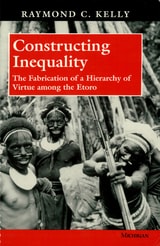
Constructing Inequality
The Fabrication of a Hierarchy of Virtue among the EtoroRaymond C. Kelly
University of Michigan Press, 1993
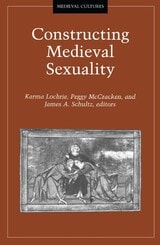
Constructing Medieval Sexuality
Karma Lochrie
University of Minnesota Press, 1997
A groundbreaking examination of sexuality in the Middle Ages.
This collection is the first to be devoted entirely to medieval sexuality informed by current theories of sexuality and gender. It brings together essays from various disciplinary perspectives-literary, theological, philosophical, medical, historical, and art historical-to consider how the Middle Ages defined, regulated, and represented sexual practices and desires.
Always considering sexuality in relation to gender, the body, and identity, the essays explore medieval sexuality as a historical construction produced by and embedded in the cultures and institutions of that period. Examining a range of medieval texts and images, the contributors explore the medieval understanding of sodomy, the historical construction of heterosexuality, the polymorphous erotics of female mysticism, and the intersections of sexuality with race, gender, and religion. This work not only offers new perspectives on the ways in which queer theory might inform our views of sexuality in medieval Europe, but also suggests that medieval constructions of sexuality may offer important contributions to both queer theory and the history of sexuality.These essays, situated in the context of current debates, linger over various definitions of medieval sexuality; they speak to each other in their differences and their similarities to further productive thinking about the sometimes conflicting and always fascinating ways in which the Middle Ages regarded sex and sexuality. Contributors: E. Jane Burns, U of North Carolina; Joan Cadden, U of California, Davis; Michael Camille, U of Chicago; Dyan Elliott, Indiana U; Louise O. Fradenburg, U of California, Santa Barbara; Mark D. Jordan, U of Notre Dame; Steven F. Kruger, CUNY.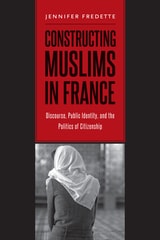
Constructing Muslims in France
Discourse, Public Identity, and the Politics of CitizenshipJennifer Fredette
Temple University Press, 2014
Constructing National Interests
The United States and the Cuban Missile CrisisJutta Weldes
University of Minnesota Press, 1999
Not simply an “event” or merely an “incident,” the 1962 standoff between the U. S. and the Soviet Union over missiles in Cuba was a crisis, which subsequently has achieved almost mythic significance in the annals of United States foreign policy. Jutta Weldes asks why this occurrence in particular should be cast as a crisis, and how this so significantly affected “the national interest.” Here, Weldes analyzes the so-called Cuban missile crisis as a means to rethink the idea of national interest, a notion central to both the study and practice of international relations.
Why did the presence of Soviet missiles in Cuba constitute a crisis for U.S. state officials and thus a dire threat to U.S. national interests? It was, Weldes suggests, more a matter of discursive construction than of objective facts or circumstances. Drawing on social theory and on concepts from cultural studies, she exposes the “realities” of the crisis as social creations in the service of a particular and precarious U.S. state identity defined within the Cold War U.S. “security imaginary.”
Constructing National Interests shows how this process allowed for a redefining of the identities, interests, and likely actions of various states, so that it seemed to logically serve the U.S. national interest in removing the missiles from Cuba.
Constructing Nationhood in Modern East Asia
Kai-wing Chow, Kevin M. Doak, and Poshek Fu, Editors
University of Michigan Press, 2001
This is an interdisciplinary study of the cultural politics of nationalism and national identities in modern East Asia. Combining theoretical insights with empirical research, it explores the cultural dimensions of nationhood and identity-making in China, Japan, Korea, Hong Kong, and Taiwan. The essays address issues ranging from the complex relations between popular culture and national consciousness to the representation of ethnic/racial identity and gendered discourse on nationalism. The cutting-edge research on the diverse forms of cultural preacceptance and the various ways in which this participates in the construction and projection of national and ethnic identities in East Asia illuminates several understudied issues in Asian studies, including the ambiguity of Hong Kong identity during World War II and the intricate politics of the post-war Taiwanese trial of collaboration.
Addressing a wide range of theoretical and historical issues regarding cultural dimensions of nationalism and national identities all over East Asia, these essays draw insights from such recent theories as cultural studies, postcolonial theories, and archival-researched cultural anthropology. The book will be important reading for students of Asian studies as well as for serious readers interested in issues of nationalism and culture.
Kai-wing Chow is Associate Professor of East Asian Languages and Cultures. Kevin Doak is Associate Professor of History. Poshek Fu is Associate Professor of History and Cinema Studies. All three teach at University of Illinois, Urbana-Champaign.
Constructing Social Theories
Arthur L. Stinchcombe
University of Chicago Press, 1987
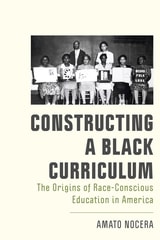
Constructing a Black Curriculum
The Origins of Race-Conscious Education in AmericaAmato Nocera
Rutgers University Press, 2027
Constructing a Black Curriculum reframes how we understand Black Americans’ intellectual and political engagement with education during the first half of the twentieth century. It traces the powerful, diffuse movement created by Black Americans to build what Nocera calls a “Black Curriculum:" a communal effort to represent Black identity, guide racial consciousness, and rebut claims of inferiority. This curriculum first developed as a public educational project in Black learned societies and during the Harlem Renaissance before making its way into schools. The struggle for a Black curriculum was not only a fight against white supremacy, but also an internal debate among Black advocates over the very nature of how race should be represented and taught. This book illuminates this struggle through the work of Black intellectuals (Alexander Crummell, Carter G. Woodson, Hubert Harrison, and Alain Locke) and the intellectual contributions of African American educators (Nannie Burroughs, Jane Dabney Shackelford, and Julia Davis). This essential history provides vital context for contemporary debates over curriculum reform, racial knowledge, and the enduring quest for educational equity.

Constructing and Deconstructing Power in Psalms 107-150
W. Dennis Tucker Jr.
SBL Press, 2014
Essential research on the relationship between the Persian empire and the the formation of the book of Psalms
In this latest entry in the Ancient Israel and Its Literature series, W. Dennis Tucker, Jr. examines the role of Persian imperial ideology in the creation of psalms in Book 5 of the Psalter and in the shaping of the book of Psalms as a whole. Although much research has been conducted on the relationship between the Persian empire and the creation of biblical texts, the book of Psalms has been largely absent from this discussion. Tucker seeks to rectify this omission by illustrating that Book 5 constructed a subtle anti-imperial ideology in response to the threats imposed from all empires both past and present.
Features:
- Close study of the psalms portrayal of human power to that of Yahweh
- Comparison of Achaemenid propaganda to the ideology found in the psalms
- Evidence drawn from Persian iconography and inscriptions
Constructing the Black Masculine
Identity and Ideality in African American Men’s Literature and Culture, 1775–1995Maurice O. Wallace
Duke University Press, 2002
Highlighting their chronic objectification under the gaze of white eyes, Wallace argues that black men suffer a social and representational crisis in being at once seen and unseen, fetish and phantasm, spectacle and shadow in the American racial imagination. Invisible and disregarded on one hand, black men, perceived as potential threats to society, simultaneously face the reality of hypervisibility and perpetual surveillance. Paying significant attention to the sociotechnologies of vision and image production over two centuries, Wallace shows how African American men—as soldiers, Freemasons, and romantic heroes—have sought both to realize the ideal image of the American masculine subject and to deconstruct it in expressive mediums like modern dance, photography, and theatre. Throughout, he draws on the experiences and theories of such notable figures as Frederick Douglass, W. E. B. Du Bois, Booker T. Washington, and James Baldwin.
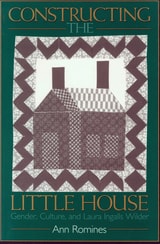
Constructing the Little House
Gender, Culture, and Laura Ingalls WilderAnn Romines
University of Massachusetts Press, 1997
Ann Romines interweaves personal observation with scholarly analysis to address these questions. Writing from a feminist perspective and drawing on resources of gender studies, cultural studies, and new historicist reading, she examines both the content of the novels and the process of their creation. She explores the relationship between mother and daughter working as collaborative authors and calls into question our assumptions about plot, juvenile fiction, and constructions of gender on the nineteenth-century frontier and in the Depression years when the Little House books were written.
This is a book that will appeal both to scholars and to general readers who might welcome an engaging and accessible companion volume to the Little House novels.
Constructing the Maya
Ethnicity, State Formation, and Material Culture in Yucatán, Chiapas, and Guatemala, Volume 55Paul K. Eiss, special issue editor
Duke University Press, 0
Contributors: David Carey Jr., Paul K. Eiss, Ben Fallaw, Stephen E. Lewis, Walter E. Little, John M. Watanabe
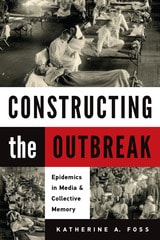
Constructing the Outbreak
Epidemics in Media and Collective MemoryKatherine A. Foss
University of Massachusetts Press, 2020
Constructing the Outbreak demonstrates how news reporting on epidemics communicates more than just information about pathogens; rather, prejudices, political agendas, religious beliefs, and theories of disease also shape the message. Analyzing seven epidemics spanning more than two hundred years—from Boston's smallpox epidemic and Philadelphia's yellow fever epidemic in the eighteenth century to outbreaks of diphtheria, influenza, and typhoid in the early twentieth century—Katherine A. Foss discusses how shifts in journalism and medicine influenced the coverage, preservation, and fictionalization of different disease outbreaks. Each case study highlights facets of this interplay, delving into topics such as colonization, tourism, war, and politics. Through this investigation into what has been preserved and forgotten in the collective memory of disease, Foss sheds light on current health care debates, like vaccine hesitancy.
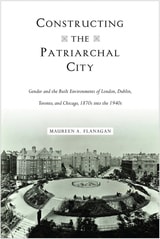
Constructing the Patriarchal City
Gender and the Built Environments of London, Dublin, Toronto, and Chicago, 1870s into the 1940sMaureen A. Flanagan
Temple University Press, 2018
In the Anglo-Atlantic world of the late nineteenth century, groups of urban residents struggled to reconstruct their cities in the wake of industrialization and to create the modern city. New professional men wanted an orderly city that functioned for economic development. Women’s vision challenged the men’s right to reconstruct the city and resisted the prevailing male idea that women in public caused the city’s disorder.
Constructing the Patriarchal City compares the ideas and activities of men and women in four English-speaking cities that shared similar ideological, professional, and political contexts. Historian Maureen Flanagan investigates how ideas about gender shaped the patriarchal city as men used their expertise in architecture, engineering, and planning to fashion a built environment for male economic enterprise and to confine women in the private home. Women consistently challenged men to produce a more equitable social infrastructure that included housing that would keep people inside the city, public toilets for women as well as men, housing for single, working women, and public spaces that were open and safe for all residents.
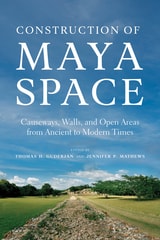
Construction of Maya Space
Causeways, Walls, and Open Areas from Ancient to Modern TimesThomas H. Guderjan
University of Arizona Press, 2023
Through fifteen engaging chapters, contributors examine the construction of spatial features by ancient, historic, and contemporary Maya elite and nonelite peoples to understand how they used spaces differently. Through cutting-edge methodologies and case studies, chapters consider how and why Maya people connected and divided the spaces they used daily in their homes, in their public centers, in their sacred places such as caves, and across their regions to inform us about the mental constructs they used to create their lives and cultures of the past.
Contributors
Elias Alcocer Puerto
Alejandra Alonso Olvera
Traci Ardren
Jaime J. Awe
Alejandra Badillo Sánchez
Nicolas C. Barth
Grace Lloyd Bascopé
Adolpho Iván Batún-Alpuche
Elizabeth Beckner
M. Kathryn Brown
Bernadette Cap
Miguel Covarrubias Reyna
Juan Fernandez Diaz
Alberto G. Flores Colin
Thomas H. Guderjan
C. Colleen Hanratty
Héctor Hernández Álvarez
Scott R. Hutson
Joshua J. Kwoka
Whitney Lytle
Aline Magnoni
Jennifer P. Mathews
Stephanie J. Miller
Shawn G. Morton
Holley Moyes
Shannon Plank
Dominique Rissolo
Patrick Rohrer
Carmen Rojas Sandoval
Justine M. Shaw
J. Gregory Smith
Travis W. Stanton
Karl A. Taube
Daniel Vallejo-Cáliz
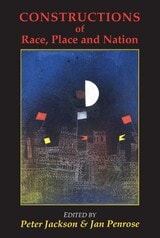
Constructions of Race, Place, and Nation
Peter Jackson
University of Minnesota Press, 1993
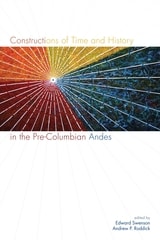
Constructions of Time and History in the Pre-Columbian Andes
Edward Swenson
University Press of Colorado, 2018
Constructions of Time and History in the Pre-Columbian Andes explores archaeological approaches to temporalities, social memory, and constructions of history in the pre-Columbian Andes. The authors examine a range of indigenous temporal experiences and ideologies, including astronomical, cyclical, generational, eschatological, and mythical time.
This nuanced, interdisciplinary volume challenges outmoded anthropological theories while building on an emic perspective to gain greater understanding of pre-Columbian Andean cultures. Contributors to the volume rethink the dichotomy of past and present by understanding history as indigenous Andeans perceived it—recognizing the past as a palpable and living presence. We live in history, not apart from it. Within this framework time can be understood as a current rather than as distinct points, moments, periods, or horizons.
The Andes offer a rich context by which to evaluate recent philosophical explorations of space and time. Using the varied materializations and ritual emplacements of time in a diverse sampling of landscapes, Constructions of Time and History in the Pre-Columbian Andes serves as a critique of archaeology’s continued and exclusive dependence on linear chronologies that obscure historically specific temporal practices and beliefs.
Contributors: Tamara L. Bray, Zachary J. Chase, María José Culquichicón-Venegas, Terence D’Altroy, Giles Spence Morrow, Matthew Sayre, Francisco Seoane, Darryl Wilkinson
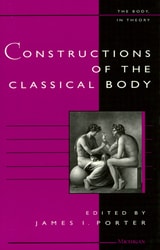
Constructions of the Classical Body
James I. Porter, Editor
University of Michigan Press, 2002
Classical scholarship has traditionally neglected the prominence of the body in antiquity. Constructions of the Classical Body theorizes that the study of antiquity is necessarily a study of the body, and that attention to this fact can lead to a much-needed shift in the way in which classical studies are approached today. This volume aims to reestablish the relevance of the problem of the body at the perimeters of several different kinds of inquiry, and, in this way, to help open up a field of possibilities for future study. The range covered by the essays in this volume is sweeping: from Corinthian vaseware to Athenian and Roman politics, poetry from Homer to Ovid, medical writers from the Hippocratic corpus to the diary of Aelius Aristides (second century c.e.), philosophy (Seneca, Porphyry), the Greek novel, Christian apocrypha, Ovid's medieval reception, and twentieth century film. This range is a consequence of the multidisciplinarity that any study of the body requires, and it attests to the particular richness of the body in classical antiquity and as an object for study today. The volume illustrates that body is located between traditional borders, not within them; the body dissolves traditional objects of study and joins areas usually kept apart. Retracing the fate of the body is thus a way of rendering antiquity truly strange again -- it allows us to see the past afresh, with open eyes. This volume includes essays by Carlin A. Barton, Anne Carson, Eric Downing, Catherine Edwards, Maud W. Gleason, John Henderson, Ralph Hexter, S. C. Humphreys, Helen King, Leslie Kurke, Robert Lamberton, David S. Potter, Amy Richlin, Giulia Sissa, Maria Wyke, and Froma I. Zeitlin, along with an introduction by James I. Porter. ". . . a superb collection, one that I know will be most welcome not only in the field of classical studies, but in the libraries of all those interested in the history and historicity of the body." --Page duBois, University of California, San Diego