Results by title
28167 books match the query 'History' and 1913 start with c

Command on Trial
Japanese Officers, War Crimes, and Command ResponsibilityPaul Taucher
Hong Kong University Press, 2026
An examination of how the legal doctrine of command responsibility was applied during military tribunals for Japanese war criminals, often inconsistently and ineffectively.
Between 1945 and 1951, the Allied powers prosecuted over 5,700 suspected Japanese war criminals across the Asia-Pacific region before one international and many national tribunals using a new legal doctrine known as command responsibility. Command responsibility holds officers criminally liable for the crimes of their subordinates even if they did not order the crimes to occur. Allied authorities believed that the structure of the Japanese military had allowed the crimes to occur and that pursuing guilt for war crimes should extend beyond enlisted soldiers who were the direct perpetrators of war crimes to those who had been in a position of command.
Command on Trial shows that the application of command responsibility in the courtroom was highly unstable and open to manipulation, especially in the trials of lower-ranking officers, resulting in outcomes that were legally, morally, and philosophically inconsistent. A clear illustration of the pitfalls of command responsibility, this book shows that the trials—and command responsibility—did not achieve comprehensive justice and left unanswered the question of who was actually responsible for many of the war crimes that were perpetrated.
Commemorating Defeat
Viral Monuments and the International Cult of the Lost Cause, 1864–1914Nicholas Parkinson
Central European University Press, 2026
Commemorating Hell
The Public Memory of Mittelbau-DoraGretchen Schafft and Gerhard Zeidler
University of Illinois Press, 2011
Prisoners at Mittelbau-Dora built the V-1 and V-2 missiles, some of them coming into direct contact with Wernher von Braun and Arthur Rudolph, who later became leading engineers in the U.S. space program. Through the continuing story of Mittelbau-Dora, from its operation as a labor camp to its social construction as a monument, Schafft and Zeidler reflect an abiding interest in the memory and commemoration of notorious national events. In extending the analysis of Mittelbau-Dora into post-war and present-day Germany, Commemorating Hell uncovers the intricate relationship between the politics of memory and broader state and global politics, revealing insights about the camp's relationship to the American space pioneers and the fate of the nearby city of Nordhausen.
Commemorating and Forgetting
Challenges for the New South AfricaMartin J. Murray
University of Minnesota Press, 2013
When the past is painful, as riddled with violence and injustice as it is in postapartheid South Africa, remembrance presents a problem at once practical and ethical: how much of the past to preserve and recollect and how much to erase and forget if the new nation is to ever unify and move forward? The new South Africa’s confrontation of this dilemma is Martin J. Murray’s subject in Commemorating and Forgetting. More broadly, this book explores how collective memory works—how framing events, persons, and places worthy of recognition and honor entails a selective appropriation of the past, not a mastery of history.
How is the historical past made to appear in the present? In addressing these questions, Murray reveals how collective memory is stored and disseminated in architecture, statuary, monuments and memorials, literature, and art—“landscapes of remembrance” that selectively recall and even fabricate history in the service of nation-building. He examines such vehicles of memory in postapartheid South Africa and parses the stories they tell—stories by turn sanitized, distorted, embellished, and compressed. In this analysis, Commemorating and Forgetting marks a critical move toward recognizing how the legacies and impositions of white minority rule, far from being truly past, remain embedded in, intertwined with, and imprinted on the new nation’s here and now.

Commentaries on the Cantatas of Johann Sebastian Bach
A Selective GuideHans-Joachim Schulze. Translated by James A. Brokaw II
University of Illinois Press, 2024
The University of Illinois Press has paired the volume with a special web-based companion overseen by the translator and hosted by the Illinois Open Publishing Network. This online resource includes Brokaw’s translations of all 225 of Schulze’s essays alongside digital tools for searching, sorting, and bundling the commentaries according to date of composition, position within the liturgical church year sequence, and librettist.

Commentaries on the Psalms, Volume
St. Hilary of Poitiers
Catholic University of America Press, 2027

Commentary In American Life
edited by Murray Friedman
Temple University Press, 2005

Commentary and Ideology
Dante in the RenaissanceDeborah Parker
Duke University Press, 1993
Parker begins by tracing the criticism of Dante commentaries from the nineteenth century to the present and then examines the tradition of commentary from the Middle Ages to the Renaissance. She shows how the civic, institutional, and social commitments of commentators shaped their response to the Comedy, and how commentators tried to use the poem as an authoritative source for various kinds of social legitimation. Parker discusses how different commentators dealt with a deeply political section of the poem: the damnation of Brutus and Cassius.
The scope and importance of Commentary and Ideology will command the attention of a broad group of scholars, including Italian specialists on Dante, late medievalists, students and professionals in early modern European literature, bibliographers, critical theorists, historians of literary criticism and theory, and cultural and intellectual historians.

Commentary on Thucydides, Book 3
Rachel Bruzzone
University of Michigan Press, 2025
Commentary on Thucydides, Book 3 remedies this situation by offering detailed linguistic explanations and grammatical clarifications designed to appeal both to seasoned Classicists and to a broader group of non-specialist readers who may still be developing their Greek language skills. Starting with 428 BCE, Book 3 covers a critical period of the Peloponnesian War in which the conflict began to manifest its extraordinary violence and scale. The book contains influential and controversial discussions, including Thucydides’ own analysis of the nature of war and the ways that it teaches “lessons of violence” to individuals and states. Book 3 also features the famous Mytilenean Debate, an argument premised on the thesis that all international relations are, or should be, fundamentally amoral. Educated readers have always looked to Thucydides in turbulent times, and this commentary will open up his text to a wider audience.

Commentary on the Songs of Songs
Vittorio Rupert of Deutz
Catholic University of America Press, 2024

Commerce and Society in Sung China
Shiba Yoshinobu; Translated by Mark Elvin
University of Michigan Press, 1969

Commerce in Color
Race, Consumer Culture, and American Literature, 1893-1933James C. Davis
University of Michigan Press, 2010
Commerce in Color exploresthe juncture of consumer culture and race by examining advertising, literary texts, mass culture, and public events in the United States from 1893 to 1933. James C. Davis takes up a remarkable range of subjects—including the crucial role publishers Boni and Liveright played in the marketing of Harlem Renaissance literature, Henry James’s critique of materialism in The American Scene, and the commodification of racialized popular culture in James Weldon Johnson’s The Autobiography of anEx-Colored Man—as he argues that racial thinking was central to the emergence of U.S. consumerism and, conversely, that an emerging consumer culture was a key element in the development of racial thinking and the consolidation of racial identity in America. By urging a reassessment of the familiar rubrics of the “culture of consumption” and the “culture of segregation,” Dawson poses new and provocative questions about American culture and social history.
Both an influential literary study and an absorbing historical read, Commerce in Color proves that—in America—advertising, publicity, and the development of the modern economy cannot be understood apart from the question of race.
“A welcome addition to existing scholarship, Davis’s study of the intersection of racial thinking and the emergence of consumer culture makes connections very few scholars have considered.”
—James Smethurst, University of Massachusetts
James C. Davis is Assistant Professor of English at Brooklyn College.
Commerce with the Classics
Ancient Books and Renaissance ReadersAnthony Grafton
University of Michigan Press, 1997

Commercial Cinema
The History of the Advertising Film in the United StatesMartin L. Johnson
University of Illinois Press, 2026
An advertising film placed promotional content into movies presented as travelogues, educational shorts, industrial films, or scenes of daily life. Business and government, meanwhile, built systems to distribute the films to unsuspecting audiences in schools, churches, civic groups, and universities. Through experimentation, corporations honed sophisticated tools of persuasion that used moving images to influence the public. What they learned reshaped notions of storytelling, technology, and corporate communication while setting the stage for advertising’s symbiotic relationship with television.
Persuasive and expert, Commercial Cinema illuminates the changing fortunes and eventual fate of a film genre in disguise.

Commercial Visions
Science, Trade, and Visual Culture in the Dutch Golden AgeDániel Margócsy
University of Chicago Press, 2014
Margócsy introduces a number of natural historians, physicians, and curiosi in Amsterdam, London, St. Petersburg, and Paris who, in their efforts to boost their trade, developed modern taxonomy, invented color printing and anatomical preparation techniques, and contributed to philosophical debates on topics ranging from human anatomy to Newtonian optics. These scientific practitioners, including Frederik Ruysch and Albertus Seba, were out to do business: they produced and sold exotic curiosities, anatomical prints, preserved specimens, and atlases of natural history to customers all around the world. Margócsy reveals how their entrepreneurial rivalries transformed the scholarly world of the Republic of Letters into a competitive marketplace.
Margócsy’s highly readable and engaging book will be warmly welcomed by anyone interested in early modern science, global trade, art, and culture.
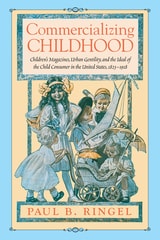
Commercializing Childhood
Children's Magazines, Urban Gentility, and the Ideal of the Child Consumer in the United States, 1823-1918Paul B. Ringel
University of Massachusetts Press, 2015
In this deeply researched and engaging book, Paul B. Ringel combines an analysis of the stories in nineteenth-century American children's magazines with the backstories of their authors, editors, and publishers to explain how this hugely successful industry trained generations of American children to become genteel consumers. Ringel demonstrates how these publications, which were read in hundreds of thousands of homes, played to two conflicting impulses within American families: to shield children from commercial influences by offering earnest and moral entertainment and to help children learn how to prosper in an increasingly market-driven society.

Commissioners and Commodores
The East India Squadron and American Diplomacy in ChinaCurtis T. Henson
University of Alabama Press, 1982
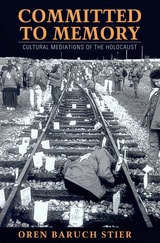
Committed to Memory
Cultural Mediations of the HolocaustOren Baruch Stier
University of Massachusetts Press, 2003
Stier discusses how these memorializations emerge, paying attention to the ways cultural memory is embodied individually, institutionally, and technologically. He defines and examines four modes of mediation: iconic, videotestimonial, museological, and ritual-ceremonial. In each context, he analyzes how Holocaust memory is inscribed, framed, displayed, and performed through a variety of media in a range of settings. Topics include the use of Holocaust-era railway cars, Art Spiegelman's Maus volumes, novels by Emily Prager, Martin Amis, and Elie Wiesel, and a CD-ROM that incorporates excerpts from Holocaust survivor testimonies. Institutions examined range from Washington's U.S. Holocaust Memorial Museum to Los Angeles's Museum of Tolerance, from Yale's Fortunoff Video Archive for Holocaust Testimonies to the Visual History Foundation created by Steven Spielberg, to the international teen pilgrimage that is the March of the Living.
In the end, Committed to Memory asks what role forgetting can and does play in the memorial landscape, demonstrating how critical attention to our memorial investments, and to the mechanics and media of memory's construction and transmission, can uncover what is both gained and lost in these commitments.

Commod Bods
Embodied Heritage, Foodways, and IndigeneityKasey Jernigan
University of Arizona Press, 2026
The term “commod bod” is used with humor and affection. It also offers a critical way to describe bodies shaped by long-term reliance on U.S. federal commodity food programs.
In Commod Bods, Kasey Jernigan shares her ongoing collaborative research with Choctaw women and describes the ways that shifting patterns of participation in food and nutrition assistance programs (commodity foods) have shaped foodways; how these foodways are linked to bodies and health, particularly “obesity” and related conditions; and how foodways and bodies are intertwined with settler colonialism and experiences of structural violence, identity making, and heritage in the Choctaw Nation of Oklahoma.
Organized thematically, the book moves from a critical history of obesity and health in Indian Country to narratives of Choctaw women navigating food, memory, and belonging. Chapters such as “Food and Fellowship” and “Heritage, Embodied” center personal stories that show how food is not only sustenance but also a site of connection, resistance, and meaning making.
Food is critical to cultural survival and affirmation. For Choctaw people, the intentional demise of traditional foodways and dependence on federal food programs are specific experiences that inform part of what it means to be Choctaw today.

Commodity & Propriety
Competing Visions of Property in American Legal Thought, 1776-1970Gregory S. Alexander
University of Chicago Press, 1997
In demonstrating how the understanding of property as a private basis for the public good has competed with the better-known market-oriented conception, Alexander radically rewrites the history of property, with significant implications for current political debates and recent Supreme Court decisions.
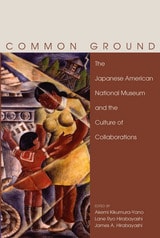
Common Ground
The Japanese American National Museum and the Culture of CollaborationsAkemi Kikumura-Yano
University Press of Colorado, 2005
Current scholarship in museum studies is generally limited to interpretations by scholars and curators. Common Ground brings descriptive data to the intellectual canon and illustrates how museum institutions must be transformed and recreated to suit the needs of the twenty-first century.
Common Knowledge (Inaugural issue marking return to publication), Volume 8
Jeffrey M. Perl, ed.
Duke University Press, 0
Described by the New York Times as one of two American journals in which public intellectuals and other scholars prefer to publish, the highly acclaimed Common Knowledge has returned to publication after a two-year hiatus. In an effort to place itself in the ferment of intellectual life and broaden its geographical range, the journal has moved to the Middle East, to Israel. Born in an attempt to moderate and get past the "culture wars" of the 90s, Common Knowledge has moved, literally, to a war zone, and accordingly its editorial interests have broadened to include culture wars of a less metaphorical kind.
Its mission is both incredibly ambitious and shockingly simple: to open up lines of communication between the academy and the community of thoughtful people outside its walls. Common Knowledge was created to form a new intellectual model, one based on conversation or cooperation rather than on metaphors adopted from sports and war, of "sides" that one must "take." The journal will collect work from a variety of fields and specialties, including philosophy, religion, psychology, literary criticism, cultural studies, art history, political science, and social, cultural, and intellectual history.
Scholars such as Richard Rorty, Bruno Latour, Clifford Geertz, Julia Kristeva, Karma Nabulsi, and J. G. A. Pocock will cross paths with political figures like Prince Hassan of Jordan and President Arpad Goncz of Hungary, novelists like Susan Sontag, poets like Yves Bonnefoy, composers like Alexander Goehr, and journalists like Adam Michnik. The pages of Common Knowledge are sure to challenge the ways we think about theory and its relevance to humanity. The first volume will feature the beginning of a Seriatim Symposium, “Disagreement, Enmity, and Dispute,” which will include discussions of the title concepts from a variety of theoretical perspectives. The Symposium asks why, in an intellectual context in which “true” and “real” are words that can be used only in condescending scare quotes, there is so much absolute conflict. If truth and reality are constructions, then why aren’t we constructing consensual orders (metaphysical and social) that are conducive to peace, calm, and cooperation?
Contributors for forthcoming issues include: Manfred Frank, Jacques Le Goff, Vicki Hearne, Sissela Bok, Edward Cardinal Cassidy, Linda Hutcheon, G. Thomas Tanselle, Arlette Farge, Marcel Detienne, Caryl Emerson, Stanley Katz, and Peter Laslett.
Common People
In Pursuit of My AncestorsAlison Light
University of Chicago Press, 2015
Most of us, however, give up a few generations back. We run into a gap, get embarrassed by a ne’er-do-well, or simply find our ancestors are less glamorous than we’d hoped. That didn’t stop Alison Light: in the last weeks of her father’s life, she embarked on an attempt to trace the history of her family as far back as she could reasonably go. The result is a clear-eyed, fascinating, frequently moving account of the lives of everyday people, of the tough decisions and hard work, the good luck and bad breaks, that chart the course of a life. Light’s forebears—servants, sailors, farm workers—were among the poorest, traveling the country looking for work; they left few lasting marks on the world. But through her painstaking work in archives, and her ability to make the people and struggles of the past come alive, Light reminds us that “every life, even glimpsed through the chinks of the census, has its surprises and secrets.”
What she did for the servants of Bloomsbury in her celebrated Mrs. Woolf and the Servants Light does here for her own ancestors, and, by extension, everyone’s: draws their experiences from the shadows of the past and helps us understand their lives, estranged from us by time yet inextricably interwoven with our own. Family history, in her hands, becomes a new kind of public history.

Common Prayer
The Language of Public Devotion in Early Modern EnglandRamie Targoff
University of Chicago Press, 2001
Through readings of William Shakespeare's Hamlet, Richard Hooker's Lawes of Ecclesiastical Politie, Philip Sidney's Apology for Poetry and his translations of the Psalms, John Donne's sermons and poems, and George Herbert's The Temple, Targoff uncovers the period's pervasive and often surprising interest in cultivating public and formalized models of worship. At the heart of this study lies an original and daring approach to understanding the origins of devotional poetry; Targoff shows how the projects of composing eloquent verse and improving liturgical worship come to be deeply intertwined. New literary practices, then, became a powerful means of forging common prayer, or controlling private and otherwise unmanageable expressions of faith.

Common Understandings, Poetic Confusion
Playhouses and Playgoers in Elizabethan EnglandWilliam N. West
University of Chicago Press, 2021
What if going to a play in Elizabethan England was more like attending a football match than a Broadway show—or playing in one? In Common Understandings, Poetic Confusion, William N. West proposes a new account of the kind of participatory entertainment expected by the actors and the audience during the careers of Shakespeare and his contemporaries. West finds surprising descriptions of these theatrical experiences in the figurative language of early modern players and playgoers—including understanding, confusion, occupation, eating, and fighting. Such words and ways of speaking are still in use today, but their earlier meanings, like that of theater itself, are subtly, importantly different from our own. Playing was not confined to the actors on the stage but filled the playhouse, embracing audiences and performers in collaborative experiences that did not belong to any one alone but to the assembled, various crowd. What emerged in playing was a kind of thinking and feeling distributed across persons and times that were otherwise distinct. Thrown apples, smashed bottles of beer, and lumbering bears—these and more gave verbal shape to the physical interactions between players and playgoers, creating circuits of exchange, production, and consumption.
Commonwealth of Compromise
Civil War Commemoration in MissouriAmy Laurel Fluker
University of Missouri Press, 2020
Acts of Civil War commemoration have long been controversial and were never undertaken for objective purposes, but instead served to transmit particular values to future generations. Understanding this process lends informative context to contemporary debates about Civil War memory.
Commonwealth of Toil
Chapters in the History of Massachusetts Workers and Their UnionsThomas Juravich
University of Massachusetts Press, 1996
Over the past two centuries, Massachusetts workers have fought for many important advances that would later be enjoyed by other Americans. The right to organize, restrictions on work hours and child labor, and workers' compensation were all pioneered in the Commonwealth. From the 1825 strike of Boston carpenters for a ten-hour day to recent victories in hospitals and universities, Massachusetts workers and their unions have been in the forefront of the battle for dignity and justice.
This book tells their story. In eighteen chapters, beginning with the first industrial workers in the nation—the Lowell “mill girls”—the authors describe the struggles of working men and women to improve their lives. In the process, the book provides a valuable perspective on the development of the American labor movement.

Communal Solidarity
Immigration, Settlement, and Social Welfare in Winnipeg's Jewish Community, 1882–1930Arthur Ross
University of Manitoba Press, 2019

Communicating the Infinite
The Emergence of the Habad SchoolNaftali Loewenthal
University of Chicago Press, 1990
Beginning with the different levels of communication in the teachings of the Baal Shem Tov and the Maggid and his disciples, Naftali Loewenthal traces the unfolding of the dialectic between the urge to transmit esoteric ideas and a powerful inner restraint. Gradually R. Shneur Zalman came to the fore as the prime exponent of the communication ethos. Loewenthal follows the development of his discourses up to the time of his death, when R. Dov Ber and R. Aaron Halevi Horowitz formed their respective "Lubavitch" and "Staroselye" schools. The author continues with a detailed examination of the teachings of R. Dov Ber, an inspired mystic. Central in his thought was the esoteric concept of self-abnegation, bitul, yet this combined with the quest to communicate hasidic teachings to every level of society, including women.
From the late eighteenth century onwards, the main problem for the Jewish world was posed by the fall of the walls of the social and political ghetto. Generally, the response was either to secularize, or abandon altogether, traditional Judaism or to retreat from the threatening modern world into enclave religiosity; by stressing communication, the Habad school opened the way for a middle range response that was neither a retreat into elitism nor an abandonment of tradition. Based on years of research from Hebrew and Yiddish primary source materials, Communicating the Infinite is a work of importance not only to specialists of Judaic studies but also to historians and sociologists.

Communicating with the Spirits
Gábor Klaniczay
Central European University Press, 2005

Communication Ethics and Tenacious Hope
Contemporary Implications of the Scottish EnlightenmentRonald C. Arnett with Foreword by Thomas M. Lessl
Southern Illinois University Press, 2022
Tenacious hope, the heart of a just and free society
During the Enlightenment, Scottish intellectuals and administrators met the demands of profit and progress while shepherding concerns for self and other, individual and community, and family and work. Communication Ethics and Tenacious Hope captures the “unity of contraries,” offering the Scottish Enlightenment as an exemplar of tenacious hope countering the excesses of individualism. Ronald C. Arnett reveals two stories: the struggle between optimism and tenacious hope, and optimism’s ultimate triumph in the exclusion of difference and the reification of progress as an ultimate good.
In chapters that detail the legacies of Lord Provost George Drummond, Adam Smith, David Hume, Thomas Reid, George Campbell, Adam Ferguson, and Sir Walter Scott, Arnett highlights the problematic nature of optimism and the ethical agency of tenacious hope. Arnett illustrates the creative union of education and administration, the ability to accept doubt within systems of knowledge and imagination, and an abiding connection to local soil. As principles of progress, free will, and capitalism swept Europe, proponents of optimism envisioned a world of consumerism and absolutes. In contrast, practitioners of tenacious hope embraced uncertainty and compassion as pragmatic necessities.
This work continues Arnett’s scholarship, articulating the vital importance of communication ethics. Those seeking to discern and support a temporal sense of the good in this historical moment will find in this timely work the means to pursue, hold, and nourish tenacious hope. This insightful theorization of the Scottish Enlightenment distills the substance of a just and free society for meeting dangerous and uncertain times.
Communication and Empire
Media, Markets, and Globalization, 1860-1930Dwayne R. Winseck and Robert M. Pike
Duke University Press, 2007
Drawing on extensive research in corporate and government archives, Winseck and Pike illuminate the actions of companies and cartels during the late nineteenth century and early twentieth, in many different parts of the globe, including Africa, Asia, and Central and South America as well as Europe and North America. The complex history they relate shows how cable companies exploited or transcended national policies in the creation of the global cable network, how private corporations and government agencies interacted, and how individual reformers fought to eliminate cartels and harmonize the regulation of world communications. In Communication and Empire, the multinational conglomerates, regulations, and the politics of imperialism and anti-imperialism as well as the cries for reform of the late nineteenth century and early twentieth emerge as the obvious forerunners of today’s global media.
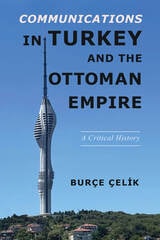
Communications in Turkey and the Ottoman Empire
A Critical HistoryBurçe Çelik
University of Illinois Press, 2023
The history of communications in the Ottoman Empire and Turkey contradicts the widespread belief that communications is a byproduct of modern capitalism and other Western forces. Burçe Çelik uses a decolonial perspective to analyze the historical commodification and militarization of communications and how it affected production and practice for oppressed populations like women, the working class, and ethnic and religious minorities. Moving from the mid-nineteenth century through today, Çelik places networks within the changing geopolitical landscape and the evolution of modern capitalism in relationship to struggles involving a range of social and political actors. Throughout, she challenges Anglo- and Eurocentric assumptions that see the non-West as an ahistorical imitation of, or aberration from, the development of Western communications.
Ambitious and comprehensive, Communications in Turkey and the Ottoman Empire merges political economy with social history to challenge Western-centered assumptions about the origins and development of modern communications.

Communications
An international history of the formative yearsRussell W. Burns
The Institution of Engineering and Technology, 2004
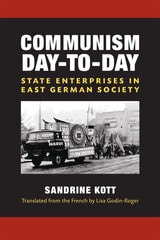
Communism Day-to-Day
State Enterprises in East German SocietySandrine Kott
University of Michigan Press, 2014
First published in France in 2001 by Éditions Belin under the title Le communisme au quotidien, Sandrine Kott’s book examines how East German businesses and government carried out communist practices on a daily basis and how citizens and workers experienced the conditions created by the totalitarian state in their daily lives. Kott undertakes a social analysis of the Communist Party’s grasp on state enterprises and the limits of its power. She then analyzes the enterprises themselves and the social, generational, and gender tensions that had a profound impact on the lived experience of socialism. Finally, she considers the development and acceptance of a complex set of rituals and gift exchanges that masked latent conflicts while providing meaning to socialism’s role in ordinary life.
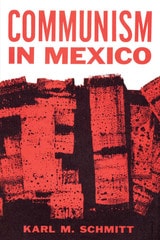
Communism in Mexico
A Study in Political FrustrationBy Karl M. Schmitt
University of Texas Press, 1965
The ease with which Cuba slipped into its relationship with Communism revived in the United States its recurring nightmare in which other Latin American countries, particularly Mexico, become satellites of Russia or Red China. But such an occurrence is most unlikely in Mexico, according to Karl Schmitt, former intelligence research analyst with the United States Department of State.
Communism in Mexico traces efforts during the early twentieth century to create a Soviet-style society in one of the largest and most strategically situated of the Latin American countries. Schmitt writes authoritatively of the Mexican Communist movement, tracing its development from an early and potentially powerful political-economic base to the increasingly fragmented and weakened collection of parties and front groups of the 1960s. He follows the various schisms and factional divisions to the mid-1950s, when the process of disintegration became most noticeable, and explores and analyzes in detail Communist attempts since then to establish unity among the many quarreling and frustrated groups of the now-splintered movement.
Three Communist parties in Mexico, a score of front groups, and numerous infiltration cells in non-Communist organizations such as student and labor groups, all recognize in a broad way a common and ultimate goal: the creation of a Soviet-style society. But their attempts at unity have consistently led only to further bickering and frustration. This period is subjected to a thorough study and analysis in an effort to understand and explain the Communists' lack of success. Schmitt presciently concludes that Communism's future in Mexico will be as cloudy as its past, and that the accelerating economy and improving social conditions there will serve to weaken the movement still further.

Communism, Religion, and Revolt in Banten in the Early Twentieth Century
Mis Sea#86Michael Williams
Ohio University Press, 1990
Twice in this century popular revolts against colonial rule have occured in the Banten district of West Java. These revolts, conducted largely under an Islamic leadership, also proclaimed themselves Communist. Islamic Communism is seemingly a paradox. This is especially the case when one considers that probably no religion has proved more resistant to Communist ideology than Islam.
Michael Williams here details the complicated history of the Bantenese revolts in the twentieth century and probes the ideological riddle of Islamic Communism. Modern history is replete with examples of regions with a long history of organizing themselves politically to resist intrusion on their territory, resources, and people. This book establishes that in Indonesia, the Bantenese were among the most practiced exponents of resistance.
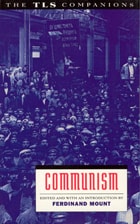
Communism
A TLS CompanionEdited by Ferdinand Mount
University of Chicago Press, 1993
Contributors to this volume include Isaac Deutscher, Eric Hobsbawm, Richard Pipes, Hugh Seton-Watson, Robert Conquest, Geoffrey Hosking, C. M. Woodhouse, Max Hayward, Leszek Kolakowski, Timothy Garton Ash, and many others of equal distinction. The volume is arranged in four sections covering the period leading to the Russian Revolution, the post-Revolution era of Lenin, Trotsky, and Stalin; the Soviet Union from World War II to 1968; and the final period of disillusionment and collapse.

Communist Gourmet
The Curious Story of Food in the People’s Republic of BulgariaAlbena Shkodrova
Central European University Press, 2021
Communist Gourmet presents a lively, detailed account of how the communist regime in Bulgaria determined people’s everyday food experience between 1944 and 1989. It examines the daily routines of acquiring food, cooking it, and eating out at restaurants through the memories of Bulgarians and foreigners, during communism.
In looking back on a wide array of issues and events, Albena Shkodrova attempts to explain the paradoxes of daily existence. She reports human stories that are touching, sometimes dark, but often full of humor and anecdotes from nearly one hundred people: some of them are Bulgarians who were involved in the communist food industry, whether as consumers or employees, while others are visitors from the United States and Western Europe who report culinary highlights and disappointments. The author made use of the national press, officially published cookbooks, Communist Party documents, and other previously unstudied sources.
An appendix containing recipes of dishes typical of the period and an extensive set of archival photographs are special features of the volume.
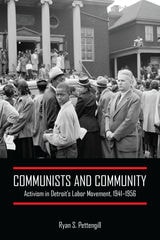
Communists and Community
Activism in Detroit's Labor Movement, 1941-1956Ryan S. Pettengill
Temple University Press, 2020
Communists and Community seeks to reframe the traditional chronology of the Communist Party in the United States as a means to better understand the change that occurred in community activism in the mid-twentieth century. Ryan Pettengill argues that Popular Front activism continued to flourish throughout the war years and into the postwar period. In Detroit, where there was a critical mass of heavy industry, Communist Party activists mobilized support for civil rights and affordable housing, brought attention to police brutality, sought protection for the foreign-born, and led a movement for world peace.
Communists and Community demonstrates that the Communist Party created a social space where activists became effective advocates for the socioeconomic betterment of a multiracial work force. Pettengill uses Detroit as a case study to examine how communist activists and their sympathizers maintained a community to enhance the quality of life for the city’s working class. He investigates the long-term effects of organized labor’s decision to force communists out of the unions and abandon community-based activism. Communists and Community recounts how leftists helped workers, people of color, and other under-represented groups became part of the mainstream citizenry in America.
Communists in Harlem during the Depression
Mark Naison
University of Illinois Press, 2004
Winner of the Ralph Bunche Award, American Political Science Association
No socialist organization has ever had a more profound effect on black life than the Communist Party did in Harlem during the Depression. Mark Naison describes how the party won the early endorsement of such people as Adam Clayton Powell Jr. and how its support of racial equality and integration impressed black intellectuals, including Richard Wright, Langston Hughes, and Paul Robeson.
This meticulously researched work, largely based on primary materials and interviews with leading black Communists from the 1930s, is the first to fully explore this provocative encounter between whites and blacks. It provides a detailed look at an exciting period of reform, as well as an intimate portrait of Harlem in the 1920s and 30s, at the high point of its influence and pride.
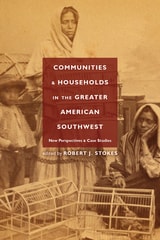
Communities and Households in the Greater American Southwest
New Perspectives and Case StudiesRobert J. Stokes
University Press of Colorado, 2019
Today’s archaeologists and anthropologists understand that communities operate as a multi-level, -organizational, -contextual, and -referential human creation, which informs their understanding of how people actively negotiate their way through and around community constraints. The chapters in this book creatively examine these interactions, revealing the dynamic nature of ancient and modern groups in the American Southwest. The book has two broad complementary themes: one focusing on household decision-making, identity, and structural relations with the greater community; the other concerned with community organization and integration, household roles within the community, and changes in community organization—violence and destabilization, coalescence and cooperation—over time.
Communities and Households in the Greater American Southwest weaves a rich tapestry of ancient and modern life through innovative approaches that will be of interest not only to Southwestern archaeologists but to all researchers and students interested in social organization at the household and community levels.
Contributors: James R. Allison, Andrew Duff, Lindsay Johansson, Michael Lindeman, Myles Miller, James Potter, Alison E. Rautman, J. Jefferson Reid, Katie Richards, Oscar Rodriguez, Barbara Roth, Kristin Safi, Deni Seymour, Robert J. Stokes, Richard K. Talbot, Scott Ure, Henry Wallace, Stephanie M. Whittlesey
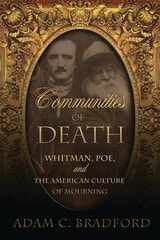
Communities of Death
Whitman, Poe, and the American Culture of MourningAdam C. Bradford
University of Missouri Press, 2014
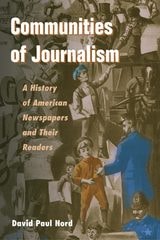
Communities of Journalism
A History of American Newspapers and Their ReadersDavid Paul Nord
University of Illinois Press, 2006
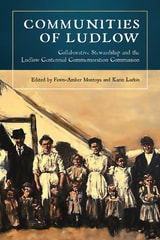
Communities of Ludlow
Collaborative Stewardship and the Ludlow Centennial Commemoration CommissionFawn-Amber Montoya
University Press of Colorado, 2021
The history of the Ludlow Massacre encompasses the stories of immigrant groups, women, the working-class, and people of color as much as the story of that tragedy, and the continued relevance of these issues creates a need for remembrance and discussion of how to make the events of the Ludlow Massacre available to contemporary society. The book outlines recent efforts to remember and commemorate this important historical event, documenting the unique collaborations in public scholarship and outreach among the diverse group of people involved in marking the 100-year anniversary of the Ludlow Massacre. The chapters relate the tales of the stewards of the Ludlow Massacre—the various communities that rallied together to keep this history alive and show its relevance, including lineal descendants, members of the United Mine Workers of America, historians, archaeologists, scholars, artists, interpreters, authors, playwrights, and politicians. The book also offers tips, strategies, and cautionary tales for practicing engaged public scholarship.
The history of the Ludlow Massacre has been told as a tragedy of striking miners in the West that occurred during a turbulent time in US labor relations, but it is so much more than that. Communities of Ludlow explores the intersections of public scholarship, advocacy, and personal experience, weaving these perspectives together with models for practicing public scholarship to illustrate the power of creating spaces for sharing ideas and information in an environment that encourages creativity, open dialogue, public outreach, political action, and alternative narratives.
Contributors: Robert Butero, Robin Henry, Michael Jacobson, Elizabeth Jameson, Linda Linville, Matthew Maher, Yolanda Romero
Communities of Sense
Rethinking Aesthetics and PoliticsBeth Hinderliter, William Kaizen, Vered Maimon, Jaleh Mansoor, and Seth McCormick, eds.
Duke University Press, 2009
The first of the collection’s three sections explicitly examines the links between aesthetics and social and political experience. Here a new essay by Rancière posits art as a key site where disagreement can be staged in order to produce new communities of sense. In the second section, contributors investigate how sense was constructed in the past by the European avant-garde and how it is mobilized in today’s global visual and political culture. Exploring the viability of various models of artistic and political critique in the context of globalization, the authors of the essays in the volume’s final section suggest a shift from identity politics and preconstituted collectivities toward processes of identification and disidentification. Topics discussed in the volume vary from digital architecture to a makeshift museum in a Paris suburb, and from romantic art theory in the wake of Hegel to the history of the group-subject in political art and performance since 1968. An interview with Étienne Balibar rounds out the collection.
Contributors. Emily Apter, Étienne Balibar, Carlos Basualdo, T. J. Demos, Rachel Haidu, Beth Hinderliter, David Joselit, William Kaizen, Ranjanna Khanna, Reinaldo Laddaga, Vered Maimon, Jaleh Mansoor, Reinhold Martin, Seth McCormick, Yates McKee, Alexander Potts, Jacques Rancière, Toni Ross
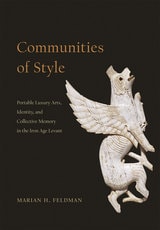
Communities of Style
Portable Luxury Arts, Identity, and Collective Memory in the Iron Age LevantMarian H. Feldman
University of Chicago Press, 2014
Marian H. Feldman brings her dual training as an art historian and an archaeologist to bear on the networks that were essential to the movement and trade of luxury goods—particularly ivories and metal works—and how they were also central to community formation. The interest in, and relationships to, these art objects, Feldman shows, led to wide-ranging interactions and transformations both within and between communities. Ultimately, she argues, the production and movement of luxury goods in the period demands a rethinking of our very geo-cultural conception of the Levant, as well as its influence beyond what have traditionally been thought of as its borders.
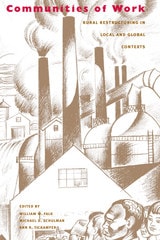
Communities of Work
Rural Restructuring in Local and Global ContextsWilliam W. Falk
Ohio University Press, 2003
The image of rural America portrayed in this illuminating study is one that is vibrant, regionally varied, and sometimes heroic. Communities of Work focuses on the ways in which rural people and places are affected by political, social, and economic forces far outside their control and how they sustain themselves and their communities in response.
Bringing together the two fundamental concepts of community—where the relationships and practices of daily life occur—and work, in which an elementary exchange occurs, Communities of Work bridges several fields of study. Presented here is the contextual and embedded nature of social relations and the complexity involved in understanding them. Through the use of multiple case studies, the authors apply diverse theories and methods in seeking an integrated outcome, one captured by “communities of work.”
Beginning with a description of the broad changes in work and economic activities across the United States, ranging from the Ohio River Valley to a western boomtown, the book shifts its focus to the interplay of work, family, and local networks in time and place. Activities range from fishing in the Mississippi Delta to farming and family life in the Midwest. The authors then highlight how rural people and places respond to extra-local, increasingly global forces in settings as diverse as rural South Carolina and Wisconsin.
A certain communitarian theme runs through Communities of Work. It is about people and communities not merely reacting, but instead responding in ways that reflect their local culture, while being cognizant of the larger world within which they live.

Community Health Centers
A Movement and the People Who Made It HappenLefkowitz, Bonnie
Rutgers University Press, 2007
This book tells the story of one groundbreaking approach to medicine that attacks the problem by focusing on the wellness of whole neighborhoods. Since their creation during the 1960s, community health centers have served the needs of the poor in the tenements of New York, the colonias of Texas, the working class neighborhoods of Boston, and the dirt farms of the South. As products of the civil rights movement, the early centers provided not only primary and preventive care, but also social and environmental services, economic development, and empowerment.
Bonnie Lefkowitz-herself a veteran of community health administration-explores the program's unlikely transformation from a small and beleaguered demonstration effort to a network of close to a thousand modern health care organizations serving nearly 15 million people. In a series of personal accounts and interviews with national leaders and dozens of health care workers, patients, and activists in five communities across the United States, she shows how health centers have endured despite cynicism and inertia, the vagaries of politics, and ongoing discrimination.

Community Health Equity
A Chicago ReaderEdited by Fernando De Maio, Raj C. Shah, MD, John Mazzeo, and David A. Ansell, MD
University of Chicago Press, 2019