Results by title
5448 books match the query 'History and criticism' and 372 start with c
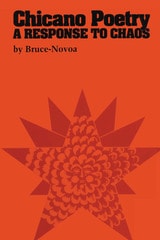
Chicano Poetry
A Response to ChaosBy Bruce-Novoa
University of Texas Press, 1982
Alurista. Gary Soto. Bernice Zamora. José Montoya. These names, luminous to some, remain unknown to those who have not yet discovered the rich variety of late twentieth century Chicano poetry.
With the flowering of the Chicano Movement in the mid-1960s came not only increased political awareness for many Mexican Americans but also a body of fine creative writing. Now the major voices of Chicano literature have begun to reach the wider audience they deserve. Bruce-Novoa's Chicano Poetry: A Response to Chaos—the first booklength critical study of Chicano poetry—examines the most significant works of a body of literature that has grown dramatically in size and importance in less than two decades.
Here are insightful new readings of the major writings of Abelardo Delgado, Sergio Elizondo, Rodolfo Gonzales, Miguel Méndez, J. L. Navarro, Raúl Salinas, Ricardo Sánchez, and Tino Villanueva, as well as Alurista, Soto, Zamora, and Montoya. Close textual analyses of such important works as I Am Joaquín, Restless Serpents, and Floricanto en Aztlán enrich and deepen our understanding of their imagery, themes, structure, and meaning.
Bruce-Novoa argues that Chicano poetry responds to the threat of loss, whether of hero, barrio, family, or tradition. Thus José Montoya elegizes a dead Pachuco in "El Louie," and Raúl Salinas laments the disappearance of a barrio in "A Trip through the Mind Jail." But this elegy at the heart of Chicano poetry is both lament and celebration, for it expresses the group's continuing vitality and strength.
Common to twentieth-century poetry is the preoccupation with time, death, and alienation, and the work of Chicano poets—sometimes seen as outside the traditions of world literature—shares these concerns. Bruce-Novoa brilliantly defines both the unique and the universal in Chicano poetry.
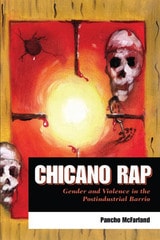
Chicano Rap
Gender and Violence in the Postindustrial BarrioBy Pancho McFarland
University of Texas Press, 2008
Powered by a driving beat, clever lyrics, and assertive attitudes, rap music and hip hop culture have engrossed American youth since the mid-1980s. Although the first rappers were African Americans, rap and hip hop culture quickly spread to other ethnic groups who have added their own cultural elements to the music. Chicano Rap offers the first in-depth look at how Chicano/a youth have adopted and adapted rap music and hip hop culture to express their views on gender and violence, as well as on how Chicano/a youth fit into a globalizing world.
Pancho McFarland examines over five hundred songs and seventy rap artists from all the major Chicano rap regions—San Diego, San Francisco and Northern California, Texas, and Chicago and the Midwest. He discusses the cultural, political, historical, and economic contexts in which Chicano rap has emerged and how these have shaped the violence and misogyny often expressed in Chicano rap and hip hop. In particular, he argues that the misogyny and violence of Chicano rap are direct outcomes of the "patriarchal dominance paradigm" that governs human relations in the United States. McFarland also explains how globalization, economic restructuring, and the conservative shift in national politics have affected Chicano/a youth and Chicano rap. He concludes with a look at how Xicana feminists, some Chicano rappers, and other cultural workers are striving to reach Chicano/a youth with a democratic, peaceful, empowering, and liberating message.
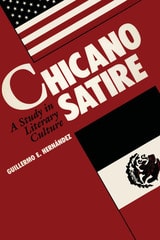
Chicano Satire
A Study in Literary CultureBy Guillermo E. Hernández
University of Texas Press, 1991
Geographically close to Mexico, but surrounded by Anglo-American culture in the United States, Chicanos experience many cultural tensions and contradictions. Their lifeways are no longer identical with Mexican norms, nor are they fully assimilated to Anglo-American patterns. Coping with these tensions—knowing how much to let go of, how much to keep—is a common concern of Chicano writers, who frequently use satire as a means of testing norms and deviations from acceptable community standards. In this groundbreaking study, Guillermo Hernández focuses on the uses of satire in the works of three authors—Luis Valdez, Rolando Hinojosa, and José Montoya—and on the larger context of Chicano culture in which satire operates.
Hernández looks specifically at the figures of the pocho (the assimilated Chicano) and the pachuco (the zoot-suiter, or urbanized youth). He shows how changes in their literary treatment—from simple ridicule to more understanding and respect—reflect the culture's changes in attitude toward the process of assimilation.
Hernández also offers many important insights into the process of cultural definition that engaged Chicano writers during the 1960s and 1970s. He shows how the writers imaginatively and syncretically formed new norms for the Chicano experience, based on elements from both Mexican and United States culture but congruent with the historical reality of Chicanos.
With its emphasis on culture change and creation, Chicano Satire will be of interest across a range of human sciences.
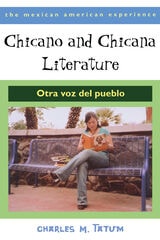
Chicano and Chicana Literature
Otra voz del puebloCharles M. Tatum
University of Arizona Press, 2006
In this comprehensive examination of Chicano and Chicana literature, Charles M. Tatum brings a new and refreshing perspective to the ethnic identity of Mexican Americans. From the earliest sixteenth-century chronicles of the Spanish Period, to the poetry and narrative fiction of the second half of the nineteenth century and the first half of the twentieth century, and then to the flowering of all literary genres in the post–Chicano Movement years, Chicano/a literature amply reflects the hopes and aspirations as well as the frustrations and disillusionments of an often marginalized population.
Exploring the work of Rudolfo Anaya, Sandra Cisneros, Luis Alberto Urrea, and many more, Tatum examines the important social, historical, and cultural contexts in which the writing evolved, paying special attention to the Chicano Movement and the flourishing of literary texts during the 1960s and early 1970s. Chapters provide an overview of the most important theoretical and critical approaches employed by scholars over the past forty years and survey the major trends and themes in contemporary autobiography, memoir, fiction, and poetry.
The most complete and up-to-date introduction to Chicana/o literature available, this book will be an ideal reference for scholars of Hispanic and American literature. Discussion questions and suggested reading included at the end of each chapter are especially suited for classroom use.
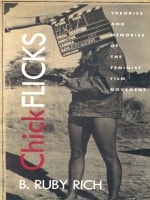
Chick Flicks
Theories and Memories of the Feminist Film MovementB. Ruby Rich
Duke University Press, 1998
For over three decades Rich has been one of the most important voices in feminist film criticism. Her presence at film festivals (such as Sundance, where she is a member of the selection committee), her film reviews in the Village Voice, Elle, Out, and the Advocate, and her commentaries on the public radio program “The World” have secured her a place as a central figure in the remarkable history of what she deems “cinefeminism.” In the hope that a new generation of feminist film culture might be revitalized by reclaiming its own history, Rich introduces each essay with an autobiographical prologue that describes the intellectual, political, and personal moments from which the work arose. Travel, softball, sex, and voodoo all somehow fit into a book that includes classic Rich articles covering such topics as the antiporn movement, the films of Yvonne Rainer, a Julie Christie visit to Washington, and the historically evocative film Maedchen in Uniform. The result is a volume that traces the development not only of women’s involvement in cinema but of one of its key players as well.
The first book-length work from Rich—whose stature and influence in the world of film criticism and theory continue to grow—Chick Flicks exposes unexplored routes and forgotten byways of a past that’s recent enough to be remembered and far away enough to be memorable.

Child Brides and Intruders
Carol Wershoven
University of Wisconsin Press, 1993
Children of the Series and How They Grew
or A Century of Heroines & Heroes, Romantic, Comic, MoralFaye Riter Kensinger
University of Wisconsin Press, 1987
Children's Literature in the Nordic World
Charlotte Appel and NIna Christensen
University of Wisconsin Press, 2021
The emergence of a dedicated market for children’s books in the Global North coincided with national school reforms, when Luther’s Small Catechism started to be supplemented—or replaced—by new books published for and about young readers, learners, and citizens. Children’s use of books and media is closely related to adults’ wishes to influence the present and future of a child through instruction, entertainment, or play. Chapters point to strong continuities as well as remarkable changes in the relationships between child readers and adult authors, artists, publishers, teachers, librarians, and parents through the centuries.
Focusing on children as the central users and producers of texts, this interdisciplinary and transnational history shows how children’s exposure to and use of media impacted the Nordic welfare state, and vice versa. As narratives for young audiences are continuously rewritten, republished, and adapted into new forms, this pithy synthesis brings forward new knowledge about the material and social history of books, literature, and childhood.
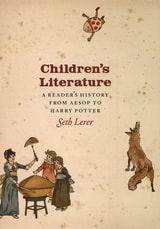
Children's Literature
A Reader's History, from Aesop to Harry PotterSeth Lerer
University of Chicago Press, 2008
Ever since children have learned to read, there has been children’s literature. Children’s Literature charts the makings of the Western literary imagination from Aesop’s fables to Mother Goose, from Alice's Adventures in Wonderland to Peter Pan, from Where the Wild Things Are to Harry Potter.
The only single-volume work to capture the rich and diverse history of children’s literature in its full panorama, this extraordinary book reveals why J. R. R. Tolkien, Dr. Seuss, Laura Ingalls Wilder, Beatrix Potter, and many others, despite their divergent styles and subject matter, have all resonated with generations of readers. Children’s Literature is an exhilarating quest across centuries, continents, and genres to discover how, and why, we first fall in love with the written word.
“Lerer has accomplished something magical. Unlike the many handbooks to children’s literature that synopsize, evaluate, or otherwise guide adults in the selection of materials for children, this work presents a true critical history of the genre. . . . Scholarly, erudite, and all but exhaustive, it is also entertaining and accessible. Lerer takes his subject seriously without making it dull.”—Library Journal (starred review)
“Lerer’s history reminds us of the wealth of literature written during the past 2,600 years. . . . With his vast and multidimensional knowledge of literature, he underscores the vital role it plays in forming a child’s imagination. We are made, he suggests, by the books we read.”—San Francisco Chronicle
“There are dazzling chapters on John Locke and Empire, and nonsense, and Darwin, but Lerer’s most interesting chapter focuses on girls’ fiction. . . . A brilliant series of readings.”—Diane Purkiss, Times Literary Supplement
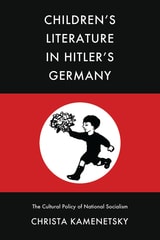
Children’s Literature in Hitler’s Germany
The Cultural Policy of National SocialismChrista Kamenetsky
Ohio University Press, 1984
Between 1933 and 1945, National Socialists enacted a focused effort to propagandize children’s literature by distorting existing German values and traditions with the aim of creating a homogenous “folk community.” A vast censorship committee in Berlin oversaw the publication, revision, and distribution of books and textbooks for young readers, exercising its control over library and bookstore content as well as over new manuscripts, so as to redirect the cultural consumption of the nation’s children. In particular, the Nazis emphasized Nordic myths and legends with a focus on the fighting spirit of the saga heroes, their community loyalty, and a fierce spirit of revenge—elements that were then applied to the concepts of loyalty to and sacrifice for the Führer and the fatherland. They also tolerated select popular series, even though these were meant to be replaced by modern Hitler Youth camping stories.
In this important book, first published in 1984 and now back in print, Christa Kamenetsky demonstrates how Nazis used children’s literature to selectively shape a “Nordic Germanic” worldview that was intended to strengthen the German folk community, the Führer, and the fatherland by imposing a racial perspective on mankind. Their efforts corroded the last remnants of the Weimar Republic’s liberal education, while promoting an enthusiastic following for Hitler.
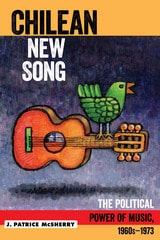
Chilean New Song
The Political Power of Music, 1960s - 1973J Patrice McSherry
Temple University Press, 2015
In Chilean New Song, J. Patrice McSherry deftly combines a political-historical view of Chile with a narrative of its cultural development. She examines the democratizing power of this music and, through interviews with key protagonists, the social roles of politically committed artists who participated in a movement for change. McSherry explores the impact of Chilean New Song and the way this artistic/cultural phenomenon related to contemporary politics to capture the passion, pain, and hope of millions of Chileans.
Chinatown Opera Theater in North America
Nancy Yunhwa Rao
University of Illinois Press, 2017
Irving Lowens Award, Society for American Music (SAM), 2019
Music in American Culture Award, American Musicological Society (AMS), 2018
Certificate of Merit for Best Historical Research in Recorded Country, Folk, Roots, or World Music, Association for Recorded Sound Collections (ARSC), 2018
Outstanding Achievement in Humanities and Cultural Studies: Media, Visual, and Performance Studies, Association for Asian American Studies (AAAS), 2019
The Chinatown opera house provided Chinese immigrants with an essential source of entertainment during the pre–World War II era. But its stories of loyalty, obligation, passion, and duty also attracted diverse patrons into Chinese American communities
Drawing on a wealth of new Chinese- and English-language research, Nancy Yunhwa Rao tells the story of iconic theater companies and the networks and migrations that made Chinese opera a part of North American cultures. Rao unmasks a backstage world of performers, performance, and repertoire and sets readers in the spellbound audiences beyond the footlights. But she also braids a captivating and complex history from elements outside the opera house walls: the impact of government immigration policy; how a theater influenced a Chinatown's sense of cultural self; the dissemination of Chinese opera music via recording and print materials; and the role of Chinese American business in sustaining theatrical institutions. The result is a work that strips the veneer of exoticism from Chinese opera, placing it firmly within the bounds of American music and a profoundly American experience.
Chinese American Literature since the 1850s
Xiao-huang Yin
University of Illinois Press, 2000
The writings of immigrants from China and their descendants in the United States reflect the changes and continuity in the Chinese American experience. Xiao-huang Yin combines literary and historical scholarship to trace the origins and development of this extensive, neglected body of literature.
Chinese American Literature since the 1850s covers representative works from the 1850s to the present. Selections include journalism and autobiography by nineteenth-century Chinese authors; writings on the walls of Angel Island, the main Asian immigrant arrival point on the West Coast; writings of late-nineteenth and early-twentieth-century "cultivated Chinese," students and scholars who came to America to advance their educations; important writing by immigrants such as Chen Ruoxi, Yu Lihua, and Zhang Xiguo; and the works of more recent authors like Sui Sin Far, Jade Snow Wong, Frank Chin, Maxine Hong Kingston, and Amy Tan.
An essential introduction and guide to the field, Chinese American Literature since the 1850s enlarges the available body of literature and provides new insights into the Chinese American immigrant experience and the writing inspired by it.
Chinese Dreams
Pound, Brecht, Tel QuelEric Hayot
University of Michigan Press, 2011
China’s profound influence on the avant-garde in the 20th century was nowhere more apparent than in the work of Ezra Pound, Bertolt Brecht, and the writers associated with the Parisian literary journal Tel quel. Chinese Dreams explores the complex, intricate relationship between various “Chinas”—as texts—and the nation/culture known simply as “China”—their context—within the work of these writers. Eric Hayot calls into question the very means of representing otherness in the history of the West and ultimately asks if it might be possible to attend to the political meaning of imagining the other, while still enjoying the pleasures and possibilities of such dreaming. The latest edition of this critically acclaimed book includes a new preface by the author.
“Lucid and accessible . . . an important contribution to the field of East-West comparative studies, Asian studies, and modernism.”
—Comparative Literature Studies
“Instead of trying to decipher the indecipherable ‘China’ in Western literary texts and critical discourses, Hayot chose to show us why and how ‘China’ has remained, and will probably always be, an enchanting, ever-elusive dream. His approach is nuanced and refreshing, his analysis rigorous and illuminating.”
—Michelle Yeh, University of California, Davis
Chinese Modern
The Heroic and the QuotidianXiaobing Tang
Duke University Press, 2000
Tang uncovers crucial clues to modern Chinese literary and cultural practices through readings of Wu Jianren’s 1906 novel The Sea of Regret and works by canonical writers Lu Xun, Ding Ling, and Ba Jin. For the midcentury, he broadens his investigation by considering theatrical, cinematic, and visual materials in addition to literary texts. His reading of the 1963 play The Young Generation reveals the anxiety and terror underlying the exhilarating new socialist life portrayed on the stage. This play, enormously influential when it first appeared, illustrates the utopian vision of China’s lyrical age and its underlying discontents—both of which are critical for understanding late-twentieth-century China. Tang closes with an examination of post–Cultural Revolution nostalgia for the passion of the lyrical age.
Throughout Chinese Modern Tang suggests a historical and imaginative affinity between apparently separate literatures and cultures. He thus illuminates not only Chinese modernity but also the condition of modernity as a whole, particularly in light of the postmodern recognition that the market and commodity culture are both angel and devil.
This elegantly written volume will be invaluable to students of China, Asian studies, literary criticism, and cultural studies, as well as to readers who study modernity.

Chinese Modernism in the Era of Reforms
Cultural Fever, Avant-Garde Fiction, and the New Chinese CinemaXudong Zhang
Duke University Press, 1997
In examining the aesthetic and philosophical formulations of the New Era’s intellectual elites, Zhang first analyzes the intense cultural and intellectual debates, known as the “Great Cultural Discussion” or “Cultural Fever” that took place in Chinese urban centers in the mid- and late 1980s. Chinese literary modernism is then explored, specifically in relation to Deng Xiaoping’s sweeping reforms and with a focus on the changing literary sensibility and avant-garde writers such as Yu Hua, Ge Fei, and Su Tong. Lastly, Zhang looks at the the making of New Chinese Cinema and films such as Yellow Earth, Horse Thief, and King of the Children—films through which Fifth Generation filmmakers first developed a style independent from socialist realism. By tracing the origins and contemporary elaboration of the idea of Chinese modernism, Zhang identifies the discourse of modernism as one of the decisive formal articulations of the social dynamism and cultural possibilities of post-Mao China.
Capturing the historical experience and the cultural vision of China during a crucial decade in its emergence as a world power, Chinese Modernism in the Era of Reforms will interest students and scholars of modernism, Chinese literature and history, film studies, and cultural studies.
Chinese Narrative Poetry
The Late Han Through T'ang DynastiesDore J. Levy
Duke University Press, 1988
Drawing on both classical Chinese critical works and the most recent Western contributions to the theory of narrative, Levy shows how narrative elements developed out of the lyrical conventions of shih. In doing so, she accomplishes a double purpose, guiding the modern reader to an understanding of the nature of narrative in Chinese poetry and shedding light on the ways in which Chinese poets adapted the devises of lyric to the needs of a completely different expressive mode.
Students of Chinese literature will welcome this pathbreaking study, but Chinese Narrative Poetry will interest other scholars as well because it addresses questions of crucial importance for literary theory and comparative literature, particularly the central issue of the applicability of Western critical concepts to non-Western literature and culture.
Chinese Reportage
The Aesthetics of Historical ExperienceCharles A. Laughlin
Duke University Press, 2002
Laughlin traces the roots of reportage (or baogao wenxue) to the travel literature of the Qing Dynasty but shows that its flourishing was part of the growth of Chinese communism in the twentieth century. In a modern Asian context critical of capitalism and imperialism, reportage offered the promise of radicalizing writers through a new method of literary practice and the hope that this kind of writing could in turn contribute to social revolution and China’s national self-realization. Chinese Reportage explores the wide range of social engagement depicted in this literature: witnessing historic events unfolding on city streets; experiencing brutal working conditions in 1930s Shanghai factories; struggling in the battlefields and trenches of the war of resistance against Japan, the civil war, and the Korean war; and participating in revolutionary rural, social, and economic transformation. Laughlin’s close readings emphasize the literary construction of social space over that of character and narrative structure, a method that brings out the critique of individualism and humanism underlying the genre’s aesthetics.
Chinese Reportage recaptures a critical aspect of leftist culture in China with far-reaching implications for historians and sociologists as well as literary scholars.
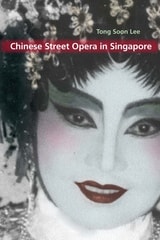
Chinese Street Opera in Singapore
Tong Soon Lee
University of Illinois Press, 2009
Since Singapore declared independence from Malaysia in 1965, Chinese street opera has played a significant role in defining Singaporean identity. Carefully tracing the history of amateur and professional performances in Singapore, Tong Soon Lee reflects on the role of street performance in fostering cultural nationalism and entrepreneurship. He explains that the government welcomes Chinese street opera performances because they combine tradition and modernism and promote a national culture that brings together Singapore's four main ethnic groups--Eurasian, Malay, Chinese, and South Asian.
Chinese Street Opera in Singapore documents the ways in which this politically motivated art form continues to be influenced and transformed by Singaporean politics, ideology, and context in the twenty-first century. By performing Chinese street opera, amateur troupes preserve their rich heritage, underscoring the Confucian mind-set that a learned person engages in the arts for moral and unselfish purposes. Educated performers also control behavior, emotions, and values. They are creative and innovative, and their use of new technologies indicates a modern, entrepreneurial spirit. Their performances bring together diverse ethnic groups to watch and perform, Lee argues, while also encouraging a national attitude focused on both remembering the past and preparing for the future in Singapore.
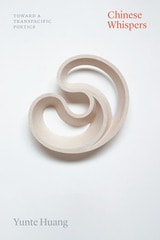
Chinese Whispers
Toward a Transpacific PoeticsYunte Huang
University of Chicago Press, 2022
In this new book, the noted critic and best-selling author Yunte Huang explores the dynamics of poetry and poetics in the age of globalization, particularly questions of translatability, universality, and risk in the transpacific context. “Chinese whispers” refers to an American children’s game dating to the years of the Cold War, a period in which everything Chinese, or even Chinese sounding, was suspect. Taking up various manifestations of the phrase in the twentieth and twenty-first centuries, Huang investigates how poetry, always to a significant degree untranslatable, complicates the transpacific production of meanings and values.
The book opens with the efforts of I. A. Richards, arguably the founder of Anglo-American academic literary criticism, to promote Basic English in China in the early twentieth century. It culminates by resituating Ernest Fenollosa’s famous essay “The Chinese Written Character as a Medium for Poetry,” exploring the ways in which Chinese has historically enriched but also entrapped the Western conception of language.
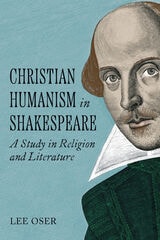
Christian Humanism in Shakespeare
A Study in Religion and LiteratureLee Oser
Catholic University of America Press, 2022

Christina Rossetti
The Poetry of EnduranceDolores Rosenblum
Southern Illinois University Press, 1987
Christina Rossetti was considered the ideal female poet of her time. Her poetry was devotional, moral, and spoke of frustrated affection.
Dolores Rosenblum presents a fresh reading of Rossetti’s works and places them in the context of her life. Rosenblum shows that what was ostensibly devotional, moral, and loveless, was actually what Luce Irigaray calls “mimetism,” a subtle parody and subversion of the male tradition of literature.
Only with the coming of feminist criticism can Rossetti be meaningfully re-evaluated. Rosenblum calls Rossetti’s works the “poetry of endurance,” stating that it is similar, and at times identical, to the female “sentimental” tradition in literature. Rossetti endured the constraints of the Victorian female artistic spirit by becoming a “watcher.” Within this self-accepted role, Rossetti was able to carefully and deliberately choose artistic self-protection. In her religious poetry, Rossetti transcended, by aesthetic renunciation, the alienation and immobilization forced upon her.
Rossetti’s poetry is full of paradox; it sings about silence, exposes the poet’s oblivion. From the repining Victorian poet, there emerged a “stone woman.” Rosenblum discusses this passively enduring female figure’s alienation from knowledge and power, and how the myth of self strengthened the lyric voice within her. Because she was a woman, she was denied the male use of the lyric “I.”
Rossetti’s work is unified, Rosenblum argues, because she was a deliberate poet, and by accepting the “burden of womanhood,” she played out what men only symbolized as female in their art. By her mimicry and revision of the male tradition of literature, Christina Rossetti engaged the patriarchal tradition in ways that make it usable for the female experience, and that provide a critique of male objectification of women in art.
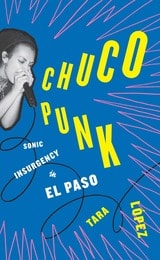
Chuco Punk
Sonic Insurgency in El PasoTara López
University of Texas Press, 2024
2025 Al Lowman Memorial Prize, Texas State Historical Association
An immersive study of the influential and predominantly Chicanx punk rock scene in El Paso, Texas.
Punk rock is known for its daring subversion, and so is the West Texas city of El Paso. In Chuco Punk, Tara López dives into the rebellious sonic history of the city, drawing on more than seventy interviews with punks, as well as unarchived flyers, photos, and other punk memorabilia. Connecting the scene to El Paso's own history as a borderland, a site of segregation, and a city with a long lineage of cultural and musical resistance, López throws readers into the heat of backyard punx shows, the chaos of riots in derelict mechanic shops, and the thrill of skateboarding on the roofs of local middle schools. She reveals how, in this predominantly Chicanx punk rock scene, women forged their own space, sound, and community. Covering the first roots of Chuco punk in the late 1970s through the early 2000s, López moves beyond the breakout bands to shed light on how the scene influenced not only the contours of sound and El Paso but the entire topography of punk rock.
Ciardi Himself
Fifteen Essays in the Reading, Writing, and Teaching of PoetryJohn Ciardi
University of Arkansas Press, 1989
Cicero's Use of Judicial Theater
Jon Hall
University of Michigan Press, 2014
While Cicero’s Use of Judicial Theater will be of interest primarily to professional scholars and students studying the speeches of Cicero, its wider analyses, both of Roman cultural customs and the idiosyncratic practices of the courts, will prove relevant also to social historians, as well as historians of legal procedure.
Cicero, Catullus, and the Language of Social Performance
Brian A. Krostenko
University of Chicago Press, 2001
As Krostenko demonstrates, a key feature of this language is its capacity to express both approval and disdain—an artifact of its origins at a time when the "style" and "charm" of imported Greek cultural practices were greeted with both enthusiasm and hostility. Cicero played on that ambiguity, for example, by chastising lepidus ("fine") boys in the "Second Oration against Catiline" as degenerates, then arguing in his De Oratore that the successful speaker must have a certain charming lepos ("wit"). Catullus, in turn, exploited and inverted the political subtexts of this language for innovative poetic and erotic idioms.
Cigarettes Are Sublime
Richard Klein
Duke University Press, 1993
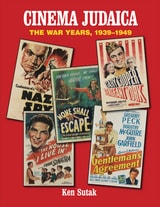
Cinema Judaica
Ken Sutak
Central Conference of American Rabbis, 2012
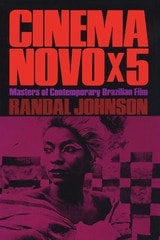
Cinema Novo x 5
Masters of Contemporary Brazilian FilmBy Randal Johnson
University of Texas Press, 1984
With such stunning films as Dona Flor and Her Two Husbands, Bye Bye Brazil, and Pixote, Brazilian cinema achieved both critical acclaim and popular recognition in the 1970s and 1980s, becoming the premier cinema of Latin America and one of the largest film producers in the western world. But the success of Brazilian film at home and abroad came after many years of struggle by filmmakers determined to create a strong film industry in Brazil. At the forefront of this struggle were the filmmakers of Cinema Novo, the internationally acclaimed movement whose flowering in the 1960s marked the birth of modern Brazilian film.
Cinema Novo x 5 places the success of Brazilian cinema in perspective by examining the films of the five leaders of this groundbreaking movement—Andrade, Diegues, Guerra, Rocha, and dos Santos. By exploring the individuality of these masters of contemporary Brazilian film, Randal Johnson reveals the astonishing stylistic and thematic diversity of Cinema Novo. His emphasis is on the films themselves, as well as their makers’ distinctive cinematic vision and views of what cinema should be and is. At the same time, he provides a wealth of valuable background information to enhance readers’ understanding of the historical, cultural, and economic context in which Cinema Novo was born and flourished.
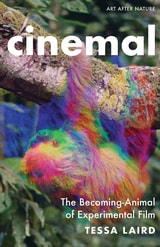
Cinemal
The Becoming-Animal of Experimental FilmTessa Laird
University of Minnesota Press, 2025
A foray through the wilds where experimental films and animals collide
Like the flash of a tropical bird’s iridescent wing, cinema can be furtive and intensely beautiful—and it can leave a viewer craving more. Cinemal is Tessa Laird’s passionate inquiry into the ways that films mimic the majesty, mystery, and movements of animals,her field notes from countless hair-raising encounters with films in their natural habitat.
Part of a growing focus on nonhuman animals in film, Cinemal ventures to the “furry underbelly” of global experimental film practice, focusing on films from New Zealand, Australia, and South America. Laird examines how animals are depicted in film and analyzes the various animal qualities of cinema, like scratching and sniffing, vibrant colors, and voices (barking, howling, or echolocation). Burrowing into the work of filmmakers such as Arthur and Corinne Cantrill, Sriwhana Spong, and Ana Vaz, Laird’s energetic prose embodies the films she discusses, seamlessly combining personal anecdotes with art theory and philosophy to spread a wide sensory buffet.
Lively and optimistic, Laird uses cinematic animal tropes to encourage readers to rethink what it means to be human. She argues that, in a time of ecological collapse, such an impulse is a necessary means of imagining other, healthier ways of being in this world. Connecting us with the more-than-human, Cinemal lures us toward the beastly becomings of film and, ultimately, our own animal natures.
Retail e-book files for this title are screen-reader friendly.
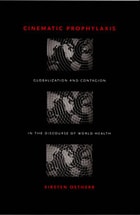
Cinematic Prophylaxis
Globalization and Contagion in the Discourse of World HealthKirsten Ostherr
Duke University Press, 2005
Ostherr presents the first in-depth analysis of the public health films produced between World War II and the 1960s that popularized the ideals of world health and taught viewers to imagine the presence of invisible contaminants all around them. She considers not only the content of specific films but also their techniques for making invisible contaminants visible. By identifying the central aesthetic strategies in films produced by the World Health Organization, the Centers for Disease Control, and other institutions, she reveals how ideas about racial impurity and sexual degeneracy underlay messages ostensibly about world health. Situating these films in relation to those that preceded and followed them, Ostherr shows how, during the postwar era, ideas about contagion were explicitly connected to the global circulation of bodies. While postwar public health films embraced the ideals of world health, they invoked a distinct and deeply anxious mode of representing the spread of disease across national borders.

Cinematic Uses of the Past
Marcia Landy
University of Minnesota Press, 1996
Cinematic Uses of the Past was first published in 1996. Minnesota Archive Editions uses digital technology to make long-unavailable books once again accessible, and are published unaltered from the original University of Minnesota Press editions.
From the first, cinema has sustained a romance with the past. The nature of this attachment, and what it reveals about our culture, is the subject of Marcia Landy's book. Cinematic Uses of the Past looks at British, American, Italian, and African films for what they can tell us about popular history and our cultural investment in certain images of the past.
Landy peruses six different moments in the history of cinema, employing the theories of Nietzsche and Gramsci. Her reading of these films explores their investments in history and memory in relation to ideas of nation, sexuality, gender, and race. Among the films she discusses are A Fistful of Dynamite, The Scarlet Empress, Dance with a Stranger, Holocaust, Schindler's List, Le camp de Thiaroye, Guelwaar, The Leopard, and Veronika Voss.
A thoroughly compelling reading of these emblematic films, Cinematic Uses of the Past is also a revealing interpretation of popular history, exposing the fragmentary, tentative, and invested nature of cultural memory.
Marcia Landy is professor of literature and film studies at the University of Pittsburgh. She is the author of several books, including Film, Politics, and Gramsci (Minnesota, 1995).
Circle of Winners
How the Guggenheim Foundation Composition Awards Shaped American Music CultureDenise Von Glahn
University of Illinois Press, 2023
An essential high culture institution, the John Simon Guggenheim Memorial Foundation has both supported and molded American musical culture. Denise Von Glahn examines the Foundation and its immense influence from the organization’s prehistory and origins through the onset of World War II.
Funded by the Guggenheim mining fortune, the Foundation took early shape from the efforts of Carroll Wilson, Frank Aydelotte, and Henry Allen Moe--three Rhodes Scholars who initially struggled to envision and implement the organization’s ambitious goals. Von Glahn also examines the career of the longtime musical advisor Thomas Whitney Surette while profiling early awardees Aaron Copland, Ruth Crawford Seeger, William Grant Still, Roger Sessions, George Antheil, and Carlos Chàvez. She examines the processes behind their selection, their values and aesthetics, and their relationships with the insiders and others who championed their work.
Circuit Listening
Chinese Popular Music in the Global 1960sAndrew F. Jones
University of Minnesota Press, 2020
How the Chinese pop of the 1960s participated in a global musical revolution
What did Mao’s China have to do with the music of youth revolt in the 1960s? And how did the mambo, the Beatles, and Bob Dylan sound on the front lines of the Cold War in Asia? In Circuit Listening, Andrew F. Jones listens in on the 1960s beyond the West, and suggests how transistor technology, decolonization, and the Green Revolution transformed the sound of music around the globe.
Focusing on the introduction of the transistor in revolutionary China and its Cold War counterpart in Taiwan, Circuit Listening reveals the hidden parallels between music as seemingly disparate as rock and roll and Maoist anthems. It offers groundbreaking studies of Mandarin diva Grace Chang and the Taiwanese folk troubadour Chen Da, examines how revolutionary aphorisms from the Little Red Book parallel the Beatles’ “Revolution,” uncovers how U.S. military installations came to serve as a conduit for the dissemination of Anglophone pop music into East Asia, and shows how consumer electronics helped the pop idol Teresa Teng bring the Maoist era to a close, remaking the contemporary Chinese soundscape forever.
Circuit Listening provides a multifaceted history of Chinese-language popular music and media at midcentury. It profiles a number of the most famous and best loved Chinese singers and cinematic icons, and places those figures in a larger geopolitical and technological context. Circuit Listening’s original research and far-reaching ideas make for an unprecedented look at the role Chinese music played in the ’60s pop musical revolution.
Circular Breathing
The Cultural Politics of Jazz in BritainGeorge McKay
Duke University Press, 2005
McKay explores the music in relation to issues of whiteness, blackness, and masculinity—all against a backdrop of shifting imperial identities, postcolonialism, and the Cold War. He considers objections to the music’s spread by the “anti-jazzers” alongside the ambivalence felt by many leftist musicians about playing an “all-American” musical form. At the same time, McKay highlights the extraordinary cultural mixing that has defined British jazz since the 1950s, as musicians from Britain’s former colonies—particularly from the Caribbean and South Africa—have transformed the genre. Circular Breathing is enriched by McKay’s original interviews with activists, musicians, and fans and by fascinating images, including works by the renowned English jazz photographer Val Wilmer. It is an invaluable look at not only the history of jazz but also the Left and race relations in Great Britain.
Circulating Queerness
Before the Gay and Lesbian NovelNatasha Hurley
University of Minnesota Press, 2018
A new history of the queer novel shows its role in constructing gay and lesbian lives
The gay and lesbian novel has long been a distinct literary genre with its own awards, shelving categories, bookstore spaces, and book reviews. But very little has been said about the remarkable history of its emergence in American literature, particularly the ways in which the novel about homosexuality did not just reflect but actively produced queer life.
Drawing on Mikhail Bakhtin’s insight that the history of society is connected to the history of language, author Natasha Hurley charts the messy, complex movement by which the queer novel produced the very frames that made it legible as a distinct literature and central to the imagination of queer worlds. Her vision of the queer novel's development revolves around the bold argument that literary circulation is the key ingredient that has made the gay and lesbian novel and its queer forebears available to its audiences.
Challenging the narrative that the gay and lesbian novel came into view in response to the emergence of homosexuality as a concept, Hurley posits a much longer history of this novelistic genre. In so doing, she revises our understanding of the history of sexuality, as well as of the processes of producing new concepts and the evolution of new categories of language.

Citizen Critics
Literary Public SpheresRosa A. Eberly
University of Illinois Press, 2000
The condition of our public discussions about literary and cultural works has much to say about the state of our democracy. Classrooms, newspapers, magazines, Internet forums, and many other places grant citizens a place to hold public discourses—and claim a voice on national artistic matters.
Rosa A. Eberly looks at four censorship controversies where professionals asserted their authority to deny citizen critics a voice—and effectively removed discussion of literature from the public sphere. Eberly compares the outrage sparked by the publication of James Joyce's Ulysses and Henry Miller's Tropic of Cancer with the relative quiescence that greeted the much more violent and sexually explicit content of Bret Easton Ellis's American Psycho and Andrea Dworkin's Mercy. Through a close reading of letters to the editor, reviews, media coverage, and court cases, Eberly shows how literary critics and legal experts defused censorship debates—and undercut the authority of citizen critics—by shifting the focus from content to aesthetics and from social values to publicity.
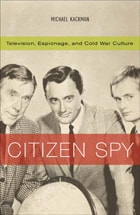
Citizen Spy
Television, Espionage, and Cold War CultureMichael Kackman
University of Minnesota Press, 2005
During the first decade of the Cold War, Hollywood developed such shows as I Led 3 Lives and Behind Closed Doors with the approval of federal intelligence agencies, even basing episodes on actual case files. These “documentary melodramas” were, Kackman argues, vehicles for the fledgling television industry to proclaim its loyalty to the government, and they came stocked with appeals to patriotism and anti-Communist vigilance.
As the rigid cultural logic of the Red Scare began to collapse, spy shows became more playful, self-referential, and even critical of the ideals professed in their own scripts. From parodies such as The Man from U.N.C.L.E. and Get Smart to the more complicated global and political situations of I Spy and Mission: Impossible, Kackman situates espionage television within the tumultuous culture of the civil rights and women’s movements and the war in Vietnam. Yet, even as spy shows introduced African-American and female characters, they continued to reinforce racial and sexual stereotypes.
Bringing these concerns to the political and cultural landscape of the twenty-first century, Kackman asserts that the roles of race and gender in national identity have become acutely contentious. Increasingly exclusive definitions of legitimate citizenship, heroism, and dissent have been evident through popular accounts of the Iraq war. Moving beyond a snapshot of television history, Citizen Spy provides a contemporary lens to analyze the nature—and implications—of American nationalism in practice.
Michael Kackman is assistant professor in Radio-Television-Film at the University of Texas, Austin.
Citizen-Saints
Shakespeare and Political TheologyJulia Reinhard Lupton
University of Chicago Press, 2005
Among the many questions Julia Reinhard Lupton attempts to answer under the rubric of the citizen-saint are: how did states of emergency, acts of sovereign exception, and Messianic anticipations lead to new forms of religious and political law? What styles of universality were implied by the abject state of the pure creature, at sea in a creation abandoned by its creator? And how did circumcision operate as both a marker of ethnicity and a means of conversion and civic naturalization?
Written with clarity and grace, Citizen-Saints will be of enormous interest to students of English literature, religion, and early modern culture.
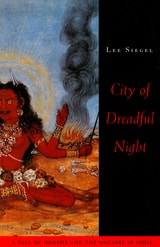
City of Dreadful Night
A Tale of Horror and the Macabre in IndiaLee Siegel
University of Chicago Press, 1995
But what started out as a study of other people's stories became a compelling story itself. City of Dreadful Night is an astonishing work of fiction, a tangle of tales that transports the reader from the Medieval India of magicians, witches, and vampires, through the British India of Brahm Kathuwala's childhood, into the chaos and political terror of contemporary India. Vividly recreating Indian literary and oral traditions, Siegel weaves a web of possession, reincarnation, and magical transformation unlike any found in the Western tradition. Flesh-eating demons, Rajiv Gandhi's assassin, even Bram Stoker and Dracula populate the serpentine narrative, which intermingles stories about the characters with the terrifying tales they tell.
Siegel pursues Brahm Kathuwala from the ghastly lights of the cremation ground at Banaras through villages all over north India. Brahm's life story is revealed through countless tales along the way. We learn that he was raised, and abandoned, by two mothers—one the destitute floor sweeper who bore him; the other her employer, a wealthy Irish woman who read and reread to him the story of Dracula. We hear of his marriage to the daughter of a cremation ground attendant, his battles against her demonic possession, and their painful parting. We come to understand the daily life and motivations of this "horror professional," who uses terrifying tales to ward off the evil he himself fears.
This unorthodox book is more than a story; it blends scholarship, fantasy, travelogue, and autobiography—fusing and overlapping historical accounts and newscasts, literary texts and films, dreams and nocturnal tales. Siegel uses imagination to explore the relation of real terror to horror fiction and to contemplate the ways fear and disgust become thrilling elements in stories of the macabre.
This book is the product of Siegel's deep knowledge of both Indian and Western literary and philosophical traditions. It is also an attempt to come to grips with the omnipresence of political and religious terror in contemporary India. Shocking, original, beautifully written, City of Dreadful Night offers readers a captivating immersion in the wonder and terror of India, past and present.
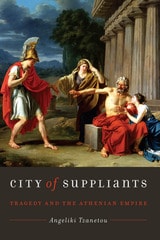
City of Suppliants
Tragedy and the Athenian EmpireBy Angeliki Tzanetou
University of Texas Press, 2012
After fending off Persia in the fifth century BCE, Athens assumed a leadership position in the Aegean world. Initially it led the Delian League, a military alliance against the Persians, but eventually the league evolved into an empire with Athens in control and exacting tribute from its former allies. Athenians justified this subjection of their allies by emphasizing their fairness and benevolence towards them, which gave Athens the moral right to lead. But Athenians also believed that the strong rule over the weak and that dominating others allowed them to maintain their own freedom. These conflicting views about Athens’ imperial rule found expression in the theater, and this book probes how the three major playwrights dramatized Athenian imperial ideology.
Through close readings of Aeschylus’ Eumenides, Euripides’ Children of Heracles, and Sophocles’ Oedipus at Colonus, as well as other suppliant dramas, Angeliki Tzanetou argues that Athenian tragedy performed an important ideological function by representing Athens as a benevolent and moral ruler that treated foreign suppliants compassionately. She shows how memorable and disenfranchised figures of tragedy, such as Orestes and Oedipus, or the homeless and tyrant-pursued children of Heracles were generously incorporated into the public body of Athens, thus reinforcing Athenians’ sense of their civic magnanimity. This fresh reading of the Athenian suppliant plays deepens our understanding of how Athenians understood their political hegemony and reveals how core Athenian values such as justice, freedom, piety, and respect for the laws intersected with imperial ideology.
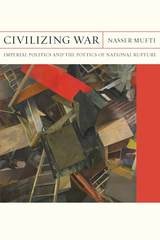
Civilizing War
Imperial Politics and the Poetics of National RuptureNasser Mufti
Northwestern University Press, 2018
Honorable Mention for the 2019 Sonya Rudikoff Prize, awarded by the Northeast Victorian Studies Association
Civilizing War traces the historical transformation of civil war from a civil affair into an uncivil crisis. Civil war is today synonymous with the global refugee crisis, often serving as grounds for liberal-humanitarian intervention and nationalist protectionism.
In Civilizing War, Nasser Mufti situates this contemporary conjuncture in the long history of British imperialism, demonstrating how civil war has been and continues to be integral to the politics of empire. Through comparative readings of literature, criticism, historiography, and social analysis, Civilizing War shows how writers and intellectuals of Britain’s Anglophone empire articulated a “poetics of national rupture” that defined the metropolitan nation and its colonial others.
Mufti’s tour de force marshals a wealth of examples as diverse as Thomas Carlyle, Benjamin Disraeli, Friedrich Engels, Arthur Conan Doyle, Rudyard Kipling, Joseph Conrad, V. S. Naipaul, Nadine Gordimer, and Michael Ondaatje to examine the variety of forms this poetics takes—metaphors, figures, tropes, puns, and plot—all of which have played a central role in Britain’s civilizing mission and its afterlife. In doing so, Civilizing War shifts the terms of Edward Said’s influential Orientalism to suggest that imperialism was not only organized around the norms of civility but also around narratives of civil war.
Claiming Others
Transracial Adoption and National BelongingMark C. Jerng
University of Minnesota Press, 2010
Jerng considers how adoption makes us rethink the parent-child bond as central to issues of race and nationality, showing the ways adoption also speaks to broader questions about our history and identity. He analyzes adoption through a diverse set of texts, including the 1851 Massachusetts statute that established adoption as we understand it today, early adoption manuals, the New York Times blog Relative Choices, and the work of John Tanner, Lydia Maria Child, William Faulkner, Charles Chesnutt, Chang-rae Lee, and David Henry Hwang.
Imaginative and social practices of transracial adoption have shaped major controversies, Jerng argues, from Native American removal to slavery to cold war expansionism in the twentieth century and the contemporary global market in children. As Claiming Others makes clear, understanding adoption is crucial not just to understanding the history between races in the United States, but also the meaning of emancipation and the role of family in nationhood.
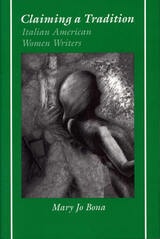
Claiming a Tradition
Italian American Women WritersMary Jo Bona
Southern Illinois University Press, 1999
Bona discusses the novels in pairs according to their focus on Italian American life. She first examines the traditions of italianitá (a flavor of things Italian) that inform and enhance works of fiction. The novelists in that tradition were Mari Tomasi (Like Lesser Gods, 1949) and Marion Benasutti (No Steady Job for Papa, 1966).
Bona then turns to later novels that highlight the Italian American belief in the family's honor and reputation. Conflicts between generations, specifically between autocratic fathers and their children, are central to Octavia Waldo's 1961 A Cup of the Sun and Josephine Gattuso Hendin's 1988 The Right Thing to Do.
Even when writers choose to steer away from the familial focus, Bona notes, their developmental narratives trace the reintegration of characters suffering from a crisis of cultural identity. Relating the characters' struggles to their relationship to the family, Bona examines Diana Cavallo's 1961 A Bridge of Leaves and Dorothy Bryant's 1978 Miss Giardino.
Bona then discusses two innovative novels— Helen Barolini's 1979 Umbertina and Tina De Rosa's 1980 Paper Fish— both of which feature a granddaughter who invokes her grandmother, a godparent figure. Through Barolini's feminist and De Rosa's modernist perspectives, both novels present a young girl developing artistically.
Closing with a discussion of the contemporary terrain Italian American women traverse, Bona examines such topics as sexual identity when it meets cultural identity and the inclusion of italianitá when Italian American identity is not central to the story. Italian American women writers, she concludes, continue in the 1980s and 1990s to focus on the interplay between cultural identity and women's development.
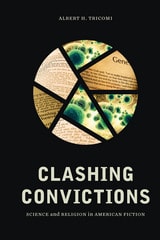
Clashing Convictions
Science and Religion in American FictionAlbert H. Tricomi
The Ohio State University Press, 2016
With chapters on James Lane Allen’s The Reign of Law, Harold Frederic’s The Damnation of Theron Ware, William Dean Howells’s The Leatherwood God, Sinclair Lewis’s Arrowsmith and Elmer Gantry, Jerome Lawrence and Robert E. Lee’s Inherit the Wind, and James Scott Bell’s The Darwin Conspiracy, Tricomi offers new readings emphasizing how this canon represents science and religion as in deep, if not irreconcilable, conflict. Tricomi’s sweeping study, with its emphasis on the twentieth century, thus reveals from several directions the processes of secularism even as it identifies the emergence of what some have come to describe as the current “postsecular” moment in America.

Class Act
The Cultural and Political Life of Ewan MaccollBen Harker
Pluto Press, 2007
MacColl became a communist at fourteen and spent six decades at the cultural forefront of numerous political struggles, producing plays, songs and radio programmes on subjects ranging from the Spanish Civil War to the Poll Tax. Charting his involvement in radical theatre, his ground breaking radio work in the UK and the USA, as well as his musical influences and legacy, his three marriages, and his relationship with his songwriter daughter Kirstie MacColl, this is a lively account of a much-loved icon of 20th century folk music.
Drawing on extensive research, Class Act is a freshly conceived and energetically written account of a highly creative and controversial activist.
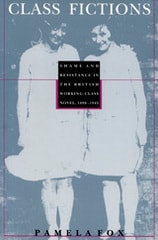
Class Fictions
Shame and Resistance in the British Working Class Novel, 1890–1945Pamela Fox
Duke University Press, 1994
With a focus on certain classics in the working-class literary "canon," such as The Ragged Trousered Philanthropists and Love on the Dole, as well as lesser-known texts by working-class women, Fox uncovers the anxieties that underlie representations of class and consciousness. Shame repeatedly emerges as a powerful counterforce in these works, continually unsettling the surface narrative of protest to reveal an ambivalent relation toward the working-class identities the novels apparently champion.
Class Fictions offers an equally rigorous analysis of cultural studies itself, which has historically sought to defend and value the radical difference of working-class culture. Fox also brings to her analysis a strong feminist perspective that devotes considerable attention to the often overlooked role of gender in working-class fiction. She demonstrates that working-class novels not only expose master narratives of middle-class culture that must be resisted, but that they also reveal to us a need to create counter narratives or formulas of working-class life. In doing so, this book provides a more subtle sense of the role of resistance in working class culture. While of interest to scholars of Victorian and working-class fiction, Pamela Fox’s argument has far-reaching implications for the way literary and cultural studies will be defined and practiced.
Classical Epic Tradition
John Kevin Newman
University of Wisconsin Press, 1986
The literary epic and critical theories about the epic tradition are traced from Aristotle and Callimachus through Apollonius, Virgil, and their successors such as Chaucer and Milton to Eisenstein, Tolstoy, and Thomas Mann. Newman's revisionist critique will challenge all scholars, students, and general readers of the classics, comparative literature, and western literary traditions.
Classical Rhetoric in English Poetry
Brian Vickers
Southern Illinois University Press, 1989
Back in print after 17 years, this is a concise history of rhetoric as it relates to structure, genre, and style, with special reference to English literature and literary criticism from Ancient Greece to the end of the 18th century.
The core of the book is a quite original argument that the figures of rhetoric were not mere mechanical devices, were not, as many believed, a "nuisance, a quite sterile appendage to rhetoric to which (unaccountably) teachers, pupils, and writers all over the world devoted much labor for over 2,000 years." Rather, Vickers demonstrates, rhetoric was a stylized representation of language and human feelings.
Vickers supplements his argument through analyses of the rhetorical and emotional structure of four Renaissance poems. He also defines 16 of the most common figures of rhetoric, citing examples from the classics, the Bible, and major English poets from Chaucer to Pope.
Classics Beyond the Pleasure Principle
Edited by Paul Allen Miller and Mario Telò
The Ohio State University Press, 2026
Contributors:
Karen Bassi, Martin Devecka, Micaela Janan, Hagi Kenaan, Vered Lev Kenaan, Sara Lindheim, Paul Allen Miller, Helen Morales, Jay Oliver, Victoria Rimell, Mario Telò