28167 books match the query 'History' and 1913 start with c
cover of Crime and Punishment in the Jim Crow South

Crime and Punishment in the Jim Crow South

Edited by Amy Louise Wood and Natalie J. Ring

University of Illinois Press, 2019

Policing, incarceration, capital punishment: these forms of crime control were crucial elements of Jim Crow regimes. White southerners relied on them to assert and maintain racial power, which led to the growth of modern state bureaucracies that eclipsed traditions of local sovereignty. Friction between the demands of white supremacy and white southern suspicions of state power created a distinctive criminal justice system in the South, elements of which are still apparent today across the United States.

In this collection, Amy Louise Wood and Natalie J. Ring present nine groundbreaking essays about the carceral system and its development over time. Topics range from activism against police brutality to the peculiar path of southern prison reform to the fraught introduction of the electric chair. The essays tell nuanced stories of rapidly changing state institutions, political leaders who sought to manage them, and African Americans who appealed to the regulatory state to protect their rights.

Contributors: Pippa Holloway, Tammy Ingram, Brandon T. Jett, Seth Kotch, Talitha L. LeFlouria, Vivien Miller, Silvan Niedermeier, K. Stephen Prince, and Amy Louise Wood
[more]
cover of Crime in Verse: The Poetics of Murder in the Victorian Era

Crime in Verse

The Poetics of Murder in the Victorian Era

Ellen L. O’Brien

The Ohio State University Press, 2008
Over the last few decades, Victorian scholars have produced many nuanced studies connecting the politics of crime to the generic developments of the novel—and vice versa. Ellen L. O’Brien’s Crime in Verse grants the same attention and status to poetic representations of crime. Considering the literary achievements and cultural engagements of poetry while historicizing murder’s entanglement in legal fictions, punitive practices, medical theories, class conflicts, and gender codes, O’Brien argues that shifting approaches to poetry and conflicted understandings of murder allowed poets to align problems of legal and literary interpretation in provocative, disruptive, and innovative ways.
 
Developing focused analyses of generic and discursive meanings, individual chapters examine the classed politics of crime and punishment in the broadside ballad, the epistemological tensions of homicidal lunacy and criminal responsibility in the dramatic monologue, and the legal and ideological frictions of domestic violence in the verse novel and verse drama. Their juxtaposition of the rhymes of anonymous street balladeers, the underexamined verse of “minor” poets, and the familiar poems of canonical figures suggests the interactive and intertextual relationships informing poetic agendas and political arguments. As it simultaneously reconsiders the institutional and ideological status of murder and the aesthetic and political interests of poetry, Crime in Verse offers new ways of thinking about Victorian poetry’s contents and contexts.
          
[more]
cover of Crime, Corrections, and the COVID-19 Pandemic: Responses and Adaptations in the U.S. Criminal Justice System

Crime, Corrections, and the COVID-19 Pandemic

Responses and Adaptations in the U.S. Criminal Justice System

Edited by Breanne Pleggenkuhle and Joseph A. Schafer

Southern Illinois University Press, 2025

Analyses of crime and justice in an unprecedented time

While COVID-19 lockdowns affected nearly everyone worldwide, feelings of anxiety and fear were exacerbated for those already entangled in the criminal justice system. Scholars recognized the unique opportunity to study crime and the justice system’s response during this period, though they soon realized that determining the pandemic’s effects would be a complicated, nuanced process.

Crime, Corrections, and the COVID-19 Pandemic features analyses and findings from more than thirty contributors in eleven essays. The collection examines the multifaceted social, economic, cultural, legislative, and policy responses to COVID-19 and their impacts on crime and justice. It also explores how professionals across the criminal justice system—police officers, campus police officers, attorneys, judges, correctional staff, and community supervision agents—adapted to unprecedented challenges.

The book provides real-world evidence of how unconventional solutions and groundbreaking practices were implemented in response to a global crisis. Contributors analyze how incarcerated individuals, their families, and their supervisors dealt with the fear of transmission, medical care, and death. Their findings, which are necessarily dependent on timing, place, measurement, and operationalization, include both change and stasis, both negative and positive outcomes. For instance, while minor and property-related offenses initially declined, violent crimes like homicide and intimate partner violence increased. Drug usage patterns changed, leading to a rise in opioid overdoses, and despite the rise in digital interactions, there was no significant difference in self-reported cybervictimization. Furthermore, rates of gang-related crimes did not decrease. Policy and public health responses reshaped criminal activities, influencing the methods and motivations behind theft, child and elder abuse, and other offenses. This volume includes in-depth examinations of certain often-overlooked crimes, such as labor trafficking, and provides direct insights into the job challenges faced by criminal justice professionals, from probation personnel to labor rights advocates.

Emerging innovations in health risk management within correctional facilities led to increased awareness and focus on specific types of crime. Responses to the pandemic revealed significant challenges, such as burnout among justice system personnel, difficulties in adapting and innovating, and challenges in providing services to vulnerable populations.

Through diverse perspectives and empirical approaches ranging from advanced statistical analysis to qualitative interviews, Crime, Corrections, and the COVID-19 Pandemic offers a comprehensive exploration of the complexities that affect research results.  It showcases the resilience and innovation within the criminal justice field and details the challenges professionals in this area tackled during a universally trying time, presenting valuable lessons for future crises. 
[more]
cover of Crimes Against Feeling: Piracy, Sympathy, and Ocean Politics in Antebellum American Legal Culture

Crimes Against Feeling

Piracy, Sympathy, and Ocean Politics in Antebellum American Legal Culture

Mark B. Kelley

University of Massachusetts Press, 2026

Demonstrating how emotion became central to the legal and literary meanings of piracy in nineteenth-century America

Pirates have long occupied a central yet unstable place in American law and national identity. In the decades leading up to and including the U.S. Civil War, the charge of piracy was leveled against an unusually wide range of figures: foreign heads of state, imperial filibusters, transoceanic enslavers, enslaved mutineers, radical abolitionists, and others who challenged established forms of authority. Early American literature reflects this instability, portraying pirates who vary dramatically in politics, race, gender, and allegiance. As Mark B. Kelley shows, these characters are united less by ideology than by their challenge to landed social norms and fixed national belonging. The pirate, in both law and literature, emerges as an individual defined by multiplicity rather than political coherence. 

Crimes Against Feeling examines how Americans made sense of this ambiguous figure by turning to emotion. Drawing on legal materials including treaties, trial transcripts, congressional debates, and U.S. Supreme Court decisions, as well as popular sentimental fiction (often written by women), Kelley argues that piracy was codified as an offense against moral feeling rather than being a singular political position. Legal thinkers and writers such as John Quincy Adams, Abraham Lincoln, Jefferson Davis, Catharine Maria Sedgwick, Harriet Beecher Stowe, and Maria S. Cummins relied on shared affective frameworks—sympathy, sentiment, and domestic vulnerability—to render piracy legible and punishable. American pirate law, Kelley demonstrates, was shaped by the same emotional logics that structured the era’s popular fiction. 

By tracing piracy across debates over domestic sovereignty, global enslavement and abolition, imperial expansion, postbellum reparations, and international copyright, Crimes Against Feeling reveals the pirate as a key figure for understanding gender, home, family, and nation in early America. Reading law and literature together, the book shows how emotional judgment—not political consensus—became a foundational tool for managing oceanic violence and transnational disorder in the nineteenth-century United States. 
[more]
cover of Criminal Intimacy: Prison and the Uneven History of Modern American Sexuality

Criminal Intimacy

Prison and the Uneven History of Modern American Sexuality

Regina Kunzel

University of Chicago Press, 2008
Sex is usually assumed to be a closely guarded secret of prison life. But it has long been the subject of intense scrutiny by both prison administrators and reformers—as well as a source of fascination and anxiety for the American public. Historically, sex behind bars has evoked radically different responses from professionals and the public alike. In Criminal Intimacy, Regina Kunzel tracks these varying interpretations and reveals their foundational influence on modern thinking about sexuality and identity.
 
Historians have held the fusion of sexual desire and identity to be the defining marker of sexual modernity, but sex behind bars, often involving otherwise heterosexual prisoners, calls those assumptions into question. By exploring the sexual lives of prisoners and the sexual culture of prisons over the past two centuries—along with the impact of a range of issues, including race, class, and gender; sexual violence; prisoners’ rights activism; and the HIV epidemic—Kunzel discovers a world whose surprising plurality and mutability reveals the fissures and fault lines beneath modern sexuality itself.
 
Drawing on a wide range of sources, including physicians, psychiatrists, sociologists, correctional administrators, journalists, and prisoners themselves—as well as depictions of prison life in popular culture—Kunzel argues for the importance of the prison to the history of sexuality and for the centrality of ideas about sex and sexuality to the modern prison. In the process, she deepens and complicates our understanding of sexuality in America.
[more]
cover of Criminal-Inquisitorial Trials in English Church Trials: From the Middle Ages to the Reformation

Criminal-Inquisitorial Trials in English Church Trials

From the Middle Ages to the Reformation

Henry Ansgar Kelly

Catholic University of America Press, 2023
After inquisitorial procedure was introduced at the Fourth Lateran Council in Rome in 1215 (the same year as England’s first Magna Carta), virtually all court trials initiated by bishops and their subordinates were inquisitions. That meant that accusers were no longer needed. Rather, the judges themselves leveled charges against persons when they were publicly suspected of specific offenses—like fornication, or witchcraft, or simony. Secret crimes were off limits, including sins of thought (like holding a heretical belief). Defendants were allowed full defenses if they denied charges. These canonical rules were systematically violated by heresy inquisitors in France and elsewhere, especially by forcing self-incrimination. But in England, due process was generally honored and the rights of defendants preserved, though with notable exceptions. In this book, Henry Ansgar Kelly, a noted forensic historian, describes the reception and application of inquisition in England from the thirteenth century onwards and analyzes all levels of trial proceedings, both minor and major, from accusations of sexual offenses and cheating on tithes to matters of religious dissent. He covers the trials of the Knights Templar early in the fourteenth century and the prosecutions of followers of John Wyclif at the end of the century. He details how the alleged crimes of “criminous clerics” were handled, and demonstrates that the judicial actions concerning Henry VIII’s marriages were inquisitions in which the king himself and his queens were defendants. Trials of Alice Kyteler, Margery Kempe, Eleanor Cobham, and Anne Askew are explained, as are the unjust trials condemning Bishop Reginald Pecock of error and heresy (1457-59) and Richard Hunne for defending English Bibles (1514). He deals with the trials of Lutheran dissidents at the time of Thomas More’s chancellorship, and trials of bishops under Edward VI and Queen Mary, including those against Stephen Gardiner and Thomas Cranmer. Under Queen Elizabeth, Kelly shows, there was a return to the letter of papal canon law (which was not true of the papal curia). In his conclusion he responds to the strictures of Sir John Baker against inquisitorial procedure, and argues that it compares favorably to the common-law trial by jury.
[more]
cover of Criminalization/Assimilation: Chinese/Americans and Chinatowns in Classical Hollywood Film

Criminalization/Assimilation

Chinese/Americans and Chinatowns in Classical Hollywood Film

Philippa Gates

Rutgers University Press, 2019
Criminalization/Assimilation traces how Classical Hollywood films constructed America’s image of Chinese Americans from their criminalization as unwanted immigrants to their eventual acceptance when assimilated citizens, exploiting both America’s yellow peril fears about Chinese immigration and its fascination with Chinatowns. Philippa Gates examines Hollywood’s responses to social issues in Chinatown communities, primarily immigration, racism, drug trafficking, and prostitution, as well as the impact of industry factors including the Production Code and star system on the treatment of those subjects. Looking at over 200 films, Gates reveals the variety of racial representations within American film in the first half of the twentieth century and brings to light not only lost and forgotten films but also the contributions of Asian American actors whose presence onscreen offered important alternatives to Hollywood’s yellowface fabrications of Chinese identity and a resistance to Hollywood’s Orientalist narratives.
[more]
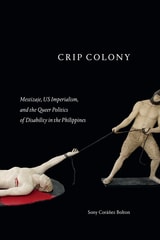
cover of Crip Colony: Mestizaje, US Imperialism, and the Queer Politics of Disability in the Philippines

Crip Colony

Mestizaje, US Imperialism, and the Queer Politics of Disability in the Philippines

Sony Coráñez Bolton

Duke University Press, 2023

In Crip Colony, Sony Coráñez Bolton examines the racial politics of disability, mestizaje, and sexuality in the Philippines. Drawing on literature, poetry, colonial records, political essays, travel narratives, and visual culture, Coráñez Bolton traces how disability politics colluded with notions of Philippine mestizaje. He demonstrates that Filipino mestizo writers in the late nineteenth and early twentieth centuries used mestizaje as a racial ideology of ability that marked Indigenous inhabitants of the Philippines as lacking in civilization and in need of uplift and rehabilitation. Heteronormative, able-bodied, and able-minded mixed-race Filipinos offered a model and path for assimilation into the US empire. In this way, mestizaje allowed for supposedly superior mixed-race subjects to govern the archipelago in collusion with American imperialism. By bringing disability studies together with studies of colonialism and queer-of-color critique, Coráñez Bolton extends theorizations of mestizaje beyond the United States and Latin America while considering how Filipinx and Filipinx American thought fundamentally enhances understandings of the colonial body and the racial histories of disability.
[more]
cover of Cripping Girlhood

Cripping Girlhood

Anastasia Todd

University of Michigan Press, 2024

Cripping Girlhood offers a new theorization of disabled girlhood, tracing how and why representations of disabled girls emerge with frequency in twenty-first century U.S. media culture. It uncovers how the exceptional figure of the disabled girl most often appears as a resource to work through post-Americans with Disabilities Act (ADA) anxieties about the family, healthcare, labor, citizenship, and the precarity of the bodymind. In paying critical attention to disabled girlhood, the book uses feminist disability studies to rupture the unwitting assumption in girls’ studies that girlhood is necessarily non-disabled. 

By closely examining the ways that disabled girls represent themselves, Anastasia Todd goes beyond a critique of the figure of the privileged, disabled girl subject in the national imagination to explore how disabled girls circulate their own capacious re-envisioning of what it means to be a disabled girl. In analyzing a range of cultural sites, including YouTube, TikTok, documentaries, and GoFundMe campaigns, Todd shows how disabled girls actively upend what we think we know about them and their experience, recasting the meanings ascribed to their bodyminds in their own terms.  By analyzing disabled girls’ self-representational practices and cultural productions, Todd shows how disabled girls deftly theorize their experiences of ableism, sexism, racism, and ageism, and cultivate communities online, creating archives of disability knowledge and politicizing other disabled people in the process. 
[more]
cover of Cripping the Archive: Disability, History, and Power

Cripping the Archive

Disability, History, and Power

Edited by Jenifer L. Barclay and Stefanie Hunt-Kennedy Foreword by Jaipreet Virdi

University of Illinois Press, 2025

How do we explain the conspicuous absence of disability from the histories we write? What forces and factors create this dynamic? How can disability be everywhere and nowhere, present and absent, and obvious and overlooked in both the historical record and historians’ interpretations of the past?

Jenifer L. Barclay and Stefanie Hunt-Kennedy edit a collection of interdisciplinary essays that consider how and why physical, sensory, intellectual, and psychological disabilities are underrepresented, erased, or distorted in the historical record. The contributors draw on the methodology and practice of cripping to uncover disability in contested archives and explore ways to build inclusive archives accountable to, and centered on, disabled people and disability justice. Throughout, they show ableness informing the politics of the archive as a physical space, a discriminatory record, and a collection of silences.

An essential contribution to research methods and disability justice, Cripping the Archive offers a blueprint for intersectional and interdisciplinary approaches that bridge disability studies, history, and archival studies.
[more]
cover of Crippled Justice: The History of Modern Disability Policy in the Workplace

Crippled Justice

The History of Modern Disability Policy in the Workplace

Ruth O'Brien

University of Chicago Press, 2001

Crippled Justice, the first comprehensive intellectual history of disability policy in the workplace from World War II to the present, explains why American employers and judges, despite the Americans with Disabilities Act, have been so resistant to accommodating the disabled in the workplace. Ruth O'Brien traces the origins of this resistance to the postwar disability policies inspired by physicians and psychoanalysts that were based on the notion that disabled people should accommodate society rather than having society accommodate them.

O'Brien shows how the remnants of postwar cultural values bogged down the rights-oriented policy in the 1970s and how they continue to permeate judicial interpretations of provisions under the Americans with Disabilities Act. In effect, O'Brien argues, these decisions have created a lose/lose situation for the very people the act was meant to protect. Covering developments up to the present, Crippled Justice is an eye-opening story of government officials and influential experts, and how our legislative and judicial institutions have responded to them.
[more]
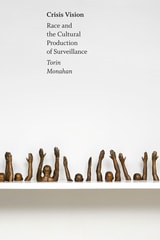
cover of Crisis Vision: Race and the Cultural Production of Surveillance

Crisis Vision

Race and the Cultural Production of Surveillance

Tom Monahan

Duke University Press, 2022
In Crisis Vision, Torin Monahan explores how artists confront the racializing dimensions of contemporary surveillance. He focuses on artists ranging from Kai Wiedenhöfer, Paolo Cirio, and Hank Willis Thomas to Claudia Rankine and Dread Scott, who engage with what he calls crisis vision—the regimes of racializing surveillance that position black and brown bodies as targets for police and state violence. Many artists, Monahan contends, remain invested in frameworks that privilege transparency, universality, and individual responsibility in ways that often occlude racial difference. Other artists, however, disrupt crisis vision by confronting white supremacy and destabilizing hierarchies through the performance of opacity. Whether fostering a recognition of a shared responsibility and complicity for the violence of crisis vision or critiquing how vulnerable groups are constructed and treated globally, these artists emphasize ethical relations between strangers and ask viewers to question their own place within unjust social orders.
[more]
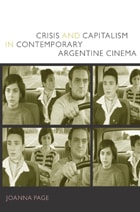
cover of Crisis and Capitalism in Contemporary Argentine Cinema

Crisis and Capitalism in Contemporary Argentine Cinema

Joanna Page

Duke University Press, 2009

There has been a significant surge in recent Argentine cinema, with an explosion in the number of films made in the country since the mid-1990s. Many of these productions have been highly acclaimed by critics in Argentina and elsewhere. What makes this boom all the more extraordinary is its coinciding with a period of severe economic crisis and civil unrest in the nation. Offering the first in-depth English-language study of Argentine fiction films of the late twentieth century and early twenty-first, Joanna Page explains how these productions have registered Argentina’s experience of capitalism, neoliberalism, and economic crisis. In different ways, the films selected for discussion testify to the social consequences of growing unemployment, rising crime, marginalization, and the expansion of the informal economy.

Page focuses particularly on films associated with New Argentine Cinema, but she also discusses highly experimental films and genre movies that borrow from the conventions of crime thrillers, Westerns, and film noir. She analyzes films that have received wide international recognition alongside others that have rarely been shown outside Argentina. What unites all the films she examines is their attention to shifts in subjectivity provoked by political or economic conditions and events. Page emphasizes the paradoxes arising from the circulation of Argentine films within the same global economy they so often critique, and she argues that while Argentine cinema has been intent on narrating the collapse of the nation-state, it has also contributed to the nation’s reconstruction. She brings the films into dialogue with a broader range of issues in contemporary film criticism, including the role of national and transnational film studies, theories of subjectivity and spectatorship, and the relationship between private and public spheres.
[more]
cover of Crisis and Conversion in Apuleius' Metamorphoses

Crisis and Conversion in Apuleius' Metamorphoses

Nancy Shumate

University of Michigan Press, 1996

Apuleius' wonderful Latin novel Metamorphoses, written in the second century C.E., was for a long time neglected. In recent years some have attempted to understand the Metamorphoses by applying contemporary critical theory to the work, without notable success. In Crisis and Conversion in Apuleius' "Metamorphoses" Nancy Shumate takes a new and profitable approach: she uses an epistemologically oriented model of religious conversion to study the experiences of the novel's central character, Lucius, who is turned into an ass and back again.
Shumate draws on a wide range of literary and nonliterary representations of conversion in order to establish a useful theoretical framework. The Metamorphoses is exposed as a text anticipating later narratives in its concern with world-building, with the narrator's subjective reality, and with the invocation and critique of religious experience.
Crisis and Conversion in Apuleius' "Metamorphoses" will be of interest to classicists and scholars of Silver Latin and of the increasingly popular ancient novel, as well as to students of psychology and the sociology of religious experience.
Nancy Shumate is Associate Professor of Classical Languages and Literatures, Smith College.
[more]
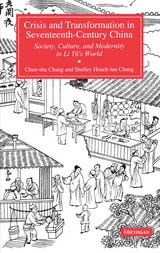
cover of Crisis and Transformation in Seventeenth-Century China: Society, Culture, and Modernity in Li Yu's World

Crisis and Transformation in Seventeenth-Century China

Society, Culture, and Modernity in Li Yu's World

Chun-shu Chang and Shelley Hsueh-lun Chang

University of Michigan Press, 1998

The seventeenth century was a time of great social and political upheaval in China. In Crisis and Transformation in Seventeenth-Century China, Chun-shu Chang and Shelley Hsueh-lun Chang offer a detailed and engaging analysis of society, culture, and the state in China during this critical period.
The main thread of the book follows the life and works of a remarkable figure of the period, Li Yü (1611-80), whose vast array of accomplishments and experiences mirror seventeenth-century China in all its complexity and excitement. Li Yü's China was a world of unprecedented changes in almost all spheres of life. A thriving commercial and industrial economy, stupendous population growth, and the emergence of a new age of science and technology were accompanied by intense urbanization, radical views on money, wealth, and luxury, liberal attitudes toward sexuality, and developments that would change the nature of the literary and intellectual world. The Changs' exhaustive exploration of Chinese historical and literary sources of the sixteenth and seventeenth centuries is combined with a selective application of interpretive insights and analytic techniques from the major theoretical schools.
An important resource for scholars in history, literature, and Asian studies, Crisis and Transformation extends its appeal to those interested in the history of science, issues of gender and social transformation, and popular culture movements.
Chun-shu Chang is Professor of History, University of Michigan, and Honorary Professor of Chinese History, China. Shelley Hsueh-lun Chang is Visiting Associate Professor of History and Research Associate, Center for Chinese Studies, University of Michigan.
[more]
cover of Crisis in Costa Rica: The 1948 Revolution

Crisis in Costa Rica

The 1948 Revolution

By John Patrick Bell

University of Texas Press, 1971

The Costa Rican revolution of 1948 capped an extended period of social tension and political unrest. This book analyzes the circumstances of 1940–1948 that led to a successful armed uprising. A secondary and related theme is the role of José Figueres Ferrer in marshaling disparate groups into a movement sufficiently cohesive to seize and hold power.

In the 1940s the Communists, the Social Democrats (forerunners of the National Liberation Party), and the followers of Rafael Angel Calderón Guardia within the traditional National Republican party competed to lead the middle sector’s demand for modernization. Most accounts of this period have presented the Calderón regime as aristocratic or oligarchic in nature, yet as linked to an international Communist movement.

John Patrick Bell, supporting his argument with considerable detail and documentation from newspapers and private papers, argues that Calderón came to depend upon his alliance with the Communist-oriented Vanguardia Popular to counteract the defection of the right wing of the National Republican party and that the sources of the Vanguardia Popular were basically indigenous. The calderonistas’ comprehensive program for social and economic reform had elicited strong conservative reaction, and this opposition was ready to push the charge of communism against Calderón.

Costa Rica thus entered a period of violent political confrontation that culminated in the electoral victory of the conservative candidate, Otilio Ulate Blanco, in February 1948. When the calderonista majority in Congress annulled the election, José Figueres Ferrer launched a successful uprising purportedly to force ratification of Ulate’s election. In reality, however, Figueres had been planning a revolt for nearly six years to redirect modernization along social democratic lines.

Figueres and his group, seeking even more radical reforms than the calderonistas, were able to use the opposition movement to their advantage, simply because they were prepared, even with force, when the right moment arrived. The National Liberation Movement, led to power by Figueres, dominated the national political development of Costa Rica for decades afterward.

Eschewing a strictly chronological framework, Bell has utilized a topical structure that facilitates a full description of shifts in foreign policy in the United States and Latin America that affected the outcome of the struggle in Costa Rica.
[more]
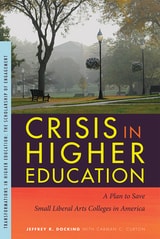
cover of Crisis in Higher Education: A Plan to Save Small Liberal Arts Colleges in America

Crisis in Higher Education

A Plan to Save Small Liberal Arts Colleges in America

Jeffrey R. Docking

Michigan State University Press, 2014
In 2005 Adrian College was home to 840 enrolled students and had a tuition income of $8.54 million. By fall of 2011, enrollment had soared to 1,688, and tuition income had increased to $20.45 million. For the first time in years, the small liberal arts college was financially viable. Adrian College experienced this remarkable growth during the worst American economy in seventy years and in a state ravaged by the decline of the big three auto companies. How, exactly, did this turnaround happen? Crisis in Higher Education: A Plan to Save Small Liberal Arts Colleges in America was written to facilitate replication and generalization of Adrian College’s tremendous enrollment growth and retention success since 2005. This book directly addresses the economic competitiveness of small four-year institutions of higher education and presents an evidence-based solution to the enrollment and economic crises faced by many small liberal arts colleges throughout the country.
[more]
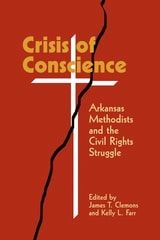
cover of Crisis of Conscience: Arkansas Methodists and the Civil Rights Struggle

Crisis of Conscience

Arkansas Methodists and the Civil Rights Struggle

James T. Clemons

Butler Center for Arkansas Studies, 2007
Crisis of Conscience features personal stories by Arkansas Methodist pastors, laypersons, and community leaders—including Dale Bumpers, M. Joycelyn Elders, and Miller Williams—who lived through the struggles for civil rights in the 1950s and saw their congregations and other institutions rocked by the tumultuous events of the history-making era. The book also depicts the desegregation of Hendrix College, the prophetic role of Philander Smith College in civil rights activism, and the experiences of other Arkansas Methodist institutions in the great freedom struggle that caused many of the state’s church members to realize they could no longer reconcile their belief in God with participation in a segregated society.
[more]
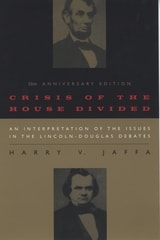
cover of Crisis of the House Divided: An Interpretation of the Issues in the Lincoln-Douglas Debates, 50th Anniversary Edition

Crisis of the House Divided

An Interpretation of the Issues in the Lincoln-Douglas Debates, 50th Anniversary Edition

Harry V. Jaffa

University of Chicago Press, 2009

The definitive account of the Lincoln-Douglas debates and their importance to American history

A lasting classic, Crisis of the House Divided offers an unparalleled account of the Lincoln-Douglas debates. Harry Jaffa provides the definitive analysis of the political principles that guided Lincoln from his reentry into politics in 1854 through his Senate campaign against Douglas in 1858.
[more]
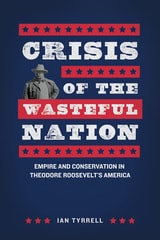
cover of Crisis of the Wasteful Nation: Empire and Conservation in Theodore Roosevelt's America

Crisis of the Wasteful Nation

Empire and Conservation in Theodore Roosevelt's America

Ian Tyrrell

University of Chicago Press, 2014

Long before people were “going green” and toting reusable bags, the Progressive generation of the early 1900s was calling for the conservation of resources, sustainable foresting practices, and restrictions on hunting. Industrial commodities such as wood, water, soil, coal, and oil, as well as improvements in human health and the protection of “nature” in an aesthetic sense, were collectively seen for the first time as central to the country’s economic well-being, moral integrity, and international power. One of the key drivers in the rise of the conservation movement was Theodore Roosevelt, who, even as he slaughtered animals as a hunter, fought to protect the country’s natural resources.

In Crisis of the Wasteful Nation, Ian Tyrrell gives us a cohesive picture of Roosevelt’s engagement with the natural world along with a compelling portrait of how Americans used, wasted, and worried about natural resources in a time of burgeoning empire. Countering traditional narratives that cast conservation as a purely domestic issue, Tyrrell shows that the movement had global significance, playing a key role in domestic security and in defining American interests around the world. Tyrrell goes beyond Roosevelt to encompass other conservation advocates and policy makers, particularly those engaged with shaping the nation’s economic and social policies—policies built on an understanding of the importance of crucial natural resources. Crisis of the Wasteful Nation is a sweeping transnational work that blends environmental, economic, and imperial history into a cohesive tale of America’s fraught relationships with raw materials, other countries, and the animal kingdom.
[more]
cover of Critical Digital Art History: Interface and Data Politics in the Post-Digital Era

Critical Digital Art History

Interface and Data Politics in the Post-Digital Era

Edited by Amanda Wasielewski and Anna Näslund

Intellect Books, 2024

Approaching the use of digital technology in art history from a theoretical perspective.

Digital art history has often aligned itself with the practical concerns of digital technology and the responsibilities of art institutions and associated institutional roles such as collection managers, information specialists, curators, and conservators. This emphasis on practicalities and implementation, while undeniably important, has often left little room for critical examination of the broader implications of digital technology and computational methodologies in art history.

A long-standing concern of the field—and a major focal point of this book—is museum and collecting practices in the digital era. While there is a certain degree of continuity in the field, there are also important shifts and changes to address—namely, the widespread uptake of artificial intelligence tools and increased attention to both the broader historical and societal aspects of the use of digital repositories and tools. This anthology seeks to address the dearth of critical reflection by critically assessing specific case study examples and considering the political dimensions associated with large-scale digitization and the application of digital tools within museums and collection management.
 
[more]
cover of Critical Historical Studies, volume 10 number 1 (Spring 2023)

Critical Historical Studies, volume 10 number 1 (Spring 2023)

The University of Chicago Press

University of Chicago Press Journals, 2023
This is volume 10 issue 1 of Critical Historical Studies. Critical Historical Studies is an interdisciplinary journal devoted to historical reflections on politics, culture, economy, and social life. CHS features research on the implications of socio-economic transformations for cultural, political, and social change. In the broad tradition of Critical Theory, CHS will explore the complex connections between cultural form and socio-economic context and promote a reflexive awareness of the researcher’s own position in the history of global capitalist society. The journal aims to foster interdisciplinary exchange among scholars across the entire range of the social sciences and humanities, and publishes work on all historical eras and regions of the world.
[more]
cover of Critical Historical Studies, volume 10 number 2 (Fall 2023)

Critical Historical Studies, volume 10 number 2 (Fall 2023)

The University of Chicago Press

University of Chicago Press Journals, 2023
This is volume 10 issue 2 of Critical Historical Studies. Critical Historical Studies is an interdisciplinary journal devoted to historical reflections on politics, culture, economy, and social life. CHS features research on the implications of socio-economic transformations for cultural, political, and social change. In the broad tradition of Critical Theory, CHS will explore the complex connections between cultural form and socio-economic context and promote a reflexive awareness of the researcher’s own position in the history of global capitalist society. The journal aims to foster interdisciplinary exchange among scholars across the entire range of the social sciences and humanities, and publishes work on all historical eras and regions of the world.
[more]
cover of Critical Historical Studies, volume 11 number 1 (Spring 2024)

Critical Historical Studies, volume 11 number 1 (Spring 2024)

The University of Chicago Press

University of Chicago Press Journals, 2024
This is volume 11 issue 1 of Critical Historical Studies. Critical Historical Studies is an interdisciplinary journal devoted to historical reflections on politics, culture, economy, and social life. CHS features research on the implications of socio-economic transformations for cultural, political, and social change. In the broad tradition of Critical Theory, CHS will explore the complex connections between cultural form and socio-economic context and promote a reflexive awareness of the researcher’s own position in the history of global capitalist society. The journal aims to foster interdisciplinary exchange among scholars across the entire range of the social sciences and humanities, and publishes work on all historical eras and regions of the world.
[more]
cover of Critical Historical Studies, volume 11 number 2 (Fall 2024)

Critical Historical Studies, volume 11 number 2 (Fall 2024)

The University of Chicago Press

University of Chicago Press Journals, 2024
This is volume 11 issue 2 of Critical Historical Studies. Critical Historical Studies is an interdisciplinary journal devoted to historical reflections on politics, culture, economy, and social life. CHS features research on the implications of socio-economic transformations for cultural, political, and social change. In the broad tradition of Critical Theory, CHS will explore the complex connections between cultural form and socio-economic context and promote a reflexive awareness of the researcher’s own position in the history of global capitalist society. The journal aims to foster interdisciplinary exchange among scholars across the entire range of the social sciences and humanities, and publishes work on all historical eras and regions of the world.
[more]
cover of Critical Historical Studies, volume 12 number 1 (Spring 2025)

Critical Historical Studies, volume 12 number 1 (Spring 2025)

The University of Chicago Press

University of Chicago Press Journals, 2025
This is volume 12 issue 1 of Critical Historical Studies. Critical Historical Studies is an interdisciplinary journal devoted to historical reflections on politics, culture, economy, and social life. CHS features research on the implications of socio-economic transformations for cultural, political, and social change. In the broad tradition of Critical Theory, CHS will explore the complex connections between cultural form and socio-economic context and promote a reflexive awareness of the researcher’s own position in the history of global capitalist society. The journal aims to foster interdisciplinary exchange among scholars across the entire range of the social sciences and humanities, and publishes work on all historical eras and regions of the world.
[more]
cover of Critical Historical Studies, volume 12 number 2 (Fall 2025)

Critical Historical Studies, volume 12 number 2 (Fall 2025)

The University of Chicago Press

University of Chicago Press Journals, 2025
This is volume 12 issue 2 of Critical Historical Studies. Critical Historical Studies is an interdisciplinary journal devoted to historical reflections on politics, culture, economy, and social life. CHS features research on the implications of socio-economic transformations for cultural, political, and social change. In the broad tradition of Critical Theory, CHS will explore the complex connections between cultural form and socio-economic context and promote a reflexive awareness of the researcher’s own position in the history of global capitalist society. The journal aims to foster interdisciplinary exchange among scholars across the entire range of the social sciences and humanities, and publishes work on all historical eras and regions of the world.
[more]
cover of Critical Historical Studies, volume 13 number 1 (Spring 2026)

Critical Historical Studies, volume 13 number 1 (Spring 2026)

The University of Chicago Press

University of Chicago Press Journals, 2026
This is volume 13 issue 1 of Critical Historical Studies. Critical Historical Studies is an interdisciplinary journal devoted to historical reflections on politics, culture, economy, and social life. CHS features research on the implications of socio-economic transformations for cultural, political, and social change. In the broad tradition of Critical Theory, CHS will explore the complex connections between cultural form and socio-economic context and promote a reflexive awareness of the researcher’s own position in the history of global capitalist society. The journal aims to foster interdisciplinary exchange among scholars across the entire range of the social sciences and humanities, and publishes work on all historical eras and regions of the world.
[more]
cover of Critical Historical Studies, volume 8 number 2 (Fall 2021)

Critical Historical Studies, volume 8 number 2 (Fall 2021)

The University of Chicago Press

University of Chicago Press Journals, 2021
This is volume 8 issue 2 of Critical Historical Studies. Critical Historical Studies is an interdisciplinary journal devoted to historical reflections on politics, culture, economy, and social life. CHS features research on the implications of socio-economic transformations for cultural, political, and social change. In the broad tradition of Critical Theory, CHS will explore the complex connections between cultural form and socio-economic context and promote a reflexive awareness of the researcher’s own position in the history of global capitalist society. The journal aims to foster interdisciplinary exchange among scholars across the entire range of the social sciences and humanities, and publishes work on all historical eras and regions of the world.
[more]
cover of Critical Historical Studies, volume 9 number 1 (Spring 2022)

Critical Historical Studies, volume 9 number 1 (Spring 2022)

The University of Chicago Press

University of Chicago Press Journals, 2022
This is volume 9 issue 1 of Critical Historical Studies. Critical Historical Studies is an interdisciplinary journal devoted to historical reflections on politics, culture, economy, and social life. CHS features research on the implications of socio-economic transformations for cultural, political, and social change. In the broad tradition of Critical Theory, CHS will explore the complex connections between cultural form and socio-economic context and promote a reflexive awareness of the researcher’s own position in the history of global capitalist society. The journal aims to foster interdisciplinary exchange among scholars across the entire range of the social sciences and humanities, and publishes work on all historical eras and regions of the world.
[more]
cover of Critical Historical Studies, volume 9 number 2 (Fall 2022)

Critical Historical Studies, volume 9 number 2 (Fall 2022)

The University of Chicago Press

University of Chicago Press Journals, 2022
This is volume 9 issue 2 of Critical Historical Studies. Critical Historical Studies is an interdisciplinary journal devoted to historical reflections on politics, culture, economy, and social life. CHS features research on the implications of socio-economic transformations for cultural, political, and social change. In the broad tradition of Critical Theory, CHS will explore the complex connections between cultural form and socio-economic context and promote a reflexive awareness of the researcher’s own position in the history of global capitalist society. The journal aims to foster interdisciplinary exchange among scholars across the entire range of the social sciences and humanities, and publishes work on all historical eras and regions of the world.
[more]
cover of Critical Hours: Search and Rescue in the White Mountains

Critical Hours

Search and Rescue in the White Mountains

Sandy Stott

University Press of New England, 2018
A misread map, a sudden storm, a forgotten headlamp—and suddenly a leisurely hike turns into a treacherous endeavor. In the past decade, inexpensive but sophisticated navigation devices and mobile phones have led to alarming levels of overconfidence on the trail. Adding to this worrisome trend, the increasing popularity of ventures into mountainous terrain has led hikers seeking solitude—or an adrenaline rush—into increasingly remote or risky forays. Sandy Stott, the “Accidents” editor at the journal of the Appalachian Mountain Club, delivers both a history and a celebration of the search and rescue workers who save countless lives in the White Mountains—along with a plea for us not to take their steadfastness and bravery for granted. Filled with tales of astonishing courage and sobering tragedy, Critical Hours will appeal to outdoor enthusiasts and armchair adventurers alike.
[more]
cover of Critical Patriots: The Contested Declaration of Independence and the Political Thought of James Fennimore Cooper, Herman Melville, and Walt Whitman

Critical Patriots

The Contested Declaration of Independence and the Political Thought of James Fennimore Cooper, Herman Melville, and Walt Whitman

John Alvis

St. Augustine's Press, 2026

[more]
cover of Critical Perspectives on Latino Education in Massachusetts

Critical Perspectives on Latino Education in Massachusetts

Lorna Rivera and Melissa Colón, editors

University of Massachusetts Press, 2025

In Massachusetts, the Latino population increased by 475 percent between 1980 and 2017, marking a dramatic growth. This diverse ethnic community of Puerto Ricans, Dominicans, Salvadoreans, Colombians, Brazilians, and more also contains a wide range of cultures, immigration and migration experiences, languages, and socio-political backgrounds. However, there are numerous commonalities involving education. Recent research at the Mauricio Gastón Institute for Latino Community Development and Policy reveals that Latino students in Massachusetts are more likely to attend public schools, in communities with significant academic achievement and opportunity gaps as well as other challenges, from food scarcity to higher rates of unemployment. At the same time, the state-wide shift to standards-based education has had a disproportionately negative impact on Latino students, who already feel the effects of politically motivated anti-immigrant policies and laws that limit bilingual education.

This collection of essays, from those working inside the classroom as well as researchers taking a broader look at policy, addresses the array of issues facing Latino students in Massachusetts. These perspectives paint a complex picture of the educational experience for Latinos, and offer expert suggestions for improving classrooms, school environments, and ultimate educational outcomes for an important growing demographic in the Commonwealth.

In addition to editors Lorna Rivera and Melissa Colón, this volume’s contributors include Almudena G. Abeyta, Nasteho Ali, Cristina Araujo Brinkerhoff, Michael Berardino, Alex Briesacher, Thomas Conroy, Judenie Dabel, Liya Escalera, Luis Enrique Esquivel, Deyja Enriquez, Isahiah Erilus, Nyal Fuentes, Jazmin Rubi Flete Gomez, Manuel Frau-Ramos, Kimberly A. S. Howard, Patricia Krueger-Henney, Steven Lue, Mary Jo Marion, Timothy E. Murphy, Cecilia Nardi, Laurie Occhipinti, Alexandra Oliver-Davila, Chong Myung Park, Angelica Rodriquez, Marta T. Rosa, Diana Santiago, Melissa Sargent, Ester Shapiro, V. Scott H. Solberg, Fabián Torres-Ardila, Ashley Torres Carrasquillo, Paul Trunfio, Carmen N. Veloria, and Heilam Xie.
[more]
cover of Critical Problems in the History of Science: Proceedings of the Institute for the History of Science, 1957

Critical Problems in the History of Science

Proceedings of the Institute for the History of Science, 1957

Edited by Marshall Clagett

University of Wisconsin Press, 1969

"A permanent record of the proceedings of a particularly important Institute for the History of Science, held at the University of Wisconsin in 1957. Seventy-two distinguished historians of science took part in this stimulating and serious exchange of ideas covering many aspects of ancient, medieval, and modern scientific thought."—The New Scholasticism

"This publication indicates in a striking manner the catholicity of the history of science; professors of philosophy, the history of science, the philosophy of science, history, biology, and metallurgy readily conferred with one another."—The American Historical Review
[more]
cover of Critical Studies in Indian Grammarians I: The Theory of Homogeneity (Savar?ya)

Critical Studies in Indian Grammarians I

The Theory of Homogeneity (Savar?ya)

Madhav M. Deshpande

University of Michigan Press, 1975
In the historical study of the Indian grammarian tradition, a line of demarcation can often be drawn between the conformity of a system with the well-known grammar of Pāṇini and the explanatory effectiveness of that system. One element of Pāṇini’s grammar that scholars have sometimes struggled to bring across this line of demarcation is the theory of homogeneity, or sāvarṇya, which concerns the final consonants in Pāṇini’s reference catalog, as well as phonetic similarities between sounds. While modern Sanskrit scholars understand how to interpret and apply Pāṇini’s homogeneity, they still find it necessary to unravel the history of varying interpretations of the theory in subsequent grammars.
Madhav Deshpande’s The Theory of Homogeneity provides a thorough account of the historical development of the theory. Proceeding first to study this conception in the Pāṇinian tradition, Deshpande then passes on to other grammatical systems. Deshpande gives attention not only to the definitions of homogeneity in these systems but also the implementation of the theory in those respective systems. Even where definitions are identical, the concept may be applied quite differently, in which cases Deshpande examines by considering the historical relationships among the various systems.
[more]
cover of Critical Study Of Work

Critical Study Of Work

edited by Rick Baldoz, Charles Koeber and Philip Kraft

Temple University Press, 2001

Two broad developments reshaped work at the end of the twentieth century. The first was the implosion of the Soviet Union and the worldwide triumph of market capitalism. The second was the increasing use of computer-based production technologies and management command-and-control systems. How do we make sense of these important developments.

The editors have assembled a collection of provocative, original essays on work and workplaces throughout the world that challenge the current celebration of globalization and new technologies. Building on labor process analysis, individual case studies venture beyond factory and office to examine "virtual" workplaces, computer-era cottage work, and emotional and household labor. The settings range from Indian and Irish software factories to Brazilian supermarkets, Los Angeles sweatshops, and Taiwanese department stores.

Other essays seek to make theoretical sense of increasingly de-centered production chains, fluid work relations, and uncertain employment. Individually and collectively the authors construct a new critical study of work, highlighting the connections between geography, technology, gender, race, and class. They offer an accessible and flexible approach to the study of workplace relations and production organization -- and even  the notion of work itself.
[more]
cover of Critical Terms for Art History, Second Edition

Critical Terms for Art History, Second Edition

Edited by Robert S. Nelson and Richard Shiff

University of Chicago Press, 2003

"Art" has always been contested terrain, whether the object in question is a medieval tapestry or Duchamp's Fountain. But questions about the categories of "art" and "art history" acquired increased urgency during the 1970s, when new developments in critical theory and other intellectual projects dramatically transformed the discipline. The first edition of Critical Terms for Art History both mapped and contributed to those transformations, offering a spirited reassessment of the field's methods and terminology.

Art history as a field has kept pace with debates over globalization and other social and political issues in recent years, making a second edition of this book not just timely, but crucial. Like its predecessor, this new edition consists of essays that cover a wide variety of "loaded" terms in the history of art, from sign to meaning, ritual to commodity. Each essay explains and comments on a single term, discussing the issues the term raises and putting the term into practice as an interpretive framework for a specific work of art. For example, Richard Shiff discusses "Originality" in Vija Celmins's To Fix the Image in Memory, a work made of eleven pairs of stones, each consisting of one "original" stone and one painted bronze replica.

In addition to the twenty-two original essays, this edition includes nine new ones—performance, style, memory/monument, body, beauty, ugliness, identity, visual culture/visual studies, and social history of art—as well as new introductory material. All help expand the book's scope while retaining its central goal of stimulating discussion of theoretical issues in art history and making that discussion accessible to both beginning students and senior scholars.

Contributors: Mark Antliff, Nina Athanassoglou-Kallmyer, Stephen Bann, Homi K. Bhabha, Suzanne Preston Blier, Michael Camille, David Carrier, Craig Clunas, Whitney Davis, Jas Elsner, Ivan Gaskell, Ann Gibson, Charles Harrison, James D. Herbert, Amelia Jones, Wolfgang Kemp, Joseph Leo Koerner, Patricia Leighten, Paul Mattick Jr., Richard Meyer, W. J. T. Mitchell, Robert S. Nelson, Margaret Olin, William Pietz, Alex Potts, Donald Preziosi, Lisbet Rausing, Richard Shiff, Terry Smith, Kristine Stiles, David Summers, Paul Wood, James E. Young
[more]
cover of Critical Terms for Religious Studies, Second Edition

Critical Terms for Religious Studies, Second Edition

Edited by Sarah Hammerschlag

University of Chicago Press, 2025

A new edition of a classic resource—composed of twenty-three essays written specifically for this volume.

First published nearly thirty years ago, Critical Terms for Religious Studies proved a vital resource for an emerging interdisciplinary conversation. We still use much of the same language in the study of religion, but fresh concerns have both changed the meaning of terms and given rise to new terms altogether. This edition consists of twenty-three entirely new essays that offer students and scholars alike the tools to historicize and evaluate the shifting role of familiar and emerging critical terms in religious studies.

These are “critical terms” both because they are important in our cultural moment and because thinking through them reveals how religions are embedded in and shaped by material, social, economic, and political forces. A shared conviction unites contributors from a range of traditions and methodologies: a recognition that our world is saturated by the persistence of religious traditions as shape-shifting (not static or transcendent) forces of authority, as powerful today as ever before.
[more]
cover of Critical Terms for the Study of Africa

Critical Terms for the Study of Africa

Edited by Gaurav Desai and Adeline Masquelier

University of Chicago Press, 2018

For far too long, the Western world viewed Africa as unmappable terrain—a repository for outsiders’ wildest imaginings. This problematic notion has had lingering effects not only on popular impressions of the region but also on the development of the academic study of Africa. Critical Terms for the Study of Africa considers the legacies that have shaped our understanding of the continent and its place within the conceptual grammar of contemporary world affairs.
 
Written by a distinguished group of scholars, the essays compiled in this volume take stock of African studies today and look toward a future beyond its fraught intellectual and political past. Each essay discusses one of our most critical terms for talking about Africa, exploring the trajectory of its development while pushing its boundaries. Editors Gaurav Desai and Adeline Masquelier balance the choice of twenty-five terms between the expected and the unexpected, calling for nothing short of a new mapping of the scholarly field. The result is an essential reference that will challenge assumptions, stimulate lively debate, and make the past, present, and future of African Studies accessible to students and teachers alike.
[more]
cover of Critically Capitalist: The Spirit of Asset Capitalism in South Korea

Critically Capitalist

The Spirit of Asset Capitalism in South Korea

Bohyeong Kim

University of Michigan Press, 2025

Critically Capitalist presents an ethnography of South Korea’s asset seekers, including amateur stock investors, real estate enthusiasts, and money coaches, to demonstrate how financialized asset capitalism is sustained. As they hunt for profit margins, rent, and dividends, they simultaneously critique capitalism and posit their pursuit of assets as a form of resistance. Bohyeong Kim theorizes this new spirit of capitalism in South Korea as “critical capitalism,” arguing that it reflects the popular discontent with both national development and financial neoliberalism. As a paradoxical critique and legitimation, Bohyeong Kim argues that critical capitalism valorizes the capitalist economy not through a triumphant narrative, but by highlighting the emotional wounds, destroyed communities, and oppressive tactics of modern capitalism. 

Drawing on multi-sited ethnography and in-depth interviews with a broad community of aspiring millionaires, Critically Capitalist illuminates how contemporary capitalism thrives by channeling discontent into financial and real estate markets, which in turn has cemented critical capitalism as the cultural and affective backbone of South Korea’s economy.

[more]
cover of Critically Sovereign: Indigenous Gender, Sexuality, and Feminist Studies

Critically Sovereign

Indigenous Gender, Sexuality, and Feminist Studies

Joanne Barker, editor

Duke University Press, 2017

Critically Sovereign traces the ways in which gender is inextricably a part of Indigenous politics and U.S. and Canadian imperialism and colonialism. The contributors show how gender, sexuality, and feminism work as co-productive forces of Native American and Indigenous sovereignty, self-determination, and epistemology. Several essays use a range of literary and legal texts to analyze the production of colonial space, the biopolitics of “Indianness,” and the collisions and collusions between queer theory and colonialism within Indigenous studies. Others address the U.S. government’s criminalization of traditional forms of Diné marriage and sexuality, the Iñupiat people's changing conceptions of masculinity as they embrace the processes of globalization, Hawai‘i’s same-sex marriage bill, and stories of Indigenous women falling in love with non-human beings such as animals, plants, and stars. Following the politics of gender, sexuality, and feminism across these diverse historical and cultural contexts, the contributors question and reframe the thinking about Indigenous knowledge, nationhood, citizenship, history, identity, belonging, and the possibilities for a decolonial future.

Contributors. Jodi A. Byrd, Joanne Barker, Jennifer Nez Denetdale, Mishuana Goeman,  J. Kēhaulani Kauanui, Melissa K. Nelson, Jessica Bissett Perea, Mark Rifkin
[more]
cover of Criticism Without Authority: Gene Swenson's and Jill Johnston’s Queer Practices

Criticism Without Authority

Gene Swenson's and Jill Johnston’s Queer Practices

Jennifer Sichel

University of Chicago Press, 2025

A reframing of the history of 1960s New York avant-garde art centered on the queer, genre-bending criticism of Gene Swenson and Jill Johnston.
 
In the early 1960s, Gene Swenson and Jill Johnston began to imagine art criticism as something unruly and expansive, rejecting modernist appeals to purity and coherence that had overtaken the field. These critics were deeply enmeshed in New York’s avant-garde art scene, and both were explicitly and unapologetically queer. First working independently of one another, then later in dialogue, Swenson and Johnston demanded criticism become life-sustaining, subverting protocols and distorting its form beyond recognition. They utilized criticism as a means of navigating queer existence and reclaimed terms like lesbian, homosexual, mad, and psychotic as their own.
 
Jennifer Sichel follows the intertwined paths of Swenson and Johnston, providing a history of queer practices that were central to the development of avant-garde art but have been largely overlooked. Criticism Without Authority makes their work visible not just as criticism, but as its own form of art. As Sichel shows, Swenson's and Johnston’s practices, bucking categories and disciplinary formations, resist historical streamlining and stand as a key for unlocking the queerness of postwar art history.
 
[more]
cover of Critique of Exotica: Music, Politics and the Culture Industry

Critique of Exotica

Music, Politics and the Culture Industry

John Hutnyk

Pluto Press, 2000

[more]
cover of Crooked Cats: Beastly Encounters in the Anthropocene

Crooked Cats

Beastly Encounters in the Anthropocene

Nayanika Mathur

University of Chicago Press, 2021

Big cats—tigers, leopards, and lions—that make prey of humans are commonly known as “man-eaters.” Anthropologist Nayanika Mathur reconceptualizes them as cats that have gone off the straight path to become “crooked.” Building upon fifteen years of research in India, this groundbreaking work moves beyond both colonial and conservationist accounts to place crooked cats at the center of the question of how we are to comprehend a planet in crisis.

There are many theories on why and how a big cat comes to prey on humans, with the ecological collapse emerging as a central explanatory factor. Yet, uncertainty over the precise cause of crookedness persists. Crooked Cats explores in vivid detail the many lived complexities that arise from this absence of certain knowledge to offer startling new insights into both the governance of nonhuman animals and their intimate entanglements with humans. Through creative ethnographic storytelling, Crooked Cats illuminates the Anthropocene in three critical ways: as method, as a way of reframing human-nonhuman relations on the planet, and as a political tool indicating the urgency of academic engagement. Weaving together “beastly tales” spun from encounters with big cats, Mathur deepens our understanding of the causes, consequences, and conceptualization of the climate crisis.
[more]
cover of Crooked Past: The History of a Frontier Mining Camp

Crooked Past

The History of a Frontier Mining Camp

Terrence Cole

University of Alaska Press, 1991
The crookedest street in Fairbanks, an Alaskan sourdough once said, is rightly named for town founder E. T. Barnette. Crooked Past, Terrence Cole's lively history of Fairbanks examines one of Alaska's most notorious con men. Barnette, a footloose fortune hunter who had served time in an Oregon penitentiary, came north during the Klondike gold rush of 1897-1898. He struck it rich after founding the city of Fairbanks in the early 1900s. Yet less than ten years later he was run out of the territory and allegedly disappeared in Mexico, becoming the most hated man in the town he founded and fled.
[more]
cover of Crooked Road: The Story of the Alaska Highway

Crooked Road

The Story of the Alaska Highway

David A. Remley

University of Alaska Press, 2008
Crooked Road tells the tale of how the Alaska Highway was built during World War II. David Remley chronicles how Americans and Canadians mapped and built the highway under the 1942 authorization of President Franklin D. Roosevelt, who ordered its construction for the joint defense of the United States and Canada. Crooked Road draws upon archival images and oral histories from those who lived in the prior unpaved wilderness and those who regularly drive on the highway today, and ultimately offers a fascinating historical account of the expansion of the American landscape.
 
[more]
cover of Crooked Stalks: Cultivating Virtue in South India

Crooked Stalks

Cultivating Virtue in South India

Anand Pandian

Duke University Press, 2009

How do people come to live as they ought to live? Crooked Stalks seeks an answer to this enduring question in diverse practices of cultivation: in the moral horizons of development intervention, in the forms of virtue through which people may work upon their own desires, deeds, and habits, and in the material labors that turn inhabited worlds into environments for both moral and natural growth. Focusing on the colonial subjection and contemporary condition of the Piramalai Kallar caste—classified, condemned, and policed for decades as a “criminal tribe”—Anand Pandian argues that the work of cultivation in all of these senses has been essential to the pursuit of modernity in south India. Colonial engagements with the Kallars in the early twentieth century relied heavily upon agrarian strategies of moral reform, an approach that echoed longstanding imaginations of the rural cultivator as a morally cultivated being in Tamil literary, moral, and religious tradition. These intertwined histories profoundly shape how people of the community struggle with themselves as ethical subjects today.

In vivid, inventive, and engaging prose, Pandian weaves together ethnographic encounters, archival investigations, and elements drawn from Tamil poetry, prose, and popular cinema. Tacking deftly between ploughed soils and plundered orchards, schoolroom lessons and stationhouse registers, household hearths and riverine dams, he reveals moral life in the postcolonial present as a palimpsest of traces inherited from multiple pasts. Pursuing these legacies through the fragmentary play of desire, dream, slander, and counsel, Pandian calls attention not only to the moral potential of ordinary existence, but also to the inescapable force of accident, chance, and failure in the making of ethical lives. Rarely are the moral coordinates of modern power sketched with such intimacy and delicacy.
[more]
cover of Cross Currents in the International Women’s Movement, 1848–1948

Cross Currents in the International Women’s Movement, 1848–1948

Patricia Ward D'Itri

University of Wisconsin Press, 1999

This study portrays individuals, organizations, and events that contributed to the development of the world movement for women's rights between 1848 and 1948.
[more]
cover of Cross Purposes: Pierce v. Society of Sisters and the Struggle over Compulsory Public Education

Cross Purposes

Pierce v. Society of Sisters and the Struggle over Compulsory Public Education

Paula Abrams

University of Michigan Press, 2009

"A definitive study of an extremely important, though curiously neglected, Supreme Court decision, Pierce v. Society of Sisters."
---Robert O'Neil, Professor of Law Emeritus, University of Virginia School of Law

"A careful and captivating examination of a dramatic and instructive clash between nationalism and religious pluralism, and of the ancient but ongoing struggle for control over the education of children and the formation of citizens."
---Richard W. Garnett, Professor of Law and Associate Dean, Notre Dame Law School

"A well-written, well-researched blend of law, politics, and history."
---Joan DelFattore, Professor of English and Legal Studies, University of Delaware

In 1922, the people of Oregon passed legislation requiring all children to attend public schools. For the nativists and progressives who had campaigned for the Oregon School Bill, it marked the first victory in a national campaign to homogenize education---and ultimately the populace. Private schools, both secular and religious, vowed to challenge the law. The Catholic Church, the largest provider of private education in the country and the primary target of the Ku Klux Klan campaign, stepped forward to lead the fight all the way to the U.S. Supreme Court.

In Pierce v. Society of Sisters (1925), the court declared the Oregon School Bill unconstitutional and ruled that parents have the right to determine how their children should be educated. Since then, Pierce has provided a precedent in many cases pitting parents against the state.

Paula Abrams is Professor of Constitutional Law at Lewis & Clark Law School.

[more]