Results by title
3258 books match the query 'Art' and 225 start with c
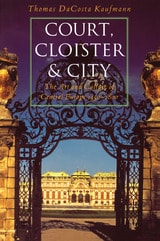
Court, Cloister, and City
The Art and Culture of Central Europe, 1450-1800Thomas DaCosta Kaufmann
University of Chicago Press, 1995
"Kaufmann throws considerable light on one of the more neglected and least understood periods in art history."—Philadelphia Inquirer
"A wonderful book which does justice both to a formal analysis of the art and to an explanation of broader political and economic forces at work."—Virginia Quarterly Review
"Important and stimulating, Kaufmann's study examines the cultural legacy of a region too little known and understood."—Choice
"Peaks of the creative heritage which [Kaufmann] describes reserve their message—and their surprises—for those who visit them in situ. But invest in Kaufmann's volume before you go."—R. J. W. Evans, New York Review of Books
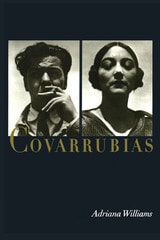
Covarrubias
By Adriana Williams
University of Texas Press, 1994
At the center of an artistic milieu as vital and exciting as the Left Bank of Paris or Greenwich Village, Rosa and Miguel Covarrubias knew almost everyone in the limelight of the 1930s and 1940s—Langston Hughes, Carl Van Vechten, John Huston, Diego Rivera, and Frida Kahlo, to name just a few. As fascinating themselves as any of their friends, the couple together fostered a renaissance of interest in the history and traditional arts of Mexico's indigenous peoples, while amassing an extraordinary collection of art that ranged from pre-Hispanic Olmec and Aztec sculptures to the work of Diego Rivera.
Written by a long-time friend of Rosa, this book presents a sparkling account of the life and times of Rosa and Miguel. Adriana Williams begins with Miguel's birth in 1904 and follows the brilliant early flowering of his artistic career as a renowned caricaturist for Vanity Fair and the New Yorker magazines, his meeting and marriage with Rosa at the height of her New York dancing career, and their many years of professional collaboration on projects ranging from dance to anthropology to painting and art collecting to the development of museums to preserve Mexico's pre-Columbian heritage. Interviewing as many of their friends as possible, Williams fills her narrative with reminiscences that illuminate Miguel's multifaceted talents, Rosa's crucial collaboration in many of his projects, and their often tempestuous relationship.
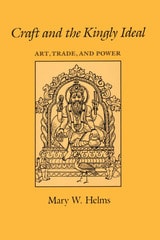
Craft and the Kingly Ideal
Art, Trade, and PowerBy Mary W. Helms
University of Texas Press, 1993
In ancient Mediterranean cultures, diamonds were thought to endow their owners with invincibility. In contemporary United States culture, a foreign-made luxury car is believed to give its owner status and prestige. Where do these beliefs come from?
In this study of craft production and long-distance trade in traditional, nonindustrial societies, Mary W. Helms explores the power attributed to objects that either are produced by skilled artisans and/or come from "afar." She argues that fine artisanship and long-distance trade, both of which are more available to powerful elites than to ordinary people, are means of creating or acquiring tangible objects that embody intangible powers and energies from the cosmological realms of gods, ancestors, or heroes. Through the objects, these qualities become available to human society and confer honor and power on their possessors.
Helms’ novel approach equates trade with artistry and emphasizes acquisition rather than distribution. She rejects the classic Western separation between economics and aesthetics and offers a new paradigm for understanding traditional societies that will be of interest to all anthropologists and archaeologists.
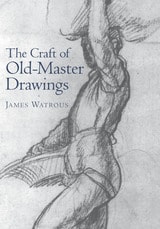
Craft of Old-Master Drawings
James Watrous
University of Wisconsin Press, 1967
A comprehensive study of the techniques of drawing, this is both a historical work, covering the period from the late Middle Ages to the present, and a useful manual for contemporary artists. It presents the old masters’ techniques by means of a thorough study of the historical and written evidence of the tools and materials used. The author also includes a series of workshop procedures he has developed with which the contemporary artist may produce the equivalents of the techniques of earlier draughtsmen. This book comprises a body of knowledge that is essential to students of art history, curators, collectors and artists, and is a significant addition to the literature on drawing.
In addition to his scholarly investigation of earlier practices, the author identifies materials and processes used by such important artists as Rembrandt, Van Gogh, Romney, Picasso, Michelangelo, Watteau, Holbein, Tiepolo, and Delacroix. For the artist interested in reproducing the effects achieved by these and many other acknowledged masters, there are full discussions and specific directions concerning the making of inks, styluses, reed and quill pens, fabricated chalks, and instructions for preparing grounds for metalpoint drawings. At every step, the discussion is supplemented with illustrations from laboratory experiments and from drawings by both old and contemporary artists. Of the more than sixty illustrations included, thirty-six are reproductions of master works, and among the others there are microphotographic enlargements of detail showing the differences in density and texture produced by various tools on different papers or grounds. Thus, as a collection of master drawings, the book is worthy of the art lover’s library; as a technical study, it is an indispensable aid to the art student and practicing artist.
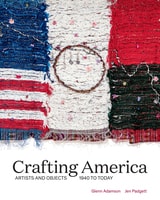
Crafting America
Artists and Objects, 1940 to TodayJen Padgett
University of Arkansas Press, 2020
Craft is a diverse, democratic art form practiced by Americans of every gender, age, ethnicity, and class. Crafting America traces this expansive range of skilled making in a variety of forms, from ceramics and wood to performance costume and community-based practice. In exploring the intertwining of craft and American experience, this volume reveals how artists leverage their craft to realize the values of life, liberty, and the pursuit of happiness.
Accompanying an exhibition of the same title organized by Crystal Bridges Museum of American Art, Crafting America features contributions from scholars that illuminate craft’s relationship to ritual and memory, personal independence, abstraction, and Native American histories. The richly illustrated catalog section—with more than a hundred color images accompanied by lively commentary—presents a vivid picture of American craft over the past eight decades, offering fresh insights on the relationships between objects.
Building upon recent advances in craft scholarship and encouraging more inclusive narratives, Crafting America presents a bold statement on the vital role of craft within the broader context of American art and identity.
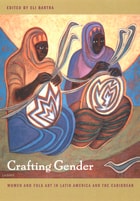
Crafting Gender
Women and Folk Art in Latin America and the CaribbeanEli Bartra, ed.
Duke University Press, 2003
Art historians, anthropologists, and sociologists from Latin America, the Caribbean, and the United States discuss artwork from Mexico, Argentina, Chile, Colombia, Ecuador, Panama, Suriname, and Puerto Rico, and many of their essays focus on indigenous artists. They highlight the complex webs of social relations from which folk art emerges. For instance, while several pieces describe the similar creative and technical processes of indigenous pottery-making communities of the Amazon and of mestiza potters in Mexico and Colombia, they also reveal the widely varying functions of the ceramics and meanings of the iconography. Integrating the social, historical, political, geographical, and economic factors that shape folk art in Latin America and the Caribbean, Crafting Gender sheds much-needed light on a rich body of art and the women who create it.
Contributors
Eli Bartra
Ronald J. Duncan
Dolores Juliano
Betty LaDuke
Lourdes Rejón Patrón
Sally Price
María de Jesús Rodríguez-Shadow
Mari Lyn Salvador
Norma Valle
Dorothea Scott Whitten
Crafting Mexico
Intellectuals, Artisans, and the State after the RevolutionRick A. López
Duke University Press, 2010
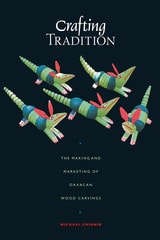
Crafting Tradition
The Making and Marketing of Oaxacan Wood CarvingsBy Michael Chibnik
University of Texas Press, 2003
Since the mid-1980s, whimsical, brightly colored wood carvings from the Mexican state of Oaxaca have found their way into gift shops and private homes across the United States and Europe, as Western consumers seek to connect with the authenticity and tradition represented by indigenous folk arts. Ironically, however, the Oaxacan wood carvings are not a traditional folk art. Invented in the mid-twentieth century by non-Indian Mexican artisans for the tourist market, their appeal flows as much from intercultural miscommunication as from their intrinsic artistic merit.
In this beautifully illustrated book, Michael Chibnik offers the first in-depth look at the international trade in Oaxacan wood carvings, including their history, production, marketing, and cultural representations. Drawing on interviews he conducted in the carving communities and among wholesalers, retailers, and consumers, he follows the entire production and consumption cycle, from the harvesting of copal wood to the final purchase of the finished piece. Along the way, he describes how and why this "invented tradition" has been promoted as a "Zapotec Indian" craft and explores its similarities with other local crafts with longer histories. He also fully discusses the effects on local communities of participating in the global market, concluding that the trade in Oaxacan wood carvings is an almost paradigmatic case study of globalization.
Crafting Womanhood
Needlework, Gender, and Politics in the United States, 1810-1920Mariah Kupfner
University of Delaware Press, 2027
Decorative needlework was a key medium through which American women constructed femininity and its relationship to public and political concerns in the nineteenth and early twentieth centuries. Through samplers, needlecases, lace coats, silk sofas, cotton scraps, banners, and other textile things, scholars can see the ways in which women and girls related to education, property-holding, slavery and freedom, labor, and women’s right to vote. Needlework’s durable association with “traditional” notions about womanhood made it a potent resource through which to make gender in expansive and meaningful ways that had profound public, political implications as educational opportunities for girls and women were expanding, and the antislavery and women's suffrage movements were growing. Indeed, needlework's very conventionality and relationship to the past made it a useful tool for crafting womanhood anew.
Crafting Wounaan Landscapes
Identity, Art, and Environmental Governance in Panama's DariénJulie Velásquez Runk
University of Arizona Press, 2017
Panama’s Darién is a name many conservationists know. Renowned for its lowland tropical forests, its fame is more pronounced because a road that should be there is not: environmentalists have repeatedly, and remarkably, blocked all attempts to connect the Americas via the Pan American Highway. That lacuna, that absence of a road, also serves to occlude history in the region as its old-growth forests give the erroneous impression of a peopleless nature.
In Crafting Wounaan Landscapes, Julie Velásquez Runk upends long-standing assumptions about the people that call Darién home, and she demonstrates the agency of the Wounaan people to make their living and preserve and transform their way of life in the face of continuous and tremendous change. Velásquez Runk focuses on Wounaan crafting—how their ability to subtly effect change has granted them resilience in a dynamic and globalized era. She theorizes that unpredictable landscapes, political decisions, and cultural beliefs are responsible for environmental conservation problems, and she unpacks environmental governance efforts that illustrate what happens when conservation is confronted with people in a purportedly peopleless place.
The everyday dangers of environmental governance without local crafting include logging, land grabbing, and loss of carbon in a new era of carbon governance in the face of climate change. Crafting Wounaan Landscapes provides recognition of local ways of knowing and being in the world that may be key to the future of conservation practice.
Crafts, Trades, and Techniques of Early Cinema
Ian Christie, Priska Morrissey, Louis Pelletier, Valentine Robert, Jean-Pierre Sirois-Trahan, and Tami Williams
Michigan Publishing Services, 2024
The intermedial approaches deployed in this collection bring into focus the influence of multiple professional worlds and cultural practices on the nascent film medium, as well as the necessary adaptations and transformations required by the latter. This circulatory dynamic concerns people and practices, studied in a non-diffusionist approach taking into account transcultural interactions. Chapters examine the mechanisms of professionalization and identity-building as they relate to professions such as filmmaker or colorist, as well as to more unexpected occupations such as accountant, censor, or chemical engineer.
The notion of technique is broadly defined. Several of the volume’s chapters deal with cameras or special effects, as well as with new historical investigation into mysterious technical devices such as shutters, cue systems or working samples. Going beyond this preoccupation with materiality, the collected studies also approach technique as a human and cultural activity, and thus as a set of gestures, crafts, and expertise. The book more specifically opens up a reflection on the skills of screen performers and on the training that brought the institutionalization of body techniques and film acting. The book further illustrates to an unprecedented extent that the first film workers were frequently women.
Several chapters are dedicated to the unconventional careers of specific film workers, with particular attention being given to the diversity and complexity of professional trajectories. Indeed, this book demonstrates that the invention of cinema was deeply enmeshed with the rise of international networks, which resulted in the standardization of technical practices within corporate and national contexts being ultimately shaped by globalization.

Crate Missions
The Art and Archive of Hip Hop Beat-MakingJason D. Rawls
University of Michigan Press, 2027
Crate Missions takes readers inside the world of Hip Hop producers, where dusty record stores, forgotten albums, and decades-old recordings become the raw materials for new musical creation. Drawing on qualitative research, autoethnography, and oral history, Crate Missions combines the author’s more than twenty-five years of experience as a producer and DJ with interviews conducted with influential Hip Hop practitioners, including Pete Rock, Diamond D, Buckwild, Ski Beatz, K-Def, Mr. Walt and Evil Dee of the Beatminerz, and Breakbeat Lou. The online audio component allows readers to hear three new beats created by Rawls for this project, as well as “producer’s commentaries” in which Rawls walks listeners through his inspiration and process. Together, the text and audio reveal how crate digging is far more than collecting records—it is a form of historical discovery, cultural preservation, and creative expression.
Crazy Quilts
A Beginner’s GuideBetty Fikes Pillsbury
Ohio University Press, 2016
Textile artist and instructor Betty Fikes Pillsbury has won hundreds of awards for her homages to the elegance of Victorian crazy quilting. Grounded in traditional methods but crafted with elements of whimsy, each piece stands on its own as a work of art. In this definitive guide, Pillsbury shares her methods for piecing, embroidering, and embellishing. Her instructions equip readers at any level of quilting skill to use those techniques to express their own visions.
Encouraging her readers to see functional and artistic possibilities beyond quilts (wall hangings, purses, and pillowcases are just some of the options), Pillsbury shows them how to make each work by hand, the slow cloth way. An inspiring primer for beginning and experienced quilters alike, this meticulously illustrated how-to book is far more expansive than previous guides. Pillsbury—a master of the form—shows us why crazy quilting belongs firmly in the twenty-first century.
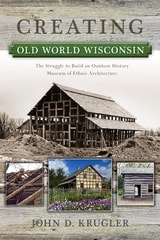
Creating Old World Wisconsin
The Struggle to Build an Outdoor History Museum of Ethnic ArchitectureJohn D. Krugler
University of Wisconsin Press, 2013
Visionaries, researchers, curators, and volunteers launched a massive preservation initiative to salvage fast-disappearing immigrant and migrant architecture. Dozens of historic buildings in the 1970s were transported from locations throughout the state to the Kettle Moraine State Forest. These buildings created a backdrop against which twenty-first-century interpreters demonstrate nineteenth- and early twentieth-century agricultural techniques and artisanal craftsmanship. The site, created and maintained by the Wisconsin Historical Society, offers visitors a unique opportunity to learn about the state’s rich and ethnically diverse past through depictions of the everyday lives of its Norwegian, Danish, Finnish, German, Polish, African American, and Yankee inhabitants.
Creating Old World Wisconsin chronicles the fascinating and complex origins of this outdoor museum, highlighting the struggles that faced its creators as they worked to achieve their vision. Even as Milwaukee architect and preservationist Richard W. E. Perrin, the Society's staff, and enthusiastic volunteers opened the museum in time for the national bicentennial in 1976, the site was plagued by limited funds, bureaucratic tangles, and problems associated with gaining public support. By documenting the engaging story of the challenges, roadblocks, false starts, and achievements of the site's founders, Krugler brings to life the history of the dedicated corps who collected and preserved Wisconsin's diverse social history and heritage.
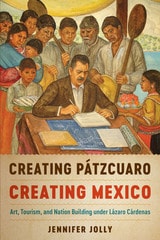
Creating Pátzcuaro, Creating Mexico
Art, Tourism, and Nation Building under Lázaro CárdenasBy Jennifer Jolly
University of Texas Press, 2018
LASA Visual Culture Studies Section Book Prize, Latin American Studies Association (LASA)
Winner, Arthur P. Whitaker Prize, Middle Atlantic Council of Latin American Studies, 2019In the 1930s, the artistic and cultural patronage of celebrated Mexican president Lázaro Cárdenas transformed a small Michoacán city, Pátzcuaro, into a popular center for national tourism. Cárdenas commissioned public monuments and archeological excavations; supported new schools, libraries, and a public theater; developed tourism sites and infrastructure, including the Museo de Artes e Industrias Populares; and hired artists to paint murals celebrating regional history, traditions, and culture. The creation of Pátzcuaro was formative for Mexico; not only did it provide an early model for regional economic and cultural development, but it also helped establish some of Mexico’s most enduring national myths, rituals, and institutions.
In Creating Pátzcuaro, Creating Mexico, Jennifer Jolly argues that Pátzcuaro became a microcosm of cultural power during the 1930s and that we find the foundations of modern Mexico in its creation. Her extensive historical and archival research reveals how Cárdenas and the artists and intellectuals who worked with him used cultural patronage as a guise for radical modernization in the region. Jolly demonstrates that the Pátzcuaro project helped define a new modern body politic for Mexico, in which the population was asked to emulate Cárdenas by touring the country and seeing and embracing its land, history, and people. Ultimately, by offering Mexicans a means to identify and engage with power and privilege, the creation of Pátzcuaro placed art and tourism at the center of Mexico’s postrevolutionary nation building project.
Creating Worlds Otherwise
Art, Collective Action, and (Post)ExtractivismPaula Serafini
Vanderbilt University Press, 2022
Extractivism has increasingly become the ground on which activists and scholars in Latin America frame the dynamics of ecological devastation, accumulation of wealth, and erosion of rights. These maladies are the direct consequences of long-standing extraction-oriented economies, and more recently from the expansion of the extractive frontier and the implementation of new technologies in the extraction of fossil fuels, mining, and agriculture. But the fields of sociology, political ecology, anthropology, and geography have largely ignored the role of art and cultural practices in studies of extractivism and post-extractivism.
The field of art theory, on the other hand, has offered a number of texts that put forward insightful analyses of artwork addressing extraction, environmental devastation, and the climate crisis. However, an art theory perspective that does not engage firsthand and in depth with collective action remains limited and fails to provide an account of the role, processes, and politics of art in anti- and post-extractivist movements.
Creating Worlds Otherwise examines the narratives that subaltern groups generate around extractivism, and how they develop, communicate, and mobilize these narratives through art and cultural practices. It reports on a six-year project on creative resistance to extractivism in Argentina and builds on long-term engagement working on environmental justice projects and campaigns in Argentina and the UK.
It is an innovative contribution to the fields of Latin American studies, political ecology, cultural studies, and art theory, and addresses pressing questions regarding what post-extractivist worlds might look like as well as how such visions are put into practice.
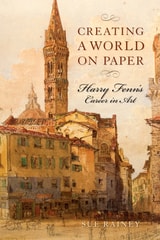
Creating a World on Paper
Harry Fenn's Career in ArtSue Rainey
University of Massachusetts Press, 2013
Arriving in New York from London in 1857 as a young wood engraver, Fenn soon forged a career in illustration. His tiny black-and-white wood engravings for Whittier's Snow-Bound (1868) surprised critics with their power, and his bold, innovative compositions for Picturesque America (1872–74) were enormously popular and expanded the field for illustrators and publishers. In the 1880s and '90s, his illustrations appeared in many of the finest magazines and newspapers, depicting the places and events that interested the public—from post–Civil War national reconciliation to the World's Columbian Exposition in 1893 to the beginnings of imperialism in the Spanish-American War.
This handsomely designed volume documents Fenn's prolific career from the 1860s until his death in 1911. Sue Rainey also recounts his adventurous sketching trips in the western United States, Europe, and the Middle East, which enhanced his reputation for depicting far-flung places at a time when the nation was taking a more prominent role on the world stage.
Creating the Witness
Documenting Genocide on Film, Video, and the InternetLeshu Torchin
University of Minnesota Press, 2012
Since the beginning of the conflict in 2003, more than 300,000 lives have been lost in Darfur. Players of the video game Darfur Is Dying learn this sobering fact and more as they work to ensure the survival of a virtual refugee camp. The video game not only puts players in the position of a struggling refugee, it shows them how they can take action in the real world.
Creating the Witness examines the role of film and the Internet in creating virtual witnesses to genocide over the last one hundred years. The book asks, how do visual media work to produce witnesses—audiences who are drawn into action? The argument is a detailed critique of the notion that there is a seamless trajectory from observing an atrocity to acting in order to intervene. According to Leshu Torchin, it is not enough to have a camera; images of genocide require an ideological framework to reinforce the messages the images are meant to convey. Torchin presents wide-ranging examples of witnessing and genocide, including the Armenian genocide, the Holocaust (engaging film as witness in the context of the Nuremburg trials), and the international human rights organization WITNESS and its sustained efforts to use video to publicize human rights advocacy and compel action.
From a historical and comparative approach, Torchin’s broad survey of media and the social practices around it investigates the development of popular understandings of genocide to achieve recognition and response—both political and judicial—ultimately calling on viewers to act on behalf of human rights.
Creative Alaska
A Ten-Year Retrospective of Support for Alaska Artists, 2004-2013Edited by Sven Haakanson and Amy Steffian
University of Alaska Press, 2016
Creative Alaska profiles the award winners from 2004 to 2013 in three categories: Distinguished Artists, Fellowships, and Project Awards. Richly illustrated accounts of each of the artists and their work illuminate the challenges and opportunities of the artistic life in Alaska and the powerful impact of the Rasmuson Foundation’s support.

Creative Communities
Regional Inclusion and the ArtsEdited by Janet McDonald and Robert Mason
Intellect Books, 2015

Creative Dissent
Alternative Cultures during SocialismKatalin Cseh-Varga
Central European University Press, 2027
Creative Dissent argues that the region was teeming with alternative cultures: emerging practices and expressions that actively challenged the dominant social code and reshaped the reality of the people’s democracies.
The book explores how ordinary people, intellectuals, and cultural players across socialist Europe responded to state repression and comprehensive control with ingenuity and defiance. By examining how these dissenting voices circumvented or even penetrated official spaces, this collection illuminates the complex heterogeneity of life behind the Iron Curtain.
Structured around four key areas—communities, markets, media, and spaces—this work offers a necessary, nuanced understanding of cultural resistance and the limits of authoritarian control.
Creative Infrastructures
Artists, Money and Entrepreneurial ActionLinda Essig
Intellect Books, 2022
As in sports, business, and other sectors, the top 1% of artists have disproportionately influenced public expectations for what it means to be successful. In Creative Infrastructures, Linda Essig takes an unconventional approach and looks at the quotidian artist—and at what they do, not what they make. All too often, artists who are attentive to the business side of their creative practice are accused of selling out. But for many working artists, that attention to business is what enables them not just to survive but to thrive. When artists follow their mission, Essig contends that they don’t sell out, they spiral up by keeping mission at the forefront. Through illustrative case studies from culturally and racially diverse communities, Essig examines the relationships between art, innovation, entrepreneurship, and money while offering a theory for arts entrepreneurship that places more emphasis on means than ends.
Creative Life
Music, Politics, People, and MachinesBob Ostertag
University of Illinois Press, 2008
Drawing on his intimate engagement with political conflict in Latin America and the Balkans, Ostertag identifies an art of "insurgent politics" that struggles to expand the parameters of the physical and social world. He also discusses his innovative collaborations with major modern performers, filmmakers, and artists around the world. Part memoir, part journalism, and part aesthetic manifesto, Creative Life is a dazzling set of writings from a musical artist who has worked on the cutting edge of new music for thirty years.
Creativity in the Classroom
Case Studies in Using the Arts in Teaching and Learning in Higher EducationEdited by Paul McIntosh and Digby Warren
Intellect Books, 2013

Creatures
Leonid Tishkov
Duke University Press, 0
The work in Creatures is centered on the imaginative and playful idea of the Dabloids, foot-shaped creatures of all sizes and colors who emerge magically from the Dablus, a sausage-like object that appears one misty morning in the fields of a collective farm. Tishkov’s drawings, paintings, and sculptures recount the history of the Dablus and the Dabloids. These mystical creatures are at once pets and gods, beings immensely wise and yet foolish. They are surreal manifestations of the artistic consciousness even as they are symbols of human isolation. In this sense, Tishkov’s roots in surrealism are charged with humorous social commentary often reminiscent of Hogarth, Red Grooms, and Robert Crumb.
Tishkov explores other mythological and absurdist themes in a series of elephant watercolors in which people live within an elephant trunk. The book also features a translation of the text of Tishkov’s play "Dabloids—A Fantasy," as well as brief essays that provide an introduction to the artist and his work, his mythology, and his roots in Russian folk culture.
Creatures introduces a major contemporary Russian artist to the western world. It should delight all who enter its world and should expand the horizons of all who delight in its artistic merits.
Crime Uncovered
Anti-heroEdited by Fiona Peters and Rebecca Stewart
Intellect Books, 2015
Crime Uncovered: Antihero tackles that question and more. Mixing the popular and iconic, contemporary and ancient, the book explores the place and appeal of the antihero. Using figures from books, TV, film, and more, including such up-to-the-minute examples as True Detective’s Rust Cole, the book places the antihero’s actions within the society he or she is rejecting, showing how expectations and social and familial structures create the backdrop against which the antihero’s posture becomes compelling. Featuring interviews with genre masters James Ellroy and Paul Johnston, Crime Uncovered: Antiherois an accessible, engaging analysis of what drives us to embrace those characters who acknowledge—or even flaunt—the dark side we all have somewhere deep inside.
Crime Uncovered
DetectiveEdited by Barry Forshaw
Intellect Books, 2015
Taking readers into the worlds of such beloved authors as P. D. James, Henning Mankell, Jo Nesbø, Ian Rankin, and Håkan Nesser, this book zeroes in on the characteristics that define the iconic characters they created, discussing how they relate to their national and social settings, questions of class, and to the criminals they relentlessly pursue. Showing how the role of the authority figure has changed—and how each of these writers creates characters who work both within and against the strictures of official investigations—the book shows how creators cleverly subvert expectations of both police procedure and the crime genre itself.
Written by a leading expert in the field and drawn from interviews with the featured authors, Crime Uncovered: Detectivewill thrill the countless fans of Inspector Rebus, Harry Hole, Adam Dalgliesh, and the other enduring police detectives who define the genre.
Crime Uncovered
Private InvestigatorEdited by Alistair Rolls and Rachel Franks
Intellect Books, 2016
Assembling a cast of notable crime fiction experts, including Stephen Knight and Carolyn Beasley, the book covers characters from the whole world of international noir—Giorgio Scerbanenco’s Duca Lambert, Léo Malet’s Nestor Burma, and many more. Including essays on the genealogy and emergence of the protagonist in nineteenth-century fiction; interviews with crime writers Leigh Redhead, Nick Quantrill, and Fernando Lalana; and analyses of the transatlantic exchanges that helped to develop public perception of a literary icon, Crime Uncovered: Private Investigator will redefine what we think we know about the figure of the P. I.
Rolls and Franks have engaged here the tension between the popular and scholarly that is inherent in any critical examination of a literary type, along the way unraveling the mystery of the alluring, enigmatic private investigator. Crime Uncovered: Private Investigator will be a handy companion for any crime fiction fan.
Crimes of Art and Terror
Frank Lentricchia and Jody McAuliffe
University of Chicago Press, 2003
Crimes of Art and Terror reveals how the desire beneath many romantic literary visions is that of a terrifying awakening that would undo the West's economic and cultural order. This is also the desire, of course, of what is called terrorism. As the authority of writers and artists recedes, it is criminals and terrorists, Lentricchia and McAuliffe suggest, who inherit this romantic, destructive tradition. Moving freely between the realms of high and popular culture, and fictional and actual criminals, the authors describe a web of impulses that catches an unnerving spirit.
Lentricchia and McAuliffe's unorthodox approach pairs Dostoevsky's Crime and Punishment with Martin Scorsese's King of Comedy and connects the real-life Unabomber to the surrealist Joseph Cornell and to the hero of Bret Easton Ellis's bestselling novel American Psycho. They evoke a desperate culture of art through thematic dialogues among authors and filmmakers as varied as Don DeLillo, Joseph Conrad, Francis Ford Coppola, Jean Genet, Frederick Douglass, Hermann Melville, and J. M. Synge, among others. And they conclude provocatively with an imagined conversation between Heinrich von Kleist and Mohamed Atta. The result is a brilliant and unflinching reckoning with the perilous proximity of the impulse to create transgressive art and the impulse to commit violence.
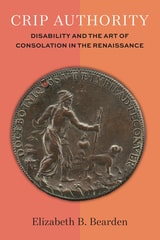
Crip Authority
Disability and the Art of Consolation in the RenaissanceElizabeth B. Bearden
University of Michigan Press, 2025
Disabled authors include Francesco Petrarca, Teresa de Cartagena, Giovani Paolo Lomazzo, Miguel de Cervantes Saavedra, Robert Burton, and John Milton. They all explore their experiences of disability, but their work has rarely or never been considered from a disability studies perspective. Bearden thus brings today’s models of disability studies and crip theory together with early modern articulations of disability based on ancient and Renaissance models of military, political, biblical, and literary authority. In sum, Crip Authority makes a significant contribution to the growing field of early modern disability studies and invites us to rethink the extent of crip history and the endurance of disability gain.
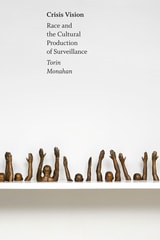
Crisis Vision
Race and the Cultural Production of SurveillanceTom Monahan
Duke University Press, 2022
Critical Digital Art History
Interface and Data Politics in the Post-Digital EraEdited by Amanda Wasielewski and Anna Näslund
Intellect Books, 2024
Digital art history has often aligned itself with the practical concerns of digital technology and the responsibilities of art institutions and associated institutional roles such as collection managers, information specialists, curators, and conservators. This emphasis on practicalities and implementation, while undeniably important, has often left little room for critical examination of the broader implications of digital technology and computational methodologies in art history.
A long-standing concern of the field—and a major focal point of this book—is museum and collecting practices in the digital era. While there is a certain degree of continuity in the field, there are also important shifts and changes to address—namely, the widespread uptake of artificial intelligence tools and increased attention to both the broader historical and societal aspects of the use of digital repositories and tools. This anthology seeks to address the dearth of critical reflection by critically assessing specific case study examples and considering the political dimensions associated with large-scale digitization and the application of digital tools within museums and collection management.

Critical Heritage Studies and the Futures of Europe
Edited by Rodney Harrison, Nélia Dias, and Kristian Kristiansen
University College London, 2023
Cultural and natural heritage are central to ideas of what Europe and “the European project’” are. Heritage studies were prevalent in the emergence of nation-states in the eighteenth and nineteenth centuries, where they were used to justify differences over which border conflicts were fought. Later, the idea of a “common European heritage” provided a rationale for the development of the European Union. Now, the emergence of “new” populist nationalisms shows how the imagined past continues to play a role in cultural and social governance, while a series of interlinked social and ecological crises are changing the ways that heritage operates, with new discourses and ontologies emerging to reconfigure heritage for the circumstances of the present and the uncertainties of the future.
Critical Heritage and Social Justice
Redistribution, Recognition and Representation in ContextEdited by Veysel Apaydin, Kalliopi Fouseki, David Francis, Jonathan Gardner, and Sara Perry
University College London, 2026
The first edited volume in the field of heritage to conceptualize and contextualize social justice in depth, both theoretically and through practical applications.
In this edited volume, scholars and practitioners working across heritage, museums, galleries, and cultural institutions explore how principles of social justice can be embedded within these spaces. Highlighting intersections between critical heritage studies and urgent global challenges, the book seeks to foster inclusive, community-engaged heritage practices. Applying Nancy Fraser’s theory of three-dimensional justice—redistribution, recognition, and representation—within the context of heritage studies, the authors reflect on global social, cultural, political, and environmental issues through an interdisciplinary heritage-focused approach.
Critical Perspectives on Cultural Memory and Heritage
Construction, Transformation and DestructionEdited by Veysel Apaydin
University College London, 2020
Critical Studies in Art and Design Education
Edited by Richard Hickman
Intellect Books, 2005
Rod Taylor, who has done much to promote and develop critical studies in the UK, provides us with examples of classroom practice and gives us his more recent thoughts on fundamental issues – "universal themes" in art – and gives examples of how both primary and secondary schools might develop their teaching of art through attending to themes such as "identity," "myth," and "environments" to help "re-animate the practical curriculum."
Although some of the discussion in this book centres on or arises from the English National curriculum, the issues are more global, and relevant to anyone involved in developing or delivering art curricula in schools. An American perspective is given in papers by George Geahigan and Paul Duncum. Geahigan outlines an approach to teaching about visual form which begins with students' personal responses and is developed through structured instruction. In Duncum’s vision of ‘visual culture art education’ sites such as theme parks and shopping malls are the focus of students' critical attention in schools; Nick Stanley gives a lucid account of just such an enterprise, giving practical examples of ways to engage students with this particular form of visual pleasure.
This publication serves to highlight some of the more pressing issues of concern to art and design teachers in two aspects. Firstly it seeks to contextualise the development of critical studies, discussing its place in the general curriculum – possibly as a discrete subject – and secondly it examines different approaches to its teaching.
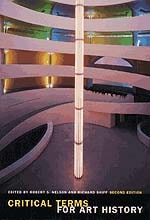
Critical Terms for Art History, Second Edition
Edited by Robert S. Nelson and Richard Shiff
University of Chicago Press, 2003
Art history as a field has kept pace with debates over globalization and other social and political issues in recent years, making a second edition of this book not just timely, but crucial. Like its predecessor, this new edition consists of essays that cover a wide variety of "loaded" terms in the history of art, from sign to meaning, ritual to commodity. Each essay explains and comments on a single term, discussing the issues the term raises and putting the term into practice as an interpretive framework for a specific work of art. For example, Richard Shiff discusses "Originality" in Vija Celmins's To Fix the Image in Memory, a work made of eleven pairs of stones, each consisting of one "original" stone and one painted bronze replica.
In addition to the twenty-two original essays, this edition includes nine new ones—performance, style, memory/monument, body, beauty, ugliness, identity, visual culture/visual studies, and social history of art—as well as new introductory material. All help expand the book's scope while retaining its central goal of stimulating discussion of theoretical issues in art history and making that discussion accessible to both beginning students and senior scholars.
Contributors: Mark Antliff, Nina Athanassoglou-Kallmyer, Stephen Bann, Homi K. Bhabha, Suzanne Preston Blier, Michael Camille, David Carrier, Craig Clunas, Whitney Davis, Jas Elsner, Ivan Gaskell, Ann Gibson, Charles Harrison, James D. Herbert, Amelia Jones, Wolfgang Kemp, Joseph Leo Koerner, Patricia Leighten, Paul Mattick Jr., Richard Meyer, W. J. T. Mitchell, Robert S. Nelson, Margaret Olin, William Pietz, Alex Potts, Donald Preziosi, Lisbet Rausing, Richard Shiff, Terry Smith, Kristine Stiles, David Summers, Paul Wood, James E. Young
Criticism Without Authority
Gene Swenson's and Jill Johnston’s Queer PracticesJennifer Sichel
University of Chicago Press, 2025
In the early 1960s, Gene Swenson and Jill Johnston began to imagine art criticism as something unruly and expansive, rejecting modernist appeals to purity and coherence that had overtaken the field. These critics were deeply enmeshed in New York’s avant-garde art scene, and both were explicitly and unapologetically queer. First working independently of one another, then later in dialogue, Swenson and Johnston demanded criticism become life-sustaining, subverting protocols and distorting its form beyond recognition. They utilized criticism as a means of navigating queer existence and reclaimed terms like lesbian, homosexual, mad, and psychotic as their own.
Jennifer Sichel follows the intertwined paths of Swenson and Johnston, providing a history of queer practices that were central to the development of avant-garde art but have been largely overlooked. Criticism Without Authority makes their work visible not just as criticism, but as its own form of art. As Sichel shows, Swenson's and Johnston’s practices, bucking categories and disciplinary formations, resist historical streamlining and stand as a key for unlocking the queerness of postwar art history.
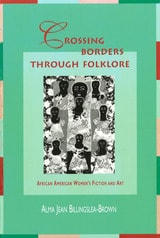
Crossing Borders through Folklore
African American Women's Fiction and ArtAlma Jean Billingslea-Brown
University of Missouri Press, 1999
Examining works by Toni Morrison, Paule Marshall, Faith Ringgold, and Betye Saar, this innovative book frames black women's aesthetic sensibilities across art forms. Investigating the relationship between vernacular folk culture and formal expression, this study establishes how each of the four artists engaged the identity issues of the 1960s and used folklore as a strategy for crossing borders in the works they created during the following two decades.
As a dynamic, open-ended process, folklore historically has enabled African-descended people to establish differential identity, resist dominance, and affirm group solidarity. This book documents the use of expressive forms of folklore in the fiction of Morrison and Marshall and the use of material forms of folklore in the visual representations of Ringgold and Saar. Offering a conceptual paradigm of a folk aesthetic to designate the practices these women use to revise and reverse meanings—especially meanings imposed on images such as Aunt Jemima and Sambo—Crossing Borders through Folklore explains how these artists locate sites of intervention and reconnection. From these sites, in keeping with the descriptive and prescriptive formulations for art during the sixties, Morrison, Marshall, Ringgold, and Saar articulate new dimensions of consciousness and creatively theorize identity.
Crossing Borders through Folklore is a significant and creative contribution to scholarship in both established and still- emerging fields. This volume also demonstrates how recent theorizing across scholarly disciplines has created elastic metaphors that can be used to clarify a number of issues. Because of its interdisciplinary approach, this study will appeal to students and scholars in many fields, including African American literature, art history, women's studies, diaspora studies, and cultural studies.
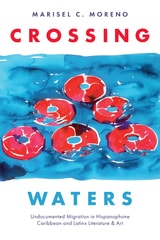
Crossing Waters
Undocumented Migration in Hispanophone Caribbean and Latinx Literature & ArtMarisel C. Moreno
University of Texas Press, 2022
2023 Honorable Mention, Isis Duarte Book Prize, Haiti/ Dominican Republic section (LASA)
2023 Winner, Gordon K. and Sybil Lewis Book Award, Caribbean Studies Association
An innovative study of the artistic representations of undocumented migration within the Hispanophone Caribbean
Debates over the undocumented migration of Latin Americans invariably focus on the southern US border, but most migrants never cross that arbitrary line. Instead, many travel, via water, among the Caribbean islands. The first study to examine literary and artistic representations of undocumented migration within the Hispanophone Caribbean, Crossing Waters relates a journey that remains silenced and largely unknown.
Analyzing works by novelists, short-story writers, poets, and visual artists replete with references to drowning and echoes of the Middle Passage, Marisel Moreno shines a spotlight on the plight that these migrants face. In some cases, Puerto Rico takes on a new role as a stepping-stone to the continental United States and the society migrants will join there. Meanwhile the land border between Haiti and the Dominican Republic, the only terrestrial border in the Hispanophone Caribbean, emerges as a complex space within this cartography of borders. And while the Border Patrol occupies US headlines, the Coast Guard occupies the nightmares of refugees.
An untold story filled with beauty, possibility, and sorrow, Crossing Waters encourages us to rethink the geography and experience of undocumented migration and the role that the Caribbean archipelago plays as a border zone.
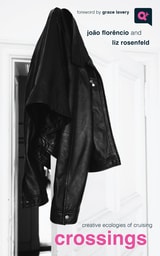
Crossings
Creative Ecologies of CruisingJoão Florêncio
Rutgers University Press, 2025
A creative dialogue between a queer artist and a queer academic reminiscing about and thinking with their cruising experiences, Crossings takes queer sex practices and cultures seriously as ways of knowing and world-making. The result is an erotic hybrid form hovering between scholarship and avant-garde experimentation, between critical manifesto and sex memoir. Here, the voices of each author, merged together in one, invite the reader to inhabit the erotic spacetime between self and other, the familiar and the strange, desire and pleasure, climax and release. That is, the spaces and temporalities of cruising itself.
Crossroads of Culture
Anthropology Collections at the Denver Museum of Nature & ScienceChip Colwell
University Press of Colorado, 2010
The book presents 123 full-color images to highlight the museum's cultural treasures. Selected for their individual beauty, historic value, and cultural meaning, these objects connect different places, times, and people. From the mammoth hunters of the Plains to the first American pioneer settlers to the flourishing Hispanic and Asian diasporas in downtown Denver, the Rocky Mountain region has been home to a breathtaking array of cultures. Many objects tell this story of the Rocky Mountains' fascinating and complex past, whereas others serve to bring enigmatic corners of the globe to modern-day Denver.
Crossroads of Culture serves as a behind-the-scenes tour of the museum's anthropology collections. All the royalties from this publication will benefit the collections of the Denver Museum of Nature & Science's Department of Anthropology.
Cruising the Dead River
David Wojnarowicz and New York's Ruined WaterfrontFiona Anderson
University of Chicago Press, 2019
Crystals in Art
Ancient to TodayLauren Haynes
University of Arkansas Press, 2019
Taken together, all of these objects illustrate how crystal has bridged the gap between things we can see and things we can’t: science and art, fact and faith, medicine and magic—the visible and the invisible.
Published in collaboration with Crystal Bridges Museum of American Art and University of Arkansas School of Art.
Cuba Represent!
Cuban Arts, State Power, and the Making of New Revolutionary CulturesSujatha Fernandes
Duke University Press, 2006
Combining textual analyses of films, rap songs, and visual artworks; ethnographic material collected in Cuba; and insights into the nation’s history and political economy, Fernandes details the new forms of engagement with official institutions that have opened up as a result of changing relationships between state and society in the post-Soviet period. She demonstrates that in a moment of extreme hardship and uncertainty, the Cuban state has moved to a more permeable model of power. Artists and other members of the public are collaborating with government actors to partially incorporate critical cultural expressions into official discourse. The Cuban leadership has come to recognize the benefits of supporting artists: rappers offer a link to increasingly frustrated black youth in Cuba; visual artists are an important source of international prestige and hard currency; and films help unify Cubans through community discourse about the nation. Cuba Represent! reveals that part of the socialist government’s resilience stems from its ability to absorb oppositional ideas and values.
Cuban Artists Across the Diaspora
Setting the Tent Against the HouseBy Andrea O'Reilly Herrera
University of Texas Press, 2011
As an island—a geographical space with mutable and porous borders—Cuba has never been a fixed cultural, political, or geographical entity. Migration and exile have always informed the Cuban experience, and loss and displacement have figured as central preoccupations among Cuban artists and intellectuals. A major expression of this experience is the unconventional, multi-generational, itinerant, and ongoing art exhibit CAFÉ: The Journeys of Cuban Artists. In Cuban Artists Across the Diaspora, Andrea O'Reilly Herrera focuses on the CAFÉ project to explore Cuba's long and turbulent history of movement and rupture from the perspective of its visual arts and to meditate upon the manner in which one reconstitutes and reinvents the self in the context of diaspora.
Approaching the Cafeteros' art from a cultural studies perspective, O'Reilly Herrera examines how the history of Cuba informs their work and establishes their connections to past generations of Cuban artists. In interviews with more than thirty artists, including José Bedia, María Brito, Leandro Soto, Glexis Novoa, Baruj Salinas, and Ana Albertina Delgado, O'Reilly Herrera also raises critical questions regarding the many and sometimes paradoxical ways diasporic subjects self-affiliate or situate themselves in the narratives of scattering and displacement. She demonstrates how the Cafeteros' artmaking involves a process of re-rooting, absorption, translation, and synthesis that simultaneously conserves a series of identifiable Cuban cultural elements while re-inscribing and transforming them in new contexts.
An important contribution to both diasporic and transnational studies and discussions of contemporary Cuban art, Cuban Artists Across the Diaspora ultimately testifies to the fact that a long tradition of Cuban art is indeed flourishing outside the island.
Cue Tears
On the Act of CryingDaniel Sack
University of Michigan Press, 2024
Across seven semi-autonomous essays, Cue Tears looks at the mechanisms of tear production, internal and external techniques that actors use to weep, and the effects of tears in performance situations on the stage, in the gallery, and in the classroom. The writing moves with a light touch between theory and criticism of a broad range of instances from literature, theater, performance art, visual art, and cinema, while also embracing a strong autobiographical and personal slant. Author Daniel Sack’s father was a biochemist who studied tears and collected his son’s tears for research during his childhood. These “reflex tears” were produced as a physical response to irritation—an eye stretched past the point of blinking, a cotton swab up the nose. This childhood occupation coincided with his first years taking acting classes, trying to learn how to cry “emotional tears” onstage through psychological stimulation and the recollection of memory. Cue Tears investigates these memories and methods, finding that tears both shore up and dissolve distinctions between truth and artifice, emotional and physical, private and public, sad and humorous.
Culinary Palettes
The Visuality of Food in Postrevolutionary Mexican ArtLesley A. Wolff
University of Texas Press, 2025
2026 Mejor libro Humanidades, Mexico Section of the Latin American Studies Association
2026 Honorable Mention, First Book Prize, Cultural Studies Association
2025 Excellence in Scholarly Research and Publication Award, SECAC (formerly the Southeastern College Art Conference)
How the visual culture of food, cookery, and consumption played a central role in the making of postrevolutionary Mexico.
Postrevolutionary Mexico City was a site of anxious nation-building, as rampant modernization converged and clashed with the nation’s growing nostalgia for its pre-Columbian heritage. During this volatile period, food became a meaningful symbol for a Mexican citizenry seeking new modes of national participation.
Culinary Palettes explores how the artistic invocation of food cultures became an arena in which to negotiate the political entanglements of postrevolutionary Mexico. Lesley Wolff casts a nuanced eye on the work of visual artists such as Tina Modotti, Carlos González, and Rufino Tamayo, who nurtured the symbolic and performative power of iconic foods such as pulque, mole poblano, and watermelon. Through analysis of a wide array of visual evidence, including paintings, architecture, vintage postcards, menus, and cookbooks, Culinary Palettes demonstrates how these artists positioned their work within a broad visual landscape that relied upon the power of Mexican foodways in the urban and national imagination. In the studios of modernists, Wolff argues, artistic production, foodways, and Indigeneity proved to be mutually constitutive—and at times weaponized—agents in articulating competing claims to a new nationhood.
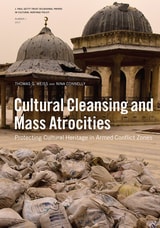
Cultural Cleansing and Mass Atrocities
Protecting Cultural Heritage in Armed Conflict ZonesThomas G. Weiss
J. Paul Getty Trust, The, 2020