Results by title
2916 books match the query 'Politics and government' and 214 start with c
Constitutional History of the American Revolution
John Phillip Reid
University of Wisconsin Press, 1995
Designed for use in courses, this abridged edition of the four-volume Constitutional History of the American Revolution demonstrates how significant constitutional disputes were in instigating the American Revolution. John Phillip Reid addresses the central constitutional issues that divided the American colonists from their English legislators: the authority to tax, the authority to legislate, the security of rights, the nature of law, the foundation of constitutional government in custom and contractarian theory, and the search for a constitutional settlement. Reid's distinctive analysis discusses the irreconcilable nature of this conflict—irreconcilable not because leaders in politics on both sides did not desire a solution, but because the dynamics of constitutional law impeded a solution that permitted the colonies to remain part of the dominions of George III.
Constitutional History of the American Revolution - Abridged
John Phillip Reid
University of Wisconsin Press, 1995
Constitutional History of the American Revolution, Volume I
The Authority Of RightsJohn Phillip Reid
University of Wisconsin Press, 1987
Constitutional History of the American Revolution
Volume I: The Authority of Rights
Volume II: The Authority to Tax
Volume III: The Authority to Legislate
Volume IV: The Authority of Law
John Phillip Reid addresses the central constitutional issues that divided the American colonists from their English legislators: the authority to tax, the authority to legislate, the security of rights, the nature of law, the foundation of constitutional government in custom and contractarian theory, and the search for a constitutional settlement.
Constitutional History of the American Revolution, Volume II
The Authority To TaxJohn Phillip Reid
University of Wisconsin Press, 1987
John Phillip Reid addresses the central constitutional issues that divided the American colonists from their English legislators: the authority to tax, the authority to legislate, the security of rights, the nature of law, the foundation of constitutional government in custom and contractarian theory, and the search for a constitutional settlement.
Constitutional History of the American Revolution, Volume III
The Authority to LegislateJohn Phillip Reid
University of Wisconsin Press, 1992
This is the first comprehensive study of the constitutionality of the Parliamentary legislation cited by the American Continental Congress as a justification for its rebellion against Great Britain in 1776. The content and purpose of that legislation is well known to historians, but here Reid places it in the context of eighteenth-century constitutional doctrine and discusses its legality in terms of the intellectual premises of eighteenth-century Anglo-American legal values.
The third installment in a planned four-volume work, The Authority to Legislate follows The Authority to Tax and The Authority of Rights. In this volume, Reid shows that the inflexibility of British constitutional principle left no room for settlement or change; Parliament became entrapped by the imperatives of the constitution it was struggling to preserve. He analyzes the legal theories put forward in support of Parliament’s authority to legislate and the specific precedents cited as evidence of that authority.
Reid’s examination of both the debate over the authority to legislate and the constitutional theory underlying the debate shows the extent to which the American Revolution and the Declaration of Independence were actions taken in defense of the rule of law. Considered as a whole, Reid’s Constitutional History of the American Revolution contributes to an understanding of the central role of legal and constitutional standards, especially concern for rule by law, in the development of the American nation.
Constitutional History of the American Revolution, Volume IV
The Authority of LawJohn Phillip Reid
University of Wisconsin Press, 1993
This is the first comprehensive study of the constitutionality of the Parliamentary legislation cited by the American Continental Congress as a justification for its rebellion against Great Britain in 1776. The content and purpose of that legislation is well known to historians, but here John Phillip Reid places it in the context of eighteenth-century constitutional doctrine and discusses its legality in terms of the intellectual premises of eighteenth-century Anglo-American legal values.
The Authority of Law is the last of a four-volume work, preceded by The Authority to Tax, The Authority of Rights, and The Authority to Legislate. In these previous volumes, Reid argued that there would have been no rebellion had taxation been the only constitutional topic of controversy, that issues of rights actually played a larger role in the drafting of state and federal constitutions than they did in instigating a rebellion, and that the American colonists finally took to the battlefield against the British because of statutes that forced Americans to either concede the authority to legislate or leave the empire.
Expanding on the evidence presented in the first three volumes, The Authority of Law determines the constitutional issues dividing American whigs from British imperialists. Reid summarizes these issues as “the supremacy issue,” “the Glorious Revolution issue,” “the liberty issue,” and the “representation issue.” He then raises a compelling question: why, with so many outstanding lawyers participating in the debate, did no one devise a constitutionally legal way out of the standoff? Reid makes an original suggestion. No constitutional solution was found because the British were more threatened by American legal theory than the Americans were by British theory. British lawyers saw the future of liberty in Great Britain endangered by the American version of constitutional law.
Considered as a whole, Reid’s Constitutional History of the American Revolution contributes to an understanding of the central role of legal and constitutional standards, especially concern for rule by law, in the development of the American nation.
Constructing Culture and Power in Latin America
Daniel H. Levine, Editor
University of Michigan Press, 1993
Constructing Identities in Mexican-American Political Organizations
Choosing Issues, Taking SidesBy Benjamin Márquez
University of Texas Press, 2003
A Choice Outstanding Academic Book, 2002
The formation of a group identity has always been a major preoccupation of Mexican American political organizations, whether they seek to assimilate into the dominant Anglo society or to remain separate from it. Yet organizations that sought to represent a broad cross section of the Mexican American population, such as LULAC and the American G.I. Forum, have dwindled in membership and influence, while newer, more targeted political organizations are prospering—clearly suggesting that successful political organizing requires more than shared ethnicity and the experience of discrimination.
This book sheds new light on the process of political identity formation through a study of the identity politics practiced by four major Mexican American political organizations—the Southwest Network for Environmental and Economic Justice, the Southwest Industrial Areas Foundation, the Texas Association of Mexican American Chambers of Commerce, and the Mexican American Women's National Association (now known as MANA—A National Latina Organization). Through interviews with activists in each organization and research into their records, Benjamin Marquez clarifies the racial, class-based, and cultural factors that have caused these organizations to create widely differing political identities. He likewise demonstrates why their specific goals resonate only with particular segments of the Mexican American community.
Constructing Tomorrow's Federalism
New Perspectives on Canadian GovernanceIan Peach
University of Manitoba Press, 2007
Constructing a Democracy
The History, Law, and Politics of Redistricting in OregonNorman R. Williams
Oregon State University Press, 2023
In Constructing a Democracy, legal scholar Norman Williams presents a comprehensive history of legislative and congressional redistricting in Oregon. Because redistricting impacts the representativeness of the ensuing legislative body, Oregon’s constitutional framers, legislators, and courts alike have understandably focused on developing legal rules to constrain the redistricting process. Williams is primarily interested in identifying and understanding the scope of those rules: What legal constraints have existed over time? How aggressively have the courts enforced those restraints? How have political actors undertaken the redistricting task in light of the various rules and the judicial pronouncements regarding those constraints?
The redistricting process in Oregon has not drawn national attention the way it has in states like North Carolina and Pennsylvania. But the process in Oregon is notable in several ways, including an early attention to malapportionment, the use of the initiative to reform the process, and and the impact of women leaders on the redistricting process. The Oregon process, however, has also notably lagged behind other states, particularly in considering issues of race and minority representation and preventing gerrymandering.
Consumption and Violence
Radical Protest in Cold-War West GermanyAlexander Sedlmaier
University of Michigan Press, 2014
Contentious City
The Politics of Recovery in New York CityJohn Mollenkopf
Russell Sage Foundation, 2005
Contentious Republicans
Popular Politics, Race, and Class in Nineteenth-Century ColombiaJames E. Sanders
Duke University Press, 2004
Beginning in the late 1840s, subaltern groups entered the political arena to forge alliances, both temporary and enduring, with the elite Liberal and Conservative Parties. In the process, each group formed its own political discourses and reframed republicanism to suit its distinct needs. These popular liberals and popular conservatives bargained for the parties’ support and deployed a broad repertoire of political actions, including voting, demonstrations, petitions, strikes, boycotts, and armed struggle. By the 1880s, though, many wealthy Colombians of both parties blamed popular political engagement for social disorder and economic failure, and they successfully restricted lower-class participation in politics. Sanders suggests that these reactionary developments contributed to the violence and unrest afflicting modern Colombia. Yet in illuminating the country’s legacy of participatory politics in the nineteenth century, he shows that the current situation is neither inevitable nor eternal.
Contested City
Municipal Politics and the Rise of Nazism in Altona, 1917-1937Anthony McElligott
University of Michigan Press, 1998
Contested Territories
Native Americans and Non-Natives in the Lower Great Lakes, 1700-1850Charles Beatty-Medina
Michigan State University Press, 2012
A remarkable multifaceted history, Contested Territories examines a region that played an essential role in America's post-revolutionary expansion—the Lower Great Lakes region, once known as the Northwest Territory. As French, English, and finally American settlers moved westward and intersected with Native American communities, the ethnogeography of the region changed drastically, necessitating interactions that were not always peaceful. Using ethnohistorical methodologies, the seven essays presented here explore rapidly changing cultural dynamics in the region and reconstruct in engaging detail the political organization, economy, diplomacy, subsistence methods, religion, and kinship practices in play. With a focus on resistance, changing worldviews, and early forms of self-determination among Native Americans, Contested Territories demonstrates the continuous interplay between actor and agency during an important era in American history.
Contesting the Constitution
Congress Debates the Missouri Crisis, 1819-1821William S. Belko
University of Missouri Press, 2021
The larger question with which the legislators grappled were the limits of the Constitution’s provisions granting Congress the authority to affect the institution of slavery—both where it already existed and where it could expand. The issue—what would come to be known as the Missouri Crisis—severely tested the still young republic and, some four decades later, would all but rend it asunder. This timely collection of original essays thoughtfully engages the intersections of history and constitutional law, and is certain to find eager readers among historians, legal scholars, political scientists, as well as many who call Missouri home.
Contributing Authors:
William S. Belko
Christopher Childers
John Eastman
Brook Poston
John R. Van Atta
Contingent States
Greater China And Transnational RelationsWilliam A. Callahan
University of Minnesota Press, 2004
Contradiction and Conflict
The Popular Church in NicaraguaDebra Sabia
University of Alabama Press, 2013
Debra Sabia describes and analyzes the rise, growth, and fragmentation of the popular church and assesses the effect of the Christian base communities on religion, politics, and the nation's social revolutionary experiment.

Control and Crisis in Colonial Kenya
The Dialectic of DominationBruce Berman
Ohio University Press, 1990
This history of the political economy of Kenya is the first full length study of the development of the colonial state in Africa.
Professor Berman argues that the colonial state was shaped by the contradictions between maintaining effective political control with limited coercive force and ensuring the profitable articulation of metropolitan and settler capitalism with African societies.
This dialectic of domination resulted in both the uneven transformation of indigenous societies and in the reconstruction of administrative control in the inter-war period.
The study traces the evolution of the colonial state from its skeletal beginnings in the 1890s to the complex bureaucracy of the post-1945 era which managed the growing integration of the colony with international capital. These contradictions led to the political crisis of the Mau Mau emergency in 1952 and to the undermining of the colonial state.
The book is based on extensive primary sources including numerous interviews with Kenyan and British participants. The analysis moves from the micro-level of the relationship of the District Commissioners and the African population to the macro-level of the state and the political economy of colonialism.
Professor Berman uses the case of Kenya to make a sophisticated contribution to the theory of the state and to the understanding of the dynamics of the development of modern African political and economic institutions.

Corner of the Dead
Lynn Lurie
University of Massachusetts Press, 2008
"I use the camera to block my view," says Lisette. This is the start of her double vision—trying to forget and trying to recall—and her struggle to come to terms with the human capacity for cruelty. But the grim reality in Peru is so overpowering that she carries it with her back to New York and through the rest of her life. Having abandoned a lover along with the fight, she desperately tries to find meaning beyond that of mere survival.
Cornerstones of Peace
Jewish Identity Politics and Democratic TheoryBrettschneider, Marla
Rutgers University Press, 1996
Throughout the seventies, the idea of being “pro-Israel” was traditionally equated with support for the Israeli government and was central to an understanding of American Jewish identity. It was so central, argues Marla Brettschneider, that even committed activists who took issue with such a monolithic stance were silenced by mainstream Jewish organizations. But during the 1980s, a change took place. An explosion of new Jewish groups intent on challenging the dominant definition of the pro-Israel attitude transformed an increasingly closed Jewish community into one more democratic and inclusive.
In Cornerstones of Peace, Marla Brettschneider skillfully combines a lucid review of contemporary Liberal political theory and its understanding of the role of groups in the political process, a sophisticated analysis of Hobbesian philosophy, and a rich history of “alternative” Jewish activist groups like Breira and Americans for Peace Now (APN) to ask: What can we learn about identity and democratic theory from the changes that have taken place in the Jewish community? Through an insightful exploration of how small, activist groups have reclaimed pro-Israel identity politics as a collective multilayered process, Brettschneider adds her voice to the growing number of political theorists envisioning a pro-diversity alternative to Liberal political thought. She theorizes about a new democratic theory, showing theorists and activists how to envision and enact more vibrant, inclusive democratic politics.

Corporate Dreams
Big Business in American Democracy from the Great Depression to the Great RecessionHoopes, James
Rutgers University Press, 2011
Public trust in corporations plummeted in the wake of the 2008 financial crisis, when “Lehman Brothers” and “General Motors” became dirty words for many Americans. In Corporate Dreams, James Hoopes argues that Americans still place too much faith in corporations and, especially, in the idea of “values-based leadership” favored by most CEOs. The danger of corporations, he suggests, lies not just in their economic power, but also in how their confused and undemocratic values are infecting Americans’ visions of good governance.
Corporate Dreams proposes that Americans need to radically rethink their relationships with big business and the government. Rather than buying into the corporate notion of “values-based leadership,” we should view corporate leaders with the same healthy suspicion that our democratic political tradition teaches us to view our political leaders. Unfortunately, the trend is moving the other way. Corporate notions of leadership are invading our democratic political culture when it should be the reverse.
To diagnose the cause and find a cure for our toxic attachment to corporate models of leadership, Hoopes goes back to the root of the problem, offering a comprehensive history of corporate culture inAmerica, from the Great Depression to today’s Great Recession. Combining a historian’s careful eye with an insider’s perspective on the business world, this provocative volume tracks changes in government economic policy, changes in public attitudes toward big business, and changes in how corporate executives view themselves.
Whether examining the rise of Leadership Development programs or recounting JFK’s Pyrrhic victory over U.S. Steel, Hoopes tells a compelling story of how America lost its way, ceding authority to the policies and values of corporate culture. But he also shows us how it’s not too late to return to our democratic ideals—and that it’s not too late to restore the American dream.
Corrupt Illinois
Patronage, Cronyism, and CriminalityThomas J. Gradel and Dick Simpson
University of Illinois Press, 2015
In Corrupt Illinois, veteran political observers Thomas J. Gradel and Dick Simpson take aim at business-as-usual. Naming names, the authors lead readers through a gallery of rogues and rotten apples to illustrate how generations of chicanery have undermined faith in, and hope for, honest government. From there, they lay out how to implement institutional reforms that provide accountability and eradicate the favoritism, sweetheart deals, and conflicts of interest corroding our civic life.
Corrupt Illinois lays out a blueprint to transform our politics from a pay-to-play–driven marketplace into what it should be: an instrument of public good.

Corruption, Class, and Politics in Ghana
Ernest Harsch
Ohio University Press, 2024
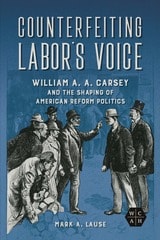
Counterfeiting Labor's Voice
William A. A. Carsey and the Shaping of American Reform PoliticsMark A. Lause
University of Illinois Press, 2024
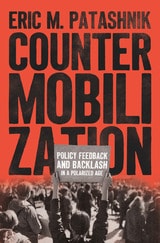
Countermobilization
Policy Feedback and Backlash in a Polarized AgeEric M. Patashnik
University of Chicago Press, 2023
An essential look at how and why backlash movements are inherent to US policymaking.
The most successful policies not only solve problems. They also build supportive coalitions. Yet, sometimes, policies trigger backlash and mobilize opposition. Although backlash is not a new phenomenon, today’s political landscape is distinguished by the frequency and pervasiveness of backlash in nearly every area of US policymaking, from abortion rights to the Affordable Care Act.
Eric M. Patashnik develops a policy-centered theory of backlash that illuminates how policies stimulate backlashes by imposing losses, overreaching, or challenging existing arrangements to which people are strongly attached. Drawing on case studies of issues from immigration and trade to healthcare and gun control, Countermobilization shows that backlash politics is fueled by polarization, cultural shifts, and negative feedback from the activist government itself. It also offers crucial insights to help identify and navigate backlash risks.
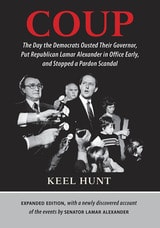
Coup
The Day the Democrats Ousted Their Governor, Put Republican Lamar Alexander in Office Early, and Stopped a Pardon ScandalKeel Hunt
Vanderbilt University Press, 2017
On January 17, 1979, driven by new information that some of the worst criminals in the state's penitentiaries were about to be released (and fears that James Earl Ray might be one of them), a small bipartisan group chose to take charge. Senior Democratic leaders, friends of the sitting governor, together with the Republican governor-elect Lamar Alexander (now US Senator from Tennessee), agreed to oust Blanton from office before another night fell. It was a maneuver unique in American political history.
Expanded edition, with a newly discovered account of the events by Senator Lamar Alexander:
"In December 2015 something unexpected happened. Keel [Hunt] delivered to my Nashville office a brown three-ring binder. He had only recently discovered it in a box that had been in storage for thirty years." —Senator Lamar Alexander
This binder contained the forgotten typescript, written in 1985, of Alexander's recollections of the events leading up to his early inauguration on January 17, 1979. In this expanded edition of Coup, the Senator's 22,000-word text has been added as a lost footnote to Hunt's definitive account.
From the foreword by John L. Seigenthaler:
"The individual stories of those government officials involved in the coup—each account unique, but all of them intersecting—were scattered like disconnected pieces of a jigsaw puzzle on the table of history until the author conceived this book. Perhaps because it happened so quickly, and without major disagreement, protest, or dissent, this truly historic moment has been buried in the public mind. In unearthing the drama in gripping detail, Keel Hunt assures that the 'dark day' will be remembered as a bright one in which conflicted politicians came together in the public interest."

Couplings
Peter Schneider
University of Chicago Press, 1998
"A little Don Giovanni, a little café sociology, a little laboratory science, a little Berlin wit—it's a pleasant mix."—Suzanne Ruta, New York Times Book Review
"With its poignant valedictory to its protagonists' waning youth and its rueful placing of them in the firing line of history, Couplings achieves a balance of light and dark that is utterly persuasive."—Michael Upchurch, San Francisco Chronicle Book Review
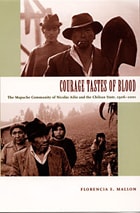
Courage Tastes of Blood
The Mapuche Community of Nicolás Ailío and the Chilean State, 1906-2001Florencia E. Mallon
Duke University Press, 2005
Mallon recounts the land usurpation Nicolás Ailío endured in the first decades of the twentieth century and the community’s ongoing struggle for restitution. Facing extreme poverty and inspired by the agrarian mobilizations of the 1960s, some community members participated in the agrarian reform under the government of socialist president Salvador Allende. With the military coup of 1973, they suffered repression and desperate impoverishment. Out of this turbulent period the Mapuche revitalization movement was born. What began as an effort to protest the privatization of community lands under the military dictatorship evolved into a broad movement for cultural and political recognition that continues to the present day. By providing the historical and local context for the emergence of the Mapuche revitalization movement, Courage Tastes of Blood offers a distinctive perspective on the evolution of Chilean democracy and its rupture with the military coup of 1973.

Couture and Consensus
Fashion and Politics in Postcolonial ArgentinaRegina A. Root
University of Minnesota Press, 2010
Crafting Mexico
Intellectuals, Artisans, and the State after the RevolutionRick A. López
Duke University Press, 2010
Creating Conservatism
Postwar Words that Made an American MovementMichael J. Lee
Michigan State University Press, 2014
Creating Dialogues
Indigenous Perceptions and Changing Forms of Leadership in AmazoniaHanne Veber
University Press of Colorado, 2017
Creating Dialogues discusses contemporary forms of leadership in a variety of Amazonian indigenous groups. Examining the creation of indigenous leaders as political subjects in the context of contemporary state policies of democratization and exploitation of natural resources, the book addresses issues of resilience and adaptation at the level of local community politics in lowland South America.
Contributors investigate how indigenous peoples perceive themselves as incorporated into the structures of states and how they tend to see the states as accomplices of the private companies and non-indigenous settlers who colonize or devastate indigenous lands. Adapting to the impacts of changing political and economic environments, leaders adopt new organizational forms, participate in electoral processes, become adept in the use of social media, experiment with cultural revitalization and new forms of performance designed to reach non-indigenous publics, and find allies in support of indigenous and human rights claims to secure indigenous territories and conditions for survival. Through these multiple transformations, the new styles and manners of leadership are embedded in indigenous notions of power and authority whose shifting trajectories predate contemporary political conjunctures.
Despite the democratization of many Latin American countries and international attention to human rights efforts, indigenous participation in political arenas is still peripheral. Creating Dialogues sheds light on dramatic, ongoing social and political changes within Amazonian indigenous groups. The volume will be of interest to students and scholars of anthropology, ethnology, Latin American studies, and indigenous studies, as well as governmental and nongovernmental organizations working with Amazonian groups.
Contributors: Jean-Pierre Chaumeil, Gérard Collomb, Luiz Costa, Oscar Espinosa, Esther López, Valéria Macedo, José Pimenta, Juan Pablo Sarmiento Barletti, Terence Turner, Hanne Veber, Pirjo Kristiina Virtanen
Creating Germans Abroad
Cultural Policies and National Identity in NamibiaDaniel Joseph Walther
Ohio University Press, 2002
When World War I brought an end to German colonial rule in Namibia, much of the German population stayed on. The German community, which had managed to deal with colonial administration, faced new challenges when the region became a South African mandate under the League of Nations in 1919. One of these was the issue of Germanness, which ultimately resulted in public conversations and expressions of identity.
In Creating Germans Abroad, Daniel Walther examines this discourse and provides striking new insights into the character of the German populace in both Germany and its former colony, Southwest Africa, known today as Namibia. In addition to German colonialism, Walther considers issues of race, class, and gender and the activities of minority groups. He offers new perspectives on German cultural and national identity during the Empire, the Weimar Republic, and the Third Reich.
In a larger context, Creating Germans Abroad acts as a model for investigating the strategies and motivations of groups and individuals engaged in national or ethnic engineering and demonstrates how unforeseen circumstances can affect the nature and outcome of these endeavors.
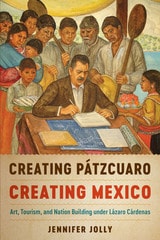
Creating Pátzcuaro, Creating Mexico
Art, Tourism, and Nation Building under Lázaro CárdenasBy Jennifer Jolly
University of Texas Press, 2018
LASA Visual Culture Studies Section Book Prize, Latin American Studies Association (LASA)
Winner, Arthur P. Whitaker Prize, Middle Atlantic Council of Latin American Studies, 2019In the 1930s, the artistic and cultural patronage of celebrated Mexican president Lázaro Cárdenas transformed a small Michoacán city, Pátzcuaro, into a popular center for national tourism. Cárdenas commissioned public monuments and archeological excavations; supported new schools, libraries, and a public theater; developed tourism sites and infrastructure, including the Museo de Artes e Industrias Populares; and hired artists to paint murals celebrating regional history, traditions, and culture. The creation of Pátzcuaro was formative for Mexico; not only did it provide an early model for regional economic and cultural development, but it also helped establish some of Mexico’s most enduring national myths, rituals, and institutions.
In Creating Pátzcuaro, Creating Mexico, Jennifer Jolly argues that Pátzcuaro became a microcosm of cultural power during the 1930s and that we find the foundations of modern Mexico in its creation. Her extensive historical and archival research reveals how Cárdenas and the artists and intellectuals who worked with him used cultural patronage as a guise for radical modernization in the region. Jolly demonstrates that the Pátzcuaro project helped define a new modern body politic for Mexico, in which the population was asked to emulate Cárdenas by touring the country and seeing and embracing its land, history, and people. Ultimately, by offering Mexicans a means to identify and engage with power and privilege, the creation of Pátzcuaro placed art and tourism at the center of Mexico’s postrevolutionary nation building project.
Creating Spaniards
Culture and National Identity in Republican SpainSandie Holguin
University of Wisconsin Press, 2002
Creating Spaniards is a cultural and intellectual history that explains the intersection of politics and culture, and the formation of a national identity, during Spain’s Second Republic and Civil War. It counters recent scholarship claiming that leaders of the Second Republic had no programs for "inventing traditions" to encourage a Spanish national identity.
Focusing on the Second Republic, 1931–1936, Sandie Holguín illustrates how various intellectuals and politicians of the Republican–Socialist coalition used theater, literature, and film to aid the construction of a unified Spanish culture and history. She uses memoirs, journals, newspapers, parliamentary debates, and archival sources in her examination of the impact that cultural reforms had on the transformation of one of Europe’s oldest states.
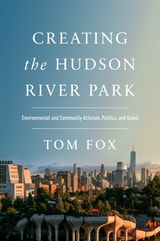
Creating the Hudson River Park
Environmental and Community Activism, Politics, and GreedTom Fox
Rutgers University Press, 2024
The 4-mile-long, 550-acre Hudson River Park is nearing completion and is the largest park built in Manhattan since Central Park opened more than 150 years ago. It has transformed a derelict waterfront, protected the Hudson River estuary, preserved commercial maritime activities, created new recreational opportunities for millions of New Yorkers, enhanced tourism, stimulated redevelopment in adjacent neighborhoods, and set a precedent for waterfront redevelopment. The Park attracts seventeen million visitors annually. Creating the Hudson River Park is a first-person story of how this park came to be. Working together over three decades, community groups, civic and environmental organizations, labor, the real estate and business community, government agencies, and elected officials won a historic victory for environmental preservation, the use and enjoyment of the Hudson River, and urban redevelopment. However, the park is also the embodiment of a troubling trend toward the commercialization of America’s public parks.
After the defeat of the $2.4 billion Westway plan to fill 234 acres of the Hudson in 1985, the stage was set for the revitalization of Manhattan’s West Side waterfront. Between 1986 and 1998 the process focused on the basics like designing an appropriate roadway, removing noncompliant municipal and commercial activities from the waterfront, implementing temporary improvements, developing the Park’s first revenue-producing commercial area at Chelsea Piers, completing the public planning and environmental review processes, and negotiating the 1998 Hudson River Park Act that officially created the Park. From 1999 to 2009 planning and construction were funded with public money and focused on creating active and passive recreation opportunities on the Tribeca, Greenwich Village, Chelsea, and Hell’s Kitchen waterfronts.
However, initial recommendations to secure long term financial support for the Park from the increase in adjacent real estate values that resulted from the Park’s creation were ignored. City and state politicians had other priorities and public funding for the Park dwindled. The recent phase of the project, from 2010 to 2021, focused on “development” both in and adjacent to the Park. Changes in leadership, and new challenges provide an opportunity to return to a transparent public planning process and complete the redevelopment of the waterfront for the remainder of the 21st-century. Fox’s first-person perspective helps to document the history of the Hudson River Park, recognizes those who made it happen and those who made it difficult, and provides lessons that may help private citizens and public servants expand and protect the public parks and natural systems that are so critical to urban well-being.

Crimes of August
A NovelRubem Fonseca
Tagus Press, 2014
Rubem Fonseca's Crimes of August offers the first serious literary treatment of the cataclysmic events of August 1954, arguably the most turbulent month in Brazilian history. A rich novel, both culturally and historically, Crimes of August tells two stories simultaneously. The first is private, involving the well-delineated character of Alberto Mattos, a police officer. The other is public, focusing on events that begin with the attempted assassination of Carlos Lacerda, a demagogic journalist and political enemy of President Getúlio Vargas, and culminate in Vargas's suicide on August 24,1954. Throughout this suspenseful novel, deceptively couched as a thriller, Fonseca interweaves fact and fiction in a complex, provocative plot. At the same time, he re-creates the atmosphere of the 1950s, when Rio de Janeiro was Brazil's capital and the nexus of political intrigue and corruption. Mattos is assigned to solve the brutal murder of a wealthy entrepreneur in the aftermath of what appears to be a homosexual liaison. An educated and introspective man, and one of the few in his precinct not on the take from the bankers of the illegal lottery, Mattos suffers from alienation and a bleeding ulcer. His investigation puts him on a dangerous collision course with the conspiracy to depose Vargas, the novel's other narrative thread. The two overlap at several points, coming to their tragic end with the aged politician's suicide and Mattos's downfall.
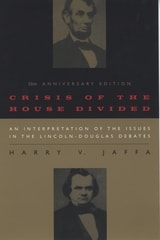
Crisis of the House Divided
An Interpretation of the Issues in the Lincoln-Douglas Debates, 50th Anniversary EditionHarry V. Jaffa
University of Chicago Press, 2009
The definitive account of the Lincoln-Douglas debates and their importance to American history
A lasting classic, Crisis of the House Divided offers an unparalleled account of the Lincoln-Douglas debates. Harry Jaffa provides the definitive analysis of the political principles that guided Lincoln from his reentry into politics in 1854 through his Senate campaign against Douglas in 1858.

Critical Studies in Indian Grammarians I
The Theory of Homogeneity (Savar?ya)Madhav M. Deshpande
University of Michigan Press, 1975
Crossing the Aisle
How Bipartisanship Brought Tennessee to the Twenty-First Century and Could Save AmericaKeel Hunt
Vanderbilt University Press, 2018
The Tennessee story, as the Pulitzer Prize–winning author Jon Meacham observes in his foreword to this book, offers striking examples of bipartisan cooperation on many policy fronts—and a mode of governing that provides lessons for America in this frustrating era of partisan stalemate.
For more on Crossing the Aisle and author Keel Hunt, visit KeelHunt.com.
Crossing the Barriers
The Autobiography of Allan H. SpearAllan H. Spear
University of Minnesota Press, 2010
Spear's memoirs are fascinating and moving: in early chapters on his childhood and college years, he writes with great introspection about his growing self-awareness of being gay. Later he writes about his development as an intellectual, particularly as a white man fighting to win legitimacy for the study of African-American history and culture. During his time at the University of Minnesota, Spear became deeply involved with the Minnesota Democratic-Farmer-Labor Party (DFL) and the antiwar movement. At the same time, Spear became increasingly active in the emerging gay rights movement and began the process of coming out to his friends and colleagues.
After a failed run for the Minnesota House in 1968, Spear was elected to the Minnesota Senate in 1972 and served as Senate president from 1993-2000. In 1993, he was instrumental in the passage of the Minnesota Human Rights Act, which protected LGBT people from discrimination in housing, education, and employment-an achievement he considered one of the finest of his career. A skilled parliamentarian, he remained a progressive leader in the legislature until his retirement in 2000.
Spear passed away on October 11, 2008, leaving his memoir slightly incomplete. A stirring afterword by John Milton completes the story of Spear's life, chronicling the recognition of his accomplishments as a politician and activist during his final years.
Crucibles of Black Empowerment
Chicago's Neighborhood Politics from the New Deal to Harold WashingtonJeffrey Helgeson
University of Chicago Press, 2014
In Crucibles of Black Empowerment, Jeffrey Helgeson recounts the rise of African American political power and activism from the 1930s onward, revealing how it was achieved through community building. His book tells stories of the housewives who organized their neighbors, building tradesmen who used connections with federal officials to create opportunities in a deeply discriminatory employment sector, and the social workers, personnel managers, and journalists who carved out positions in the white-collar workforce. Looking closely at black liberal politics at the neighborhood level in Chicago, Helgeson explains how black Chicagoans built the networks that eventually would overthrow the city’s seemingly invincible political machine.

Crude Chronicles
Indigenous Politics, Multinational Oil, and Neoliberalism in EcuadorSuzana Sawyer
Duke University Press, 2004
Through her rich ethnography of indigenous marches, demonstrations, occupations, and negotiations, Sawyer tracks the growing sophistication of indigenous politics as Indians subverted, re-deployed, and, at times, capitulated to the dictates and desires of a transnational neoliberal logic. At the same time, she follows the multiple maneuvers and discourses that the multinational corporation and the Ecuadorian state used to circumscribe and contain indigenous opposition. Ultimately, Sawyer reveals that indigenous struggles over land and oil operations in Ecuador were as much about reconfiguring national and transnational inequality—that is, rupturing the silence around racial injustice, exacting spaces of accountability, and rewriting narratives of national belonging—as they were about the material use and extraction of rain-forest resources.

Cruel Modernity
Jean Franco
Duke University Press, 2013
Franco draws on human-rights documents, memoirs, testimonials, novels, and films, as well as photographs and art works, to explore not only cruel acts but the discriminatory thinking that made them possible, their long-term effects, the precariousness of memory, and the pathos of survival.
Crusade Against Slavery
Edward Coles, Pioneer of FreedomKurt E. Leichtle and Bruce G. Carveth
Southern Illinois University Press, 2011
Rejecting slavery from a young age, Coles's early wishes to free his family's slaves initially were stymied by legal, practical, and family barriers. Instead he went to Washington, D.C., where his work in the White House was a life-changing blend of social glitter, secretarial drudge, and distasteful political patronage. Returning home, he researched places where he could live out his ideals. After considerable planning and preparation, he left his family's Virginia tobacco plantation in 1819 and started the long trip west to Edwardsville, Illinois, pausing along the Ohio River on an emotional April morning to free his slaves and offer each family 160 acres of Illinois land of their own. Some continued to work for Coles, while others were left to find work for themselves. This book revisits the lives of the slaves Coles freed, including a noted preacher and contributor to the founding of what is now the second-oldest black Baptist organization in America.
Crusade Against Slavery details Coles's struggles with frontier life and his surprise run and election to the office of Illinois governor as well as his continuing antislavery activities. At great personal cost, he led the effort to block a constitutional convention that would have legalized slavery in the state, which resulted in an acrimonious civil suit brought on by his political enemies, who claimed he violated the law by not issuing a bond of emancipation for his slaves. Although initially convicted by a partisan jury, Coles was vindicated when the Illinois Supreme Court overturned the decisions of the lower courts. Through the story of Coles's moral and legal battles against slavery, Leichtle and Carveth unearth new perspectives on an institution that was on unsure footing yet strongly ingrained in the business interests at the economic base of the fledgling state.
In 1831, after less than a decade in Illinois-and after losing a bid for Congress-Coles left for Philadelphia, where he remained in correspondence with Madison about the issue of slavery. Drawing on previous incomplete treatments of Coles's life, including his own short memoir, Crusade Against Slavery includes the first published analysis of Madison's failure to free his slaves despite his plans to do so through his will and a fascinating exploration of Coles's struggle to understand Madison's inability to live up to the ideals both men shared.

Cuba and the Politics of Passion
By Damián J. Fernández
University of Texas Press, 2000
Cuban politics has long been remarkable for its passionate intensity, and yet few scholars have explored the effect of emotions on political attitudes and action in Cuba or elsewhere. This book thus offers an important new approach by bringing feelings back into the study of politics and showing how the politics of passion and affection have interacted to shape Cuban history throughout the twentieth century.
Damián Fernández characterizes the politics of passion as the pursuit of a moral absolute for the nation as a whole. While such a pursuit rallied the Cuban people around charismatic leaders such as Fidel Castro, Fernández finds that it also set the stage for disaffection and disconnection when the grand goal never fully materialized. At the same time, he reveals how the politics of affection-taking care of family and friends outside the formal structures of government-has paradoxically both undermined state regimes and helped them remain in power by creating an informal survival network that provides what the state cannot or will not.
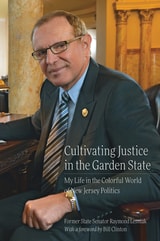
Cultivating Justice in the Garden State
My Life in the Colorful World of New Jersey PoliticsRaymond Lesniak
Rutgers University Press, 2022
He recounts the many causes he championed in his forty years as a state legislator, from the landmark Environmental Cleanup Responsibility Act to bills concerning animal protections, marriage equality, women’s reproductive rights, and the abolition of the death penalty. He also delves into his experiences on the national stage as a key advisor for Bill Clinton and Al Gore’s presidential campaigns. With refreshing candor, Lesniak describes both his greatest achievements and his moments of failure, including his unsuccessful 2017 gubernatorial run.
Cultivating Justice in the Garden State is both a gripping American success story and a must-read for anyone seeking to understand the inner workings of our political system. It offers an insider’s perspective on the past fifty years of New Jersey politics, while presenting a compelling message about what leaders and citizens can do to improve the state’s future.
Cults, Martyrs and Good Samaritans
Religion in Contemporary English Political DiscourseJames Crossley
Pluto Press, 2018
From the paternalistic Christianity used to justify ever-intensifying neoliberalism, to the ethnonationalist and protectionist Christianity of Theresa May and Brexit, to the socialist constructions of Christianity by Jeremy Corbyn and Momentum, Crossley guides us through the love affair between politics and Christianity.. Drawing on interviews with politicians, activists, revolutionaries, and voters on either side of Brexit, Crossley reveals how religion is linked to positions on issues of class, capitalism, and foreign policy, and how it can can often challenge dominant class interests, obfuscate potential causes of unrest, and even justify military intervention.
Cultural Citizenship
Cosmopolitanism, Consumerism, and Television in a Neoliberal AgeToby Miller
Temple University Press, 2006