4743 books match the query 'Religion' and 302 start with c
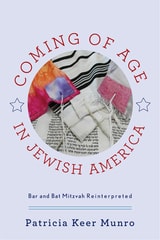
cover of Coming of Age in Jewish America: Bar and Bat Mitzvah Reinterpreted

Coming of Age in Jewish America

Bar and Bat Mitzvah Reinterpreted

Patricia Keer Munro

Rutgers University Press, 2016

The Jewish practice of bar mitzvah dates back to the twelfth century, but this ancient cultural ritual has changed radically since then, evolving with the times and adapting to local conditions. For many Jewish-American families, a child’s bar mitzvah or bat mitzvah is both a major social event and a symbolic means of asserting the family’s ongoing connection to the core values of Judaism. Coming of Age in Jewish America takes an inside look at bar and bat mitzvahs in the twenty-first century, examining how the practices have continued to morph and exploring how they serve as a sometimes shaky bridge between the values of contemporary American culture and Judaic tradition.
 
Interviewing over 200 individuals involved in bar and bat mitzvah ceremonies, from family members to religious educators to rabbis, Patricia Keer Munro presents a candid portrait of the conflicts that often emerge and the negotiations that ensue. In the course of her study, she charts how this ritual is rife with contradictions; it is a private family event and a public community activity, and for the child, it is both an educational process and a high-stakes performance.
 
Through detailed observations of Conservative, Orthodox, Reform, and independent congregations in the San Francisco Bay Area, Munro draws intriguing, broad-reaching conclusions about both the current state and likely future of American Judaism.  In the process, she shows not only how American Jews have forged a unique set of bar and bat mitzvah practices, but also how these rituals continue to shape a distinctive Jewish-American identity.  
 
[more]
cover of Commentaries on the Psalms, Volume

Commentaries on the Psalms, Volume

St. Hilary of Poitiers

Catholic University of America Press, 2027
Hilary of Poitiers (d. 367), famous for his role in the Trinitarian debates of the fourth century, was a key figure in the emergence of Western, Latin theology and biblical exegesis. His writings reflect his deep engagement with the major Greek thinkers of his time as well as his distinctive approach to the moral and spiritual meaning of Scripture. His extensive treatment of the Psalms, translated here into English for the first time, is the earliest that survives from the Latin West. The work, which Hilary composed between 364 and his death in 367, reflects his mature theology, comprising an Instructio or introduction, as well as commentary on fifty-seven Psalms (1, 2, 9, 13, 14, 51–69, 91, 119 to 150; LXX numbering) and an extended treatise on Psalm 118. While the Commentaries have received relatively little scholarly attention, they reward close reading. They reflect not only Hilary’s own keen interest in the linguistic and theological features of the biblical text, but also his debts to the traditions of interpretation that were circulating among the pro-Nicene thinkers of his time. Close study of this work reveals how Hilary supplemented his own earlier methods of figurative exegesis by engaging Greek sources, especially the thought of Origen of Alexandria (c. 185–c. 255), and by incorporating insights from his developing pro-Nicene theology. Although Hilary attends to the historical meaning of the Psalms, he regularly views Christ as the true author of the prayers. Thus, the Commentaries are closely linked to his Christological and Trinitarian writings, as well as to his theology of kenosis and deification.
[more]
cover of Commentary on Galatians

Commentary on Galatians

Catholic University of America Press, 2011
Jerome's Commentary on Galatians is presented here in English translation in its entirety.
[more]
cover of Commentary on Genesis

Commentary on Genesis

Catholic University of America Press, 2016
Blind since early childhood, the Egyptian theologian and monk Didymus (ca. 313-398) wielded a masterful knowledge of Scripture, philosophy, and previous biblical interpretation, earning the esteem of his contemporaries Athanasius, Antony of Egypt, Jerome, Rufinus, and Palladius, as well as of the historians Socrates and Theodoret in the decades following his death. He was, however, anathematized by the Fifth Ecumenical Council in 553 because of his utilization and defense of the works of Origen, and this condemnation may be responsible for the loss of many of Didymus's writings. Jerome and Palladius mentioned that Didymus had written commentaries on Old Testament books; these commentaries were assumed to be no longer extant until the discovery in 1941 in Tura, Egypt, of papyri containing commentaries on Genesis, Zechariah, Job, Ecclesiastes, and some of the Psalms.
[more]
cover of Commentary on Matthew

Commentary on Matthew

D.H. St. Hilary of Poiters

Catholic University of America Press, 2012
St. Jerome (347-420) has been considered the pre-eminent scriptural commentator among the Latin Church Fathers. His Commentary on Matthew, written in 398 and profoundly influential in the West, appears here for the first time in English translation.
[more]
cover of Commentary on Matthew

Commentary on Matthew

Saint Jerome

Catholic University of America Press, 2008
His Commentary on Matthew, written in 398 and profoundly influential in the West, appears here for the first time in English translation. Jerome covers the entire text of Matthew's gospel by means of brief explanatory comments that clarify the text literally and historically.
[more]
cover of Commentary on Saint John the Apostle and Evangelist, Homilies 1–47

Commentary on Saint John the Apostle and Evangelist, Homilies 1–47

Saint John Chrysostom

Catholic University of America Press, 1957
No description available
[more]
cover of Commentary on Saint John the Apostle and Evangelist, Homilies 48–88

Commentary on Saint John the Apostle and Evangelist, Homilies 48–88

Saint John Chrysostom

Catholic University of America Press, 1957
No description available
[more]
cover of Commentary on Zechariah

Commentary on Zechariah

Robert C. Didymus the Blind

Catholic University of America Press, 2006
A disciple of Origen, whose work on Zechariah reached only to chapter five and is no longer extant, Didymus's commentary on this apocalyptic book illustrates the typically allegorical approach to the biblical text that we associate with Alexandria
[more]
cover of Commentary on the Apocalypse

Commentary on the Apocalypse

Catholic University of America Press, 2012
Striking a balance between the symbolic language of the book and its literal, prophetic fulfillment, Andrew?s interpretation is a remarkably intelligent, spiritual, and thoughtful commentary that encourages the pursuit of virtue and confidence in the love of God for humanity
[more]
cover of Commentary on the Apocalypse

Commentary on the Apocalypse

John N. Oecumenius

Catholic University of America Press, 2006
No description available
[more]
cover of Commentary on the Epistle to the Romans

Commentary on the Epistle to the Romans

Peter Abelard

Catholic University of America Press, 2011
Despite its importance and the frequent references made to it by modern scholars, this commentary has never before been translated into English in its entirety. This volume, which includes an extensive introduction, fills this gap, thus providing a needed contribution to medieval scholarship.
[more]
cover of Commentary on the Epistle to the Romans, Books 1-5

Commentary on the Epistle to the Romans, Books 1-5

Catholic University of America Press, 2001
No description available
[more]
cover of Commentary on the Epistle to the Romans, Books 6-10

Commentary on the Epistle to the Romans, Books 6-10

Catholic University of America Press, 2002
No description available
[more]
cover of Commentary on the Gospel According to John, Books 13-32

Commentary on the Gospel According to John, Books 13-32

Catholic University of America Press, 1989
No description available
[more]
cover of Commentary on the Gospel of John, Books 1-10

Commentary on the Gospel of John, Books 1-10

Catholic University of America Press, 1989
No description available
[more]
cover of Commentary on the Gospel of John, Chapters 6-12

Commentary on the Gospel of John, Chapters 6-12

Thomas Aquinas

Catholic University of America Press, 2010
No description available
[more]
cover of Commentary on the Gospel of John: Chapters 1-5

Commentary on the Gospel of John

Chapters 1-5

Thomas Aquinas

Catholic University of America Press, 2010
No description available
[more]
cover of Commentary on the Gospel of John: Chapters 13-21

Commentary on the Gospel of John

Chapters 13-21

Thomas Aquinas

Catholic University of America Press, 2010
No description available
[more]
cover of Commentary on the Lord’s Sermon on the Mount with Seventeen Related Sermons

Commentary on the Lord’s Sermon on the Mount with Seventeen Related Sermons

Saint Augustine

Catholic University of America Press, 1951
No description available
[more]
cover of Commentary on the Old Greek and Peshitta of Isaiah 1–25

Commentary on the Old Greek and Peshitta of Isaiah 1–25

Ronald L. Troxel

SBL Press, 2020

The first thorough commentary on the Old Greek and Peshitta of Isaiah

Ronald L. Troxel’s new textual commentary on Isaiah focuses on the book’s Greek and Syriac translations and seeks to recover, as much as possible, the Hebrew texts on which these early translations relied. Troxel treats the Greek and Syriac together in order to present a detailed analysis of their relationship, devoting particular attention to whether the Syriac was directly or indirectly influenced by the Greek. This comparison sheds light on both the shared and distinct approaches that the translators took in rendering lexemes, phrases, verses, and even passages. In addition Troxel presents observations about the literary structures the translators created that differ from those implicit in their source texts (as we understand them), to produce coherent discourse in the target language.

Features:

  • Textual commentary on the life of the text of Isaiah 1–25
  • Use of the Dead Sea Scrolls to shed light on particular issues
  • Detailed comparison of the Masoretic Text, the Old Greek, and the Peshitta
[more]
cover of Commentary on the Psalms, Psalms 1-72

Commentary on the Psalms, Psalms 1-72

Robert C. Theodoret of Cyrus

Catholic University of America Press, 2000
No description available
[more]
cover of Commentary on the Songs of Songs

Commentary on the Songs of Songs

Vittorio Rupert of Deutz

Catholic University of America Press, 2024
This is the first English translation of a major work by Rupert of Deutz, arguably the most prolific Christian author since Augustine. During his lifetime, which spanned the eleventh and twelfth centuries, Rupert engaged in controversies on the Eucharist and on predestination and composed works on the Trinity, salvation in Christ, and other major theological topics. An ardent defender of a monastic theology that focused on the interpretation of Scripture and the liturgy, Rupert is well known also for his distinctive hermeneutical approach to the Bible. His Commentary on the Songs of Songs builds on the long Hebrew-Christian tradition of allegorical interpretation of this Old Testament book but adds a radically original dimension to it: it interprets the text as a dialogue between Jesus and Mary and unfolds in this context a novel approach to Mary, who is presented as the teacher of the apostles and assumed to have participated in the Apostolic Council, described in Acts 15. Rupert has prefaced his commentary with a letter to Thietmar, bishop of Verden (in northern Germany), as well as a prologue in which he reflects on his experience of being called to perform this exegetical task. The complete translation by Jieon Kim and Vittorio Hösle of this major work (up to now translated only into German) is preceded by an introduction that discusses Rupert's life and works, as well as the history of the interpretation of the Song of Songs, and offers hermeneutical reflections on Rupert's methodology.
[more]
cover of Commentary on the Twelve Prophets

Commentary on the Twelve Prophets

Robert C. Theodore of Mopsuestia

Catholic University of America Press, 2004
No description available
[more]
cover of Commentary on the Twelve Prophets, Volume 1

Commentary on the Twelve Prophets, Volume 1

Saint Cyril of Alexandria

Catholic University of America Press, 2007
No description available
[more]
cover of Commentary on the Twelve Prophets, Volume 2

Commentary on the Twelve Prophets, Volume 2

Saint Cyril of Alexandria

Catholic University of America Press, 2007
No description available
[more]
cover of Commentary on the Twelve Prophets, Volume 3

Commentary on the Twelve Prophets, Volume 3

Catholic University of America Press, 2012
No description available
[more]
cover of Commoner Ritual and Ideology in Ancient Mesoamerica

Commoner Ritual and Ideology in Ancient Mesoamerica

Nancy Gonlin

University Press of Colorado, 2016

Were most commoners in ancient Mesoamerica poor? In a material sense, yes, probably so. Were they poor in their beliefs and culture? Certainly not, as Commoner Ritual and Ideology in Ancient Mesoamerica demonstrates.

This volume explores the ritual life of Mesoamerica's common citizens, inside and outside of the domestic sphere, from Formative through Postclassic periods. Building from the premise that ritual and ideological expression inhered at all levels of society in Mesoamerica, the contributors demonstrate that ideology did not emanate solely from exalted individuals and that commoner ritual expression was not limited to household contexts. Taking an empirical approach to this under-studied and under-theorized area, contributors use material evidence to discover how commoner status conditioned the expression of ideas and values.

Revealing complex social hierarchies that varied across time and region, this volume offers theoretical approaches to commoner ideology, religious practice, and sociopolitical organization and builds a framework for future study of the correlation of ritual and ideological expression with social position for Mesoamericanists and archaeologists worldwide.
[more]
cover of Communicating Faith

Communicating Faith

John Sullivan

Catholic University of America Press, 2011

This book enriches appreciation of the many ways that Christian faith is communicated. It casts light on the sensitivities, skills, and qualities necessary for the effective communication of faith, where justice is done both to the "seed" to be sown and to the "soil" being cultivated.
[more]
cover of Communicating the Infinite: The Emergence of the Habad School

Communicating the Infinite

The Emergence of the Habad School

Naftali Loewenthal

University of Chicago Press, 1990

At the end of the eighteenth century the hasidic movement was facing an internal crisis: to what extent should the teachings of Baal Shem Tov and Maggid of Mezritch, with their implicit spiritual demands, be transmitted to the rank-and-file of the movement? Previously these teachings had been reserved for a small elite. It was at this point that the Habad school emerged with a communication ethos encouraging the transmission of esoteric to the broad reaches of the Jewish world. Communicating the Infinite explores the first two generations of the Habad school under R. Shneur Zalman of Liadi and his son R. Dov Ber and examines its early opponents.

Beginning with the different levels of communication in the teachings of the Baal Shem Tov and the Maggid and his disciples, Naftali Loewenthal traces the unfolding of the dialectic between the urge to transmit esoteric ideas and a powerful inner restraint. Gradually R. Shneur Zalman came to the fore as the prime exponent of the communication ethos. Loewenthal follows the development of his discourses up to the time of his death, when R. Dov Ber and R. Aaron Halevi Horowitz formed their respective "Lubavitch" and "Staroselye" schools. The author continues with a detailed examination of the teachings of R. Dov Ber, an inspired mystic. Central in his thought was the esoteric concept of self-abnegation, bitul, yet this combined with the quest to communicate hasidic teachings to every level of society, including women.

From the late eighteenth century onwards, the main problem for the Jewish world was posed by the fall of the walls of the social and political ghetto. Generally, the response was either to secularize, or abandon altogether, traditional Judaism or to retreat from the threatening modern world into enclave religiosity; by stressing communication, the Habad school opened the way for a middle range response that was neither a retreat into elitism nor an abandonment of tradition. Based on years of research from Hebrew and Yiddish primary source materials, Communicating the Infinite is a work of importance not only to specialists of Judaic studies but also to historians and sociologists.
[more]
cover of Communicating with the Spirits

Communicating with the Spirits

Gábor Klaniczay

Central European University Press, 2005
Focuses on the problem of communication with the other world: the phenomenon of spirit possession and its changing historical interpretations, the imaginary schemes elaborated for giving accounts of the journeys to the other world, for communicating with the dead, and finally the historical archetypes of this kind of religious manifestation—trance prophecy, divination, and shamanism.Recognized historians and ethnologists analyze the relationship, coexistence and conflicts of popular belief systems, Judeo-Christian mythology and demonology in medieval and modern Europe. The essays address links between rites and beliefs, folklore and literature; the legacy of various pre-Christian mythologies; the syncretic forms of ancient, medieval and modern belief- and rite-systems; "pure" examples from religious-ethnological research outside Europe to elucidate European problems.
[more]
cover of Communication Culture in a Digital Age: Being Seriously Relational

Communication Culture in a Digital Age

Being Seriously Relational

Cristian Mendoza

St. Augustine's Press, 2023

Why are human beings so attracted to information and communication technologies? Developments in this field have formed new social networks around these technologies and that seem to compete with pre-existing structures in human lives. Cristian Mendoza and Lluís Clavell confront this phenomenon and its effect on human happiness, but have no desire to condemn the trajectory of human reliance on communication technology. Rather, they see an opportunity to explore human nature at greater depths. Only in this way can our use of technology properly support human activity and not sabotage our grasp of reality. 

Mendoza and Clavell's treatment of this topic renders an important philosophical conversation about digital realities and how they can actually make human life more human. This book provides a framework for using human attraction to information and communication tech for human benefit. It can be done! The authors apply the work of old and new masters to help open the new horizons of communication technology wherein human beings can flourish.
[more]
cover of Communication, Pedagogy, and the Gospel of Mark

Communication, Pedagogy, and the Gospel of Mark

Elizabeth E. Shively

SBL Press, 2016

Reflections on the relationship between research and teaching

Using Mark as a test case, scholars address questions like: How should my research and my approach to the text play out in the classroom? What differences should my academic context and my students' expectations make? How should new approaches and innovations inform interpretation and teaching? This resource enables biblical studies instructors to explore various interpretative approaches and to begin to engage pedagogical issues in our changing world.

Features:

  • Ideas that may be adapted for teaching any biblical text
  • Diverse perspectives from nine experts in their fields
  • Essays include tips, ideas, and lesson plans for the classroom
[more]
cover of Communism, Religion, and Revolt in Banten in the Early Twentieth Century: Mis Sea#86

Communism, Religion, and Revolt in Banten in the Early Twentieth Century

Mis Sea#86

Michael Williams

Ohio University Press, 1990

Twice in this century popular revolts against colonial rule have occured in the Banten district of West Java. These revolts, conducted largely under an Islamic leadership, also proclaimed themselves Communist. Islamic Communism is seemingly a paradox. This is especially the case when one considers that probably no religion has proved more resistant to Communist ideology than Islam.

Michael Williams here details the complicated history of the Bantenese revolts in the twentieth century and probes the ideological riddle of Islamic Communism. Modern history is replete with examples of regions with a long history of organizing themselves politically to resist intrusion on their territory, resources, and people. This book establishes that in Indonesia, the Bantenese were among the most practiced exponents of resistance.
[more]
cover of Communities in Dispute: Current Scholarship on the Johannine Epistles

Communities in Dispute

Current Scholarship on the Johannine Epistles

R. Alan Culpepper

SBL Press, 2014

Presenting the best work on the Johannine Epistles from a world-class gathering of scholars

This anthology includes papers presented at the McAfee School of Theology Symposium on the Johannine Epistles (2010). Contributions on the relationship between the Gospel of John and the Letters of John, Johannine theology and ethics, the concept of the Antichrist, and the role of the elder round out the collection. This is a must-have book for libraries and New Testament scholars.

Features:

  • Introductory essay places the collection in context
  • Articles engage the work of Raymond Brown and J. Louis Martyn
  • Sixteen essays from the Book of Psalms Consultation group and invited scholars

[more]
cover of Companion Spirits: More-Than-Secular Journeys in More-Than-Human Worlds

Companion Spirits

More-Than-Secular Journeys in More-Than-Human Worlds

Mayanthi L. Fernando

Duke University Press, 2027
In Companion Spirits, Mayanthi L. Fernando expands the concept of the more-than-human, offered as an antidote to anthropocentric worldmaking, beyond its secular foundations. Fernando argues that ways of thinking and being that underpin the Anthropocene—the idea that nature is inert, or that human mastery of the universe is possible—are effects of secularity. Drawing on autobiography, historiography, ethnography, theology, zoology, speculative fiction, and more, Fernando simultaneously examines the nexus of the Anthropocene and secularity and accounts for more-than-human worlds in more-than-secular ways. She also offers a counter-anthropology of the secular, tracking submerged sensibilities that do not adhere to dominant norms about science and religion, matter and spirit, reality and illusion. In so doing, she invites us, secular moderns included, to imagine the present, and the future, otherwise.
[more]
cover of Comparative Essays on the Poetry and Prose of John Donne and George Herbert: Combined Lights

Comparative Essays on the Poetry and Prose of John Donne and George Herbert

Combined Lights

Russell M. Hillier

University of Delaware Press, 2022
This book brings together ten essays on John Donne and George Herbert composed by an international group of scholars. The volume represents the first collection of its kind to draw close connections between these two distinguished early modern thinkers and poets who are justly coupled because of their personal and artistic association. The contributors' distinctive new approaches and insights illuminate a variety of topics and fields while suggesting new directions that future study of Donne and Herbert might take. Some chapters explore concrete instances of collaboration or communication between Donne and Herbert, and others find fresh ways to contextualize the Donnean and Herbertian lyric, carefully setting the poetry alongside discourses of apophatic theology or early modern political theory, while still others link Herbert's verse to Donne's devotional prose. Several chapters establish specific theological and aesthetic grounds for comparison, considering Donne and Herbert's respective positions on religious assurance, comic sensibility, and virtuosity with poetic endings. 
[more]
cover of Comparative Reformed Church Polity: Similarities and Differences

Comparative Reformed Church Polity

Similarities and Differences

Leon van den Broeke

Central European University Press, 2026

The World Communion of Reformed churches (WCRC) actually has 233 members and all of these churches have in some form legal norms for their constitutional set-up. How do they look like, what is similar to them and where are the di¬fferences? What in the constitutional set-up of the Reformed churches is influenced by the organisational principles that the 16th century Reformers developed for the church and what is the outcome of the, sometimes strong, in fluence of state law? Where do we see constitutional transplants due to the fact that some churches grew out of others? With which topics are all Reformed Churches currently dealing? Finally, to what extent does the Reformed branch on the tree of Christian churches di¬ er from other Christian churches? This books contains expert papers on Reformed church polity in ¬different countries. By comparing a series of church polity topics it wants to foster an understanding of the richness of Reformed church polity in history and at present. This book, then, seeks to enlarge the knowledge on Reformed church polity and, in the meantime, to contribute to ecumenism. If you would like to order the book for delivery outside of the Netherlands, please email orders@aup.nl
[more]
cover of Comparative Reformed Church Polity: Similarities and Differences

Comparative Reformed Church Polity

Similarities and Differences

Leon van den Broeke

Central European University Press, 2026
The World Communion of Reformed churches (WCRC) actually has 233 members and all of these churches have in some form legal norms for their constitutional set-up. How do they look like, what is similar to them and where are the di¬fferences? What in the constitutional set-up of the Reformed churches is influenced by the organisational principles that the 16th century Reformers developed for the church and what is the outcome of the, sometimes strong, in fluence of state law? Where do we see constitutional transplants due to the fact that some churches grew out of others? With which topics are all Reformed Churches currently dealing? Finally, to what extent does the Reformed branch on the tree of Christian churches di¬ er from other Christian churches? This books contains expert papers on Reformed church polity in ¬different countries. By comparing a series of church polity topics it wants to foster an understanding of the richness of Reformed church polity in history and at present. This book, then, seeks to enlarge the knowledge on Reformed church polity and, in the meantime, to contribute to ecumenism. If you would like to order the book for delivery outside of the Netherlands, please email orders@aup.nl
[more]
cover of Comparing Jewish Societies

Comparing Jewish Societies

Todd M. Endelman, Editor

University of Michigan Press, 1997
Having unfolded in the diverse communities of the diaspora, Jewish experience lends itself almost effortlessly to comparative treatment. The contributors to this volume take up the challenge, examining Jewish societies from medieval to modern times, in Western and Eastern Europe, North and South America, North Africa, India, China, and the Middle East. The essays use the methodological strategies and theoretical insights of history, sociology, anthropology, and political science to explore such topics as Jewish and African nationalism; Arab and Jewish railway workers in British-ruled Palestine; East European Jewish immigrants in New York, London, and Paris; ritual murder trials in fin-de-siècle Central Europe; and Catholic and Jewish enlightenment movements. Further, because of their comparative structure and method, these essays stimulate fresh questions about the larger societies in which Jews lived--their values, practices, and structures. Comparing Jewish Societies will appeal to students and scholars at all levels who wish to break out of old frameworks to observe the Jews and their religion with a new, methodologically sophisticated eye. Todd M. Endelman is William Haber Professor of Modern Jewish History, University of Michigan.
[more]
cover of Competing Kingdoms: Women, Mission, Nation, and the American Protestant Empire, 1812–1960

Competing Kingdoms

Women, Mission, Nation, and the American Protestant Empire, 1812–1960

Barbara Reeves-Ellington, Kathryn Kish Sklar, and Connie A. Shemo, eds.

Duke University Press, 2010

Competing Kingdoms rethinks the importance of women and religion within U.S. imperial culture from the early nineteenth century to the mid-twentieth. In an era when the United States was emerging as a world power to challenge the hegemony of European imperial powers, American women missionaries strove to create a new Kingdom of God. They did much to shape a Protestant empire based on American values and institutions. This book examines American women’s activism in a broad transnational context. It offers a complex array of engagements with their efforts to provide rich intercultural histories about the global expansion of American culture and American Protestantism.

An international and interdisciplinary group of scholars, the contributors bring under-utilized evidence from U.S. and non-U.S. sources to bear on the study of American women missionaries abroad and at home. Focusing on women from several denominations, they build on the insights of postcolonial scholarship to incorporate the agency of the people among whom missionaries lived. They explore how people in China, the Congo Free State, Egypt, India, Japan, Ndebeleland (colonial Rhodesia), Ottoman Bulgaria, and the Philippines perceived, experienced, and negotiated American cultural expansion. They also consider missionary work among people within the United States who were constructed as foreign, including African Americans, Native Americans, and Chinese immigrants. By presenting multiple cultural perspectives, this important collection challenges simplistic notions about missionary cultural imperialism, revealing the complexity of American missionary attitudes toward race and the ways that ideas of domesticity were reworked and appropriated in various settings. It expands the field of U.S. women’s history into the international arena, increases understanding of the global spread of American culture, and offers new concepts for analyzing the history of American empire.

Contributors: Beth Baron, Betty Bergland, Mary Kupiec Cayton, Derek Chang, Sue Gronewold, Jane Hunter, Sylvia Jacobs, Susan Haskell Khan, Rui Kohiyama, Laura Prieto, Barbara Reeves-Ellington, Mary Renda, Connie A. Shemo, Kathryn Kish Sklar, Ian Tyrrell, Wendy Urban-Mead
[more]
cover of Complete Writings: Letterbook, Dialogue on Adam and Eve, Orations

Complete Writings

Letterbook, Dialogue on Adam and Eve, Orations

Isotta Nogarola

University of Chicago Press, 2004

Renowned in her day for her scholarship and eloquence, Isotta Nogarola (1418-66) remained one of the most famous women of the Italian Renaissance for centuries after her death. And because she was one of the first women to carve out a place for herself in the male-dominated republic of letters, Nogarola served as a crucial role model for generations of aspiring female artists and writers.

This volume presents English translations of all of Nogarola's extant works and highlights just how daring and original her convictions were. In her letters and orations, Nogarola elegantly synthesized Greco-Roman thought with biblical teachings. And striding across the stage in public, she lectured the Veronese citizenry on everything from history and religion to politics and morality. But the most influential of Nogarola's works was a performance piece, Dialogue on Adam and Eve, in which she discussed the relative sinfulness of Adam and Eve—thereby opening up a centuries-long debate in Europe on gender and the nature of woman and establishing herself as an important figure in Western intellectual history. This book will be a must read for teachers and students of Women's Studies as well as of Renaissance literature and history.
[more]
cover of Concealed God

Concealed God

Stefan Einhorn

Templeton Press, 2002

Highly acclaimed in Sweden where it was first published in both hardcover and paperback editions, A Concealed God poses two intriguing questions:

•Does God truly exist?
•If so, is the concept of God logical and in agreement with the knowledge of the world that science has provided to date?

The God presented by most religions doesn't make sense in today's world; we have little room for miracles. Furthermore, there are irreconcilable aspects in the world's religions. Must we abandon our faith or belief in God? Perhaps not, says popular Swedish thinker Stefan Einhorn. We can behave as scientists do when they run experiments only to obtain contradictory results. They ask themselves whether there might not be a logical conclusion that binds all the results together and leads to the most probable explanation.

Einhorn hypothesizes that if God truly exists, then many different religions would have discovered this. He finds a common denominator in the concept of a hidden God in seven major religions: Judaism, Christianity, Islam, Hinduism, Buddhism, Taoism, and Confucianism. But even with this shared belief, can we know if God exists? Did humankind create the idea of God to answer the unexplainable? What about evil and suffering, the absence of meaning in life, loneliness and insecurity? And most importantly, how do we search for a concealed God?

Most religions share common principles for the search for "that which is concealed," including meditation, contemplation, and prayer. Whatever route is chosen, the search for God may bring us some answers. Einhorn concludes that two themes are central to the search: one is that God is both concealed and simultaneously omnipresent; the other is that only with utter humility and an awareness of our inability to fully understand may we approach the divine.

In the end, there are no definite answers. But the search sheds light on the many paths to enlightenment offered by the world's religions.
[more]
cover of Conceived in Doubt: Religion and Politics in the New American Nation

Conceived in Doubt

Religion and Politics in the New American Nation

Amanda Porterfield

University of Chicago Press, 2012

Americans have long acknowledged a deep connection between evangelical religion and democracy in the early days of the republic. This is a widely accepted narrative that is maintained as a matter of fact and tradition—and in spite of evangelicalism’s more authoritarian and reactionary aspects.

In Conceived in Doubt, Amanda Porterfield challenges this standard interpretation of evangelicalism’s relation to democracy and describes the intertwined relationship between religion and partisan politics that emerged in the formative era of the early republic. In the 1790s, religious doubt became common in the young republic as the culture shifted from mere skepticism toward darker expressions of suspicion and fear. But by the end of that decade, Porterfield shows, economic instability, disruption of traditional forms of community, rampant ambition, and greed for land worked to undermine heady optimism about American political and religious independence. Evangelicals managed and manipulated doubt, reaching out to disenfranchised citizens as well as to those seeking political influence, blaming religious skeptics for immorality and social distress, and demanding affirmation of biblical authority as the foundation of the new American national identity.

As the fledgling nation took shape, evangelicals organized aggressively, exploiting the fissures of partisan politics by offering a coherent hierarchy in which God was king and governance righteous. By laying out this narrative, Porterfield demolishes the idea that evangelical growth in the early republic was the cheerful product of enthusiasm for democracy, and she creates for us a very different narrative of influence and ideals in the young republic.
[more]
cover of Conditionally Accepted: Christians' Perspectives on Sexuality and Gay and Lesbian Civil Rights

Conditionally Accepted

Christians' Perspectives on Sexuality and Gay and Lesbian Civil Rights

Baker A. Rogers

Rutgers University Press, 2020
This book explores Mississippi Christians’ beliefs about homosexuality and gay and lesbian civil rights and whether having a gay or lesbian friend or family member influences those beliefs. Beliefs about homosexuality and gay and lesbian rights vary widely based on religious affiliation. Despite having gay or lesbian friends or family members, evangelical Protestants believe homosexuality is sinful and oppose gay and lesbian rights. Mainline Protestants are largely supportive of gay and lesbian rights and become more supportive after getting to know gay and lesbian people. Catholics describe a greater degree of uncertainty and a conditional acceptance of gay and lesbian rights; clear differences between conservative and liberal Catholics are evident. Overall, conservative Christians, both evangelical Protestants and conservative Catholics, hold a religious identity that overshadows their relationships with gay and lesbian friends or family. Conservative religion acts as a deterrent to the positive benefits of relationships with gay and lesbian people. 

 
[more]
cover of Confessions

Confessions

Saint Augustine

Catholic University of America Press, 1953
No description available
[more]
cover of Confessions of Joan the Tall

Confessions of Joan the Tall

Joan Cusack Handler

CavanKerry Press, 2012

A memoir written in the voice of a twelve-year-old Irish Catholic girl living in the Bronx in 1954, Confessions recounts one year in the life of Joan, a very tall, religious, funny, self-conscious, emotional imprisoned, lovable girl whose journey takes her from innocence, isolation, and inhibition to the beginnings of freedom and awakening.
[more]
cover of Confessions of St. Augustine in Latin

Confessions of St. Augustine in Latin

Andrew Beer

Catholic University of America Press, 2026
This book will fill a gap in the current resources available to students of the Confessions in Latin. The scope, method, and intended readership will align not only in college Latin classrooms, but also by high school students who have completed their study of elementary Latin grammar; or by any non-specialist who would benefit from generous lexical and grammatical help in a first attempt to read the Confessions in Latin. Greek and Latin philology and classical education have long privileged classical pagan authors to the neglect of early Christian ones. This lack of attention is felt most keenly at the level of aids for intermediate students. While the Classics profession has begun to shift towards greater inclusion of Late Antique and early Christian authors, at least at the level of scholarly activity, the provision of corresponding aids for Classics students lags behind. The current AP Latin syllabus is a case in point: No opportunity is offered for the study of authors whose works comprise an enormous portion of the corpus of Latin literature and were, arguably, no less seminal to medieval and modern culture than the works of Virgil and Caesar. This book will thus serve as a vital educational tool for all persons engaged in studying and teaching the Confessions in Latin.
[more]
cover of Confessions of a Gay Priest: A Memoir of Sex, Love, Abuse, and Scandal in the Catholic Seminary

Confessions of a Gay Priest

A Memoir of Sex, Love, Abuse, and Scandal in the Catholic Seminary

Tom Rastrelli

University of Iowa Press, 2020

Tom Rastrelli is a survivor of clergy-perpetrated sexual abuse who then became a priest in the early days of the Catholic Church’s ongoing scandals. Confessions of a Gay Priest divulges the clandes­tine inner workings of the seminary, providing an intimate and unapologetic look into the psychosexual and spiritual dynamics of celibacy and lays bare the “formation” system that perpetuates the cycle of abuse and cover-up that continues today.

Under the guidance of a charismatic college campus minister, Rastrelli sought to reconcile his homosexuality and childhood sexual abuse. When he felt called to the priesthood, Rastrelli be­gan the process of “priestly discernment.” Priests welcomed him into a confusing clerical culture where public displays of piety, celibacy, and homophobia masked a closeted underworld in which elder priests preyed upon young recruits.

From there he ventured deeper into the seminary system seeking healing, hoping to help others, and striving not to live a double life. Trained to treat sexuality like an addiction, he and his brother seminarians lived in a world of cliques, competition, self-loathing, alcohol, hidden crushes, and closeted sex. Ultimately, the “for­mation” intended to make Rastrelli a compliant priest helped to liberate him.
[more]
cover of Confessions of a Mormon Historian: The Diaries of Leonard J. Arrington, 1971-1997: Volume 1, Church Historian, 1971-75

Confessions of a Mormon Historian

The Diaries of Leonard J. Arrington, 1971-1997: Volume 1, Church Historian, 1971-75

Gary James Bergera

Signature Books, 2018

Leonard Arrington (1917–99) was born an Idaho chicken rancher whose early interests seemed not to extend much beyond the American west. Throughout his life, he tended to project a folksy persona, although nothing was farther from the truth.

He was, in fact, an intellectually oriented, academically driven young man, determined to explore the historical, economic, cultural, and religious issues of his time. After distinguishing himself at the University of North Carolina (Chapel Hill) and serving in the army during World War II in North Africa and Italy, Arrington accepted a professorship at Utah State University. In 1972 he was called as the LDS Church Historian—an office he held for ten years until, following a stormy tenure full of controversy over whether the “New Mormon History” he championed was appropriate for the church, he was quietly released and transferred, along with the entire Church History Division, to Brigham Young University. It was hoped that this would remove the impression in people’s minds that his writings were church-approved.

His personal diaries reveal a man who was firmly committed to his church, as well as to rigorous historical scholarship. His eye for detail made him an important observer of “church headquarters culture.”

[more]