Results by title
4030 books match the query 'Language Arts & Disciplines' and 283 start with c

Copyright Law for Librarians and Educators
Creative Strategies and Practical SolutionsKenneth D. Crews
American Library Association, 2012
Copyright for Academic Librarians and Professionals
Rebecca P. Butler
American Library Association, 2014
Copyright for Teachers and Librarians in the 21st Century
Rebecca P. Butler
American Library Association, 2011
Core Tech Competencies for Librarians and Library Staff
American Library Association, 2009
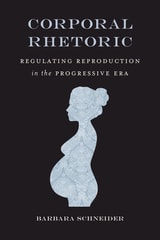
Corporal Rhetoric
Regulating Reproduction in the Progressive EraBarbara Schneider
University of Alabama Press, 2021
Examines public discourse from the Progressive Era over the state’s right to regulate women’s bodies and their reproduction
When Justice Oliver Wendell Holmes determined in 1927 that sterilization was a legitimate means of safeguarding the nation’s health, he was asserting the state’s right to regulate the production of the national body. His opinion represented a culmination of arguments about reproduction and immigration that had been circulating for years but that intensified during the Progressive Era. Arguments about reproductive and immigration practices surged to the foreground, and tectonic shifts in the conceptual schemes and practices of reproduction in the United States followed.
Drawing on feminist historiography and genre studies, Corporal Rhetoric: Regulating Reproduction in the Progressive Era explores the rhetoric of medical research, new technologies, and material practices that shifted the idea of childbirth as an act of God or Nature to a medical procedure enacted by male physicians on the bodies of women made passive by both drugs and discourse. Barbara Schneider considers how efficiency, the hallmark of scientific management, was raised to a cardinal virtue by its inclusions in the powerful mediums of presidential speeches, national educational policies, and eugenics discourse to reclassify babies, long regarded as gifts, as either valuable assets or defective products.
Schneider shows how the legal system drew upon medicine, scientific management, and the emerging discipline of sociology to restrict women’s labor in order to preserve reproductive capacity, categorized by Supreme Court opinions as a public good rather than a private capacity. Throughout, she ties the arguments developed during this era to current debates about mothering rhetorics, reproductive rights, immigration, and conceptions of the nation.
By weaving together medical research reports, clinical practices, case studies, legal opinions and legislative acts, and the epistemology of scientific management, Schneider illuminates the network that women such as Margaret Sanger, Jane Addams, Lillian Gilbreth and multiple others negotiated as they sought to give women room to exercise their reproductive capacity. Through her analysis of the machinery of these discourses and the material uptake of their genres in the daily practices of reproductive bodies, Schneider offers a provisional theory of corporal rhetoric that begins to answer the call for a new material theory of the body.
Cosmopolitan English and Transliteracy
Xiaoye You
Southern Illinois University Press, 2016
Despite the vast number of multilingual speakers in the United States and the pervasive influence of globalization, writing studies in this country is still inextricably linked to a nationalistic, monolingual English ideology. In Cosmopolitan English and Transliteracy, Xiaoye You addresses this issue by proposing that writing studies programs adopt a cosmopolitan perspective. Emphasizing local and global forms of citizenship and identification, You merges a humanistic vision with the rigor of social science, arguing that linguistic and cultural differences can be explored to recover human connections normally severed by geographical and semiotic borders.
You examines several areas of writing affected by globalization. He then turns to the composition classroom, highlighting the challenges and possibilities of crossing cultural boundaries in academic discourse before introducing a pedagogy aimed at fostering American students’ translingual and transcultural sensibilities. Included is a model for training writing teachers in the context of globalization, which aims to help instructors gain practical knowledge about the needs and resources of multilingual writers through communication technologies and cross-cultural partnerships.
By introducing cosmopolitan perspectives into the composition classroom, You challenges traditional assumptions about language, identity, and literacy as they relate to writing studies. Innovative and provocative, Cosmopolitan English and Transliteracy charts a new way forward for writing programs, with a call to focus on global rather than national identity.
Coteaching Reading Comprehension Strategies in Elementary School Libraries
Maximizing Your ImpactJudi Moreillon
American Library Association, 2013
Coteaching Reading Comprehension Strategies in Secondary School Libraries
Maximizing Your ImpactJudi Moreillon
American Library Association, 2012
Countdown to a New Library
Jeannette Woodward
American Library Association, 2000
Countdown to a New Library
Managing the Building ProjectJeannette Woodward
American Library Association, 2010
CounterStories from the Writing Center
Frankie Condon
Utah State University Press, 2021
Practicing what Derrick Bell has termed “creative truth telling,” these writers are not concerned with individual white women in writing centres but with the social, political, and cultural capital that is the historical birthright of white, straight, cis-gendered women, particularly in writing centre studies. The essays collected in this volume test, defy, and overflow the bounds of traditional academic discourse in the service of powerful testimony, witness, and counterstory.
CounterStories from the Writing Center is a must-read for writing centre directors, scholars, and tutors who are committed to antiracist pedagogy and offers a robust intersectional analysis to those who seek to understand the relationship between the work of writing centres and the problem of racism. Accessible and usable for both graduate and undergraduate students of writing centre theory and practice, this work troubles the field’s commonplaces and offers a rich envisioning of what writing centres materially committed to inclusion and equity might be and do.
Contributors: Dianna Baldwin, Nicole Caswell, Mitzi Ceballos, Romeo Garcia, Neisha-Anne Green, Doug Kern, T. Haltiwanger Morrison, Bernice Olivas, Moira Ozias, Trixie Smith, Willow Trevino
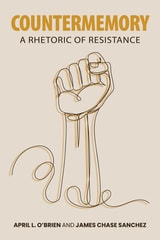
Countermemory
A Rhetoric of ResistanceApril L. O'Brien and James Chase Sanchez
University of Alabama Press, 2025
Investigates the interdisciplinary dimensions of countermemory through a rhetorical lens
Countermemory: A Rhetoric of Resistance by April L. O’Brien and James Chase Sanchez is a groundbreaking monograph that explores the concept of countermemory from an interdisciplinary and rhetorical perspective. The authors define “countermemory” as remembrance that resituates often overlooked or erased narratives of marginalized groups by positioning these memories as equally significant to dominant historical narratives. This work investigates how countermemories emerge in response to public memories, highlighting the tensions and resistance that arise when marginalized voices challenge mainstream historical accounts.
Through a mixed-methodological approach—incorporating site-based analysis, participant observation, textual analysis, and historiography—O’Brien and Sanchez examine countermemory in both physical and digital spaces. From memorial sites and museums to music videos, TV shows, and digital maps, they reveal the various ways countermemory operates and persists. The authors focus particularly on countermemory in the American South, centering on the experiences and histories of Black, Latinx, and Indigenous communities.
Countermemory is essential reading for scholars and students of rhetoric and public memory. The book also offers rich insights to readers who are passionate about addressing issues of racial inequality, people interested in examining their own experiences and the role they can play in promoting social change, and those interested in exploring the ways in which history is constructed and presented, and how marginalized perspectives are often excluded or distorted.
Counting Down to Kindergarten
A Complete Guide to Creating a School Readiness Program for Your CommunityR. Lynn Baker
American Library Association, 2015
The public library is in the perfect position as a community resource to help bridge the gap between preschool and kindergarten; however, starting from scratch can feel daunting. In this guide, Baker combines her background in early childhood education with her experience as a youth services programming specialist to present a school readiness program that can be tailored for any public library. Based on the successful framework of her tried and tested original program, this book offers everything that a public library needs in order to get started, including
- A six-week schedule of detailed lesson plans which combine the best practices of the Every Child Ready to Read® (ECRR) Second Edition (talking, singing, reading, writing, playing) with nationally identified school readiness skills
- A six-month family calendar with activities to help parents engage their children in activities that foster early literacy and school readiness skills at home
- Tips for maintaining a collaborative relationship with early childhood stakeholders and policymakers to help maintain a program that fits the school readiness needs of the local community
- Specific examples of successful school readiness programs and partnerships from public library systems across the country
Baker's guide will help public libraries ensure that young children are ready for school from day one.
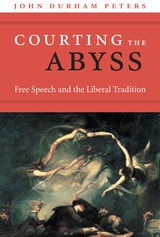
Courting the Abyss
Free Speech and the Liberal TraditionJohn Durham Peters
University of Chicago Press, 2005
A mesmerizing account of the role of public communication in the Anglo-American world, Courting the Abyss shows that liberty's earliest advocates recognized its fraternal relationship with wickedness and evil. While we understand freedom of expression to mean "anything goes," John Durham Peters asks why its advocates so often celebrate a sojourn in hell and the overcoming of suffering. He directs us to such well-known sources as the prose and poetry of John Milton and the political and philosophical theory of John Locke, Adam Smith, John Stuart Mill, and Oliver Wendell Holmes Jr., as well as lesser-known sources such as the theology of Paul of Tarsus. In various ways they all, he shows, envisioned an attitude of self-mastery or self-transcendence as a response to the inevitable dangers of free speech, a troubled legacy that continues to inform ruling norms about knowledge, ethical responsibility, and democracy today.
A world of gigabytes, undiminished religious passion, and relentless scientific discovery calls for a fresh account of liberty that recognizes its risk and its splendor. Instead of celebrating noxious doctrine as proof of society's robustness, Courting the Abyss invites us to rethink public communication today by looking more deeply into the unfathomable mystery of liberty and evil.
Covering America
A Narrative History of a Nation's JournalismChristopher B. Daly
University of Massachusetts Press, 2018
In this revised and expanded edition, Daly updates his narrative with new stories about legacy media like the New York Times and the Washington Post, and the digital natives like the Huffington Post and Buzzfeed. A new final chapter extends the study of the business crisis facing journalism by examining the "platform revolution" in media, showing how Facebook, Twitter, and other social media are disrupting the traditional systems of delivering journalism to the public. In an era when the factual basis of news is contested and when the government calls journalists "the enemy of the American people" or "the opposition party," Covering America brings history to bear on the vital issues of our times.
Covering America
A Narrative History of a Nation's JournalismChristopher B. Daly
University of Massachusetts Press, 2018
In this revised and expanded edition, Daly updates his narrative with new stories about legacy media like the New York Times and the Washington Post, and the digital natives like the Huffington Post and Buzzfeed. A new final chapter extends the study of the business crisis facing journalism by examining the "platform revolution" in media, showing how Facebook, Twitter, and other social media are disrupting the traditional systems of delivering journalism to the public. In an era when the factual basis of news is contested and when the government calls journalists "the enemy of the American people" or "the opposition party," Covering America brings history to bear on the vital issues of our times.
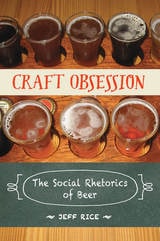
Craft Obsession
The Social Rhetorics of BeerJeff Rice
Southern Illinois University Press, 2016
Rice weaves together theories of writing, narrative, new media, and rhetoric with a personal story of his passion for craft beer. He identifies six key elements of social media rhetoric—anecdotes, repetition, aggregation, delivery, sharing, and imagery—and examines how each helps to transform small, personal experiences with craft into a more widespread movement. When shared via social media, craft anecdotes—such as the first time one had a beer—interrupt and repeat one another, building a sense of familiarity and identity among otherwise unconnected people. Aggregation, the practice of joining unlike items into one space, builds on this network identity, establishing a connection to particular brands or locations, both real and virtual. The public releases of craft beers are used to explore the concept of craft delivery, which involves multiple actors across multiple spaces and results in multiple meanings. Finally, Rice highlights how personal sharing operates within the community of craft beer enthusiasts, who share online images of acquiring, trading for, and consuming a wide variety of beers. These shared stories and images, while personal for each individual, reflect the dependence of craft on systems of involvement. Throughout, Rice relates and reflects on his own experience as a craft beer enthusiast and his participation via social media in these systems.
Both an objective scholarly study and an engaging personal narrative about craft beer, Craft Obsession provides valuable insights into digital writing, storytelling, and social media.
Crafting Compositions
Tools for Today's WritersJanet Giannotti
University of Michigan Press, 2004
The textbook features:
"Authentic readings to foster vocabulary development, show successful techniques, and serve as a jumping-off point for free writing.
"A "learning log" in which students write to practice the writing lessons and tips presented.
"A two-track system in which students simultaneously work with the writing of other students as they work on their own compositions.
"Toolbox mini-lessons to review common grammar trouble spots.
This mid-level writing text is appropriate for high school, community college, or university course
Crafting Presence
The American Essay and the Future of Writing StudiesNicole B. Wallack
Utah State University Press, 2016
Wallack analyzes examples drawn primarily from volumes of The Best American Essays to illuminate the most important quality of the essay as a literary form: the writer’s “presence.” She demonstrates how accounting for presence provides a flexible and rigorous heuristic for reading the contexts, formal elements, and purposes of essays. Such readings can help students learn writing principles, practices, and skills for crafting myriad presences rather than a single voice.
Crafting Presence holds serious implications for writing pedagogy by providing new methods to help teachers and students become more insightful and confident readers and writers of essays. At a time when liberal arts education faces significant challenges, this important contribution to literary studies, composition, and creative writing shows how an essay-centered curriculum empowers students to show up in the world as public thinkers who must shape the “knowledge economy” of the twenty-first century.
Create, Innovate, and Serve
A Radical Approach to Children's and Youth ProgrammingKathleen Campana
American Library Association, 2019
Creating Conservatism
Postwar Words that Made an American MovementMichael J. Lee
Michigan State University Press, 2014
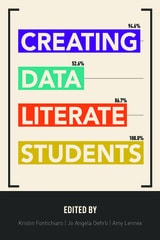
Creating Data Literate Students
Kristin Fontichiaro, Jo Angela Oehrli, Amy Lennex, editors
Michigan Publishing Services, 2017
with foundational domain knowledge to teach a new subset of information
literacy skills — data and statistical literacy, including: statistics and data comprehension; data as argument; and data visualization.
Data — both raw and displayed in visualizations — can clarify or confuse,
confirm or deny, persuade or deter. Students often learn that numbers are
objective, though data in the real world is rarely so. In fact, visualized data —
even from authoritative sources — can sometimes be anything but objective.
Librarians and classroom educators need to be as fluent with quantitative
data as they are with text in order to support high schoolers as they engage
with data in formal and informal settings. We asked contributors to this
volume — experts in high school curriculum, information literacy and/or
data literacy — to explore the intersections between data and curriculum
and identify high-impact strategies for demystifying data for educators and
students alike.
Creating Generative AI Policies
A Guide for Public and Academic LibrariesRobin Hastings
American Library Association, 2026
Though it’s challenging to set policies for a technology that is so young and still in flux, the need is urgent. Because usage of AI presents both opportunities and risks, libraries must be proactive. The WEF (World Economic Forum) predicts that while there may be a loss of 92 million jobs to various AI tools, they see 170 million new jobs and roles emerging from the use of this new technology. Whether or not this proves correct, there are already digital literacy skills, including a basic understanding of the technology around AI, that libraries can help their patrons master; and because of data privacy, security, and ethics issues, library workers require clear AI policies too. Technology expert Hastings highlights the first attempts of libraries across the country to set up policies for the use of AI in their organizations, as well as policies created by cities and other similar institutions, to guide stakeholders in creating their own smart, forward-thinking course of action. Succinct and pragmatic, this timely resource
- provides a short overview of Generative AI history, basic technical knowledge, and the key arguments put forth by those in favor and those opposed to this technology;
- offers advice on discovering how library staff encounter AI in their day-to-day work, both in their own usage and by patrons, to inform what policies the library needs and which policies to consider adjusting for particular use cases;
- includes separate chapters focusing on staff-side policy and patron/public-facing policy, delving into essential considerations like staff training, privacy and data protection, security, AI usage for reference, patron education and AI literacy, and setting limits and boundaries on patron AI use;
- suggests useful approaches to ensure that AI policies are easy to follow and understand by library workers, patrons, and the wider community;
- discusses how to craft flexible procedures that can be updated as AI continues to change, drawing on technology management best practices; and
- offers links to additional resources like sample policy documents and a curated reading list for understanding the environment around AI.
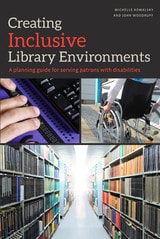
Creating Inclusive Library Environments
A Planning Guide for Serving Patrons with DisabilitiesMichelle Kowalsky
American Library Association, 2016
Creating Leaders An Examinati On Of Academic And Research Li
Irene Herold
American Library Association, 2015

Creating Leaders
An Examination of Academic and Research Library Leadership InstitutesIrene M. H. Herold
Assoc of College & Research Libraries, 2015
Creating Literacy-Based Programs for Children
Lesson Plans and Printable Resources for K–5R. Lynn Baker
American Library Association, 2017
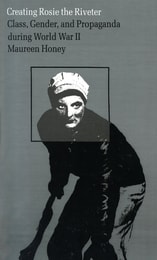
Creating Rosie the Riveter
Class, Gender, and Propaganda during World War IIMaureen Honey
University of Massachusetts Press, 1984
Creating Your Library Brand
Communicating Your Relevance and Value to Your PatronsElisabeth Doucett
American Library Association, 2008
Creating a Local History Archive at Your Public Library
Faye Phillips
American Library Association, 2017
Creating a Winning Online Exhibit
Martin R. Kalfatovic
American Library Association, 2002
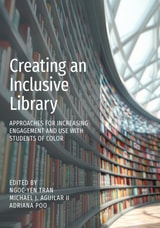
Creating an Inclusive Library
Approaches for Increasing Engagement and Use with Students of ColorNgoc-Yen Tran
Assoc of College & Research Libraries, 2024
Six themed sections provide an opportunity to further engage with issues affecting students of color and to take action to provide more just and equitable teaching and learning environments.
- Welcoming and Sense of Belonging
- Culturally Relevant Practices
- Building Representation and Inclusion
- Collaborations and Co-Creation
- Community Building and Engagement
- Fostering Diverse Student Employees
Creating the Customer-Driven Academic Library
Jeannette Woodward
American Library Association, 2009
Creating the Customer-Driven Library
Building on the Bookstore ModelJeannette Woodward
American Library Association, 2004

Creating the Modern Man
American Magazines and Consumer Culture, 1900-1950Tom Pendergast
University of Missouri Press, 2000
In the late nineteenth century, general-interest magazines began to reach an unprecedented number of readers and conveyed to those readers diverse messages about the meaning of masculinity in America. Over the next fifty years, these messages narrated a shift from Victorian masculinity, which valued character, integrity, hard work, and duty, to modern masculinity, which valued personality, self-realization, and image. In Creating the Modern Man, Tom Pendergast studies the multifaceted ways that masculinity is represented in magazines published during this transitional period.
Pendergast focuses on the rise of mass consumer culture, demonstrating that consumerism was a key factor in reshaping American notions of masculinity as presented in popular magazines. Whereas much scholarship has decried the effects of consumerism, Pendergast treats consumer culture as an energizing force in the American magazine market. He suggests that such magazines offered men new and meaningful visions of masculine identity and argues that men actively participated in restructuring the masculine ideal. Engaging a wide range of magazines from American Magazine to Esquire to True, Pendergast demonstrates how these publications presented masculinity in ways that reflected the magazines' relationship to advertisers, contributors, and readers.
This fascinating study includes such African American magazines as the Colored American, Crisis, Opportunity, and Ebony. Pendergast reasons that the rise of modern masculinity opened the way for African American men to identify with normative masculine values. As white men reinvented the idea of the "self-made man" for a new era, black men struggled to negotiate a meaningful place for black masculinity in a culture intent on denying them access.
The first complete investigation of the representation of men in American magazines, Creating the Modern Man makes an important contribution to our understanding of these publications, both as elements of mass culture and as interesting institutions in their own right. Pendergast takes readers inside the complex world of magazine publishing, demonstrating how magazines slowly yet surely help create the cultural images that shape societal gender roles.
Creating the One-Shot Library Workshop
A Step-by-Step GuideJerilyn Veldof
American Library Association, 2006
Creative Commons for Educators and Librarians
American Library Association, 2020
Creative Instructional Design
Practical Applications ForBrandon West
Assoc of College & Research Libraries, 2017
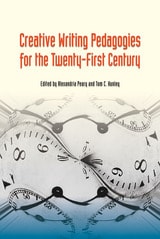
Creative Writing Pedagogies for the Twenty-First Century
Edited by Alexandria Peary and Tom C. Hunley
Southern Illinois University Press, 2015
Drawing primarily from the field of composition studies—a discipline rich with a wide range of established pedagogies—the contributors in this volume build on previous models to present fresh and inventive methods for the teaching of creative writing. Each chapter offers both a theoretical and a historical background for its respective pedagogical ideas, as well as practical applications for use in the classroom. This myriad of methods can be used either as a supplement to the customary workshop model or as stand-alone roadmaps to engage and reinvigorate the creative process for both students and teachers alike.
A fresh and inspiring collection of teaching methods, Creative Writing Pedagogies for the Twenty-First Century combines both conventional and cutting-edge techniques to expand the pedagogical possibilities in creative writing studies.
Creativity
Nancy Falciani-White
American Library Association, 2021
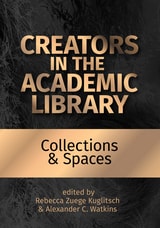
Creators in the Academic Library
Collections and SpacesRebecca Zuege Kuglitsch
Assoc of College & Research Libraries, 2023
In four parts, Creators in the Academic Library: Collections and Spaces explores how academic libraries can build collections, spaces, and communities that serve creators.
- Tailoring Collections for Creators
- Making in the Academic Library
- Creating Experiences in the Library
- Cultivating Creator Communities
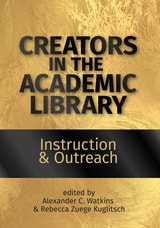
Creators in the Academic Library
Instruction and OutreachAlexander C. Watkins
Assoc of College & Research Libraries, 2023
In four parts, Creators in the Academic Library: Instruction and Outreach explores how to teach specifically for creator research, motivate learning, and deepen students’ understanding of their own practice.
- Technology, Tools, and Techniques for Creation
- Inspiring Creativity through Research
- Creator’s Unique Information Needs
- Grounding Creation in Research
Cripping Labor-Based Grading for More Equity in Literacy Courses
Asao B. Inoue
University Press of Colorado, 2024
Cripping the Archive
Disability, History, and PowerEdited by Jenifer L. Barclay and Stefanie Hunt-Kennedy Foreword by Jaipreet Virdi
University of Illinois Press, 2025
Jenifer L. Barclay and Stefanie Hunt-Kennedy edit a collection of interdisciplinary essays that consider how and why physical, sensory, intellectual, and psychological disabilities are underrepresented, erased, or distorted in the historical record. The contributors draw on the methodology and practice of cripping to uncover disability in contested archives and explore ways to build inclusive archives accountable to, and centered on, disabled people and disability justice. Throughout, they show ableness informing the politics of the archive as a physical space, a discriminatory record, and a collection of silences.
An essential contribution to research methods and disability justice, Cripping the Archive offers a blueprint for intersectional and interdisciplinary approaches that bridge disability studies, history, and archival studies.
Crisis in Employment
Jane Jerrard
American Library Association, 2008
Critical Academic Writing and Multilingual Students
A. Suresh Canagarajah
University of Michigan Press, 2002
This volume facilitates teacher self-reflection and enables readers to better understand the motivations and pedagogical implications--especially for L2 writing--of a more openly pedagogical approach.
Critical Academic Writing and Multilingual Students explains what it means to commit to an academic pedagogy, in terms of form, self, content, and community--and what it can accomplish in the L2 writing classroom. It's a guide for writing teachers who wish to embark on a journey toward increased critical awareness of the role they play, or potentially could play, in the lives of their students.
Critical Approaches to Credit-Bearing Information Literacy Courses
Angela Pashia
Assoc of College & Research Libraries, 2019
Critical Data Storytelling for Libraries
Crafting Ethical Narratives for Advocacy and ImpactKate McDowell
American Library Association, 2025
- the dynamic interrelationships between storyteller, audience, and story which lie at the heart of storytelling;
- ways to mesh library data collection processes with long-term storytelling potential, prioritizing interaction over transaction;
- three time-honored and effective narrative strategies for organizing the informational and emotional content of library data stories, easily adaptable for any situation;
- approaches for emphasizing inclusivity and justice to ensure that library advocates can tell stories that challenge stereotypes, promote equity, and align their efforts with broader ethical and social goals;
- audience attitudes as challenges and opportunities for library data communication; and
- strategies for maintaining open and transparent public communication in the face of rampant misinformation and active disinformation campaigns.
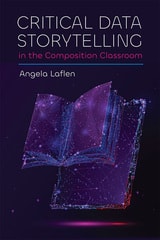
Critical Data Storytelling in the Composition Classroom
Angela Laflen
Utah State University Press, 2025
At the heart of Laflen’s approach is critical data storytelling—a practice that equips students with the skills to understand, interpret, and ethically communicate with and about data through various multimodal formats. By teaching students to make informed decisions as data storytellers, Laflen addresses the ethical implications of working with data while offering practical strategies for reading and analyzing data stories. This approach empowers both students and teachers to engage critically with data as a tool for learning and communication. It also highlights how multimodal composition has yet to fully account for the central role of data in shaping contemporary communication and argumentation.
By focusing on the ethical and rhetorical dimensions of data storytelling, Critical Data Storytelling in the Composition Classroompresents a pedagogical approach that prepares students for the challenges of working with data in a rapidly evolving digital landscape. This flexible, adaptable model for teaching critical data literacy is of great interest to writing instructors, scholars in rhetoric and composition, and educators who seek to prepare students for the demands of a data-driven world.
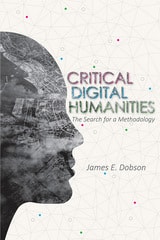
Critical Digital Humanities
The Search for a MethodologyJames E. Dobson
University of Illinois Press, 2019