Results by title
95 books match the query 'Art & Politics' and 7 start with d
Dance, Politics & Co-Immunity
Current Perspectives on Politics and Communities in the Arts Vol. 1Edited by Stefan Hölscher and Gerald Siegmund
Diaphanes, 2013
This volume is dedicated to the question of how dance, both in its historical and in its contemporary manifestations, is intricately linked to conceptualisations of the political. Whereas in this context the term "policy" means the reproduction of hegemonic power relations within already existing institutional structures, politics refers to those practices which question the space of policy as such by inscribing that into its surface which has had no place before. The art of choreography consists in distributing bodies and their relations in space. It is a distribution of parts that within the field of the visible and the sayable allocates positions to specific bodies. Yet in the confrontation between bodies and their relations, a deframing and dislocating of positions may take place. The essays included in this book are aimed at the multiple connections between politics, community, dance, and globalisation from the perspective of e.g. Dance and Theatre Studies, History, Philosophy, and Sociology.
[more]
Deconstructing the High Line
Postindustrial Urbanism and the Rise of the Elevated ParkLindner, Christoph
Rutgers University Press, 2017
2017 Choice Outstanding Academic Title
The High Line, an innovative promenade created on a disused elevated railway in Manhattan, is one of the world’s most iconic new urban landmarks. Since the opening of its first section in 2009, this unique greenway has exceeded all expectations in terms of attracting visitors, investment, and property development to Manhattan’s West Side. Frequently celebrated as a monument to community-led activism, adaptive re-use of urban infrastructure, and innovative ecological design, the High Line is being used as a model for numerous urban redevelopment plans proliferating worldwide.
Deconstructing the High Line is the first book to analyze the High Line from multiple perspectives, critically assessing its aesthetic, economic, ecological, symbolic, and social impacts. Including several essays by planners and architects directly involved in the High Line’s design, this volume also brings together a diverse range of scholars from the fields of urban studies, geography, anthropology, sociology, and cultural studies. Together, they offer insights into the project’s remarkable success, while also giving serious consideration to the critical charge that the High Line is “Disney World on the Hudson,” a project that has merely greened, sanitized, and gentrified an urban neighborhood while displacing longstanding residents and businesses.
Deconstructing the High Line is not just for New Yorkers, but for anyone interested in larger issues of public space, neoliberal redevelopment, creative design practice, and urban renewal.
[more]

Delirium and Resistance
Activist Art and the Crisis of CapitalismGregory Sholette
Pluto Press, 2017
In the aftermath of the 2016 US election, Brexit, and a global upsurge of nationalist populism, it is evident that the delirium and the crisis of neoliberal capitalism is now the delirium and crisis of liberal democracy and its culture. And though capitalist crisis does not begin within art, art can reflect and amplify its effects to positive and negative ends.
In this follow-up to his influential 2010 book, Dark Matter: Art and Politics in the Age of Enterprise Culture, Sholette engages in critical dialogue with artists’ collectives, counter-institutions, and activist groups to offer an insightful firsthand account of the relationship between politics and art in neoliberal society. Sholette lays out clear examples of art’s deep involvement in capitalism: the dizzying prices achieved by artists who pander to the financial elite, the proliferation of museums that contribute to global competition between cities in order to attract capital, and the strange relationship between art and rampant gentrification that restructures the urban landscape.
With a preface by noted author Lucy R. Lippard and an introduction by theorist Kim Charnley, Delirium and Resistance draws on over thirty years of critical debates and practices both in and beyond the art world to historicize and advocate for the art activist tradition that radically—and, at times, deliriously—entangles the visual arts with political struggles.
[more]
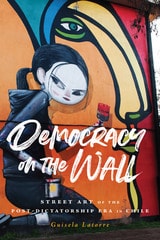
Democracy on the Wall
Street Art of the Post-Dictatorship Era in ChileGuisela Latorre
The Ohio State University Press, 2019
Guisela Latorre’s Democracy on the Wall: Street Art of the Post-Dictatorship Era in Chile documents and critically deconstructs the explosion of street art that emerged in Chile after the dictatorship of Augusto Pinochet, providing the first broad analysis of the visual vocabulary of Chile’s murals and graffiti while addressing the historical, social, and political context for this public art in Chile post-1990.
Exploring the resurgence and impact of the muralist brigades, women graffiti artists, the phenomenon of “open-sky museums,” and the transnational impact on the development of Chilean street art, Latorre argues that mural and graffiti artists are enacting a “visual democracy,” a form of artistic praxis that seeks to create alternative images to those produced by institutions of power. Keenly aware of Latin America’s colonial legacy and deeply flawed democratic processes, and distrustful of hegemonic discourses promoted by government and corporate media, the artists in Democracy on the Wall utilize graffiti and muralism as an alternative means of public communication, one that does not serve capitalist or nationalist interests. Latorre posits that through these urban interventions that combine creativity with social action, Chilean street artists formulate visions of what a true democracy looks like.
Exploring the resurgence and impact of the muralist brigades, women graffiti artists, the phenomenon of “open-sky museums,” and the transnational impact on the development of Chilean street art, Latorre argues that mural and graffiti artists are enacting a “visual democracy,” a form of artistic praxis that seeks to create alternative images to those produced by institutions of power. Keenly aware of Latin America’s colonial legacy and deeply flawed democratic processes, and distrustful of hegemonic discourses promoted by government and corporate media, the artists in Democracy on the Wall utilize graffiti and muralism as an alternative means of public communication, one that does not serve capitalist or nationalist interests. Latorre posits that through these urban interventions that combine creativity with social action, Chilean street artists formulate visions of what a true democracy looks like.
[more]
Dialogues
Ilya Kabakov and Viktor Pivovarov, Stories about OurselvesKsenia Nouril
Rutgers University Press, 2020
Artists in the Soviet Union faced a difficult choice: either join the official academies and make art that conformed to the state’s aesthetic and ideological dictates, or attempt to develop alternative artistic practices and spheres for exhibiting their work. In the early 1970s, conceptual artists Ilya Kabakov and Viktor Pivovarov chose the latter option, turning their limited resources into an asset by pioneering an entirely new artistic genre: the album. Somewhere between drawings and novels, Kabakov and Pivovarov’s albums were also the basis for unique performance pieces, as the artists invited select audiences to their Moscow apartments for private readings and viewings of the albums, helping to cultivate an alternative artistic community in the process.
This exhibition catalog brings together Kabakov and Pivovarov’s key works for the first time, putting the two artists in dialogue and recreating their artistic community. It not only includes nearly hundred pages of full-color illustrations, but also provides complete English translations of the Russian texts that appear in the volume, plus new interviews with each artist. Taken together, they give viewers a new appreciation of the different aesthetic strategies each artist used to depict the absurdities of everyday life in the Soviet era. Published in partnership with the Zimmerli Museum.
This exhibition catalog brings together Kabakov and Pivovarov’s key works for the first time, putting the two artists in dialogue and recreating their artistic community. It not only includes nearly hundred pages of full-color illustrations, but also provides complete English translations of the Russian texts that appear in the volume, plus new interviews with each artist. Taken together, they give viewers a new appreciation of the different aesthetic strategies each artist used to depict the absurdities of everyday life in the Soviet era. Published in partnership with the Zimmerli Museum.
[more]

Diasporic Intimacies
Queer Filipinos and Canadian ImaginariesEdited by Robert Diaz, Marissa Largo, and Fritz Pino
Northwestern University Press, 2018
Diasporic Intimacies: Queer Filipinos and Canadian Imaginaries is the first edited volume of its kind, featuring the works of leading scholars, artists, and activists who reflect on the contributions of queer Filipinos to Canadian culture and society.
Addressing a wide range of issues beyond the academy, the authors present a rich and under-studied archive of personal reflections, in-depth interviews, creative works, and scholarly essays. Their trandsdisciplinary approach highlights the need for queer, transgressive, and utopian practices that render visible histories of migration, empire building, settler colonialism, and globalization.
Timely, urgent, and fascinating, Diasporic Intimacies offers an accessible entry point for readers who seek to pursue critically engaged community work, arts education, curatorial practice, and socially inflected research on sexuality, gender, and race in this ever-changing world.
[more]
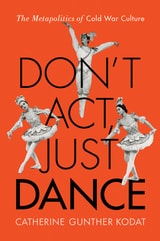
Don't Act, Just Dance
The Metapolitics of Cold War CultureCatherine Gunther Kodat
Rutgers University Press, 2014
At some point in their career, nearly all the dancers who worked with George Balanchine were told “don’t act, dear; just dance.” The dancers understood this as a warning against melodramatic over-interpretation and an assurance that they had all the tools they needed to do justice to the steps—but its implication that to dance is already to act in a manner both complete and sufficient resonates beyond stage and studio.
Drawing on fresh archival material, Don’t Act, Just Dance places dance at the center of the story of the relationship between Cold War art and politics. Catherine Gunther Kodat takes Balanchine’s catch phrase as an invitation to explore the politics of Cold War culture—in particular, to examine the assumptions underlying the role of “apolitical” modernism in U.S. cultural diplomacy. Through close, theoretically informed readings of selected important works—Marianne Moore’s “Combat Cultural,” dances by George Balanchine, Merce Cunningham, and Yuri Grigorovich, Stanley Kubrick’s Spartacus, and John Adams’s Nixon in China—Kodat questions several commonly-held beliefs about the purpose and meaning of modernist cultural productions during the Cold War.
Rather than read the dance through a received understanding of Cold War culture, Don’t Act, Just Dance reads Cold War culture through the dance, and in doing so establishes a new understanding of the politics of modernism in the arts of the period.
[more]