82 books match the query 'Arts and society' and 4 start with d

cover of Dark Matter: Art and Politics in the Age of Enterprise Culture

Dark Matter

Art and Politics in the Age of Enterprise Culture

Gregory Sholette

Pluto Press, 2011

Art is big business, with some artists able to command huge sums of money for their works, while the vast majority are ignored or dismissed by critics. This book shows that these marginalised artists, the 'dark matter' of the art world, are essential to the survival of the mainstream and that they frequently organize in opposition to it.

Gregory Sholette, a politically engaged artist, argues that imagination and creativity in the art world originate thrive in the non-commercial sector shut off from prestigious galleries and champagne receptions. This broader creative culture feeds the mainstream with new forms and styles that can be commodified and used to sustain the few artists admitted into the elite.

This dependency, and the advent of inexpensive communication, audio and video technology, has allowed this 'dark matter' of the alternative art world to increasingly subvert the mainstream and intervene politically as both new and old forms of non-capitalist, public art. This book is essential for anyone interested in interventionist art, collectivism, and the political economy of the art world.
[more]
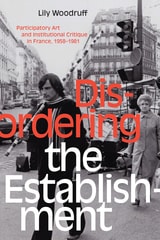
cover of Disordering the Establishment: Participatory Art and Institutional Critique in France, 1958–1981

Disordering the Establishment

Participatory Art and Institutional Critique in France, 1958–1981

Lily Woodruff

Duke University Press, 2020

In the decades following World War II, France experienced both a period of affluence and a wave of political, artistic, and philosophical discontent that culminated in the countrywide protests of 1968. In Disordering the Establishment Lily Woodruff examines the development of artistic strategies of political resistance in France in this era. Drawing on interviews with artists, curators, and cultural figures of the time, Woodruff analyzes the formal and rhetorical methods that artists used to counter establishment ideology, appeal to direct political engagement, and grapple with French intellectuals' modeling of society. Artists and collectives such as Daniel Buren, André Cadere, the Groupe de Recherche d’Art Visuel, and the Collectif d’Art Sociologique shared an opposition to institutional hegemony by adapting their works to unconventional spaces and audiences, asserting artistic autonomy from art institutions, and embracing interdisciplinarity. In showing how these artists used art to question what art should be and where it should be seen, Woodruff demonstrates how artists challenged and redefined the art establishment and their historical moment.
[more]
cover of Don't Look Away: Art, Nonviolence, and Preventive Publics in Contemporary Europe

Don't Look Away

Art, Nonviolence, and Preventive Publics in Contemporary Europe

Brianne Cohen

Duke University Press, 2023
In Don’t Look Away Brianne Cohen considers the role of contemporary art in developing a public commitment to end structural violence in Europe. Cohen focuses on art activism of the early twenty-first century that confronts the slow violence perpetuated against precarious peoples. Exploring the work of German filmmaker Harun Farocki, Swiss artist Thomas Hirschhorn, and the art collective Henry VIII’s Wives, Cohen argues that their recursive art practices offer a more sustained counter to the violence undergirding the public sphere than do artworks premised on immediate rupture. Their art reflects on a variety of flashpoints of violence and vulnerability in Europe, from the legacy of the Holocaust to Islamophobia and rising anti-immigrant sentiment. Because this violence has often cultivated fear-based publics, Cohen contends that art must foster ethical and civil relations between strangers across physical and virtual borders. In contrast to art-critical practices that privilege direct action in contemporary art activism, Cohen advocates for the imaginative, messier, often more elusive potential of art to change mindsets and foster a nonviolent social imaginary.
[more]
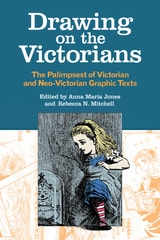
cover of Drawing on the Victorians: The Palimpsest of Victorian and Neo-Victorian Graphic Texts

Drawing on the Victorians

The Palimpsest of Victorian and Neo-Victorian Graphic Texts

Anna Maria Jones

Ohio University Press, 2017

Late nineteenth-century Britain experienced an unprecedented explosion of visual print culture and a simultaneous rise in literacy across social classes. New printing technologies facilitated quick and cheap dissemination of images—illustrated books, periodicals, cartoons, comics, and ephemera—to a mass readership. This Victorian visual turn prefigured the present-day impact of the Internet on how images are produced and shared, both driving and reflecting the visual culture of its time.

From this starting point, Drawing on the Victorians sets out to explore the relationship between Victorian graphic texts and today’s steampunk, manga, and other neo-Victorian genres that emulate and reinterpret their predecessors. Neo-Victorianism is a flourishing worldwide phenomenon, but one whose relationship with the texts from which it takes its inspiration remains underexplored.

In this collection, scholars from literary studies, cultural studies, and art history consider contemporary works—Alan Moore’s League of Extraordinary Gentlemen, Moto Naoko’s Lady Victorian, and Edward Gorey’s Gashlycrumb Tinies, among others—alongside their antecedents, from Punch’s 1897 Jubilee issue to Alice in Wonderland and more. They build on previous work on neo-Victorianism to affirm that the past not only influences but converses with the present.

Contributors: Christine Ferguson, Kate Flint, Anna Maria Jones, Linda K. Hughes, Heidi Kaufman, Brian Maidment, Rebecca N. Mitchell, Jennifer Phegley, Monika Pietrzak-Franger, Peter W. Sinnema, Jessica Straley

[more]