Results by title
239 books match the query 'Black people' and 4 start with d
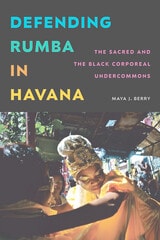
Defending Rumba in Havana
The Sacred and the Black Corporeal UndercommonsMaya J. Berry
Duke University Press, 2025
In Defending Rumba in Havana, anthropologist and dancer Maya J. Berry examines rumba as a way of knowing the embodied and spiritual dimensions of Black political imagination in post-Fidel Cuba. Historically a Black working-class popular dance, rumba, Berry contends, is a method of Black Cuban struggle that provides the community, accountability, sustenance, and dignity that neither the state nor the expanding private market can. Berry’s feminist theorization builds on the notion of the undercommons to show how rumba creates a space in which its practitioners enact deeply felt and dedicatedly defended choreographies of reciprocity, refusal, sovereignty, devotion, and pleasure, both on stage and in their daily lives. Berry demonstrates that this Black corporeal undercommons emphasizes mutual aid and refuses neoliberal development logics, favoring instead a collective self-determination rooted in African diasporic spiritual practices through which material compensation and gendered power dynamics are negotiated. By centering rumba to analyze how poor Black Cubans navigate gendered and racialized life, Berry helps readers better understand the constraints and yearnings that move diasporic Black struggles to seek refuge beyond the bounds of the nation-state.
[more]
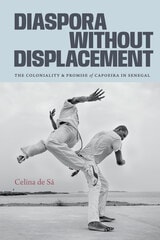
Diaspora Without Displacement
The Coloniality and Promise of Capoeira in SenegalCelina de Sá
Duke University Press, 2025
Capoeira—a game of combat primarily developed by enslaved West Central Africans—has become an icon of both Brazilian national culture and pride in the country’s diasporic African heritage. Yet the sport remains less accessible in Africa itself, overshadowed in large part by participants in the Global North. In Diaspora Without Displacement, Celina de Sá tells the story of capoeira as it "returns" to the African continent through the creative initiatives of young urban professionals in Senegal. De Sá demonstrates how a new generation of African capoeiristas are taking up their own Afro-diasporic performance tradition, effectively reframing notions of diaspora and race through their social practice. Though capoeira has largely Angolan roots and the agents of return are typically white Brazilians and Europeans, the West African practitioners de Sá documents nonetheless form an exceptional relationship to capoeira that, in turn, becomes a mode of political and social consciousness. Analyzing a capoeira network across West Africa, de Sá shows how urban West Africans use capoeira to explore the relationship between Blackness, diaspora, and African heritage.
[more]
Dreaming Equality
Color, Race, and Racism in Urban BrazilSheriff, Robin E.
Rutgers University Press, 2001
In the 1933 publication The Masters and the Slaves, Brazilian scholar and novelist Gilberto Freyre challenged the racist ideas of his day by defending the “African contribution” to Brazil’s culture. In so doing, he proposed that Brazil was relatively free of most forms of racial prejudice and could best be understood as a “racial democracy.” Over time this view has grown into the popular myth that racism in Brazil is very mild or nonexistent.
This myth contrasts starkly with the realities of a pernicious racial inequality that permeates every aspect of Brazilian life. To study the grip of this myth on African Brazilians’ views of themselves and their nation, Robin E. Sheriff spent twenty months in a primarily black shantytown in Rio de Janeiro, studying the inhabitants’s views of race and racism. How, she asks, do poor African Brazilians experience and interpret racism in a country where its very existence tends to be publicly denied? How is racism talked about privately in the family and publicly in the community—or is it talked about at all?
Sheriff’s analysis is particularly important because most Brazilians live in urban settings, and her examination of their views of race and racism sheds light on common but underarticulated racial attitudes. This book is the first to demonstrate that urban African Brazilians do not subscribe to the racial democracy myth and recognize racism as a central factor shaping their lives.
[more]
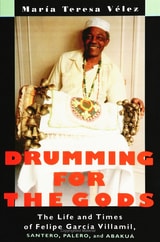
Drumming For The Gods
Maria Velez
Temple University Press, 2000
"I am Felipe Garcia Villamil" begins Drumming for the Gods, the life history of the Afro-Cuban artist whose music has survived both political and personal upheaval. "Balogun for thirty years. Oluana, of Matanzas, Cuba, for about forty years. Omoana for almost forty-five years. OluIyesa [he knows the secrets of the Iyesa drums]." A practitioner of sacred drumming for almost his entire life, Felipe practiced his trade in Cuba both before and after the Revolution and brought it with him to New York, where he continues to play for the gods.
This book focuses on three periods of Felipe's life, each marked by changes in his personal life and by important historical events. The first period covers his formative years during which he received his initial training. Through Felipe's story, we explore the legacy of slavery in Cuba, the nature of Afro-Cuban religions and their musical traditions, and the history of bata drums. The second period covers the critical years of the Cuban Revolution. Here we see the effect of social turmoil both n music and religious practice (santero, palero, and abakua). The third period covers Felipe's life in New York as a refugee/immigrant, and the role of music in rebuilding his identity. Felipe's story illuminates his cultural practices and beliefs as well as the ways in which an individual musician selects and modifies the elements of his cultural heritage to create a voice that is personal and unique. Felipe not only lives through history but also makes history, shaping an identity that cannot be described as "Cuban immigrant," "Afro-Cuban," "religious drummer," or "santeria initiate," but is composed of all of them.
Through Felipe's experiences, Maria Teresa Velez reveals the interaction between social, political, economic, and cultural forces and an individual's own actions. The professionalization of musicians in Cuba following the Revolution and the plight of Afro-Cuban immigrants in New York are seen as large historical and social problems to which Felipe must personally respond. A noted ethnomusicologist, Velez provides the most insightful and comprehensive English-language study of an individual Cuban religious drummer available.
Drumming for the Gods is a must-read for those interested in ethnomusicology, Caribbean studies, and Afro-Cuban religions and culture.
[more]