Results by title
159 books match the query 'Change' and 5 start with d
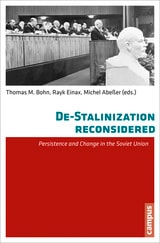
De-Stalinisation Reconsidered
Persistence and Change in the Soviet UnionEdited by Thomas M. Bohn, Rayk Einax, and Michel Abeßer
Campus Verlag, 2014

Defining the National Interest
Conflict and Change in American Foreign PolicyPeter Trubowitz
University of Chicago Press, 1998
Peter Trubowitz offers a new and compelling conception of American foreign policy and the domestic geopolitical forces that shape and animate it. Foreign policy conflict, he argues, is grounded in America's regional diversity. The uneven nature of America's integration into the world economy has made regionalism a potent force shaping fights over the national interest. As Trubowitz shows, politicians from different parts of the country have consistently sought to equate their region's interests with that of the nation. Domestic conflict over how to define the "national interest" is the result. Challenging dominant accounts of American foreign policy-making, Defining the National Interest exemplifies how interdisciplinary scholarship can yield a deeper understanding of the connections between domestic and international change in an era of globalization.
Divided Conversations
Identities, Leadership, and Change in Public Higher EducationKristin G. Esterberg
Vanderbilt University Press, 2013
Many faculty believe that one of their own who becomes an administrator has gone over to "the dark side." One provost recalled going for a beer with a faculty colleague and hearing the colleague complain about the latest memo "from the administration." He had to remind his friend of many years that he was the author of the offending document. Now he was "the administration." He realized that former colleagues now appeared in his office wearing suits and ties and referring to him by his title rather than his first name.
The disciplines serve as the tribes into which individual scholars are organized; the discipline is where a faculty member finds his community and identity. Administrators, on the other hand, identify with each other in trying to get the tribes to work together. Though most administrators came from the faculty ranks, their career paths take a different shape, especially in terms of mobility to another institution. It's not surprising that the two groups talk past each other.
A chapter is devoted to chairs of departments, who occupy an interesting middle ground. To their faculty, they can come across as a nurturing parent or a petty bureaucrat. The authors recommend training for chairs and administrative internships offered by the American Council on Education and other organizations.
The men and women on the campuses of the public universities described in the book make clear the challenges that universities face in terms of budgets, legislative politics, collective bargaining, rankings, and control of academic programs. If public institutions are truly to serve a public purpose, faculty and administrators must find ways to engage each other in shared conversation and management and find ways of engaging the university with the community.

Doing What Comes Naturally
Change, Rhetoric, and the Practice of Theory in Literary & Legal StudiesStanley Fish
Duke University Press, 1989

Doris Lessing
The Poetics of ChangeGayle Greene
University of Michigan Press, 1997
Doris Lessing has been a chronicler of our age for nearly half a century, and a study of her writing career does not yield easy generalizations. Difficult though she is to categorize, she is always concerned with change, with a search for "something new" against "the nightmare repetition" of history. The feminist quest she articulated in The Children of Violence and The Golden Notebook entered the culture with the force of a new myth: these books changed lives. The Golden Notebook--together with such works as The Second Sex and The Feminine Mystique--raised the consciousness of a generation of women readers and played a major part in making the second wave of feminism. It is the power of Lessing's novels to change people's lives, the effect she had raising the consciousness of a generation of women and the effect she continues to have on young readers, that is the subject of this book.
Gayle Greene employs an eclectic range of approaches (psychoanalytic, Marxist, biographical, historical, intertextual, formalist, feminist) to shed new light on Lessing's remarkable achievement. She sees Lessing as a feminist writer, not in offering strong female role models who climb top the top of existing social structures, but in envisioning, and indeed helping to bring about, a transformation of those structures. Lessing critiques Western values of individualism, competition, and materialism in terms similar to those developed by feminism; and, in getting us to view our culture from without, in teaching us to read cultural constructs as systems, her novels perform the deconstructing and demystifying work of feminism.