Results by title
459 books match the query 'Criminology' and 28 start with d

Dangerous Exits
Escaping Abusive Relationships in Rural AmericaDeKeseredy, Walter
Rutgers University Press, 2009
Strikingly, scant attention has focused on the victimization of women who want to leave their hostile partners. This groundbreaking work challenges the perception that rural communities are safe havens from the brutality of urban living. Identifying hidden crimes of economic blackmail and psychological mistreatment, and the complex relationship between patriarchy and abuse, Walter S. DeKeseredy and Martin D. Schwartz propose concrete and effective solutions, giving voice to women who have often suffered in silence.

Dangerous Masculinity
Fatherhood, Race, and Security Inside America's PrisonsAnna Curtis
Rutgers University Press, 2019
Dark Governance
Illegal Organizations and State PowerJavier Auyero
University of Chicago Press, 2027
A revelatory account of the ways covert, nefarious relationships between state officials and criminal groups shape daily life for all.
Far too often, the line between legal and illegal action is crossed by actors and organizations on both sides of the law. From the old Chicago Machine getting rich off criminal activity to Mexican drug cartels placing politicians in office, these relationships between criminals and the government coordinate forms of power in ways that affect where people live, what opportunities they can pursue, how they spend money, and how they treat one another. In Dark Governance, sociologist Javier Auyero describes how this kind of governance works and what it means for civic life.
Auyero analyzes instances of dark governance, including gangs in Ecuador and paramilitaries in Colombia who exert territorial control through violent specialists and government actors. He then turns to the less-studied case of the “colectivos” in Venezuela to show the scope of political work clandestine connections can achieve by thwarting grassroots organizations. In El Salvador and Honduras, the ties between gang members on the one hand, and politicians and elected officials on the other, serve to illustrate the impact dark governance has on urban spatial arrangements and on electoral campaigns. Dark Governance also offers an in-depth study of police-trafficker collusion in Argentina, which allows Auyero to identify the ways covert connections between state actors and drug traffickers operate in marginalized communities, affecting interpersonal violence. In addition to these examples in Latin America, Auyero also shares case studies in the United States and China. Dark governance can be seen in US organizations that patrol the borders and assert their control over migrants through their illicit connections with state authorities. In China, land expropriation and development projects are sometimes delayed when some households refuse to leave their properties. Enter the thugs-for-hire frequently contracted by local governments across the country to coerce residents into complying with government orders.
Demonstrating the very real effects of dark governance, Auyero argues that though the organizations involved in these dark arrangements differ, their collaboration results in a singular effect: the ability to control populations. But when these relationships come out of the shadows, collective action can bring them down.

Dead End Kids
Gang Girls and the Boys They KnowMark S. Fleisher
University of Wisconsin Press, 2000
Dead End Kids exposes both the depravity and the humanity in gang life through the eyes of a teenaged girl named Cara, a member of a Kansas City gang. In this shocking yet compassionate account, Mark Fleisher shows how gang girls’ lives are shaped by poverty, family disorganization, and parental neglect.
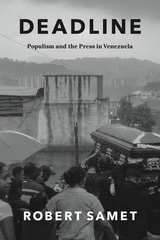
Deadline
Populism and the Press in VenezuelaRobert Samet
University of Chicago Press, 2019
In Deadline, anthropologist Robert Samet answers this question by focusing on the relationship between populism, the press, and what he calls “the will to security.” Drawing on nearly a decade of ethnographic research alongside journalists on the Caracas crime beat, he shows how the media shaped the politics of security from the ground up. Paradoxically, Venezuela’s punitive turn was not the product of dictatorship, but rather an outgrowth of practices and institutions normally associated with democracy. Samet reckons with this apparent contradiction by exploring the circulation of extralegal denuncias (accusations) by crime journalists, editors, sources, and audiences. Denuncias are a form of public shaming or exposé that channels popular anger against the powers that be. By showing how denuncias mobilize dissent, Deadline weaves a much larger tale about the relationship between the press, popular outrage, and the politics of security in the twenty-first century.
Death Penalty in Decline?
The Fight against Capital Punishment in the Decades since Furman v. GeorgiaAustin Sarat
Temple University Press, 2024
At a time when the United States is undertaking an unprecedented national reconsideration of the death penalty, Death Penalty in Decline? seeks to evaluate how abolitionists might succeed today.
Contributors: John Bessler, Corinna Barrett Lain, James R. Martel, Linda Ross Meyer, Carol S. Steiker, Jordan M. Steiker, and the editor
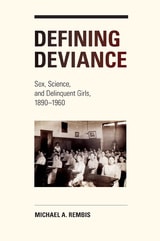
Defining Deviance
Sex, Science, and Delinquent Girls, 1890-1960Michael A. Rembis
University of Illinois Press, 2013
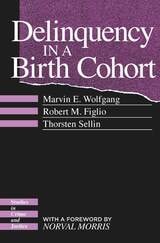
Delinquency in a Birth Cohort
Marvin E. Wolfgang, Robert M. Figlio, and Thorsten Sellin
University of Chicago Press, 1972
This study of a birth cohort was not originally meant to be etiological or predictive. Yet the data bearing on this cohort of nearly ten thousand boys born in 1945 and living in Philadelphia gave rise to a model for prediction of delinquency, and thus to the possibility for more efficient planning of programs for intervention. It is expert research yielding significant applications and, though largely statistical, the analysis is accessible to readers without mathematical training.
"No serious scholar of the methods of preventing and treating juvenile delinquency can properly ignore this book."—LeRoy L. Lamborn, Law Library Journal
"The magnitude of [this] study is awesome. . . . It should be a useful guide for anyone interested in the intricacies of cohort analysis."—Gary F. Jensen, American Journal of Sociology
"A book the student of juvenile delinquency will find invaluable."—Criminologist

Delinquency, crime, and society
James F. Short Jr.
University of Chicago Press, 1978
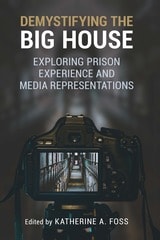
Demystifying the Big House
Exploring Prison Experience and Media RepresentationsEdited by Katherine A. Foss
Southern Illinois University Press, 2018
Scholars from cultural and critical studies, feminist studies, queer studies, African American studies, media studies, sociology, and psychology offer critical analysis of media depictions of prison, bridging the media’s portrayals of incarcerated lives with actual experiences and bringing to light forgotten voices in prison narratives.
Detained
Immigration Laws & Expanding Ins Jail ComplexMichael Welch
Temple University Press, 2002
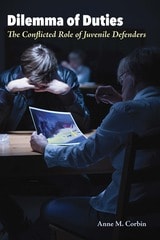
Dilemma of Duties
The Conflicted Role of Juvenile DefendersAnne M. Corbin
Southern Illinois University Press, 2018
In Dilemma of Duties, Corbin outlines patterns of role conflict that defenders experience, details its impact on counselors and clients in the juvenile justice system, and addresses the powerful influence of the juvenile court culture and the lack of resources for defenders. Tasked with guiding these children, counselors frequently must contend with and manage their clients’ general distrust of adults as they attempt to serve as their voices to the court.
Understanding how juvenile defenders define their role and experience role conflict provides valuable insights into our juvenile justice system, especially its role in upholding due process rights. Such knowledge points to the importance of the training and practices of juvenile court functionaries and the efficacy, credibility, and legitimacy of the juvenile justice system itself.

Discretionary Justice
Looking Inside a Juvenile Drug CourtPaik, Leslie
Rutgers University Press, 2011
Juvenile drug courts are on the rise in the United States, as a result of a favorable political climate and justice officials' endorsement of the therapeutic jurisprudence movement--the concept of combining therapeutic care with correctional discipline. The goal is to divert nonviolent youth drug offenders into addiction treatment instead of long-term incarceration. Discretionary Justice overviews the system, taking readers behind the scenes of the juvenile drug court. Based on fifteen months of ethnographic fieldwork and interviews at a California court, Leslie Paik explores the staff's decision-making practices in assessing the youths' cases, concentrating on the way accountability and noncompliance are assessed. Using the concept of "workability," Paik demonstrates how compliance, and what is seen by staff as "noncompliance," are the constructed results of staff decisions, fluctuating budgets, and sometimes questionable drug test results.
While these courts largely focus on holding youths responsible for their actions, this book underscores the social factors that shape how staff members view progress in the court. Paik also emphasizes the perspectives of children and parents. Given the growing emphasis on individual responsibility in other settings, such as schools and public welfare agencies, Paik's findings are relevant outside the juvenile justice system.
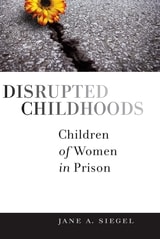
Disrupted Childhoods
Children of Women in PrisonSiegel, Jane A
Rutgers University Press, 2011
Millions of children in the United States have a parent who is incarcerated and a growing number of these nurturers are mothers. Disrupted Childhoods explores the issues that arise from a mother's confinement and provides first-person accounts of the experiences of children with moms behind bars. Jane A. Siegel offers a perspective that recognizes differences over the long course of a family's interaction with the criminal justice system.
Presenting an unparalleled view into the children's lives both before and after their mothers are imprisoned, this book reveals the many challenges they face from the moment such a critical caregiver is arrested to the time she returns home from prison. Based on interviews with nearly seventy youngsters and their mothers conducted at different points of their parent's involvement in the process, the rich qualitative data of Disrupted Childhoods vividly reveals the lived experiences of prisoners' children, telling their stories in their own words. Siegel places the mother's incarceration in context with other aspects of the youths' experiences, including their family life and social worlds, and provides a unique opportunity to hear the voices of a group that has been largely silent until now.
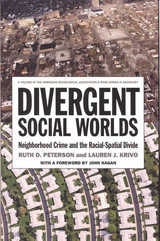
Divergent Social Worlds
Neighborhood Crime and the Racial-Spatial DivideRuth D. Peterson
Russell Sage Foundation, 2010

Divide & Conquer
Race, Gangs, Identity, and ConflictRobert D. Weide
Temple University Press, 2022
Hyper-criminalization and the normalization of violence was an integral aspect of Robert Weide’s formative years growing up in Los Angeles in the 1980s and 1990s, where Sureño, Crip, and Blood gangs maintained a precarious coexistence, often punctuated by racialized gang violence. His insider status informs Divide & Conquer, which considers how the capitalist economy, the race concept, and nationalist ideology have made gang members the instruments of their own oppression, resulting in racialized sectarian conflicts spanning generations between African American and Latino gangs in Los Angeles and California’s prisons.
While gang members may fail to appreciate the deeper historical and conceptual foundations of these conflicts, they rarely credit naked bigotry as the root cause. As Weide asserts, they divide themselves according to inherited groupist identities, thereby turning them against one another in protracted blood feuds across gang lines and racial lines.
Weide explores both the historical foundations and the conceptual and cultural boundaries and biases that divide gang members across racial lines, detailing case studies of specific racialized gang conflicts between Sureño, Crip, and Blood gangs. Weide employs mixed-methods research, having spent nearly a decade on ethnographic fieldwork and conducted over one hundred formal interviews with gang members and gang enforcement officers concerning taboo subjects like prison and gang politics, and transracial gang membership.
Divide & Conquer concludes with encouraging developments in recent years, as gang members themselves, on their own volition, have intervened to build solidarity and bring racialized gang conflicts between them to an end.
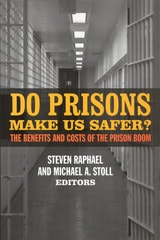
Do Prisons Make Us Safer?
The Benefits and Costs of the Prison BoomSteven Raphael
Russell Sage Foundation, 2009
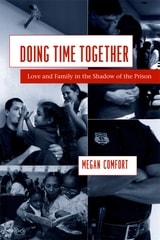
Doing Time Together
Love and Family in the Shadow of the PrisonMegan Comfort
University of Chicago Press, 2008
Megan Comfort spent years getting to know women visiting men at San Quentin State Prison, observing how their romantic relationships drew them into contact with the penitentiary. Tangling with the prison’s intrusive scrutiny and rigid rules turns these women into “quasi-inmates,” eroding the boundary between home and prison and altering their sense of intimacy, love, and justice. Yet Comfort also finds that with social welfare weakened, prisons are the most powerful public institutions available to women struggling to overcome untreated social ills and sustain relationships with marginalized men. As a result, they express great ambivalence about the prison and the control it exerts over their daily lives.
An illuminating analysis of women caught in the shadow of America’s massive prison system, Comfort’s book will be essential for anyone concerned with the consequences of our punitive culture.
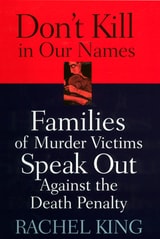
Don't Kill in Our Names
Families of Murder Victims Speak Out against the Death PenaltyKing, Rachel
Rutgers University Press, 2003
Could you forgive the murderer of your husband? Your mother? Your son?
Families of murder victims are often ardent and very public supporters of the death penalty. But the people whose stories appear in this book have chosen instead to forgive their loved ones’ murderers, and many have developed personal relationships with the killers and have even worked to save their lives. They have formed a nationwide group, Murder Victims’ Families for Reconciliation (MVFR), to oppose the death penalty.
MVFR members are often treated as either saints or lunatics, but the truth is that they are neither. They are ordinary people who have responded to an extraordinary and devastating tragedy with courage and faith, choosing reconciliation over retribution, healing over hatred. Believing that the death penalty is a form of social violence that only repeats and perpetuates the violence that claimed their loved one’s lives, they hold out the hope of redemption even for those who have committed the most hideous crimes.
Weaving third-person narrative with wrenching first-hand accounts, King presents the stories of ten MVFR members. Each is a heartrending tale of grief, soul searching, and of the challenge to choose forgiveness instead of revenge. These stories, which King sets in the context of the national discussion over the death penalty debate and restorative versus retributive justice, will appeal not only to those who oppose the death penalty, but also to those who strive to understand how people can forgive the seemingly unforgivable.

Dopers in Uniform
The Hidden World of Police on SteroidsBy John Hoberman
University of Texas Press, 2017
The recorded use of deadly force against unarmed suspects and sustained protest from the Black Lives Matter movement, among others, have ignited a national debate about excessive violence in American policing. Missing from the debate, however, is any discussion of a factor that is almost certainly contributing to the violence—the use of anabolic steroids by police officers. Mounting evidence from a wide range of credible sources suggests that many cops are abusing testosterone and its synthetic derivatives. This drug use is illegal and encourages a “steroidal” policing style based on aggressive behaviors and hulking physiques that diminishes public trust in law enforcement.
Dopers in Uniform offers the first assessment of the dimensions and consequences of the felony use of anabolic steroids in major urban police departments. Marshalling an array of evidence, John Hoberman refutes the frequent claim that police steroid use is limited to a few “bad apples,” explains how the “Blue Wall of Silence” stymies the collection of data, and introduces readers to the broader marketplace for androgenic drugs. He then turns his attention to the people and organizations at the heart of police culture: the police chiefs who often see scandals involving steroid use as a distraction from dealing with more dramatic forms of misconduct and the police unions that fight against steroid testing by claiming an officer’s “right to privacy” is of greater importance. Hoberman’s findings clearly demonstrate the crucial need to analyze and expose the police steroid culture for the purpose of formulating a public policy to deal with its dysfunctional effects.

Double Jeopardy
Adolescent Offenders with Mental DisordersThomas Grisso
University of Chicago Press, 2004
Double Jeopardy considers the newest data on the nature of youths' mental disorders—their relationships to delinquency, the values and limits of methods to treat them, and the common patterns of adolescent offending. That information is used to chart a rational course for fulfilling the juvenile justice system's duty—as a custodian of children in need of health care, as a legal system promoting fairness in youth adjudication, and as a protector of public safety—to respond to delinquent youths' mental disorders. Moreover, Double Jeopardy provides a scientific yet practical foundation for lawmakers, judges, attorneys, and mental health care professionals, as well as researchers who must fill the knowledge gaps that limit the juvenile justice system's abilities to meet youths' mental health needs.

Down and Dirty Down South
Politics and the Art of RevengeRoger Glasgow
Butler Center for Arkansas Studies, 2016
While pursuing a race for district prosecutor in the 1970s, Glasgow had run afoul of the local political machine. The machine later decided to teach Glasgow a lesson even though he’d lost the race. Down and Dirty Down South is Glasgow’s story of how he attempted to clear his name and also track down the people who had set him up for charges of smuggling illegal drugs into the United States.
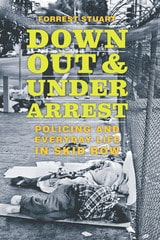
Down, Out, and Under Arrest
Policing and Everyday Life in Skid RowForrest Stuart
University of Chicago Press, 2016
Juliette, a woman he met during that time, has been stopped by police well over one hundred times, arrested upward of sixty times, and has given up more than a year of her life serving week-long jail sentences. Her most common crime? Simply sitting on the sidewalk—an arrestable offense in LA.
Why? What purpose did those arrests serve, for society or for Juliette? How did we reach a point where we’ve cut support for our poorest citizens, yet are spending ever more on policing and prisons? That’s the complicated, maddening story that Stuart tells in Down, Out and Under Arrest, a close-up look at the hows and whys of policing poverty in the contemporary United States. What emerges from Stuart’s years of fieldwork—not only with Skid Row residents, but with the police charged with managing them—is a tragedy built on mistakes and misplaced priorities more than on heroes and villains. He reveals a situation where a lot of people on both sides of this issue are genuinely trying to do the right thing, yet often come up short. Sometimes, in ways that do serious harm.
At a time when distrust between police and the residents of disadvantaged neighborhoods has never been higher, Stuart’s book helps us see where we’ve gone wrong, and what steps we could take to begin to change the lives of our poorest citizens—and ultimately our society itself—for the better.
Drug Cartels Do Not Exist
Narcotrafficking in US and Mexican CultureOswaldo Zavala
Vanderbilt University Press, 2022
Yet the realities of violence in Mexico and along the border are obscured by the books, films, and TV series we consume. In truth, works like Sicario, The Queen of the South, and Narcos hide Mexico's political realities. Alongside these examples, Zavala discusses Charles Bowden, 2666 by Roberto Bolaño, and other important Latin American writers as examples of those who do capture the realities of the drug war.
Translated into English by William Savinar, Drug Cartels Do Not Exist will be useful for journalists, political scientists, philosophers, and writers of any kind who wish to break down the constructed barriers—physical and mental—created by those in power around the reality of the Mexican drug trade.
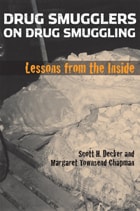
Drug Smugglers on Drug Smuggling
Lessons from the InsideScott H. Decker and Margaret Townsend Chapman
Temple University Press, 2008
Quoting frequently from their interviews, Decker and Chapman explain how individuals are recruited into smuggling, why they stay in it, and how their roles change over time. They describe the specific strategies their interviewees employed to bring drugs into the country and how they previously escaped apprehension. Over-all, the authors find that drug smuggling is organized in a series of networks which are usually unconnected.
This extraordinarily informative book will be of particular interest to law enforcement officials and policymakers, but it will appeal to anyone who wants to know how the drug business actually works.
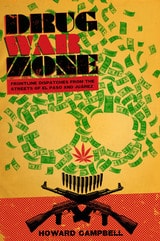
Drug War Zone
Frontline Dispatches from the Streets of El Paso and JuárezBy Howard Campbell
University of Texas Press, 2009
Winner, Southwest Book Award, Border Regional Library Association, 2011
Thousands of people die in drug-related violence every year in Mexico. Ciudad Juárez, Chihuahua, adjacent to El Paso, Texas, has become the most violent city in the Mexican drug war. Much of the cocaine, marijuana, and methamphetamine consumed in the United States is imported across the Mexican border, making El Paso/Juárez one of the major drug-trafficking venues in the world.
In this anthropological study of drug trafficking and anti-drug law enforcement efforts on the U.S.-Mexico border, Howard Campbell uses an ethnographic perspective to chronicle the recent Mexican drug war, focusing especially on people and events in the El Paso/Juárez area. It is the first social science study of the violent drug war that is tearing Mexico apart.
Based on deep access to the drug-smuggling world, this study presents the drug war through the eyes and lives of direct participants. Half of the book consists of oral histories from drug traffickers, and the other half from law enforcement officials. There is much journalistic coverage of the drug war, but very seldom are the lived experiences of traffickers and "narcs" presented in such vivid detail. In addition to providing an up-close, personal view of the drug-trafficking world, Campbell explains and analyzes the functioning of drug cartels, the corruption that facilitates drug trafficking, the strategies of smugglers and anti-narcotics officials, and the perilous culture of drug trafficking that Campbell refers to as the "Drug War Zone."
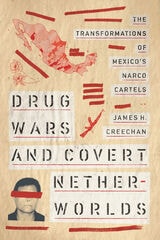
Drug Wars and Covert Netherworlds
The Transformations of Mexico's Narco CartelsJames H. Creechan
University of Arizona Press, 2021
In Drug Wars and Covert Netherworlds sociologist and criminologist James H. Creechan draws on decades of research to paint a much more nuanced picture of the transformation of Mexico’s narco cartels. Creechan details narco cartel history, focusing on the decades since Richard Nixon declared the War on Drugs. With sobering detail, Creechan unravels a web of government dependence, legitimate enterprises, covert connections, and violent infighting. He details how drug smuggling organizations have grown into powerful criminal mafias with the complicit involvement of powerful figures in civil society to create covert netherworlds.
Mexico is at a moment of change—a country on the verge of transition or perdition. It can only move forward by examining its history of narco-connections spun and re-spun over the last fifty years.

Drugs in Afghanistan
Opium, Outlaws and Scorpion TalesDavid Macdonald
Pluto Press, 2007
Afghanistan is the world's largest producer of opium and heroin. This book explores the devastating impact that the drugs trade has had on the Afghan people.
Author David Macdonald has worked as a drugs advisor to the UN. Based on his extensive experience, this book breaks down the myths surrounding the cultivation and consumption of drugs, providing a detailed analysis of the history of drug use within the country. He examines the impact of over 25 years of continuous conflict, and shows how poverty and instability has led to an increase in drugs consumption. He also considers the recent rise in the use of pharmaceutical drugs, resulting in dangerous chemical cocktails and analyses the effect of Afghanistan's drug trade on neighbouring countries.