Results by title
345 books match the query 'Design' and 44 start with d
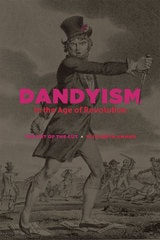
Dandyism in the Age of Revolution
The Art of the CutElizabeth Amann
University of Chicago Press, 2014
In Dandyism in the Age of Revolution, Elizabeth Amann shows that in France, England, and Spain, daring dress became a way of taking a stance toward the social and political upheaval of the period. France is the centerpiece of the story, not just because of the significance of the Revolution but also because of the speed with which its politics and fashions shifted. Dandyism in France represented an attempt to recover a political center after the extremism of the Terror, while in England and Spain it offered a way to reflect upon the turmoil across the Channel and Pyrenees. From the Hair Powder Act, which required users of the product to purchase a permit, to the political implications of the feather in Yankee Doodle’s hat, Amann aims to revise our understanding of the origins of modern dandyism and to recover the political context from which it emerged.

Demystifying Online Instruction in Libraries
People, Process, and ToolsDominique Turnbow and Amanda Roth
American Library Association, 2019
The design of information literacy instruction and the building of it are two distinct skillsets and processes; yet all too often everything gets mashed together, creating needless confusion and stress. In this book Turnbow, an instructional designer, and Roth, an instructional technologist, suggest a better way to organize the work. They shed light on the people, processes, and resources required to create a sustainable portfolio of online instruction. With the goal of fostering conversations in your library about the most streamlined and effective ways to get the work done, they provide guidance on such topics as
- design and development processes, complete with “I.D. in Action” examples and sample design documents;
- thumbnail descriptions of ADDIE, SAM, and design thinking methods;
- creating learning objects;
- types of software tools and how to evaluate them;
- crafting the best documentation of your work for efficient maintenance and reuse;
- adapting assessment to your learning outcomes and purpose;
- when to design for performance support, an underutilized method in libraries; and
- starting points for those interested in developing instructional design and development skills.
Demystifying the instructional design and development process used to create online learning objects, this book will help you understand how instructional design principles and approaches can benefit your learners.
Design Discourse
History, Theory, CriticismEdited by Victor Margolin
University of Chicago Press, 1989

Design Integrations
Research and CollaborationEdited by Sharon Poggenpohl and Keiichi Sato
Intellect Books, 2009
Design Integrations calls for an innovative rethinking of design education, one that recognizes the changing modes of design and the shifting forms of user experience. The contributors urge new methods of approach that focus on interdisciplinary collaboration between the academic and business worlds. These essays, among the first to focus on the future of design, often in-depth explorations of inter-institutional projects, cross-cultural learning experiences, and a multinational healthcare project. Design Integrations will be of interest to design teachers and practitioners alike.

Design Thinking
Rachel Ivy Clarke
American Library Association, 2020

Design and Debris
A Chaotics of Postmodern American FictionJoseph Conte
University of Alabama Press, 2002
Reading eight major contemporary authors through the lens of chaos theory, Conte offers new and original interpretations of works that have been the subject of much critical debate
Design and Debris discusses the relationship between order and disorder in the works of John Hawkes, Harry Mathews, John Barth, Gilbert Sorrentino, Robert Coover, Thomas Pynchon, Kathy Acker, and Don DeLillo. In analyzing their work, Joseph Conte brings to bear a unique approach adapted from scientific thought: chaos theory. His chief concern is illuminating those works whose narrative structures locate order hidden in disorder (whose authors Conte terms “proceduralists”), and those whose structures reflect the opposite, disorder emerging from states of order (whose authors Conte calls “disruptors”).Documenting the paradigm shift from modernism, in which artists attempted to impose order on a disordered world, to postmodernism, in which the artist portrays the process of “orderly disorder,” Conte shows how the shift has led to postmodern artists' embrace of science in their treatment of complex ideas. Detailing how chaos theory interpenetrates disciplines as varied as economics, politics, biology, and cognitive science, he suggests a second paradigm shift: from modernist specialization to postmodern pluralism. In such a pluralistic world, the novel is freed from the purely literary and engages in a greater degree of interactivity-between literature and science, and between author and reader. Thus, Conte concludes, contemporary literature is a literature of flux and flexibility.

Design and Development of Multi-Lane Smart Electromechanical Actuators
Fawaz Yahya Annaz
The Institution of Engineering and Technology, 2014
Design and Digital Interaction
Re:Research, Volume 7Edited by Gjoko Muratovski and Craig Vogel
Intellect Books, 2020
The Re:Research collection includes:
Volume 1: Teaching and Learning Design
Volume 2: Philosophical Frameworks and Design Processes
Volume 3: Design and the Creation of Social Value
Volume 4: Design and Living Well
Volume 5: Design Discourse on Culture and Society
Volume 6: Design Discourse on Business and Industry
Volume 7: Design and Digital Interaction
Design and Discomfort
Teaching Shakespeare and RaceEdited by Laura B. Turchi
Arizona Center for Medieval and Renaissance Studies, 2025
Design and Discomfort confronts the complexities of teaching Shakespeare in today’s classrooms, where discussions of race, bias, and historical legacies can provoke discomfort—but also transformation. Edited by Laura B. Turchi, this collection brings together educators and teaching artists who share innovative strategies for rethinking Shakespeare’s role in education.
Rather than treating Shakespeare as an untouchable authority, the contributors explore how his works can be a springboard for broader conversations about identity and justice. They advocate for performance-based and student-driven approaches that help students see themselves—their communities, their families, and their lived experiences—in the complex and seemingly distant world of Shakespeare.
This open-access volume provides both conceptual essays and practical lesson designs for educators navigating the intersections of Shakespeare and race. By embracing discomfort as part of the learning process, Design and Discomfort reframes how Shakespeare should be taught in classrooms today.
Design and Feminism
Re-visioning Spaces, Places, and Everyday ThingsJoan Rothschild
Rutgers University Press, 1999
The interdisciplinary essays reflect the writers' diverse fields- architecture, planning, industrial and graphic design, and architectural, urban, and design history. Essays cover such subject as rethinking the American city, graphic design and the urban landscape, working at home, theories of women and design, and a trio of essays on industrial designs. A review essay of the literature in these fields- the first of its kind- rounds out the collection.
Contributors are Amelia Amon, Wendy E. Brawer, Cheryl Buckley, Sue Cavanagh, Alethea Cheng, Roberta M. Feldman, Etain Fitzpatrick, Alice T. Friedman, Dolores Hayden, Ghislaine Hermanuz, Barbara Knecht, Ellen Lupton, Maggie Mahboubian, Francine Monaco, Nancy Perkins, Victoria Rosner, Joan Rothschild, Susana Torre, Lynne Walker, and Leslie Kanes Weismann.
Design for Business
Volume 3Edited by Gjoko Muratovski
Intellect Books, 2015
Design in the Age of Darwin
From William Morris to Frank Lloyd WrightStephen F Eisenman
Northwestern University Press, 2008
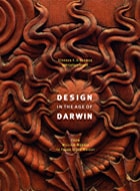
Charles Darwin’s monumental The Origin of Species, published in 1859, forever changed the landscape of natural science. The scientific world of the time had already established the principle of the “intelligent design” of a Creator; the art world had spent centuries devoting itself to the celebration of such a Designer’s creation. But the language of the book, and its implications, were stunning, and the ripples Darwin made when he rocked the boat spread outward: if he could question the Designer, what effect might there be on the art world, and on mortal designers’ renderings of Creation.
Published in partnership with the Mary and Leigh Block Museum of Art to accompany its exhibit, this catalog of essays and more than fifty color exhibition plates invokes these two senses of “intelligent design”—one from the debates between science and theology and the other from the world of art, particularly architecture and the decorative arts. The extensive exhibition includes furniture, metalware, glassware, textiles, and designs on loan from public and private collections in the United States and England. Among the artwork included are items from William Morris, C. R. Ashbee, Christopher Dresser, C. F. A. Voysey, Frank Lloyd Wright, and Louis Sullivan. Through these pieces and the accompanying examinations, the book explores how popular conceptions of the theory of evolution were used or rejected by British and American artists in the years that followed Darwin’s publication.

Design of Embedded Robust Control Systems Using MATLAB® / Simulink®
Petko Hristov Petkov
The Institution of Engineering and Technology, 2018

Design of High Frequency Integrated Analogue Filters
Yichuang Sun
The Institution of Engineering and Technology, 2002

Design of High-Efficiency Integrated AC-DC Convertors
Ke-Horng Chen
The Institution of Engineering and Technology, 2018
Design of Modern Control Systems
D.J. Bell
The Institution of Engineering and Technology, 1982
Design of Multi-Frequency CW Radars
M. Jankiraman
The Institution of Engineering and Technology, 2007

Design of Terahertz CMOS Integrated Circuits for High-Speed Wireless Communication
Minoru Fujishima
The Institution of Engineering and Technology, 2019

Design with Nature on Cape Cod and the Islands
Jack Ahern
University of Massachusetts Press, 2022
Design with Nature on Cape Cod and the Islands seeks to reverse this damaging trend by offering landscape professionals, local officials, and homeowners a sustainable approach to landscape design based on the ecoregion’s native plants and plant communities. Presenting detailed discussions of Cape Cod’s natural history, Jack Ahern focuses on the principal plant communities that define its landscape character and that are well adapted to local soils and growing conditions, including climate change. The book also includes strategies for ecological planting design and a portfolio of photographs of active ecologically designed landscapes.

Design, Control and Monitoring of Tidal Stream Turbine Systems
Mohamed Benbouzid
The Institution of Engineering and Technology, 2023
Design, Control, Predict
Logistical Governance in the Smart CityAaron Shapiro
University of Minnesota Press, 2020
An in-depth look at life in the “smart” city
Technology has fundamentally transformed urban life. But today’s “smart” cities look little like what experts had predicted. Aaron Shapiro shows us the true face of the revolution in urban technology, taking the reader on a tour of today’s smart city. Along the way, he develops a new lens for interpreting urban technologies—logistical governance—to critique an urban future based on extraction and rationalization.
Through ethnographic research, journalistic interviews, and his own hands-on experience, Shapiro helps us peer through cracks in the smart city’s facade. He investigates the true price New Yorkers pay for “free,” ad-funded WiFi, finding that it ultimately serves the ends of commercial media. He also builds on his experience as a bike courier for a food delivery startup to examine how promises of “flexible employment” in the gig economy in fact pave the way for strict managerial control. And he turns his eye toward hot-button debates around police violence and new patrol technologies, asking whether algorithms are really the answer to reforming our cities’ ongoing crises of criminal justice.
Through these gripping accounts of the new technological urbanism, Design, Control, Predict makes vital contributions to conversations around data privacy and algorithmic governance. Shapiro brings much-needed empirical research to a field that has often relied on “10,000-foot views.” Timely, important, and expertly researched, Design, Control, Predict doesn’t just help us comprehend urbanism today—it advances strategies for critiquing and resisting a dystopian future that can seem inevitable.
Designing English
Early Literature on the PageDaniel Wakelin
Bodleian Library Publishing, 2017
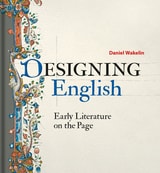
Working beyond the traditions established for Latin, scribes of English needed to be more inventive, using each book as an opportunity to redesign. Surveying eight centuries of graphic design in manuscripts and inscriptions, Designing English focuses on the craft, agency, and intentions of scribes, painters, and engravers from the Anglo-Saxon to the early Tudor periods. The book examines format, layout, and decoration, as well as bilingual manuscripts and oral recitations, weighing the balance of ingenuity and copying, imagination and practicality, behind early English book design. With over ninety illustrations, drawn especially from the holdings of the Bodleian Library, Designing English gives a comprehensive overview of English books and other material texts across the Middle Ages.

Designing the Creative Child
Playthings and Places in Midcentury AmericaAmy F. Ogata
University of Minnesota Press, 2013
The postwar American stereotypes of suburban sameness, traditional gender roles, and educational conservatism have masked an alternate self-image tailor-made for the Cold War. The creative child, an idealized future citizen, was the darling of baby boom parents, psychologists, marketers, and designers who saw in the next generation promise that appeared to answer the most pressing worries of the age.
Designing the Creative Child reveals how a postwar cult of childhood creativity developed and continues to this day. Exploring how the idea of children as imaginative and naturally creative was constructed, disseminated, and consumed in the United States after World War II, Amy F. Ogata argues that educational toys, playgrounds, small middle-class houses, new schools, and children’s museums were designed to cultivate imagination in a growing cohort of baby boom children. Enthusiasm for encouraging creativity in children countered Cold War fears of failing competitiveness and the postwar critique of social conformity, making creativity an emblem of national revitalization.
Ogata describes how a historically rooted belief in children’s capacity for independent thinking was transformed from an elite concern of the interwar years to a fully consumable and aspirational ideal that persists today. From building blocks to Gumby, playhouses to Playskool trains, Creative Playthings to the Eames House of Cards, Crayola fingerpaint to children’s museums, material goods and spaces shaped a popular understanding of creativity, and Designing the Creative Child demonstrates how this notion has been woven into the fabric of American culture.
Designs for the Pluriverse
Radical Interdependence, Autonomy, and the Making of WorldsArturo Escobar
Duke University Press, 2018

Developments in Antenna Analysis and Design, Volume 1
Raj Mittra
The Institution of Engineering and Technology, 2019

Developments in Antenna Analysis and Design, Volume 2
Raj Mittra
The Institution of Engineering and Technology, 2019
Dialectic
A Scholarly Journal of Thought Leadership, Education and Practice in the Discipline of Visual Communication Design - Volume II, Issue II - Summer 2019Michael R. Gibson
Michigan Publishing Services, 2019
Dialectic
A Scholarly Journal of Thought Leadership, Education and Practice in the Discipline of Visual Communication Design Volume I, Issue I - Winter 2016-17Keith M Owens and Michael Gibson
Michigan Publishing Services, 2017
examination of issues that affect design education, research,
and inquiry into their effects on the practice of design. Michigan
Publishing, the hub of scholarly publishing at the University of Michigan,
publishes Dialectic on behalf of the AIGA (American Institute of
Graphic Arts) Design Educators Community (DEC).
Dialectic
A Scholarly Journal of Thought Leadership, Education and Practice in the Discipline of Visual Communication Design Volume I, Issue II - Fall 2017Michael R. Gibson and Keith M. Owens (Editors)
Michigan Publishing Services, 2017
examination of issues that affect design education, research,
and inquiry into their effects on the practice of design. Michigan
Publishing, the hub of scholarly publishing at the University of Michigan,
publishes Dialectic on behalf of the AIGA (American Institute of
Graphic Arts) Design Educators Community (DEC).

Dialogue
Proceedings of the AIGA Design Educators Community Conferences: Decipher, Vol. 1Written by AIGA DEC, Edited by Kelly M. Murdoch-Kitt and Omar Sosa-Tzec
Michigan Publishing Services, 2019
Hosted by the Penny W. Stamps School of Art & Design at the
University of Michigan, Decipher:
- Connected emerging and experienced design researchers in academia and beyond
- Gathered and shared best practices, resources, tools, and exemplary research matter
- Helped participants hone research plans and writing skills
- Created opportunities for dialogues to foster mentorship and collaborative connections
Dialogue
Proceedings of the AIGA Design Educators Community Conferences: Decipher, Vol. 2Written by AIGA DEC, Edited by Kelly M. Murdoch-Kitt and Omar Sosa-Tzec
Michigan Publishing Services, 2019
Hosted by the Penny W. Stamps School of Art & Design at the University of Michigan, Decipher:
- Connected emerging and experienced design researchers in academia and beyond
- Gathered and shared best practices, resources, tools, and exemplary research matter
- Helped participants hone research plans and writing skills
- Created opportunities for dialogues to foster mentorship and collaborative connections
Dialogue
Proceedings of the AIGA Design Educators Community Conferences: MAKEWritten by AIGA DEC, Edited by Pamela Napier and Aaron Ganci
Michigan Publishing Services, 2019
Dialogue
Proceedings of the AIGA Design Educators Community Conferences: SHIFTWritten by AIGA DEC, Edited by Liese Zahabi
Michigan Publishing Services, 2022
Dialogue is the ongoing series of fully open access proceedings of the conferences and national symposia of the AIGA Design Educators Committee.
Although each conference varies in theme, issues of Dialogue contain papers from DEC conferences which focus on topics that affect design education, research, and professional practice.
Michigan Publishing, the hub of scholarly publishing at the University of Michigan, publishes Dialogue on behalf of the AIGA DEC.

Dialogue
Proceedings of the AIGA Design Educators Community Conferences: SHIFT{ED}Liese AIGA Design Educators Community (DEC)
Michigan Publishing Services, 2024
Although each conference varies in theme, issues of Dialogue contain papers from DEC conferences which focus on topics that affect design education, research, and professional practice. Michigan Publishing, the hub of scholarly publishing at the University of Michigan, publishes Dialogue on behalf of the AIGA DEC.
Dialogue
Proceedings of the AIGA Design Educators Community Conferences: WEAVEWritten by AIGA DEC, Edited by Zack Tucker & Yvette Shen
Michigan Publishing Services, 2026
Dialogue is the ongoing series of fully open access proceedings of the conferences and national symposia of the AIGA Design Educators Committee.
Although each conference varies in theme, issues of Dialogue contain papers from DEC conferences which focus on topics that affect design education, research, and professional practice. Michigan Publishing, the hub of scholarly publishing at the University of Michigan, publishes Dialogue on behalf of the AIGA DEC.
Digital Futures and the City of Today
New Technologies and Physical SpacesEdited by Glenda Amayo Caldwell, Carl Smith, and Edward Clift
Intellect Books, 2016
Digital Typography
Donald E. Knuth
CSLI, 1998

Discovering Design
Explorations in Design StudiesEdited by Richard Buchanan and Victor Margolin
University of Chicago Press, 1995
The contributors (Gianfranco Zaccai, Albert Borgmann, Richard Buchanan, Augusto Morello, Tufan Orel, Nigel Cross, Victor Margolin, Langdon Winner, Carl Mitcham, Tony Fry, and Ezio Manzini) focus on three broad themes that form a sequence of fundamental issues: how to shape design as a subject matter, how to distinguish the activity of designing in the complex world of action, and how to address the basic questions of value and responsibility that persistently arise in the discussion and practice of design. The editors' introduction provides a useful overview of these questions and offers a multidisciplinary framework for design studies. The essays discuss such topics as the relation of aesthetics to technology, the place of design in social action, the role of the consumer in design decisions, and the need for ethical practice in contemporary design. Manzini's concluding essay shows how the issue of ethics should connect responsible behavior to decisions made every day in the manufacture of objects.

Disobedient Aesthetics
Surveillance, Bodies, ControlAnthony Stagliano
University of Alabama Press, 2024
A compelling inquiry into the rhetorical and aesthetic techniques that subvert contemporary regimes of digital surveillance, embodiment, and control.
The contemporary world bristles with tools of observation and manipulation. Security cameras, social media, data mining, biometric scans, and other instruments ensnare the individual in a web of surveillance. In Disobedient Aesthetics, Anthony Stagliano exposes the use of human lives as sites of data exploitation and outlines paths of resistance. From the thermal-vision systems used on military drones, which use human body heat itself as a media object, to facial recognition platforms that use human faces as data mines, and from law enforcement tools of DNA analysis to data-driven urban governance, the realm of algorithmic surveillance and control is wide and subtle.
Disobedient Aesthetics outlines interventions into the technical systems subtending data-driven surveillance and control. Stagliano maps not only the surveillant regimes afforded by recent networked technologies, but also the inventive, artistic research into ways of undermining, upending, or redirecting such technologies. The concluding chapter examines creative, critical, and collective efforts to democratize access to the technology that undergirds such scrutiny and enables ways to detect and contest its power.
In a fascinating epilogue, Stagliano revisits current theories of control and offers an alternative reading of Gilles Deleuze’s oft-cited thesis on control societies: namely that it is not a matter of “finding new weapons” to undermine control but developing new techniques, new designs, new prototypes, and new modes of creative escape.
Drawing in the Design Process
Characterising Industrial and Educational PracticePamela Schenk
Intellect Books, 2016
It soon became apparent, however, that technological progress had not obviated the inherent value of drawing, and that, in fact, it opened up new avenues for convergent and hybrid drawing practices. This book traces the evolution of design-based drawing through analysis of a series of research projects from the 1980s to recent years that have sought to characterize the changing practices of design within various industries. Built on more than three hundred interviews with designers, academics, and design students, and an exhaustive analysis of thousands of drawings, it aims to generate discussion around historical and contemporary models of the design process.
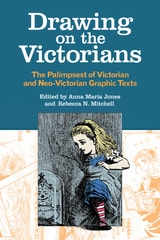
Drawing on the Victorians
The Palimpsest of Victorian and Neo-Victorian Graphic TextsAnna Maria Jones
Ohio University Press, 2017
Late nineteenth-century Britain experienced an unprecedented explosion of visual print culture and a simultaneous rise in literacy across social classes. New printing technologies facilitated quick and cheap dissemination of images—illustrated books, periodicals, cartoons, comics, and ephemera—to a mass readership. This Victorian visual turn prefigured the present-day impact of the Internet on how images are produced and shared, both driving and reflecting the visual culture of its time.
From this starting point, Drawing on the Victorians sets out to explore the relationship between Victorian graphic texts and today’s steampunk, manga, and other neo-Victorian genres that emulate and reinterpret their predecessors. Neo-Victorianism is a flourishing worldwide phenomenon, but one whose relationship with the texts from which it takes its inspiration remains underexplored.
In this collection, scholars from literary studies, cultural studies, and art history consider contemporary works—Alan Moore’s League of Extraordinary Gentlemen, Moto Naoko’s Lady Victorian, and Edward Gorey’s Gashlycrumb Tinies, among others—alongside their antecedents, from Punch’s 1897 Jubilee issue to Alice in Wonderland and more. They build on previous work on neo-Victorianism to affirm that the past not only influences but converses with the present.
Contributors: Christine Ferguson, Kate Flint, Anna Maria Jones, Linda K. Hughes, Heidi Kaufman, Brian Maidment, Rebecca N. Mitchell, Jennifer Phegley, Monika Pietrzak-Franger, Peter W. Sinnema, Jessica Straley

Drawing the Iron Curtain
Jews and the Golden Age of Soviet AnimationMaya Balakirsky Katz
Rutgers University Press, 2016

Dreams and Ideas
The Artistry of Costume Designer Winn MortonMyra Walker
University of North Texas Press, 2026
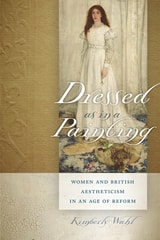
Dressed as in a Painting
Women and British Aestheticism in an Age of ReformKimberly Wahl
University of New Hampshire Press, 2013