1038 books match the query 'Economic conditions' and 41 start with d

cover of Dammed: The Politics of Loss and Survival in Anishinaabe Territory

Dammed

The Politics of Loss and Survival in Anishinaabe Territory

Brittany Luby

University of Manitoba Press, 2020
[more]
cover of Dangerous Writing: Understanding the Political Economy of Composition

Dangerous Writing

Understanding the Political Economy of Composition

Tony Scott

Utah State University Press, 2009

Building on recent work in rhetoric and composition that takes an historical materialist approach, Dangerous Writing outlines a political economic theory of composition. The book connects pedagogical practices in writing classes to their broader political economic contexts, and argues that the analytical power of students’ writing is prevented from reaching its potential by pressures within the academy and without, that tend to wed higher education with the aims and logics of “fast-capitalism.”

Since the 1980s and the “social turn” in composition studies and other disciplines, scholars in this field have conceived writing in college as explicitly embedded in socio-rhetorical situations beyond the classroom. From this conviction develops a commitment to teach writing with an emphasis on analyzing the social and political dimensions of rhetoric.

Ironically, though a leftist himself, Tony Scott’s analysis finds the academic left complicit with the forces in American culture that tend, in his view, to compromise education. By focusing on the structures of labor and of institutions that enforce those structures, Scott finds teachers and administrators are too easily swept along with the inertia of a hyper-commodified society in which students---especially working class students---are often positioned as commodities, themselves. Dangerous Writing, then, is a critique of the field as much as it is a critique of capitalism. Ultimately, Scott’s eye is on the institution and its structures, and it is these that he finds most in need of transformation.

[more]
cover of Daring to Look: Dorothea Lange's Photographs and Reports from the Field

Daring to Look

Dorothea Lange's Photographs and Reports from the Field

Anne Whiston Spirn

University of Chicago Press, 2009

Daring to Look presents never-before-published photos and captions from Dorothea Lange’s fieldwork in California, the Pacific Northwest, and North Carolina during 1939. Lange’s images of squatter camps, benighted farmers, and stark landscapes are stunning, and her captions—which range from simple explanations of settings to historical notes and biographical sketches—add unexpected depth, bringing her subjects and their struggles unforgettably to life, often in their own words.

When Lange was dismissed from the Farm Security Administration at the end of 1939, these photos and field notes were consigned to archives, where they languished, rarely seen. With Daring to Look, Anne Whiston Spirn not only returns them to the public eye, but sets them in the context of Lange’s pioneering life, work, and struggle for critical recognition—firmly placing Lange in her rightful position at the forefront of American photography.

“A thoughtful and meticulously researched account of Lange’s career. . . . Spirn, a photographer herself, traces Lange’s path, visiting her locations and subjects in a fascinating series of ‘then and now’ shots.”—Publishers Weekly

“Dorothea Lange has long been regarded as one of the most brilliant photographic witnesses we have ever had to the peoples and landscapes of America, but until now no one has fully appreciated the richness with which she wove images together with words to convey her insights about this nation. We are lucky indeed that Anne Whiston Spirn, herself a gifted photographer and writer, has now recovered Lange’s field notes and woven them into a rich tapestry of texts and images to help us reflect anew on Lange’s extraordinary body of work.”—William Cronon, author of Nature’s Metropolis
[more]
cover of Dayton: The Rise, Decline, and Transition of an Industrial City

Dayton

The Rise, Decline, and Transition of an Industrial City

Adam A. Millsap

The Ohio State University Press, 2019

The Rust Belt was once the crown of American manufacturing, a symbol of the country’s economic prowess. But now it is named for what it has become: a deteriorating stretch of industrial cities left behind by a post-industrial world. In Dayton: The Rise, Decline, and Transition of an Industrial City, Adam A. Millsap turns his focus to his hometown, an archetypal Rust Belt city, to examine its history and discuss its future.
Thoroughly researched and engagingly written, Millsap’s book explores the economic background of the region made famous by J. D. Vance’s Hillbilly Elegy. From early twentieth-century optimism, through the Great Depression and post-WWII manufacturing decline, to Dayton now, with its labor-force problems and opioid crisis, Millsap tracks the underlying forces driving the city’s trajectory. Race relations, interstates, suburbanization, climate, crime, geography, and government policies all come into play as Millsap develops a picture of the city, past and present. By examining the past, Millsap proposes a plan for the future, claiming that there is hope for Dayton to thrive again. And if Dayton can rise from its industrial ashes, then perhaps the Rust Belt can shed its stigma and once again become the backbone of American innovation.
 
[more]
cover of Decolonizing Employment: Aboriginal Inclusion in Canada's Labour Market

Decolonizing Employment

Aboriginal Inclusion in Canada's Labour Market

Shauna MacKinnon

University of Manitoba Press, 2015
[more]
cover of Deconstructing the Monolith: The Microeconomics of the National Industrial Recovery Act

Deconstructing the Monolith

The Microeconomics of the National Industrial Recovery Act

Jason E. Taylor

University of Chicago Press, 2019

The National Industrial Recovery Act (NIRA) was enacted by Congress in June of 1933 to assist the nation’s recovery during the Great Depression. Its passage ushered in a unique experiment in US economic history: under the NIRA, the federal government explicitly supported, and in some cases enforced, alliances within industries. Antitrust laws were suspended, and companies were required to agree upon industry-level “codes of fair competition” that regulated wages and hours and could implement anti-competitive provisions such as those fixing prices, establishing production quotas, and imposing restrictions on new productive capacity.
            The NIRA is generally viewed as a monolithic program, its dramatic and sweeping effects best measurable through a macroeconomic lens. In this pioneering book, however, Jason E. Taylor examines the act instead using microeconomic tools, probing the uneven implementation of the act’s codes and the radical heterogeneity of its impact across industries and time. Deconstructing the Monolith employs a mixture of archival and empirical research to enrich our understanding of how the program affected the behavior and well-being of workers and firms during the two years NIRA existed as well as in the period immediately following its demise.

 
[more]
cover of Deep South: A Social Anthropological Study of Caste and Class

Deep South

A Social Anthropological Study of Caste and Class

Allison Davis, Burleigh B. Gardner, and Mary R. Gardner

University of Chicago Press, 2022

As seen in the movie Origins, a classic examination of the lived realities of American racism, now with a new foreword from Pulitzer Prize winner Isabel Wilkerson.
 
First published in 1941, Deep South is a landmark work of anthropology, documenting in startling and nuanced detail the everyday realities of American racism. Living undercover in Depression-era Mississippi—not revealing their scholarly project or even their association with one another—groundbreaking Black scholar Allison Davis and his White co-authors, Burleigh and Mary Gardner, delivered an unprecedented examination of how race shaped nearly every aspect of twentieth-century life in the United States. Their analysis notably revealed the importance of caste and class to Black and White worldviews, and they anatomized the many ways those views are constructed, solidified, and reinforced.
​
This reissue of the 1965 abridged edition, with a new foreword from Pulitzer Prize winner Isabel Wilkerson—who acknowledges the book’s profound importance to her own work—proves that Deep South remains as relevant as ever, a crucial work on the concept of caste and how it continues to inform the myriad varieties of American inequality.
 
[more]
cover of Democracy and Development in Mali

Democracy and Development in Mali

R. James Bingen

Michigan State University Press, 2000

Mali, a country rich with history and culture, but one of the poorest in the world, emerged in the 1990s as one of Africa's most vibrant democracies. Strengthened by bold political and economic reforms at home, Mali has emerged as a leader in African peace keeping efforts. How has such a transition taken place? How have these changes built on Mali's rich heritage? These are the questions that the contributors to this volume have addressed.

During the past twenty-five years, the scholarly research and applied development work of Michigan State University faculty and students in Mali represents the most significant combined, long-term, and continuing contribution of any group of university faculty in the United States or Europe to the study of Malian society, economy, and politics. The applied nature of much of this work has resulted in a significant number of working papers, reports, and conference presentations. This volume represents a coherent and connected set of essays from one American university with a widely known and highly respected role in African development. While the essays identify and review Mali's unique historical and contemporary path to democracy and development, they also contribute to the advancement of theoretical knowledge about African development.
[more]
cover of Democracy and the Left: Social Policy and Inequality in Latin America

Democracy and the Left

Social Policy and Inequality in Latin America

Evelyne Huber and John D. Stephens

University of Chicago Press, 2012

Although inequality in Latin America ranks among the worst in the world, it has notably declined over the last decade, offset by improvements in health care and education, enhanced programs for social assistance, and increases in the minimum wage.

In Democracy and the Left, Evelyne Huber and John D. Stephens argue that the resurgence of democracy in Latin America is key to this change. In addition to directly affecting public policy, democratic institutions enable left-leaning political parties to emerge, significantly influencing the allocation of social spending on poverty and inequality. But while democracy is an important determinant of redistributive change, it is by no means the only factor. Drawing on a wealth of data, Huber and Stephens present quantitative analyses of eighteen countries and comparative historical analyses of the five most advanced social policy regimes in Latin America, showing how international power structures have influenced the direction of their social policy. They augment these analyses by comparing them to the development of social policy in democratic Portugal and Spain.
 
The most ambitious examination of the development of social policy in Latin America to date, Democracy and the Left shows that inequality is far from intractable—a finding with crucial policy implications worldwide.
[more]
cover of Demography and Nation: Social Legislation and Population Policy in Bulgaria

Demography and Nation

Social Legislation and Population Policy in Bulgaria

Svetla Baloutzova

Central European University Press, 2011
The monograph investigates the origins of state policy toward population and the family in Bulgaria. Reconstructs the evolution of state legislation in the field of social policy toward the family between the two World Wars, colored by concerns about the national good and demographic considerations. It sets the laws regarding family welfare in their framework of a distinctively cultural, historical and political discourse to follow the motives behind the legislative initiatives.
[more]
cover of Demolition Means Progress: Flint, Michigan, and the Fate of the American Metropolis

Demolition Means Progress

Flint, Michigan, and the Fate of the American Metropolis

Andrew R. Highsmith

University of Chicago Press, 2015

In 1997, after General Motors shuttered a massive complex of factories in the gritty industrial city of Flint, Michigan, signs were placed around the empty facility reading, “Demolition Means Progress,” suggesting that the struggling metropolis could not move forward to greatness until the old plants met the wrecking ball. Much more than a trite corporate slogan, the phrase encapsulates the operating ethos of the nation’s metropolitan leadership from at least the 1930s to the present. Throughout, the leaders of Flint and other municipalities repeatedly tried to revitalize their communities by demolishing outdated and inefficient structures and institutions and overseeing numerous urban renewal campaigns—many of which yielded only more impoverished and more divided metropolises. After decades of these efforts, the dawn of the twenty-first century found Flint one of the most racially segregated and economically polarized metropolitan areas in the nation.

In one of the most comprehensive works yet written on the history of inequality and metropolitan development in modern America, Andrew R. Highsmith uses the case of Flint to explain how the perennial quest for urban renewal—even more than white flight, corporate abandonment, and other forces—contributed to mass suburbanization, racial and economic division, deindustrialization, and political fragmentation. Challenging much of the conventional wisdom about structural inequality and the roots of the nation’s “urban crisis,” Demolition Means Progress shows in vivid detail how public policies and programs designed to revitalize the Flint area ultimately led to the hardening of social divisions.
[more]
cover of Desert Frontier: Ecological and Economic Change Along the Western Sahel, 1600-1850

Desert Frontier

Ecological and Economic Change Along the Western Sahel, 1600-1850

James L.A., Jr. Webb

University of Wisconsin Press, 1994

Desert Frontier is a study of the ecological and economic impact of a long-term trend toward increasing aridity along the southern edge of the western Sahara. Beginning in the early seventeenth century, this climatological trend forced the desert approximately 200–300 kilometers to the south, transforming ethnic identities and ways of life along the length of the Sahel. Based on extensive archival research and on Saharan oral data, Desert Frontier argues that the principal historical dynamics of the precolonial Sahel were determined by this pervasive ecological crisis, rather than by the dynamics of a European-dominated world system.

[more]
cover of Detroit Divided

Detroit Divided

Reynolds Farley

Russell Sage Foundation, 2000
Unskilled workers once flocked to Detroit, attracted by manufacturing jobs paying union wages, but the passing of Detroit's manufacturing heyday has left many of those workers stranded. Manufacturing continues to employ high-skilled workers, and new work can be found in suburban service jobs, but the urban plants that used to employ legions of unskilled men are a thing of the past. The authors explain why white auto workers adjusted to these new conditions more easily than blacks. Taking advantage of better access to education and suburban home loans, white men migrated into skilled jobs on the city's outskirts, while blacks faced the twin barriers of higher skill demands and hostile suburban neighborhoods. Some blacks have prospered despite this racial divide: a black elite has emerged, and the shift in the city toward municipal and service jobs has allowed black women to approach parity of earnings with white women. But Detroit remains polarized racially, economically, and geographically to a degree seen in few other American cities. A Volume in the Multi-City Study of Urban Inequality
[more]
cover of Detroit: Race and Uneven Development

Detroit

Race and Uneven Development

Joe T. Darden, Richard Child Hill, June Thomas and Richard Thomas

Temple University Press, 1990

Hub of the American auto industry and site of the celebrated Riverfront Renaissance, Detroit is also a city of extraordinary poverty, unemployment, and racial segregation. This duality in one of the mightiest industrial metropolises of twentieth-century North America is the focus of this study. Viewing the Motor City in light of sociology, geography, history, and planning, the authors examine the genesis of modern Detroit. They argue that the current situation of metropolitan Detroit—economic decentralization, chronic racial and class segregation, regional political fragmentation—is a logical result of trends that have gradually escalated throughout the post-World War II era. Examining its recent redevelopment policies and the ensuing political conflicts, Darden, Hill, Thomas, and Thomas, discuss where Detroit has been and where it is going.


In the series Comparative American Cities, edited by Joe T. Darden.

[more]
cover of Developing Country Debt and Economic Performance, Volume 1: The International Financial System

Developing Country Debt and Economic Performance, Volume 1

The International Financial System

Edited by Jeffrey D. Sachs

University of Chicago Press, 1988

For dozens of developing countries, the financial upheavals of the 1980s have set back economic development by a decade or more. Poverty in those countries has intensified as they struggle under the burden of an enormous external debt. In 1988, more than six years after the onset of the crisis, almost all the debtor countries were still unable to borrow in the international capital markets on normal terms. Moreover, the world financial system has been disrupted by the prospect of widespread defaults on those debts. Because of the urgency of the present crisis, and because similar crises have recurred intermittently for at least 175 years, it is important to understand the fundamental features of the international macroeconomy and global financial markets that have contributed to this repeated instability.

This project on developing country debt, undertaken by the National Bureau of Economic Research, provides a detailed analysis of the ongoing developing country debt crisis. The project focuses on the middle-income developing countries, particularly those in Latin America and East Asia, although many lessons of the study should apply as well to other, poorer debtor countries. The project analyzes the crisis from two perspectives, that of the international financial system as a whole (volume 1) and that of individual debtor countries (volumes 2 and 3).
[more]
cover of Developing Country Debt and Economic Performance, Volume 2: Country Studies--Argentina, Bolivia, Brazil, Mexico

Developing Country Debt and Economic Performance, Volume 2

Country Studies--Argentina, Bolivia, Brazil, Mexico

Edited by Jeffrey D. Sachs

University of Chicago Press, 1990

For dozens of developing countries, the financial upheavals of the 1980s have set back economic development by a decade or more. Poverty in those countries has intensified as they struggle under the burden of an enormous external debt. In 1988, more than six years after the onset of the crisis, almost all the debtor countries were still unable to borrow in the international capital markets on normal terms. Moreover, the world financial system has been disrupted by the prospect of widespread defaults on those debts. Because of the urgency of the present crisis, and because similar crises have recurred intermittently for at least 175 years, it is important to understand the fundamental features of the international macroeconomy and global financial markets that have contributed to this repeated instability.

This project on developing country debt, undertaken by the National Bureau of Economic Research, provides a detailed analysis of the ongoing developing country debt crisis. The project focuses on the middle-income developing countries, particularly those in Latin America and East Asia, although many lessons of the study should apply as well to other, poorer debtor countries. The project analyzes the crisis from two perspectives, that of the international financial system as a whole (volume 1) and that of individual debtor countries (volumes 2 and 3).

This second volume contains lengthy and detailed case studies of four Latin American nations—Argentina, Bolivia, Brazil, and Mexico—providing a wealth of comparative data and new statistics on the general economic development of each nation. The authors explore the various factors that contributed to the debt crisis in each country and analyze how the crisis was managed once it had taken hold. Trenchant economic analyses are enchanced by assessments of the stark political realities behind the policy choices facing each nation.
[more]
cover of Developing Country Debt and Economic Performance, Volume 3: Country Studies--Indonesia, Korea, Philippines, Turkey

Developing Country Debt and Economic Performance, Volume 3

Country Studies--Indonesia, Korea, Philippines, Turkey

Edited by Jeffrey D. Sachs and Susan M. Collins

University of Chicago Press, 1990

For dozens of developing countries, the financial upheavals of the 1980s have set back economic development by a decade or more. Poverty in those countries has intensified as they struggle under the burden of an enormous external debt. In 1988, more than six years after the onset of the crisis, almost all the debtor countries were still unable to borrow in the international capital markets on normal terms. Moreover, the world financial system has been disrupted by the prospect of widespread defaults on those debts. Because of the urgency of the present crisis, and because similar crises have recurred intermittently for at least 175 years, it is important to understand the fundamental features of the international macroeconomy and global financial markets that have contributed to this repeated instability.

This project on developing country debt, undertaken by the National Bureau of Economic Research, provides a detailed analysis of the ongoing developing country debt crisis. The project focuses on the middle-income developing countries, particularly those in Latin America and East Asia, although many lessons of the study should apply as well to other, poorer debtor countries. The project analyzes the crisis from two perspectives, that of the international financial system as a whole (volume 1) and that of individual debtor countries (volumes 2 and 3).

This third volume contains lengthy and detailed case studies of four very different Asian countries—Turkey, Indonesia, Korea, and the Philippines.
[more]
cover of Developing Uganda

Developing Uganda

Hölger Bernt Hansen

Ohio University Press, 1998

Uganda's recovery since Museveni came to power in 1986 has been one of the heartening achievements in a continent where the media have given intense coverage to disasters. This book assesses the question of whether the reality lives up to the image that has so impressed the supporters of its recovery. What has actually happened? How successful have the reforms been thus far? What are the prospects for Uganda's future?

Essays by the top scholars in the Weld span the breadth of the issue, from Uganda's growth out of poverty to development at the grass roots level. Developing Uganda replaces the myth and misinformation the last decade has witnessed with a realistic scrutiny by those who have studied it with care and caution.

[more]
cover of Development Prospects in Cuba: An Agenda in the Making

Development Prospects in Cuba

An Agenda in the Making

Edited by Pedro Monreal

University of London Press, 2002

The 1990s witnessed significant changes in the Cuban economy. The first half of the decade focused on obtaining the adjustments necessary to enable the country to overcome the profound economic crisis that had befallen it. The second half was characterized by the reality and possibilities of economic recovery. This volume may be the first academic text specifically written to assess the development perspectives of Cuba in the new conditions that prevail. The overarching question is "What comes after recovery?" The authors deal with questions of immediate relevance to the Cuban economy and its recent past, with emphasis placed on the implications for long-term prospects for development. This reflects the conviction that solutions to the challenge of development will require longer periods of analysis and different areas of focus than those which have served as the temporal and conceptual references for recent studies of the island's economy.
Contributors include Julio Carranza, Anicia Garcia, Hiram Marquetti, Lazaro Pena, Omar Everleny Perez, and Julio Diaz Vazquez (University of Havana, Cuba), Claes Brundenius (Centre for Development Research, Copenhagen, Denmark), David Dapice (Tufts University and Harvard University, USA), Francisco Leon (United Nations Economic Commission for Latin America and the Caribbean), and Mauricio de Miranda (Pontificia Universidad Javeriana, Colombia).
[more]
cover of Development in Multiple Dimensions: Social Power and Regional Policy in India

Development in Multiple Dimensions

Social Power and Regional Policy in India

Alexander Lee

University of Michigan Press, 2019
Why do some states provide infrastructure and social services to their citizens, and others do not? In Development in Multiple Dimensions, Alexander Lee examines the origins of success and failure in the public services of developing countries. Comparing states within India, this study examines how elites either control, or are shut out of, policy decisions and how the interests of these elites influence public policy. He shows that social inequalities are not single but multiple, creating groups of competing elites with divergent policy interests. Since the power of these elites varies, states do not necessarily focus on the same priorities: some focus on infrastructure, others on social services, and still others on both or neither. The author develops his ideas through quantitative comparisons and case studies focusing on four northern Indian states: Gujarat, West Bengal, Bihar, and Himachal Pradesh, each of which represents different types of political economy and has a different set of powerful caste groups. The evidence indicates that regional variation in India is a consequence of social differences, and the impact of these differences on carefully considered distributional strategies, rather than differences in ideology, geography, or institutions.
[more]
cover of Development in Spirit: Religious Transformation and Everyday Politics in Vietnam’s Highlands

Development in Spirit

Religious Transformation and Everyday Politics in Vietnam’s Highlands

Seb Rumsby

University of Wisconsin Press, 2023

As state economic policies promote integration under a single logic of modernist development, many impoverished groups remain on the margins. Development in Spirit explores the practices employed by communities on the fringes of such nation-building projects. Using an everyday political economy lens, Seb Rumsby demonstrates how seemingly powerless actors actively engage with larger forces, shaping their experience of development in ways that are underexamined but have far-reaching consequences. 

Following state-led market reforms in the 1980s, Vietnam experienced stunning economic transformation. But for the Hmong communities of the country’s north and central highlands, the benefits proved elusive. Instead, the Hmong people have pursued their own alternative paths to development. Rumsby shows how mass conversion to Christianity led to a case of “unplanned development” that put the Hmong on a trajectory of simultaneous integration into the market economy and resistance to state authority. 

Many of the strategies community members employ are tied to the Christianization of everyday life. Religious actors play complex and often contradictory roles in facilitating networks of exchange, challenging or enforcing gender norms, promoting communalism and enforcing discipline, and shaping local ideas about progress. They are influenced by national and transnational religious networks, especially US-produced radio broadcasts by Hmong American Christians and local converts.

This compelling account provides fresh theoretical and empirical insights into the interplay of religion, neoliberal development, and marketization across the world. 
[more]
cover of Developments in the Economics of Aging

Developments in the Economics of Aging

Edited by David A. Wise

University of Chicago Press, 2009

The number of Americans eligible to receive Social Security benefits will increase from forty-five million to nearly eighty million in the next twenty years. Retirement systems must therefore adapt to meet the demands of the largest aging population in our nation’s history. In Developments in the Economics of Aging, David A. Wise and a distinguished group of analysts examine the economic issues that will confront policy makers as they seek to design policies to protect the economic and physical health of these older Americans.

The volume looks at such topics as factors influencing work and retirement decisions at older ages, changes in life satisfaction associated with retirement, and the shift in responsibility for managing retirement assets from professional money managers of traditional pension plans to individual account holders of 401(k)s. Developments in the Economics of Aging also addresses the complicated relationship between health and economic status, including why health behaviors vary across populations and how socioeconomic measures correlate with health outcomes.

[more]
cover of Dhows and the Colonial Economy of Zanzibar, 1860-1970: 1860-1970

Dhows and the Colonial Economy of Zanzibar, 1860-1970

1860-1970

Erik Gilbert

Ohio University Press, 2004

Conventional history assumes that the rise of the steamship trade killed off the Indian Ocean dhow trade in the twentieth century. Erik Gilbert argues that the dhow economy played a major role in shaping the economic and social life of colonial Zanzibar. Dhows, and the regional trade they fostered, allowed a class of indigenous entrepreneurs to thrive in Zanzibar. These entrepreneurs, whose economic interests stretched across continents and colonial boundaries, were able to thwart or shape many of the colonial state’s pet projects. Not only did steamships fail to drive out indigenous sailing craft, but in some cases dhows were able to drive the steamer out of specific market niches. In highlighting the role of East Africa’s commercial connections to the Middle East and India during the colonial period, Dhows and the Colonial Economy of Zanzibar, 1860-1970 makes a major contribution to African history as part of world history.

[more]
cover of Diagnosing America: Anthropology and Public Engagement

Diagnosing America

Anthropology and Public Engagement

Shepard Forman, Editor

University of Michigan Press, 1995

For years, anthropology has brought the lives and beliefs of "exotic" peoples to audiences in the West. Diagnosing America: Anthropology and Public Engagement reveals the power of anthropological description and analysis when applied to social, economic, and political problems in the contemporary United States and demonstrates the urgent need for this work.
Debunking the notion of anthropology as a "value-free" science, the authors argue forcefully for an anthropology expressly committed to cultural pluralism and democratic participation.
At the same time, individual essays demonstrate the applicability of standard anthropological methods to the study of contemporary U.S. society and culture as they investigate contested values, community politics, middle-class economics, and workplace culture or describe the psychophysiological stress effects of exclusion on African- Americans and the coping mechanisms of Mexican-Americans along the border.
Diagnosing America and the challenging "Statement to the Profession" that concludes it call for anthropologists to reach beyond the parochialism of their own discipline and to engage history, economics, sociology, and the policy sciences. It will be of interest to scholars in each of these fields who are concerned with the study and resolution of contemporary social problems in the United States and to students of American culture in this country and abroad.
Shepard Forman is Director of the International Affairs Program of the Ford Foundation and a former Professor of Anthropology, University of Michigan.
[more]
cover of Diamonds in the Rough: A History of Alabama's Cahaba Coal Field

Diamonds in the Rough

A History of Alabama's Cahaba Coal Field

James Sanders Day

University of Alabama Press, 2013

Diamonds in the Rough reconstructs the historical moment that defined the Cahaba Coal Field, a mineral-rich area that stretches across sixty-seven miles and four counties of central Alabama.
 
Combining existing written sources with oral accounts and personal recollections, James Sanders Day’s Diamonds in the Rough describes the numerous coal operations in this region—later overshadowed by the rise of the Birmingham district and the larger Warrior Field to the north.
 
Many of the capitalists are the same: Truman H. Aldrich, Henry F. DeBardeleben, and James W. Sloss, among others; however, the plethora of small independent enterprises, properties of the coal itself, and technological considerations distinguish the Cahaba from other Alabama coal fields. Relatively short-lived, the Cahaba coal-mining operation spanned from discovery in the 1840s through development, boom, and finally bust in the mid-1950s.
 
Day considers the chronological discovery, mapping, mining, and marketing of the field’s coal as well as the issues of convict leasing, town development, welfare capitalism, and unionism, weaving it all into a rich tapestry. At the heart of the story are the diverse people who lived and worked in the district—whether operator or miner, management or labor, union or nonunion, white or black, immigrant or native—who left a legacy for posterity now captured in Diamonds in the Rough. Largely obscured today by pine trees and kudzu, the mining districts of the Cahaba Coal Field forever influenced the lives of countless individuals and families, and ultimately contributed to the whole fabric of the state of Alabama.
 

Winner of the 2014 Clinton Jackson Coley Award for Best Work on Alabama Local History from the Alabama Historical Association
[more]
cover of Dilemmas of Difference: Indigenous Women and the Limits of Postcolonial Development Policy

Dilemmas of Difference

Indigenous Women and the Limits of Postcolonial Development Policy

Sarah A. Radcliffe

Duke University Press, 2015

In Dilemmas of Difference Sarah A. Radcliffe explores the relationship of rural indigenous women in Ecuador to the development policies and actors that are ostensibly there to help ameliorate social and economic inequality. Radcliffe finds that development policies’s inability to recognize and reckon with the legacies of colonialism reinforces long-standing social hierarchies, thereby reproducing the very poverty and disempowerment they are there to solve. This ineffectiveness results from failures to acknowledge the local population's diversity and a lack of accounting for the complex intersections of gender, race, ethnicity, class, and geography. As a result, projects often fail to match beneficiaries' needs, certain groups are made invisible, and indigenous women become excluded from positions of authority. Drawing from a mix of ethnographic fieldwork and postcolonial and social theory, Radcliffe centers the perspectives of indigenous women to show how they craft practices and epistemologies that critique ineffective development methods, inform their political agendas, and shape their strategic interventions in public policy debates.
 
[more]
cover of Diplomas and Thatch Houses: Asserting Tradition in a Changing Micronesia

Diplomas and Thatch Houses

Asserting Tradition in a Changing Micronesia

Juliana Flinn

University of Michigan Press, 1992

Diplomas and Thatch Houses examines the people of Pulap, a tiny atoll just north of the Equator in the western Pacific. Pulapese consider themselves and are known to their neighbors as the most traditional islanders, a situation they regard as an asset and not as a sign of backwardness. Pulapese deliberately wear their lavalavas and loincloths and practice traditional dances and rituals. Rather than being just a remnant of the past, tradition for the Pulapese is created and displayed as a means of asserting cultural identity. Like other Micronesians, the Pulapese view a person less as an isolated, independent individual and more as a link in a network of relationships. Behavior, more than biology or descent, shapes identity. The Pulapese manipulate their "traditional" identity as a political tool--as an adaptive strategy to contend with the rapid changes wrought by a foreign administration. To the Pulapese, tradition is politically valuable; they fiercely contend that their customs and patterns of behavior entitle them to prestige and power in modern Micronesia. Diplomas and Thatch Houses is an important contribution to the literature on ethnicity, nationality, and cultural identity, as well as to Micronesian/Pacific studies.
[more]
cover of Discoveries in the Economics of Aging

Discoveries in the Economics of Aging

Edited by David A. Wise

University of Chicago Press, 2014

The oldest members of the Baby-Boomer generation are now crossing the threshold of eligibility for Social Security and Medicare with extensive and significant implications for these programs’ overall spending and fiscal sustainability. Yet the aging of the Baby Boomers is just one part of the rapidly changing landscape of aging in the United States and around the world.

The latest volume in the NBER’s Economics of Aging series, Discoveries in the Economics of Aging assembles incisive analyses of the most recent research in this expanding field of study. A substantive focus of the volume is the well-documented relationship between health and financial well-being, especially as people age. The contributors explore this issue from a variety of perspectives within the context of the changing demographic landscape. The first part of the volume explores recent trends in health measurement, including the use of alternative measurement indices. Later contributions explore, among other topics, alternate determinants of health, including retirement, marital status, and cohabitation with family, and the potential for innovations, interventions, and public policy to improve health and financial well-being.
[more]
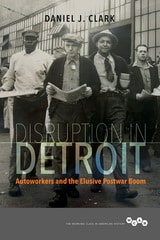
cover of Disruption in Detroit: Autoworkers and the Elusive Postwar Boom

Disruption in Detroit

Autoworkers and the Elusive Postwar Boom

Daniel J. Clark

University of Illinois Press, 2018

It is a bedrock American belief: the 1950s were a golden age of prosperity for autoworkers. Flush with high wages and enjoying the benefits of generous union contracts, these workers became the backbone of a thriving blue-collar middle class. It is also a myth. Daniel J. Clark began by interviewing dozens of former autoworkers in the Detroit area and found a different story--one of economic insecurity caused by frequent layoffs, unrealized contract provisions, and indispensable second jobs. Disruption in Detroit is a vivid portrait of workers and an industry that experienced anything but stable prosperity. As Clark reveals, the myths--whether of rising incomes or hard-nosed union bargaining success--came later. In the 1950s, ordinary autoworkers, union leaders, and auto company executives recognized that although jobs in their industry paid high wages, they were far from steady and often impossible to find.
[more]
cover of Distant Islands: The Japanese American Community in New York City, 1876-1930s

Distant Islands

The Japanese American Community in New York City, 1876-1930s

Daniel H. Inouye

University Press of Colorado, 2018

Distant Islands is a modern narrative history of the Japanese American community in New York City between America's centennial year and the Great Depression of the 1930s. Often overshadowed in historical literature by the Japanese diaspora on the West Coast, this community, which dates back to the 1870s, has its own fascinating history.
 
The New York Japanese American community was a composite of several micro communities divided along status, class, geographic, and religious lines. Using a wealth of primary sources—oral histories, memoirs, newspapers, government documents, photographs, and more—Daniel H. Inouye tells the stories of the business and professional elites, mid-sized merchants, small business owners, working-class families, menial laborers, and students that made up these communities. The book presents new knowledge about the history of Japanese immigrants in the United States and makes a novel and persuasive argument about the primacy of class and status stratification and relatively weak ethnic cohesion and solidarity in New York City, compared to the pervading understanding of nikkei on the West Coast. While a few prior studies have identified social stratification in other nikkei communities, this book presents the first full exploration of the subject and additionally draws parallels to divisions in German American communities.
 
Distant Islands is a unique and nuanced historical account of an American ethnic community that reveals the common humanity of pioneering Japanese New Yorkers despite diverse socioeconomic backgrounds and life stories. It will be of interest to general readers, students, and scholars interested in Asian American studies, immigration and ethnic studies, sociology, and history.

Winner- Honorable Mention, 2018 Immigration and Ethnic History Society First Book Award

[more]
cover of Diverse Pathways: Race and the Incorporation of Black, White, and Arab-Origin Africans in the United States

Diverse Pathways

Race and the Incorporation of Black, White, and Arab-Origin Africans in the United States

Kevin J. A. Thomas

Michigan State University Press, 2014
Africans are among the fastest-growing immigrant groups in the United States. Although they are racially and ethnically diverse, few studies have examined how these differences affect their patterns of incorporation into society. This book is the first to highlight the role of race and ethnicity, Arab ethnicity in particular, in shaping the experiences of African immigrants. It demonstrates that American conceptions of race result in significant inequalities in the ways in which African immigrants are socially integrated. Thomas argues that suggestions that Black Africans are model-minorities who have overcome the barriers of race are misleading, showing that Black and Arab-ethnicity Africans systematically experience less favorable socioeconomic outcomes than their White African counterparts. Overall, the book makes three critical arguments. First, historical and contemporary constructions of race have important implications for understanding the dynamics of African immigration and settlement in the United States. Second, there are significant racial inequalities in the social and economic incorporation of contemporary African immigrants. Finally, Arab ethnicity has additional implications for understanding intra-racial disparities in incorporation among contemporary African immigrants. In general, these arguments are foundational for understanding the diversity of African immigrant experiences.
[more]
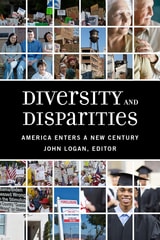
cover of Diversity and Disparities: America Enters a New Century

Diversity and Disparities

America Enters a New Century

John Logan is professor of sociology and director of the Research Initiative on Spatial Structures in the Social Sciences at Brown University and editor of Diversity and Disparities: America Enters a New Century.

Russell Sage Foundation, 2014
The United States is more diverse than ever before. Increased immigration has added to a vibrant cultural fabric, and women and minorities have made significant strides in overcoming overt discrimination. At the same time, economic inequality has increased significantly in recent decades, and the Great Recession substantially weakened the economic standing not only of the poor but also of the middle class. Diversity and Disparities, edited by sociologist John Logan, assembles impressive new studies that interpret the social and economic changes in the United States over the last decade. The authors, leading social scientists from many disciplines, analyze changes in the labor market, family structure, immigration, and race. They find that while America has grown more diverse, the opportunities available to disadvantaged groups have become more unequal. Drawing on detailed data from the decennial census, the American Community Survey, and other sources, the authors chart the growing diversity and the deepening disparities among different groups in the United States Harry J. Holzer and Marek Hlavac document that although the economy always rises and falls over the business cycle, the Great Recession of 2007–2009 was a catastrophic event that saw record levels of unemployment, especially among less-educated workers, young people, and minorities. Emily Rosenbaum shows how the Great Recession amplified disparities in access to home ownership, and demonstrates that young adults, especially African Americans, are falling behind previous cohorts not only in home ownership and wealth but even in starting their own families and households. Sean F. Reardon and Kendra Bischoff explore the rise of class segregation as higher-income Americans are moving away from others into separate and privileged neighborhoods and communities. Immigration has also seen class polarization, with an increase in both highly skilled workers and undocumented immigrants. As Frank D. Bean and his colleagues show, the lack of a path to legal status for undocumented immigrants inhibits the educational and economic opportunities for their children and grandchildren. Barrett Lee and colleagues demonstrate that the nation and most cities and towns are becoming more diverse by race and ethnicity. However, while black-white segregation is slowly falling, Hispanics and Asians remain as segregated today as they were in 1980. Diversity and Disparities raises concerns about the extent of socioeconomic immobility in the United States today. This volume provides valuable information for policymakers, journalists, and researchers seeking to understand the current state of the nation.
[more]
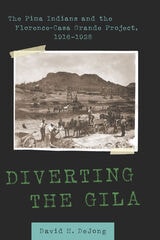
cover of Diverting the Gila: The Pima Indians and the Florence-Casa Grande Project,  1916–1928

Diverting the Gila

The Pima Indians and the Florence-Casa Grande Project, 1916–1928

David H. DeJong

University of Arizona Press, 2021

In the late nineteenth and early twentieth centuries, Americans assumed the land and water resources of the West were endless. Water was as vital to newcomers to Arizona’s Florence and Casa Grande valleys as it had always been to the Pima Indians, who had been successfully growing crops along the Gila River for generations when the white settlers moved in.

Diverting the Gila explores the complex web of tension, distrust, and political maneuvering to divide and divert the scarce waters of the Gila River. Residents of Florence, Casa Grande, and the Pima Reservation fought for vital access to water rights. Into this political foray stepped Arizona’s freshman congressman Carl Hayden, who not only united the farming communities but also used Pima water deprivation to the advantage of Florence-Casa Grande and Upper Gila Valley growers. The result was the federal Florence-Casa Grande Project that, as legislated, was intended to benefit Pima growers on the Gila River Indian Reservation first and foremost. As was often the case in the West, well-heeled, nontribal political interests manipulated the laws at the expense of the Indigenous community.

Diverting the Gila is the sequel to David H. DeJong’s 2009 Stealing the Gila, and it continues to tell the story of the forerunner to the San Carlos Irrigation Project and the Gila River Indian Community’s struggle to regain access to their water.

 
[more]
cover of Divide, Provide and Rule: An Integrative History of Poverty Policy, Social Reform, and Social Policy in Hungary under the Habsburg Monarchy

Divide, Provide and Rule

An Integrative History of Poverty Policy, Social Reform, and Social Policy in Hungary under the Habsburg Monarchy

Susan Zimmermann

Central European University Press, 2011

A concise and comprehensive account of the transformation of social policy from traditional poor relief towards social insurance systems in a European state before World War One. Brings together the analysis of older, mostly local welfare policies with the history of social policy developed by the state and operated at a national level. Explores also the interaction of various layers of and actors in welfare policy, i.e. of poor relief, social reform policies and the unfolding welfare state over time, including often neglected elements of these policies such as e.g. protective policies at the work place, housing policy, child protection, and prostitution policies.
[more]
cover of Dixie Diaspora: An Anthology of Southern Jewish History

Dixie Diaspora

An Anthology of Southern Jewish History

Mark K. Bauman

University of Alabama Press, 2006

Regional Jewish history at its best.
 
This book is an anthology of essays designed to introduce readers to key issues in this growing field of scholarship and to encourage further study. Divided into five sections--“Jews and Judaism,” “Small Town Life,” “Business and Governance,” “Interaction,” and “Identity”--the essays cover a broad geographical and chronological span and address a variety of topics, including economics, politics, roles of women, ethnicity, and race. This organizational structure enhances the volume’s historical treatment of regional Jewish history and lends itself to cross-disciplinary study in fields such as cultural studies, religious studies, and political science.


[more]
cover of Doing Business in Arizona: A Legal Guide

Doing Business in Arizona

A Legal Guide

Snell & Wilmer Associates Snell & Wilmer Associates

University of Arizona Press, 1998
Doing Business in Arizona brings together in one place the essential legal information for anyone who is planning to start a business, locate a facility, or invest in Arizona. What are the differences between sole proprietorships, general and limited partnerships, and corporations? And how do you choose between them in establishing your business? What is the best form of financing for your business? What do you need to know about immigration laws, employee benefits, and intellectual property? Doing Business in Arizona answers these and many more essential questions for both new and veteran business owners. The book includes valuable information for the foreign investors, offering a perspective not readily available in other legal guides. In addition to pointing out concerns specific to foreign companies and individuals doing business in the state, the book also provides a brief factual look at Arizona, including statistics on employment, industry, housing, and government, and an overview of the U.S. legal system. Compiled by the attorneys and staff of Snell & Wilmer, Arizona's largest law firm, Doing Business in Arizona is a necessary reference for business owners and investors alike.
[more]
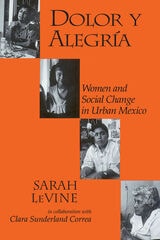
cover of Dolor y Alegria: Women and Social Change in Urban Mexico

Dolor y Alegria

Women and Social Change in Urban Mexico

Sarah LeVine; In Collaboration with Clara Sunderland Correa

University of Wisconsin Press, 1993

In Dolor y Alegría (Sorrow and Joy), fifteen mothers, grandmothers, and great grandmothers in the Mexican city of Cuernavaca speak about the dramatic effects that urbanization and rapid social change have had on their lives.  Sarah LeVine deftly combines these autobiographical vignettes with ethnographic material, survey findings, and her own observations.  The result is a vivid picture of contrast and continuity.

While many earlier publications have focused on the poor of Latin America who live at the margins of urban life, Dolor y Alegría explores the experiences of ordinary working and lower-middle class women, most of them transplants from villages and small towns to a densely populated city neighborhood.  In their early years, many experienced family disruption, emotional deprivation, and economic hardship; but steadily increasing educational opportunities, improved health care, and easily available contraception have significantly altered how the younger women relate to their families and the larger society.

Today’s Mexican schoolgirl, LeVine shows, is encouraged to apply herself to her studies for her own benefit, and the longer she remains in school, the greater the self-confidence she will carry with her into the world of work and later into marriage and motherhood.  Hard economic times have forced many married women into the workplace where their sense of personal efficacy is enhanced; at the same time, in the domestic sphere, their earnings allow them greater negotiating power with husbands and male relatives.  Changes are not confined to the younger generation.  Older women are enjoying better health and living longer; but with adult children either less able or willing to accept responsibility for aged parents than they were in the past, anxiety runs high and family relations are often strained.

Dolor y Alegría takes a close look at the efforts of three generations of Mexican women to redefine themselves in both family and workplace; it shows that today’s young woman has very different expectations of herself and others from those that her grandmother or even her mother had.
[more]
cover of Down and Out in the New Economy: How People Find (or Don’t Find) Work Today

Down and Out in the New Economy

How People Find (or Don’t Find) Work Today

Ilana Gershon

University of Chicago Press, 2017

What does it mean to market yourself as a business in today's job search world?

Finding a job used to be simple.  Now . . . well, it’s complicated. In today’s economy, you can’t just be an employee looking to get hired—you have to market yourself as a business, one that can help another business achieve its goals.
 
That’s a radical transformation in how we think about work and employment, says Ilana Gershon. And with Down and Out in the New Economy, she digs deep into that change and what it means, not just for job seekers, but for businesses and our very culture. In telling this story, Gershon covers all parts of the employment spectrum: she interviews hiring managers about how they assess candidates; attends personal branding seminars; talks with managers at companies around the United States to suss out regional differences—like how Silicon Valley firms look askance at the lengthier employment tenures of applicants from the Midwest. And she finds that not everything has changed: though the technological trappings may be glitzier, in a lot of cases, who you know remains more important than what you know.
 
Rich in the voices of people deeply involved with all parts of the employment process, Down and Out in the New Economy offers a snapshot of the quest for work today—and a pointed analysis of its larger meaning.

[more]
cover of Dream Books and Gamblers: Black Women's Work in Chicago's Policy Game

Dream Books and Gamblers

Black Women's Work in Chicago's Policy Game

Elizabeth Schroeder Schlabach

University of Illinois Press, 2022

Ubiquitous illegal lotteries known as policy flourished in Chicago’s Black community during the overlapping waves of the Great Migration. Policy “queens” owned stakes in lucrative operations while women writers and clerks canvased the neighborhood, passed out winnings, and kept the books.

Elizabeth Schroeder Schlabach examines the complexities of Black women’s work in policy gambling. Policy provided Black women with a livelihood for themselves and their families. At the same time, navigating gender expectations, aggressive policing, and other hazards of the infromal economy led them to refashion ideas about Black womanhood and respectability. Policy earnings also funded above-board enterprises ranging from neighborhood businesses to philanthropic institutions, and Schlabach delves into the various ways Black women straddled the illegal policy business and reputable community involvement.

Vivid and revealing, Dream Books and Gamblers tells the stories of Black women in the underground economy and how they used their work to balance the demands of living and laboring in Black Chicago.

[more]
cover of Dream Zones: Anticipating Capitalism and Development in India

Dream Zones

Anticipating Capitalism and Development in India

Jamie Cross

Pluto Press, 2014

Dream Zones explores the dreamed of and desired futures that constitute, sustain and disrupt capitalism in contemporary India.

Drawing on five years of research in and around India's Special Economic Zones (SEZs), the book follows the stories of regional politicians, corporate executives, rural farmers, industrial workers and social activists to show how the pursuit of growth, profit and development shapes the politics of industrialisation and liberalisation.

This book offers a timely reminder that the global economy is shaped by sentiment as much as reason and that un-realised expectations are the grounds on which new hopes for the future are sown.

[more]
cover of Dual City: Restructuring New York

Dual City

Restructuring New York

John H. Mollenkopf

Russell Sage Foundation, 1991

Have the last two decades produced a New York composed of two separate and unequal cities? As the contributors to Dual City reveal, the complexity of inequality in New York defies simple distinctions between black and white, the Yuppies and the homeless. The city's changing economic structure has intersected with an increasingly diversified population, providing upward mobility for some groups while isolating others. As race, gender, ethnicity, and class become ever more critical components of the postindustrial city, the New York experience illuminates not just one great city, or indeed all large cities, but the forces affecting most of the globe. "The authors constitute an impressive assemblage of seasoned scholars, representing a wide array of pertinent disciplines. Their product is a pioneering volume in the social sciences and urban studies...the 20-page bibliography is a major research tool on its own." —Choice
[more]