Results by title
1832 books match the query 'Essays' and 55 start with d

D. H. Lawrence
An Unprofessional StudyAnaïs Nin
Ohio University Press, 1964
In 1932, two years after D. H. Lawrence’s death, a young woman wrote a book about him and presented it to a Paris publisher. She recorded the event in her diary: “It will not be published and out by tomorrow, which is what a writer would like when the book is hot out of the oven, when it is alive within oneself. He gave it to his assistant to revise.” The woman was Anaïs Nin.
Nin examined Lawrence’s poetry, novels, essays, and travel writing. She analyzed and explained the more important philosophical concepts contained in his writings, particularly the themes of love, death, and religion, as well as his attention to primitivism and to women. But what Anaïs Nin brought to the explication of Lawrence’s writing was an understanding of the fusion of imaginative, intuitive, and intellectual elements from which he drew his characters, themes, imagery and symbolism.
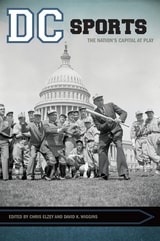
DC Sports
The Nation's Capital at PlayChris Elzey
University of Arkansas Press, 2015
A southern city at heart, Washington drew a strong color line in every facet of people’s lives. Race informed how sport was played, written about, and watched in the city. In 1962, the Redskins became the final National Football League team to integrate. That same year, a race riot marred the city’s high-school championship game in football. A generation later, race as an issue resurfaced after Georgetown’s African American head coach John Thompson Jr. led the Hoyas to national prominence in basketball.
DC Sports takes a hard look at how sports in one city has shaped culture and history, and how culture and history inform sports. This informative and engaging collection will appeal to fans and students of sports and those interested in the rich history of the nation’s capital.

Dancing Bahia
Essays on Afro-Brazilian Dance, Education, Memory, and RaceEdited by Lucia M. Suarez, Amélia Conrado and Yvonne Daniel
Intellect Books, 2018
Dancing Bahia is an edited collection that draws together the work of leading scholars, artists, and dance activists from Brazil, Canada, and the United States to examine the particular ways in which dance has responded to socio-political notions of race and community, resisting stereotypes, and redefining African Diaspora and Afro-Brazilian traditions.
Using the Brazilian city of Salvador da Bahia as its focal point, this volume brings to the fore questions of citizenship, human rights, and community building. The essays within are informed by both theory and practice, as well as black activism that inspires and grounds the research, teaching, and creative output of dance professionals from, or deeply connected to, Bahia.
Dancing at the Devil's Party
Essays on Poetry, Politics, and the EroticAlicia Suskin Ostriker
University of Michigan Press, 2000
In her work, Ostriker can be controversial, as when she attacks the academic establishment for rejecting the erotic dimension of poetry, or when she meditates on the significance of the black poet Lucille Clifton to herself as a reader, or when she argues that Allen Ginsberg's "Howl"--famous as the primary poem of the Beat Generation--is also a profoundly Jewish poem. Yet her writing is always lively and readable, free of academic jargon, inviting the reader to enjoy a wide range of poetic styles and experiences.
Ostriker's criticism, like her poetry, is both feminist and deeply humane. These essays on American poetry will appeal to students of poetry, scholars of American literature, and anyone who enjoys the work of the poets discussed in the book.
Alicia Ostriker is the author of nine books of poetry, including The Imaginary Lover, which won the William Carlos Williams Award and The Crack in Everything, which was a National Book award finalist in 1996, and which received the Paterson Prize in 1997 and the San Fransisco State Poetry Center Award in 1998. She is Distinguished Professor of English at Rutgers University.
Dancing in Spite of Myself
Essays on Popular CultureLawrence Grossberg
Duke University Press, 1997
In the course of conducting this exploration into the meaning of "popularity," he investigates the nature of fandom, the social effects of rock music and youth culture, and the possibilities for understanding the history of popular texts and practices. Describing what he calls "the postmodernity of everyday life," Grossberg offers important insights into the relation of pop music to issues of postmodernity and inton the growing power of the new cultural conservatism and its relationship to "the popular." Exploring the limits of existing theories of hegemony in cultural studies, Grossberg reveals the ways in which popular culture is being mobilized in the service of economic and political struggles. In articulating his own critical practice, Grossberg surveys and challenges some of the major assumptions of popular culture studies, including notions of domination and resistance, mainstream and marginality, and authenticity and incorporation.
Dancing in Spite of Myself provides an introduction to contemporary theories of popular culture and a clear statement of relationships among theories of the nature of rock music, postmodernity, and conservative hegemony.
Danger, Man Working
Writing from the Heart, the Gut, and the Poison Ivy PatchArenas
Wisconsin Historical Society Press, 2017
"Every writer has advice for aspiring writers. Mine is predicated on formative years spent cleaning my father’s calf pens: Just keep shoveling until you’ve got a pile so big, someone has to notice. The fact that I cast my life’s work as slung manure simply proves that I recognize an apt metaphor when I accidentally stick it with a pitchfork. . . . Poetry was my first love, my gateway drug—still the poets are my favorites—but I quickly realized I lacked the chops or insights to survive on verse alone. But I wanted to write. Every day. And so I read everything I could about freelancing, and started shoveling."
The pieces gathered within this book draw on fifteen years of what Michael Perry calls "shovel time"—a writer going to work as the work is offered. The range of subjects is wide, from musky fishing, puking, and mountain-climbing Iraq War veterans to the frozen head of Ted Williams. Some assignments lead to self-examination of an alarming magnitude (as Perry notes, "It quickly becomes obvious that I am a self-absorbed hypochondriac forever resolving to do better nutritionally and fitness-wise but my follow-through is laughable.") But his favorites are those that allow him to turn the lens outward: "My greatest privilege," he says, "lies not in telling my own story; it lies in being trusted to tell the story of another."
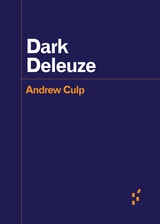
Dark Deleuze
Andrew Culp
University of Minnesota Press, 2016
French philosopher Gilles Deleuze is known as a thinker of creation, joyous affirmation, and rhizomatic assemblages. In this short book, Andrew Culp polemically argues that this once-radical canon of joy has lost its resistance to the present. Concepts created to defeat capitalism have been recycled into business mantras that joyously affirm “Power is vertical; potential is horizontal!”
Culp recovers the Deleuze’s forgotten negativity. He unsettles the prevailing interpretation through an underground network of references to conspiracy, cruelty, the terror of the outside, and the shame of being human. Ultimately, he rekindles opposition to what is intolerable about this world.
Forerunners is a thought-in-process series of breakthrough digital works. Written between fresh ideas and finished books, Forerunners draws on scholarly work initiated in notable blogs, social media, conference plenaries, journal articles, and the synergy of academic exchange. This is gray literature publishing: where intense thinking, change, and speculation take place in scholarship.
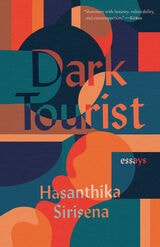
Dark Tourist
EssaysHasanthika Sirisena
The Ohio State University Press, 2021
Finalist for the 2022 LAMBDA literary award in bisexual nonfiction
Winner of the 2021 Gournay Prize
“Shimmers with honesty, vulnerability, and circumspection.” —Kirkus“Sirisena explores how stories can become a ‘talisman against the overwhelming darkness of another’s pain’ in her emotionally charged nonfiction debut … [Her] searching spirit leaves readers with plenty to dig into.” —Publishers Weekly
Dark tourism—visiting sites of war, violence, and other traumas experienced by others—takes different forms in Hasanthika Sirisena’s stunning excavation of the unexpected places (and ways) in which personal identity and the riptides of history meet. The 1961 plane crash that left a nuclear warhead buried near her North Carolina hometown, juxtaposed with reflections on her father’s stroke. A visit to Jaffna in Sri Lanka—the country of her birth, yet where she is unmistakably a foreigner—to view sites from the recent civil war, already layered over with the narratives of the victors. A fraught memory of her time as a young art student in Chicago that is uneasily foundational to her bisexual, queer identity today. The ways that life-changing impairments following a severe eye injury have shaped her thinking about disability and self-worth.
Deftly blending reportage, cultural criticism, and memoir, Sirisena pieces together facets of her own sometimes-fractured self to find wider resonances with the human universals of love, sex, family, and art—and with language’s ability to both fail and save us. Dark Tourist becomes then about finding a home, if not in the world, at least within the limitless expanse of the page.
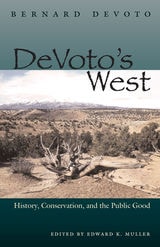
DeVoto’s West
History, Conservation, and the Public GoodBernard DeVoto
Ohio University Press, 2005
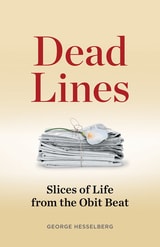
Dead Lines
Slices of Life from the Obit BeatGeorge Hesselberg
Wisconsin Historical Society Press, 2021
In more than forty years at the Wisconsin State Journal, Hesselberg frequently found himself writing about fatal accidents, crime investigations, and the deaths of the wealthy, famous, or notorious. But he was most drawn to the curious, the unknown, and the unsung—the deaths that normally wouldn’t make much of a splash, if any mention at all, in the news columns of a daily paper.
Digging deeper, he uncovered the extraordinary among the ordinary, memorializing the lives of a sword designer, a radio villain, a pioneering female detective, a homeless woman who spoke fluent French, a beloved classroom tarantula, and many more. Their stories are alternately amusing, sad, surprising, and profound. Together they speak to a shared human experience and inspire us to see the people around us with new eyes, valuing the lives while they are still being lived.
Dead Weight
A Memoir in EssaysRandall Horton
Northwestern University Press, 2022
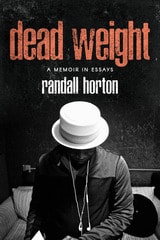
The memoir begins with a conversation between Horton and Ralph Ellison’s Invisible Man statue in New York City. Their imagined dialogue examines the psychological impact of racism on Black men and boys, including Horton’s separation from his mother, immediately after his birth, in a segregated Alabama hospital. From his current life as a professor and prison reformer, Horton looks back on his experiences as a drug smuggler and trafficker during the 1980s–1990s as well as the many obstacles he faced after his release. He also examines the lasting impact of his drug activity on those around him, reflecting on the allure of economic freedom and the mental escapism that cocaine provided, an allure so strong that both sellers and users were willing to risk prison. Horton shares historical context and vivid details about people caught in the war on drugs who became unsuspecting protagonists in somebody else’s melodrama.
Lyrical and gripping, Dead Weight reveals the lifelong effects of one man’s incarceration on his psyche, his memories, and his daily experience of American society.
Dear Colleague
Common And Uncommon ObservationsYi-Fu Tuan
University of Minnesota Press, 2002
Dear Friend
Rainer Maria Rilke and Paula Modersohn-BeckerEric Torgersen
Northwestern University Press, 2000
Death Valley National Park
A HistoryHal Rothman
University of Nevada Press, 2013
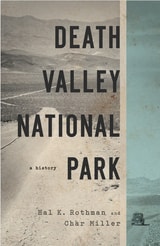
This history begins with a discussion of the physical setting, its geography and geology, and descriptions of the Timbisha, the first peoples to inhabit this tough and dangerous landscape. In the 19th-century and early 20th century, new arrivals came to exploit the mineral resources in the region and develop permanent agricultural and resort settlements. Although Death Valley was established as a National Monument in 1933, fear of the harsh desert precluded widespread acceptance by both the visiting public and its own administrative agency. As a result, Death Valley lacked both support and resources. This volume details the many debates over the park’s size, conflicts between miners, farmers, the military, and wilderness advocates, the treatment of the Timbisha, and the impact of tourists on its cultural and natural resources.
In time, Death Valley came to be seen as one of the great natural wonders of the United States, and was elevated to full national park status in 1994. The history of Death Valley National Park embodies the many tensions confronting American environmentalism.
Death to the Death of Poetry
Essays, Reviews, Notes, InterviewsDonald Hall
University of Michigan Press, 1994
Donald Hall believes that American poetry, at the present moment, thrives both in quality and in leadership. In his latest collection of essays, reviews, and interviews, Hall counters the increasingly publicized view that poetry has an ever-diminishing importance in contemporary American culture. He resents the endlessly repeated cliché that finds poetry unpopular and losing popularity. Thus: Death to the Death of Poetry.
Throughout the pages of this latest offering in the Poets on Poetry series, Hall returns again and again to the theme of poetry's health, and offers essays praising contemporary poets, who serve as examples of poetry's thriving condition. In addition, Death to the Death of Poetry collects interviews in which Hall discusses the work of poetry--revisions, standards, the psychology and sociology of the poet's life.
The collection will be warmly received by Donald Hall's large readership, enhanced in 1993 by publication of two exemplary volumes: The Museum of Clear Ideas, his eleventh book of poetry; and his essay Life Work, which brought him both new and returning readers.
Decentralizing Knowledges
Essays on Distributed AgencyLeandro Rodriguez Medina and Sandra Harding, editor
Duke University Press, 2025
Contributors: Linda Martín Alcoff, Elías Barticevic, Johan Henrik Buljo, Ronald Cancino, Cristina Flores, Kim Fortun, Sandra Harding, Line Aimee Kalak, Duygu Kasdogan, Wiebke Keim, Aalok Khandekar, Daniel Lee Kleinman, Wen-Hua Kuo, John Law, Les Levidow, Leandro Rodriguez Medina, Angela Okune, Liv Østmo, Ari Sitas, Maka Suarez, Sharon Traweek, Hebe Vessuri
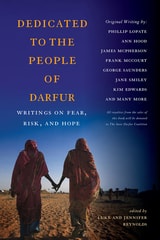
Dedicated to the People of Darfur
Writings on Fear, Risk, and HopeEdited and with an Introduction by Luke Reynolds and Jennifer Reynolds
Rutgers University Press, 2009
Nobel and Pulitzer Prize winners, a gallery of O.Henry award recipients, and many best-selling authors come together to share personal and compelling challenges and experiences. From contemplations on past drug use to reflections on gun control, social justice, passion and its sacrifices, and adventures such as skydiving, mountain climbing, and golfing, the topics vary greatly. This kaleidoscopic anthology is a commentary on the lives of prominent literary artists and ordinary citizens who have made simple, yet powerful choices that provoked change in one's self and for humanityùmuch the same way that Luke and Jennifer Reynolds do by building this invaluable collection for readers and the world of human rights.
Not too long ago, as struggling graduate students, Luke and Jennifer Reynolds conceived this uniquely themed volume as a way to raise funds to support ending the genocide in Darfur. Some people carry signs, others make speeches, many take action. What is most special about this book is that it extends beyond words and ideas, into a tangible effort to effect change. To this end, all royalties from the sales of Dedicated to the People of Darfur:Writings on Fear, Risk, and Hope will benefit The Save Darfur Coalition, an organization that seeks to end the genocide in Darfur, Sudan.
Deep Woods, Wild Waters
A MemoirDouglas Wood
University of Minnesota Press, 2025
A journey through the wilds of nature and the twists and turns of daily life with an icon of the North Woods—now in paperback
Wait, young Douglas’s grandfather says as the bobber twitches on the surface of Little Lake. Be patient. And so begins an encounter with the wonder and promise of nature that will last a lifetime. Deep Woods, Wild Waters traces the winding path that carried Douglas Wood from one marvel to the next, through a landscape of rocks, woods, and waters, with stops along the way for questions and reflections that link human nature to the larger mysteries of the natural world.
Like life itself, the author’s way is not linear. One landmark leads back to a favorite campsite, another prompts him to consider the “gospel of rocks,” another launches him into the wilderness beyond the stars—a contemplation of time and space and humanity’s place in all of it. The creator of thirty-four books, including the classic Old Turtle, and an expert woodsman and wilderness canoe guide, Wood brings all his storytelling and bushwhacking skills to bear as he takes us hurtling down wild rapids, crossing stormy lakes, or simply navigating the treacherous currents and twisty trails of everyday life.
A warm, generous, and knowing guide, Wood maps a journey that, as he says, “anyone can take, through a landscape anyone can know.” Turning the pages, hiking the portages, running the rapids, or scanning the wild country from a high promontory, he invites us to say, in a soul-satisfying moment of recognition, “I know that place.”
Deepening the Dialogue
Jewish-Americans and Israelis Envisioning the Jewish-Democratic StateRabbi Stanley M. Davids
Central Conference of American Rabbis, 2020
Defending AI Research
A Collection of Essays and ReviewsEdited by John McCarthy
CSLI, 1996
Defending the American Way of Life
Sport, Culture, and the Cold WarToby C. Rider
University of Arkansas Press, 2018
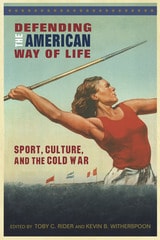
The Cold War was fought in every corner of society, including in the sport and entertainment industries. Recognizing the importance of culture in the battle for hearts and minds, the United States, like the Soviet Union, attempted to win the favor of citizens in nonaligned states through the soft power of sport. Athletes became de facto ambassadors of US interests, their wins and losses serving as emblems of broader efforts to shield American culture—both at home and abroad—against communism.
In Defending the American Way of Life, leading sport historians present new perspectives on high-profile issues in this era of sport history alongside research drawn from previously untapped archival sources to highlight the ways that sports influenced and were influenced by Cold War politics. Surveying the significance of sports in Cold War America through lenses of race, gender, diplomacy, cultural infiltration, anti-communist hysteria, doping, state intervention, and more, this collection illustrates how this conflict remains relevant to US sporting institutions, organizations, and ideologies today.
Degas at the Gas Station
EssaysThomas Beller
Duke University Press, 2025
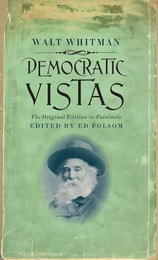
Democratic Vistas
The Original Edition in FacsimileWhitman, Walt
University of Iowa Press, 2010
Written in the aftermath of the American Civil War during the ferment of national Reconstruction, Walt Whitman’s Democratic Vistas remains one of the most penetrating analyses of democracy ever written. Diagnosing democracy’s failures as well as laying out its vast possibilities, Whitman offers an unflinching assessment of the ongoing social experiment known as the United States. Now available for the first time in a facsimile of the original 1870–1871 edition, with an introduction and annotations by noted Whitman scholar Ed Folsom that illuminate the essay’s historical and cultural context, this searing analysis of American culture offers readers today the opportunity to argue with Whitman over the nature of democracy and the future of the nation.
Living in Washington, D.C., where Congress granted male African Americans the right to vote nearly five years before the fifteenth amendment extended that right across the nation, and working for the office charged with enforcing the new civil rights amendments to the Constitution, Whitman was at the volatile center of his nation’s massive attempt to reconstruct and redefine itself after the tumultuous years of civil war. In the enduring cultural document that Democratic Vistas has become, the great poet of democracy analyzes the role that literature plays in the development of a culture, the inevitable tensions between the “democratic individual” and the “democratic nationality,” and the corrosive effects of materialism on the democratic spirit.
His own conflicting racial biases notwithstanding, Whitman in Democratic Vistas offers his most eloquent and extended articulation of the beckoning American democratic future. At a time when the nation has elected a president whom Whitman could never have imagined, his controversial and provocative book is a timely reminder of those occasions when we experience the expansion of America’s democratic dream.
Democratize Work
The Case for Reorganizing the EconomyIsabelle Ferreras, Julie Battilana, and Dominique Méda
University of Chicago Press, 2022
What happens to a society—and a planet—when capitalism outgrows democracy? The tensions between democracy and capitalism are longstanding, and they have been laid bare by the social effects of COVID-19. The narrative of “essential workers” has provided thin cover for the fact that society’s lowest paid and least empowered continue to work risky jobs that keep our capitalism humming. Democracy has been subjugated by the demands of capitalism. For many, work has become unfair.
In Democratize Work, essays from a dozen social scientists—all women—articulate the perils and frustrations of our collective moment, while also framing the current crisis as an opportunity for renewal and transformation. Amid mounting inequalities tied to race, gender, and class—and with huge implications for the ecological fate of the planet—the authors detail how adjustments in how we organize work can lead to sweeping reconciliation. By treating workers as citizens, treating work as something other than an asset, and treating the planet as something to be cared for, a better way is attainable. Building on cross-disciplinary research, Democratize Work is both a rallying cry and an architecture for a sustainable economy that fits the democratic project of our societies.
Contributors include Alyssa Battistoni (Barnard College of Columbia University), Adelle Blackett (McGill University), Julia Cagé (Sciences Po), Neera Chandhoke (University of Delhi), Lisa Herzog (University of Groningen), Imge Kaya Sabanci (IE Business School), Sara Lafuente (European Trade Union Institute), Hélène Landemore (Yale University), Flávia Máximo (Universidade Federal de Ouro Preto, Brazil), and Pavlina R. Tcherneva (Levy Economics Institute of Bard College).
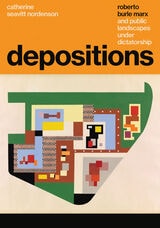
Depositions
Roberto Burle Marx and Public Landscapes under DictatorshipBy Catherine Seavitt Nordenson
University of Texas Press, 2018
Recipient of 2019 John Brinckerhoff Jackson Book Prize, Foundation for Landscape Studies
2021 On the Brinck Book Award Winner
“Burle Marx created a new and modern grammar for international landscape design.”
—Lauro Cavalcanti, quoted in the New York Times
“The real creator of the modern garden.”
—American Institute of Architects
Presenting the first English translation of Burle Marx’s “depositions,” this volume highlights the environmental advocacy of a preeminent Brazilian landscape architect who advised and challenged the country’s military dictatorship.
Roberto Burle Marx (1909–1994) is internationally known as one of the preeminent modernist landscape architects. He designed renowned public landscapes in Brazil, beginning with small plazas in Recife in the 1930s and culminating with large public parks in the early 1960s, most significantly the Parque do Flamengo in Rio de Janeiro. Depositions explores a pivotal moment in Burle Marx’s career—the years in which he served as a member of the Federal Cultural Council created by the military dictatorship in the mid-1960s. Despite the inherent conflict and risk in working with the military regime, Burle Marx boldly used his position to advocate for the protection of the unique Brazilian landscape, becoming a prophetic voice of caution against the regime’s policies of rapid development and resource exploitation.
Depositions presents the first English translation of eighteen environmental position pieces that Burle Marx wrote for the journal Cultura , a publication of the Brazilian Ministry of Education and Culture, from 1967 through 1973. Catherine Seavitt Nordenson introduces and contextualizes the depositions by analyzing their historical and political contexts, as well as by presenting pertinent examples of Burle Marx’s earlier public projects, which enables a comprehensive reading of the texts. Addressing deforestation, the establishment of national parks, the place of commemorative sculpture, and the unique history of the Brazilian cultural landscape, Depositions offers new insight into Burle Marx’s outstanding landscape oeuvre and elucidates his transition from prolific designer to prescient counselor.
Design and Digital Interaction
Re:Research, Volume 7Edited by Gjoko Muratovski and Craig Vogel
Intellect Books, 2020
The Re:Research collection includes:
Volume 1: Teaching and Learning Design
Volume 2: Philosophical Frameworks and Design Processes
Volume 3: Design and the Creation of Social Value
Volume 4: Design and Living Well
Volume 5: Design Discourse on Culture and Society
Volume 6: Design Discourse on Business and Industry
Volume 7: Design and Digital Interaction

Developments in Russian Politics 6
Stephen White, Zvi Gitelman, and Richard Sakwa, eds.
Duke University Press, 0
Contributors. Alfred B. Evans, Zvi Gitelman, Gordon Hahn, Margot Light, Michael McFaul, Sarah Oates, Thomas F. Remington, Peter Rutland, Richard Sakwa, Robert Sharlet, Darrell Slider, Judy Twigg, Stephen White, John P. Willerton
Devotion
Three Inquiries in Religion, Literature, and Political ImaginationConstance M. Furey, Sarah Hammerschlag, and Amy Hollywood
University of Chicago Press, 2021
We are living in a time of radical uncertainty, faced with serious political, ecological, economic, epidemiological, and social problems. Scholars of religion Constance M. Furey, Sarah Hammerschlag, and Amy Hollywood come together in this volume with a shared conviction that what and how we read opens new ways of imagining our political futures and our lives.
Each essay in this book suggests different ways to characterize the object of devotion and the stance of the devout subject before it. Furey writes about devotion in terms of vivification, energy, and artifice; Hammerschlag in terms of commentary, mimicry, and fetishism; and Hollywood in terms of anarchy, antinomianism, and atopia. They are interested in literature not as providing models for ethical, political, or religious life, but as creating the site in which the possible—and the impossible—transport the reader, enabling new forms of thought, habits of mind, and ways of life. Ranging from German theologian Martin Luther to French-Jewish philosopher Sarah Kofman to American poet Susan Howe, this volume is not just a reflection on forms of devotion and their critical and creative import but also a powerful enactment of devotion itself.
Devouring One's Own Tail
Autopoiesis in PerspectiveEdited by Vojtech Kolman and Tomáš Murár
Karolinum Press, 2022
Inspired by Niklas Luhmann’s theories on social systems, this book examines the concept of autopoiesis, or self-creation, as it relates to society and culture. Approaching the concept from a variety of fields—philosophy, philology, aesthetics, linguistics, archaeology, and religious and media studies—the contributors present the products of humanity as self-referential, self-sustaining, and self-creating systems. Through four sections, the book addresses the philosophical concept of autopoiesis and its relations to creativity, destruction, and self-organization; autopoiesis in literature and art history; autopoiesis in religion; and autopoiesis in historiography, cognitive linguistics, and social media. Whether exploring Hegel’s theory of knowledge or the viral spread of conspiracy theories on the internet, the authors concentrate on the ouroboros-like nature of their subjects in the ways they feed off of themselves.
Digital Stockholm Syndrome in the Post-Ontological Age
Mark Jarzombek
University of Minnesota Press, 2016
Once, humans were what they believed. Now, the modern person is determined by data exhaust—an invisible anthropocentric ether of ones and zeros that is a product of our digitally monitored age. Author Mark Jarzombek argues that the world has become redesigned to fuse the algorithmic with the ontological, and the discussion of ontology must be updated to rethink the question of Being. In Digital Stockholm Syndrome in the Post-Ontological Age, Jarzombek provocatively studies the new interrelationship between human and algorithm.
Forerunners is a thought-in-process series of breakthrough digital works. Written between fresh ideas and finished books, Forerunners draws on scholarly work initiated in notable blogs, social media, conference plenaries, journal articles, and the synergy of academic exchange. This is gray literature publishing: where intense thinking, change, and speculation take place in scholarship.
Dimensions Of Forgiveness
A Research ApproachEverett L. Worthington
Templeton Press, 1999
The scientific study of forgiveness is a new approach to an age-old problem. For thousands of years, people have practiced forgiveness within religious systems. Now, the field of scholarly research of forgiveness reveals the beneficial aspects of the process.
p>Contributors include Elliot Dorff and Martin Marty discussing religious interpretations, followed by social implications explained by Kenneth Pargament and Mark Rye. Roy Baumeister, Julie Exline, and Kristin Sommer present the victim's point of view. Other contributors focusing on the forgiveness research are: Everett Worthington, Robert Enright, Catherine Coyle, Carl Thoresen, Frederic Luskin, and Alex Harris. An annotated bibliography by Michael McCullough, Julie Exline, and Roy Baumeister, covers the empirical literature on the subject. Lewis Smedes concludes with the four steps necessary for forgiveness: moving from estrangement to forgiveness to reconciliation to hope.
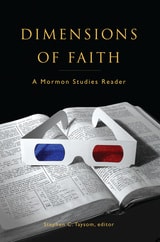
Dimensions of Faith
A Mormon Studies ReaderStephen C. Taysom
Signature Books, 2011
In these seventeen articles on things Mormon—prominent people, religious experience, memory, media, literature, and investigative theory—there is an obvious respect for the past and simultaneous desire to get to the bottom of things, to test the boundaries of knowledge. For instance, Jonathan Stapley and Kristine Wright look at the history of ritual healing within Mormonism, including the use of magic handkerchiefs and blessings performed by women. Matthew Bowman’s essay on “A Mormon Bigfoot” looks at the story retold in Sunday school and elsewhere about an early Church apostle who saw the biblical Cain. Brian Stuy examines Church President Wilford Woodruff’s account of the American founding fathers reaching from beyond the grave—a summons the prophet responded favorably to—requesting temple baptisms on their behalf. Unknown to Woodruff, this ordinance had been performed the year before. And Kathleen Flake looks at how the First Vision and other founding narratives were not emphasized in the Church until the twentieth century.
Other contributors include Gary James Bergera, Martha Bradley, Newell Bringhurst, Samuel Brown, Claudia Bushman, Brian Cannon, Douglas Davies, Rebecca de Schweinitz, Lawrence Foster, Reinhold Hill, and Jacob Olmstead.
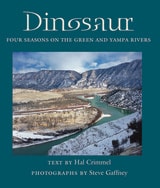
Dinosaur
Four Seasons on the Green and Yampa RiversHal Crimmel
University of Arizona Press, 2007
Gaffney’s reflective photographs emphasize the rough perfection of the landscape; Crimmel’s pensive meditations and his river expertise combine to create a rare point of view, one that ventures into places the guidebooks don’t go. But this narrative is more than tribute—it is a reminder of the fragile nature of desert places. Crimmel lyrically combines his descriptions with an examination of the complex issues relevant to managing public lands—invasive species, tourism, dams, endangered flora and fauna—to address the contradictions inherent in “managed wilderness.” Over four seasons and multiple trips, Crimmel and Gaffney have captured the rivers’ sense of place, creating a portrait of a dazzling high desert landscape that needs to be appreciated and protected.
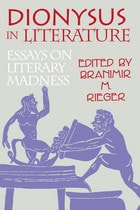
Dionysus in Literature
Essays on Literary MadnessEdited by Branimir M. Rieger
University of Wisconsin Press, 1994
In this anthology, outstanding authorities present their assessments of literary madness in a variety of topics and approaches. The entire collection of essays presents intriguing aspects of the Dionysian element in literature.
Dirt
A Love StoryEdited by Barbara Richardson
University Press of New England, 2015
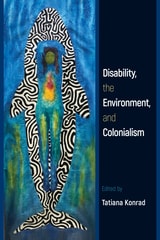
Disability, the Environment, and Colonialism
Edited by Tatiana Konrad
Temple University Press, 2024
The editor and contributors provide a careful analysis of the intersection of disability, the environment, and colonialism to understand issues such as eco-ableism, environmental degradation, homogenized approaches to environmentalism, and climate change. They also look at the body as a site of colonial oppression and environmental exploitation.
Contributors: Holly Caldwell, Matthew J. C. Cella, John Gulledge, Memona Hossain, Nancy J. Hirschmann, Iain Hutchison, Andrew B. Jenks, Suha Kudsieh, Gordon M. Sayre, Jessica A. Schwartz, Anna Stenning, Aubrey Tang, Alice Wexler, and the editor.
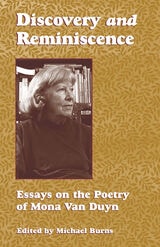
Discovery and Reminiscence
Essays on the Poetry of Mona Van DuynMichael Burns
University of Arkansas Press, 1999
A former United States Poet Laureate, winner of a Pulitzer Prize, and recipient of numerous grants and awards, Mona Van Duyn has been hailed as one of our greatest living American poets. To help broaden and uniquely inform our understanding of Van Duyn’s work, editor Michael Burns has gathered ten essays, a poem, a succinct biographical sketch, and Van Duyn’s own laureate address to the Library of Congress.
In the first section of this collection, poets Maxine Kumin and Carolyn Kizer provide tributes that elucidate the special effect Van Duyn’s poetry has had on their work and thought. Pulitzer Prize–winner Richard Howard contributes a poem that both extols the qualities of Van Duyn’s poems and lyrically places those qualities within her contemporary scene.
The second section contains eight essays exploring aspects as varied as Van Duyn’s penchant for particularity, her remarkable ability to rediscover for us the strangeness of everyday living, and her elegant style, fluid in both free verse and form. Included are contributions from Stephen Yenser, Rachel Hadas, Emily Grosholz, Sidney Burris, Ann Townsend, Michael Bugeja, Wyatt Prunty, and Jane Hoogestraat.
The final section opens with Van Duyn’s witty and incisive overview of the state of poetry in America at the close of the twentieth century. Also included is a short narrative history of Van Duyn’s literary career. Filled with keen prose by distinguished poets and critics, this collection is not only a resounding tribute to one poet’s body of work, but also a timely pulse-taking of the literary scene surrounding Van Duyn’s poetry.

Disease And Medical Care In The Mountain West
Essays On Region, History, And PracticeMartha L. Hildreth
University of Nevada Press, 1998
This collection of eight essays examines the health, disease, and medical care of the American West—an area flanked by the Rocky Mountains, Sierra Nevada, and Cascade Mountains. Topics include Mormons and the Thomsonian Movement in the nineteenth century, the silicosis epidemic in hardrock mining, Native American health, frontier nursing, and Chinese medicine.
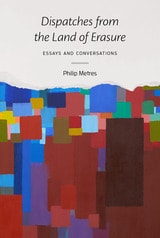
Dispatches from the Land of Erasure
Essays and ConversationsPhilip Metres
University of Michigan Press, 2025
With keen insight into the lived experience of Arab Americans and other historically marginalized communities, the book explores the struggle for a just peace through reading Palestinian Arab and Israeli Jewish writers of conscience who contend with the wall of silence around the issue of Palestine. Further, Dispatches illuminates how to write a poetry of peace and justice, and how poetic activism and activist poets situate themselves in communities seeking change. Divided into four sections—Erasing the Erasures: Writing While Arab, The Poetics of Palestine, The Poetics of Justice, and The Poetics of Peacebuilding—Dispatches weaves personal essays, cultural criticism, group chats, interviews, literary analysis, reviews, and roundtables that include luminaries like Mosab Abu Toha, Hayan Charara, Sahar Khalifeh, Marwa Helal, Erika Meitner, Naomi Shihab Nye, Craig Santos Perez, and M. NourbeSe Philip. Together, the book models the crucial need for robust dialogue to overcome the echo chamber that limits the growth and reach of social movements and to dream of a future beyond the land of erasure.
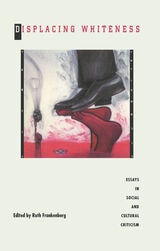
Displacing Whiteness
Essays in Social and Cultural CriticismRuth Frankenberg, ed.
Duke University Press, 1997
Approaching whiteness as a plural rather than singular concept, the essays describe, for instance, African American, Chicana/o, European American, and British experiences of whiteness. The contributors offer critical readings of theory, literature, film and popular culture; ethnographic analyses; explorations of identity formation; and examinations of racism and political process. Essays examine the alarming epidemic of angry white men on both sides of the Atlantic; far-right electoral politics in the UK; underclass white people in Detroit; whiteness in "brownface" in the film Gandhi; the engendering of whiteness in Chicana/o movement discourses; "whiteface" literature; Roland Barthes as a critic of white consciousness; whiteness in the black imagination; the inclusion and exclusion of suburban "brown-skinned white girls"; and the slippery relationships between culture, race, and nation in the history of whiteness. Displacing Whiteness breaks new ground by specifying how whiteness is lived, engaged, appropriated, and theorized in a range of geographical locations and historical moments, representing a necessary advance in analytical thinking surrounding the burgeoning study of race and culture.
Contributors. Rebecca Aanerud, Angie Chabram-Dernersesian, Phil Cohen, Ruth Frankenberg, John Hartigan Jr., bell hooks, T. Muraleedharan, Chéla Sandoval, France Winddance Twine, Vron Ware, David Wellman

Dissent and Affirmation
Essays in Honor of Mulford Q. SibleyArthur L. Kalleberg
University of Wisconsin Press, 0
Dissent from the Homeland
Essays After September 11, Volume 101Stanley Hauerwas and Frank Lentricchia, eds.
Duke University Press, 0
Addressing such questions as why the Middle East harbors a deep-seated hatred for the U.S., the contributors refuse to settle for the easy answers preferred by the mass media. "Thoughts in the Presence of Fear" urges Americans away from the pitfall of national self-righteousness toward an active peaceableness—an alert, informed, practiced state of being—deeply contrary to both passivity and war. Another essay argues that the U.S. drive to win the Cold War made the nation more like its enemies, leading the government to support ruthless anti-Communist tyrants such as Mobutu, Suharto, and Pinochet. "Groundzeroland" offers a sharp commentary on the power of American consumer culture to absorb the devastation and loss of life by transforming the attack sites into patriotic tourist attractions. James Nachtwey’s photo essay provides a visual document of the devastation of the attacks.
Contributors. Michael Baxter, Jean Baudrillard, Robert Bellah, Daniel Berrigan, Wendell Berry, Vincent Cornell, Stanley Hauerwas, Fredric Jameson, Frank Lentricchia, Catherine Lutz, Jody McAuliffe, John Milbank, James Nachtwey, Peter Ochs, Anne Rosalind Slifkin, Rowan Williams, Susan Willis, Slavoj Zizek
For more information about SAQ, please visit http://www.dukeupress.edu/saq/
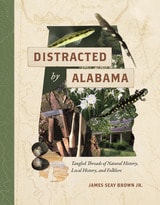
Distracted by Alabama
Tangled Threads of Natural History, Local History, and FolkloreJames Seay Brown Jr.
University of Alabama Press, 2022
Where rivers, railroads, and redhorse fish tell the story of Alabama’s soul.
A gateway to Alabama for the omnivorous mind, Distracted by Alabama is a collection of twelve captivating essays about Alabama and the South by Samford University writer and scholar Jim Brown, a former president of the Alabama Folklife Association.
During his decades living and teaching in Alabama, Brown followed his curiosity down myriad pathways about Alabama and the region, including the state’s majestic landscape, plants and animals found nowhere else, history, and rich folkways. In the tapestry of Alabama culture, Brown traces the threads of Native American, African slave, and European settler influences, woven over the centuries into novel patterns that surprise and fascinate.
Writing in the voice of a learned companion, Brown reveals insights and stories about unforgettable facets of Alabama culture, such as Sacred Harp singers and African American railroad callers, the use of handmade snares and stationary fishtraps to catch river redhorse and freshwater drum, white oak basketmaking and herbal medicine traditions, the evolution of the single-pen log cabin into the impressive two-story I-house, and a wealth of other engrossing stories.
An instant classic, Distracted by Alabama is a keepsake that readers who love, visit, or are curious about Alabama and Southern culture will return to again and again.
Divine Love
Perspectives from the World's Religious TraditionsJeff Levin
Templeton Press, 2010
The contributors to Divine Love cover a broad spectrum of world religions, comparing and contrasting approaches among Christians of several denominations, Jews, Buddhists, Muslims, Hindus, and adherents of traditional African religions. Each chapter focuses on the definition and conceptual boundaries of divine love; its expression and experience; its instrumentality and salience; how it can become distorted, and how it has been made manifest or restored by great historic exemplars of altruism, compassion, and unlimited love.
The ultimate aim for many of the world’s major faith traditions is to love and be loved by God—to live in connection with the Divine, in union with the Beloved, in reconciliation with the Ultimate. Religious scholars Jeff Levin and Stephen G. Post have termed this connection “divine love.” In their new collection of the same name, they have invited eight of the world’s preeminent religious scholars to share their perspectives on the what, how, and why of divine love.From this diverse gathering of perspectives emerges evidence that to love and to be loved by God, to enter into a mutual and covenantal relationship with the Divine, may well offer solutions to many of the current crises around the world. Only a loving relationship with the Source of being within the context of the great faith and wisdom traditions of the world can fully inform and motivate the acts of love, unity, justice, compassion, kindness, and mercy for all beings that are so desperately required to counter the toxic influences in the world.
Contributors: William C. Chittick, Vigen Guroian, Ruben L. F. Habito, William K. Mahony, John S. Mbiti, Jacob Neusner, Clark H. Pinnock, and David Tracy.
Documents of American Realism and Naturalism
Donald Pizer
Southern Illinois University Press, 1998
Donald Pizer presents the major critical discussions of American realism and naturalism from the beginnings of the movement in the 1870s to the present. He includes the most often cited discussions ranging from William Dean Howells, Henry James, and Frank Norris in the late nineteenth century to those by V. L. Parrington, Malcolm Cowley, and Lionel Trilling in the early twentieth century. To provide the full context for the effort to interpret the nature and significance of realism and naturalism during the periods when the movements were live issues on the critical scene, however, he also includes many uncollected essays. His selections since World War II reflect the major recent tendencies in academic criticism of the movements.
Through introductions to each of the three sections, Pizer provides background, delineating the underlying issues motivating attempts to attack, defend, or describe American realism and naturalism. In particular, Pizer attempts to reveal the close ties between criticism of the two movements and significant cultural concerns of the period in which the criticism appeared. Before each selection, Pizer provides a brief biographical note and establishes the cultural milieu in which the essay was originally published. He closes his anthology with a bibliography of twentieth-century academic criticism of American realism and naturalism.
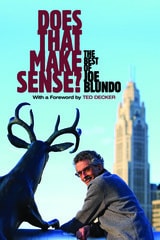
Does That Make Sense?
The Best of Joe BlundoJoe Blundo
The Ohio State University Press, 2019
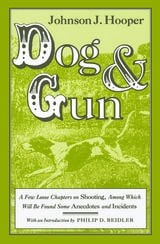
Dog and Gun
A Few Loose Chapters on Shooting, Among Which Will Be Found Some Anecdotes and IncidentsJohnson J. Hooper, with an Introduction by Philip D. Beidler
University of Alabama Press, 1992
A classic portrait of hunting, sport, and gentlemanly culture in the antebellum South.
The least well known of Johnson Jones Hooper’s works, Dog and Gun was first published as a newspaper series, then appeared in six book editions between 1856 and 1871. Hooper is Alabama’s most celebrated antebellum author, and here he gives insight into the meaning of a culture where every male hunts – and a man who shoots as a gentleman will be assumed a gentleman. Beidler’s introduction to this reprint edition explores the social, literary, and technical dimensions of Dog and Gun, which he sees as an important commentary on class distinctions in the antebellum South, as well as a straightforward treatise on hunting.
Although the book is a manual for the hunter, with characteristic humor and a certain disdain, Hooper gives a full picture of the gentlemanly sport of hunting – clearly distinct from hunting for food – in all aspects including hunter, weaponry, and sporting dogs. He takes us back to an autumnal ritual of the hunt, where one is always a boy with his first gun – to the natural mystery of quest, competition, predation, pursuit, survival, bravery, endurance, and eventual defeat, called the mystery of the hunt.
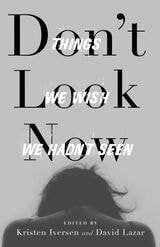
Don't Look Now
Things We Wish We Hadn't SeenEdited by Kristen Iversen and David Lazar
The Ohio State University Press, 2020
Featuring essays by Jericho Parms, XU XI, Jerald Walker, José Orduña, Kristen Iversen, Nicole Walker, Mary Cappello, Lina Ferreira, Colleen O’Connor, Sonya Huber, Paul Crenshaw, Alyce Miller, Patrick Madden, Amelia María de la Luz Montes, Yalie Kamara, Emily Heiden, Lee Martin, and David Lazar,
this collection bares all. The authors invite readers into a dream that resurrects a departed mother each night, only to lose her again each morning upon waking; the post-mortem newspaper photos of a former student; kaleidoscope childhood memories of the mundane mixed up together with the traumatic; an unplanned pregnancy; a bullfight and a spouse’s mortality; a teen witnessing the suicide of her father; a parent trying to shield his children from witnessing a violent death. What these writers are after, though, is not the melancholic/grotesque/violent moment itself, but the process of remembering—and trying to forget. They examine the way these memories take hold, resurface, and never leave, and what it means for a life lived long after these moments have passed. These scenes, slowly enfolding us like bad dreams or flying by like trains on elevated platforms, demand we reach some kind of accommodation with them—make peace or make sense or make amends. The one thing they insist with certainty is this: they cannot—will not—be unseen.
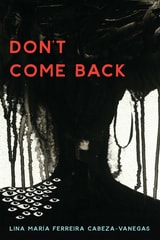
Don’t Come Back
Lina María Ferreira Cabeza-Vanegas
The Ohio State University Press, 2017
Don’t Come Back intermixes translations of Spanish adages and adaptations of major Colombian myths with personal essays about growing up amidst violence, magic, and an unyielding Andean sun. Home is place and time and people and language and history, and none of these are ever set in stone. Attempting to reconcile the irreconcilable and translate the untranslatable—to move smoothly and cohesively between culture, language, and place—Ferreira Cabeza-Vanegas is torn between spaces, between the aunt who begs her to return to Colombia and the mother who tells her, “There’s nothing here for you, Lina. Don’t come back.” Don’t Come Back is an exploration of home and identity that constantly asks, “If you really could go back, would you?”